Kameido Tenjin Shrine Complete Guide | Wisteria Festival, Goshuin (Shrine Seal), Access, and Benefits Explained in Detail
Kameido Tenjin Shrine, located in Koto Ward, Tokyo, is a historic shrine dedicated to Sugawara no Michizane, known as the god of learning. Also called “the Dazaifu of the East” or “Eastern Dazaifu Tenmangu,” its magnificent wisteria trellises during the spring wisteria festival attract many visitors. This article thoroughly explains everything you need to know before visiting Kameido Tenjin Shrine, including its history, benefits, highlights, goshuin information, and access methods.
What is Kameido Tenjin Shrine? | The History of Tokyo’s Representative Tenmangu Shrine
Origin and History of its Founding
Kameido Tenjin Shrine was founded in 1662 (Kanbun 2) by Sugawara Otori Inobusuke, a Shinto priest of Dazaifu Tenmangu Shrine in Kyushu. At that time, this area was a small island called “Turtle Island,” part of Honjo-Kameido Village.
During the reconstruction of Edo after the Great Fire of Meireki (1657), Nobuyuki obtained permission from the fourth shogun, Tokugawa Ietsuna, to construct a shrine modeled after Dazaifu Tenmangu Shrine. Because he faithfully reproduced the layout of the shrine buildings and grounds of the main Dazaifu Tenmangu Shrine, it came to be known as “Dazaifu of the East.”
A Faith Continuing from the Edo Period
During the Edo period, Tenjin worship spread among the common people, and Kameido Tenjin Shrine became the foremost Tenjin shrine in Edo, bustling with many worshippers. In particular, many people visited to pray for academic success, and numerous votive plaques were displayed on the shrine grounds.
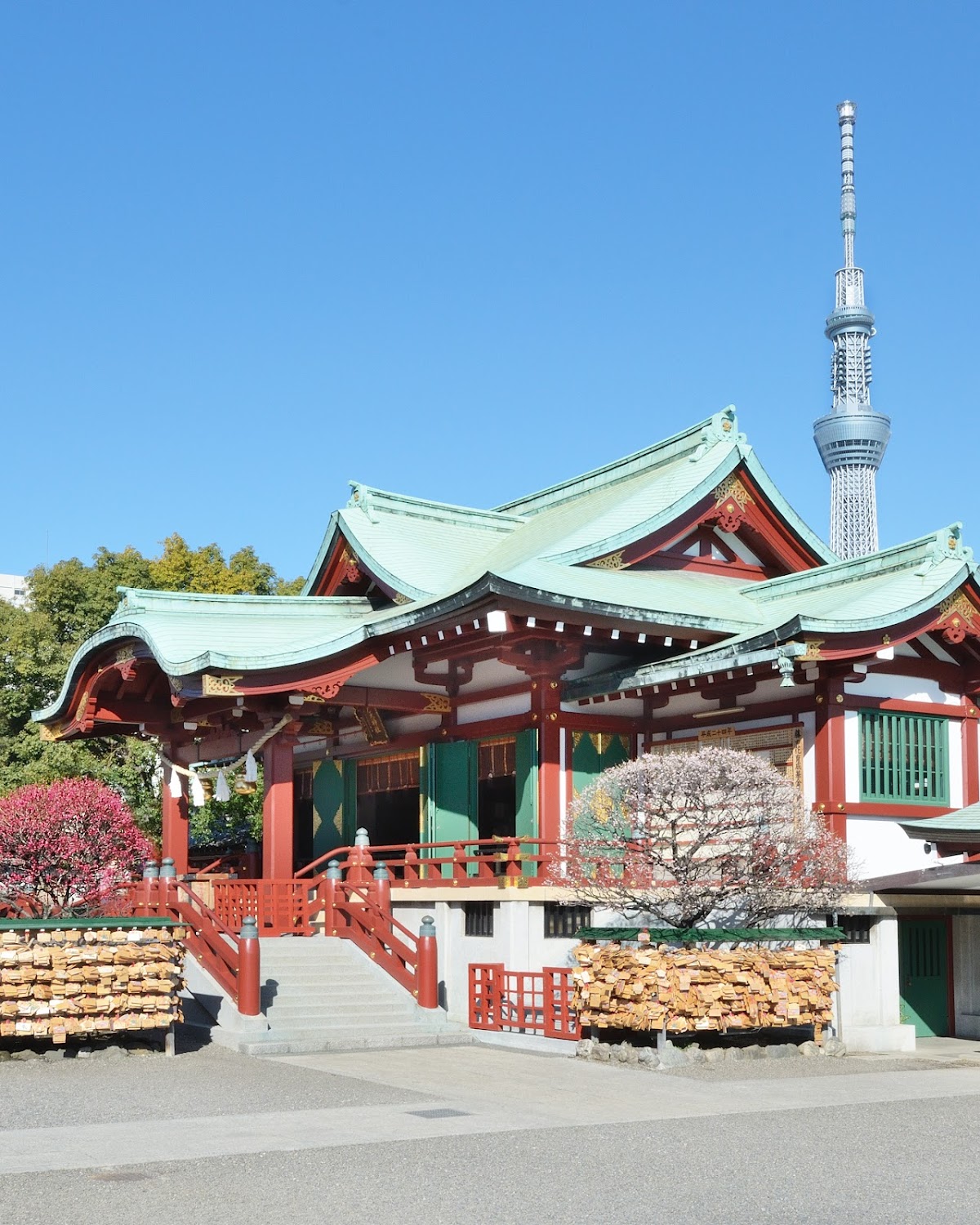
It was widely known as a famous Edo landmark, even being depicted in Utagawa Hiroshige’s ukiyo-e print “One Hundred Famous Views of Edo.” Even today, the collaboration of the Tokyo Skytree and the wisteria trellis is gaining popularity as a new landmark.
Deity and Blessings | Sugawara no Michizane, God of Learning
Main Deity: Sugawara no Michizane
The main deity enshrined at Kameido Tenjin Shrine is Sugawara no Michizane. Michizane was a scholar and politician active during the Heian period, and is revered throughout Japan as the “God of Learning” due to his outstanding knowledge and sincere character.
Michizane excelled in waka and Chinese poetry from a young age, and there is an anecdote that he composed a waka poem at the tender age of five. He rose to the position of Minister of the Right, but was demoted to Dazaifu due to slander from his political enemies, where he spent the rest of his life.
Expected Blessings
The main blessings you can receive at Kameido Tenjin Shrine are as follows:
Academic Success and Passing Exams
This is the most well-known blessing, and many students and those preparing for qualification exams visit the shrine. Especially during exam season, the shrine grounds are filled with ema (votive tablets) praying for success. Academic Advancement and Wisdom
This shrine is revered not only by students but also by those who aspire to lifelong learning and self-improvement.
Protection from Misfortune and Disaster
It is believed that the strong spiritual power of Sugawara no Michizane provides protection from misfortune.
Improvement in Performing Arts
In honor of Michizane, who excelled in waka and Chinese poetry, many visit to pray for improvement in literature and performing arts.
Highlights of the Shrine Grounds | Beautiful Layout Modeled After Dazaifu
Shinji Pond and Three Drum Bridges
Upon entering the shrine grounds, the first thing you see is the Shinji Pond, shaped like the character for “heart.” Three vermilion-lacquered drum bridges span this pond, known as “Otokobashi” (Male Bridge), “Hirabashi” (Flat Bridge), and “Onnabashi” (Female Bridge).
The Otokobashi has the steepest slope and represents the past. The Hirabashi Bridge currently stands, and the Onnabashi Bridge symbolizes the future. It is believed that crossing these three bridges purifies the mind and body, bringing one closer to the gods. The Taikobashi Bridge offers a view of the Tokyo Skytree, making it an excellent photo spot.
Shrine and Worship Hall
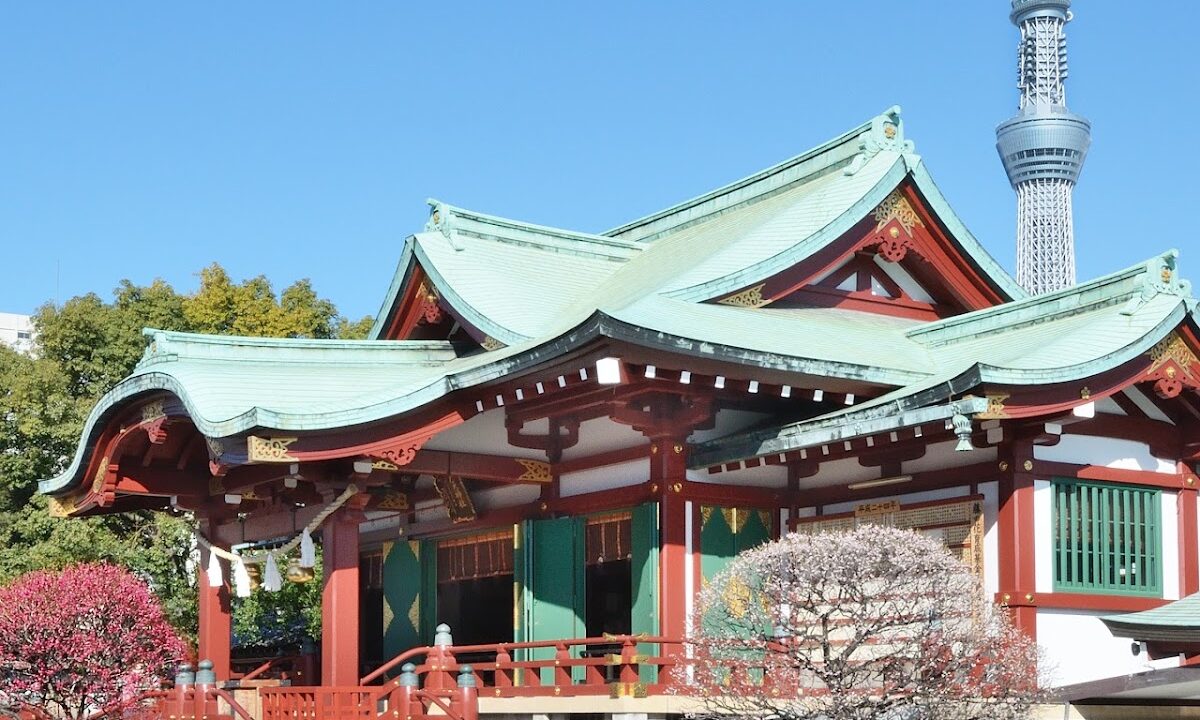
The current shrine was rebuilt in 1961 and adopts the Gongen-zukuri style. The beautiful vermilion-painted shrine is modeled after Dazaifu Tenmangu Shrine, creating a solemn atmosphere.
In front of the worship hall, instead of guardian lions, sits a “sacred ox” associated with Sugawara no Michizane. The ox is considered a messenger of Tenjin-sama, and it is believed that stroking the ox’s head bestows wisdom.
Brush Mound
Within the shrine grounds is a “brush mound” where worn-out brushes are commemorated. As befits a shrine dedicated to the god of learning, many students and calligraphers visit this place to express gratitude for the brushes they used in calligraphy and academic pursuits.
Ontake Shrine
Ontake Shrine, one of the subsidiary shrines within the grounds, is believed to bring good fortune and prosperity in business. Many people visit this shrine along with the main shrine.
Wisteria Festival | Tokyo’s Premier Wisteria Spot
History and Characteristics of the Wisteria Trellis
Kameido Tenjin Shrine has been known as a “famous wisteria spot” since the Edo period, and was even depicted in Hiroshige’s ukiyo-e prints as “Kameido’s Five-Foot Wisteria.” Approximately 50 wisteria plants are planted on the grounds, many of which are ancient trees over 100 years old.
The total length of the wisteria trellis is approximately 100 meters, and wisteria of various colors, including purple, white, and pink, blooms magnificently. In particular, the wisteria known as “Nine-Foot Wisteria” boasts flower clusters that reach up to 1.5 meters in length, overwhelming those who see it.
Wisteria Festival: Dates and Best Viewing Times
The Wisteria Festival is held annually from late April to early May. The typical best viewing times are as follows:
- Early-blooming varieties: Mid-April to late April
- Peak season: Late April to early May (around Golden Week)
- Late-blooming varieties: Early to mid-May
During the Wisteria Festival, the wisteria is illuminated at night, allowing visitors to enjoy a magical view of the wisteria at night. The illuminated wisteria against the backdrop of the Tokyo Skytree is truly a spectacular sight.
How to Enjoy the Wisteria Festival
Optimal Visiting Time
Weekday mornings are relatively less crowded. Weekends, holidays, and peak viewing times are extremely crowded, so visiting early in the morning right after opening is recommended.
Photo Spots
- The combination of the Taiko Bridge and wisteria trellis
- The inverted wisteria reflected in the Shinji Pond
- The collaboration of Tokyo Skytree and wisteria
- The illuminated wisteria at night
Food Stalls and Booths
During the Wisteria Festival, numerous food stalls are set up on the temple grounds and approach, creating a festive atmosphere.
Plum Blossom Festival and Other Annual Events
Plum Blossom Festival (February-March)
Speaking of Tenjin-sama, plum blossoms are also essential. Because Sugawara no Michizane loved plum blossoms, plum trees are planted at Tenmangu shrines. At Kameido Tenjin Shrine, the “Plum Blossom Festival” is held from early February to early March, with approximately 300 plum trees in full bloom.
While not as famous as the wisteria, the temple grounds in early spring, when red and white plum blossoms bloom, also have a charming atmosphere, allowing visitors to enjoy a quiet visit enveloped in the fragrance of plum blossoms.
Chrysanthemum Festival (Late October to Mid-November)
In autumn, the “Chrysanthemum Festival” is held, displaying approximately 2,000 chrysanthemum plants, including large-flowered varieties and cascading chrysanthemums. Chrysanthemum dolls and chrysanthemum crafts are also exhibited, making it a beloved autumn tradition.
Other Major Annual Events
- Hatsumode (January 1st-3rd): A lively event with many worshippers.
- Setsubun Festival (February 3rd): Bean-throwing ceremony.
- Tenjin-sama’s Festival (25th of every month): A festival commemorating the death anniversary of Sugawara no Michizane.
- Shichi-Go-San Festival (November): A lively event with families.
- Great Purification Ceremony (June 30th, December 31st): A Shinto ritual to purify oneself of sins and impurities accumulated over the past six months.
Goshuin (Shrine Seal) Information | Types and Reception Hours
Standard Goshuin
Kameido Tenjin Shrine offers beautiful goshuin. The seal features “Kameido Tenjin Shrine” in calligraphy in the center, “Homage” in the upper right, and the date of visit in the lower left. The shrine seal bears the plum blossom crest (Sugawara no Michizane’s family crest).
Offering Fee: 500 yen
Reception Hours: 8:30 AM – 5:00 PM (may vary depending on the season)
Reception Location: Shrine Office
Limited Edition Goshuin (Shrine Seals)
Limited edition goshuin are also available, tailored to the season and events:
- Wisteria Festival Limited Edition Goshuin (late April – early May): Special edition with a wisteria stamp
- Plum Blossom Festival Limited Edition Goshuin (February – March): Features a plum blossom stamp
- New Year’s Limited Edition Goshuin (January 1st – 7th): Special design celebrating the New Year
- Monthly Goshuin: Design may change monthly
Limited edition goshuin may be available in limited quantities, so early visit is recommended.
Goshuincho (Shrine Seal Book)
Kameido Tenjin Shrine also offers original goshuincho. These beautiful goshuincho feature wisteria and plum blossom designs and are available in multiple colors and designs.
Offering Fee: Approximately 1,500 to 2,000 yen (including Goshuin stamp)
Amulets and Souvenirs | Amulets for Academic Success are Popular
Amulets for Academic Success and Passing Exams
As befits a shrine dedicated to the god of learning, there is a wide variety of amulets for academic success and passing exams:
- Academic Success Amulet: A basic amulet for students diligently studying
- Passing Exam Amulet: A popular amulet for students taking exams
- Academic Success Pencil: A pencil usable for exams and tests
- Victory Amulet: An amulet for winning exams and competitions
- Wisdom Amulet: An amulet for bestowing wisdom
Other Amulets
- Exorcism Amulet: For those in their unlucky year or those seeking protection from misfortune
- Health Amulet: An amulet for wishing for good health and longevity
- Traffic Safety Amulet: An amulet for safe driving and cycling
- Good Fortune Charm: A charm to pray for improved luck
Ema (Votive Tablets)
Ema at Kameido Tenjin Shrine are popular, featuring designs of plum blossoms and oxen. Many ema, inscribed with prayers for success in exams and academic achievement, are dedicated to the shrine’s ema rack.
Access | How to get there by train, bus, or car
Access by Train
The most convenient way to access Kameido Tenjin Shrine is by train.
If using the JR Sobu Line
- Approximately 15 minutes on foot from the North Exit of Kameido Station on the JR Sobu Line
- Head north from the station, cross Meiji-dori, and proceed along Kuramae-bashi-dori.
If using the Tobu Kameido Line
- Approximately 5 minutes on foot from Kameido Tenjinmae Station on the Tobu Kameido Line
- This is the nearest station, and the station name also includes the name of the shrine.
- Head north from the station, and you will immediately see the shrine’s torii gate.
If using the Toei Subway/Tokyo Metro
- Approximately 15 minutes on foot from Kinshicho Station on the Toei Shinjuku Line/Tokyo Metro Hanzomon Line
- Bus access is also available.
Access by Bus
Toei Bus
- Get off at the Kameido Tenjinmae bus stop from Kinshicho Station, then a 2-minute walk.
- Routes: Kin27, Kin28, etc.
Access by Car and Parking
If using the Metropolitan Expressway
- Approximately 10 minutes from the Kinshicho exit of the Metropolitan Expressway Route 7 Komatsugawa Line.
Parking Information
There is a parking lot for visitors on the temple grounds, but the number of spaces is limited (approximately 60). During peak seasons such as the Wisteria Festival, it is often full, so we recommend using public transportation.
Parking Fee: Free (for visitors only)
Operating Hours: During opening hours
There are several coin-operated parking lots nearby, but they are crowded on weekends and during events.
Visiting Hours and Basic Information
Opening Hours
Normal Season: 6:00 AM – 5:00 PM
Wisteria Festival: 6:00 AM – 6:00 PM (until around 9:00 PM during illuminations)
New Year’s Period: Open 24 hours (first three days of the New Year)
Opening hours may change depending on the season and events, so we recommend checking official information.
Shrine Office Hours
Goshuin (Shrine Seal) and Amulet Distribution: 8:30 AM – 5:00 PM
Prayer Request Reception: 9:00 AM – 4:30 PM
Admission Fee
Entry to the shrine grounds is free. Anyone is welcome to visit.
Basic Information Summary
- Official Name: Kameido Tenjin Shrine
- Other Names: Higashi-Zaifu Tenmangu Shrine, Kameido Tenmangu Shrine
- Address: 3-6-1 Kameido, Koto-ku, Tokyo 136-0071
- Phone Number: 03-3681-0010
- Deities Enshrined: Sugawara no Michizane, Amenohohi no Mikoto
- Founded: Kanbun 2 (1662)
- Shrine Rank: Former Prefectural Shrine
Nearby Tourist Spots | Highlights of the Kameido Area
Tokyo Skytree
Located approximately 2km from Kameido Tenjin Shrine, about a 25-minute walk or a 10-minute train ride away, the Tokyo Skytree is the world’s tallest freestanding radio tower at 634m. From the observation deck, you can enjoy a panoramic view of the Kanto Plain, and on clear days, you can even see Mount Fuji.
A popular photo spot is taking a picture of the Tokyo Skytree through the wisteria trellis at Kameido Tenjin Shrine.
Kameido Katori Shrine
Located about a 10-minute walk from Kameido Tenjin Shrine, Kameido Katori Shrine is known as the god of sports promotion. It is believed to bring good fortune in competitions and improvement in martial arts, and is visited by athletes.
Kameido Clock
This commercial facility in front of Kameido Station offers shopping and dining. It’s convenient for taking a break after visiting the shrine or for souvenir shopping.
Kameido Central Park
This spacious metropolitan park has sports facilities and playground equipment, making it popular with families. Cherry blossoms can be enjoyed in the spring.
Manners and Points for Visiting a Shrine
Proper Way to Visit a Shrine
- Bow before passing through the torii gate: Show respect before entering the sacred area.
- Purify yourself at the water basin: Purify in the following order: left hand → right hand → mouth → handle of the ladle in your left hand.
- Walk along the edge of the path: The center is considered the path of the gods.
- Two bows, two claps, one bow: This is the basic way to pray in front of the main hall.
Photography Manners
Photography is generally permitted on the shrine grounds, but please note the following:
- Avoid using tripods when it is crowded.
- Be considerate of other worshippers.
- Photography inside the shrine may be prohibited.
- Avoid using flash photography.
Tips for Avoiding Crowds
- Weekday mornings are the least crowded.
- During the Wisteria Festival it gets especially crowded, so early morning visits are recommended.
- Tenjin-sama’s Festival Day (25th) is more crowded than usual.
- New Year’s Visit Period (January 1st-3rd) is extremely crowded.
To fully enjoy the charm of Kameido Tenjin Shrine
Kameido Tenjin Shrine is a shrine with diverse attractions, including the worship of the god of learning, seasonal flowers, a landscape that retains the atmosphere of the Edo period, and its harmony with the modern symbol, Tokyo Skytree.
Students and students can pray for success in exams and academic achievement, flower lovers can enjoy the wisteria festival and plum blossom festival, and history buffs can enjoy the history of Tenjin worship that has continued since the Edo period.
The wisteria season, in particular, boasts unparalleled beauty in Tokyo and is a breathtaking sight that you should see at least once in your lifetime. The landscape created by the Taiko Bridge, wisteria trellis, and Tokyo Skytree is a unique Tokyo scene where tradition and modernity merge.
Whether you are visiting for the first time or have visited many times before, please experience the charm of Kameido Tenjin Shrine, which shows a different face in each season. You will be able to enjoy a peaceful time while receiving blessings for academic success.