Complete Guide to Higashi-Fushimi Inari Shrine (Tokyo) | Thorough Explanation of Goshuin (Shrine Seals), Access, Benefits, and Highlights
Located in Nishitokyo City, Tokyo, Higashi-Fushimi Inari Shrine is one of the leading Inari shrines in the Kanto region, having received a divided spirit from Kyoto’s Fushimi Inari Taisha. This guide provides detailed information you should know before visiting this shrine, with its vermilion-colored grounds, numerous torii gates, and a history that gave rise to station and place names.
What is Higashi-Fushimi Inari Shrine? | The Only Branch Shrine of Kyoto’s Fushimi Inari Taisha in Eastern Japan
Higashi-Fushimi Inari Shrine, founded in 1929, is a relatively new shrine, but its history is exceptional. It was established in response to the strong desire of local residents to have a divided spirit of Kyoto’s Fushimi Inari Okami in Tokyo, and was formally granted a divided spirit from Kyoto’s head shrine, Fushimi Inari Taisha.
As the only branch shrine of Fushimi Inari Taisha in eastern Japan, and holding the special position of a directly managed branch shrine, it is an important center of Inari worship in the Kanto region.
Main Deities and Divine Virtues
Three deities are enshrined at Higashi Fushimi Inari Shrine.
Ukanomitama-no-Okami
The main deity of Inari, widely worshipped as the god of abundant harvests, business prosperity, and industrial development.
Satahiko-no-Okami
Known as the god of opening paths and guidance, this deity leads to success at life’s crossroads and in new ventures.
Omiyanome-no-Okami
The god of harmony and unity, believed to bring smooth interpersonal relationships and family harmony.
History of Higashi-Fushimi Inari Shrine | The Shrine That Influenced Place and Station Names
Circumstances of Founding
In the early Showa period, the residents of the then Kami-Hoya Village (present-day Nishitokyo City) had a strong desire to welcome a divided spirit of Fushimi Inari Okami from Kyoto to Tokyo. Praying for the development of the region and the happiness of the residents, in 1929 (Showa 4), the formal invitation of a divided spirit from Kyoto’s Fushimi Inari Taisha was realized.
From its inception, it attracted many worshippers and developed into a center of Inari worship in western Tokyo.
The Birth of the Place Name Higashi-Fushimi
The founding of Higashi-Fushimi Inari Shrine had a significant impact on the name of the region. Around the same time as its founding, Kami-Hoya Station on the Seibu Shinjuku Line was renamed “Higashi-Fushimi Station.” This name originates from the fact that the divided spirit was brought east from Fushimi in Kyoto.
Furthermore, in 1966 (Showa 41), the area where the shrine is located was officially named “Higashi-Fushimi,” after the shrine’s name. As a rare example of a shrine being the origin of a place name and station name, it has become a symbolic landmark of the region.
Highlights of the Shrine Grounds | A Sacred Precinct Adorned in Vermilion
The Grand Torii Gate and Stone Lanterns
At the entrance to the approach to Higashi-Fushimi Inari Shrine stands a striking vermilion torii gate. On either side of this gate are a pair of impressive, gigantic stone lanterns, guiding visitors into the sacred precinct.
The size and beauty of the stone lanterns are one of the distinctive features of Higashi-Fushimi Inari Shrine, creating a fantastical atmosphere when lit at dusk or at night.
The Shrine Building
After passing through the grand torii gate and the main gate, a magnificent reinforced concrete shrine building appears. Built using early Showa-era construction techniques, it features a robust structure and a beautiful exterior primarily in vermilion and white.
In front of the shrine is a spacious worship area, which is bustling with many worshippers during New Year’s visits and festivals. Prayers can also be received inside the shrine, and people constantly visit to pray for business prosperity, family safety, and other blessings.
The Mounds and Votive Torii Gates
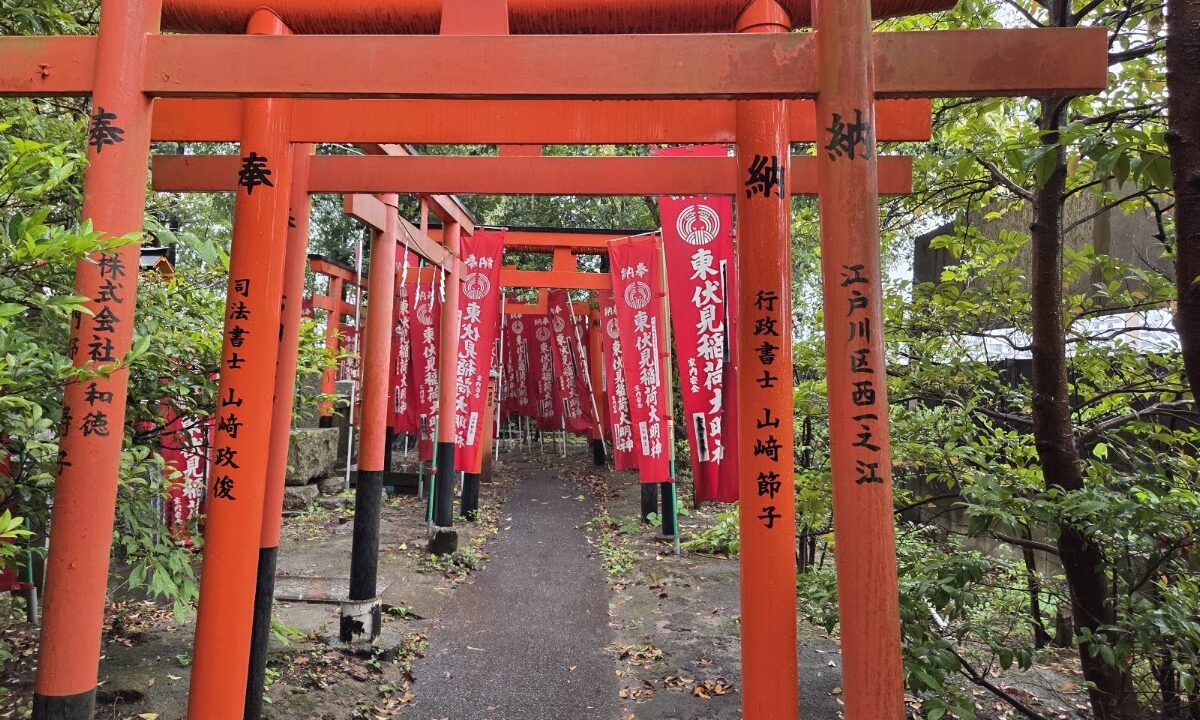
The biggest highlight of Higashi-Fushimi Inari Shrine is the mound area behind the main shrine. A mystical space unfolds, with rows of vermilion torii gates reminiscent of Kyoto’s Fushimi Inari Taisha.
There are over 100 votive torii gates within the grounds, allowing worshippers to walk through the mounds. The experience of walking through the tunnel of torii gates is said to give visitors the feeling of visiting Kyoto’s Fushimi Inari, even though they are in Tokyo.
The mound area contains several small shrines and mounds, each enshrining a statue of a fox, the divine messenger of Inari Okami. This tranquil space is popular as a spiritual power spot that allows you to forget the hustle and bustle of the city.
Shrine Grounds
Several shrines are arranged around the main shrine building. Each shrine enshrines a different deity, attracting worshippers seeking various blessings.
It is believed that visiting each shrine while walking around the grounds will bring even greater divine blessings.
Selected as one of the New 100 Views of Tokyo
Higashi-Fushimi Inari Shrine has been selected as one of the “New 100 Views of Tokyo” for its beautiful scenery. The landscape of rows of vermilion torii gates, in particular, is a popular photo spot among photography enthusiasts in Tokyo.
The shrine grounds display different expressions throughout the seasons, offering beautiful scenery no matter when you visit: cherry blossoms in spring, fresh greenery in summer, autumn leaves, and snowscapes in winter.
Goshuin (Shrine Seals) and Amulets
Goshuin (Shrine Seals)
At Higashi-Fushimi Inari Shrine, you can receive a goshuin as proof of your visit. Goshuin (temple/shrine stamps) are available at the shrine office and are characterized by their carefully written, powerful calligraphy.
The goshuin bears the name of Higashi-Fushimi Inari Shrine and the date of visit, along with a stamp indicating that it is a branch shrine of Fushimi Inari Taisha. You can bring your own goshuincho (stamp book) or purchase one on-site.
Amulets and Souvenirs
The shrine office offers a variety of amulets and souvenirs. You can receive amulets for various wishes, such as business prosperity, family safety, traffic safety, and academic success.
Particularly popular are amulets for business prosperity and business success, as is typical for Inari shrines, and are frequently sought after by business owners and self-employed individuals. Cute amulets featuring foxes are also popular with visitors.
Benefits and Spiritual Appeal
Main Benefits
Higashi-Fushimi Inari Shrine is believed to offer the following benefits:
- Business Prosperity and Success: A representative blessing of Inari, frequently visited by business owners and company managers.
- Abundant Harvest and Industrial Prosperity: Prayers for the development of all industries, including agriculture and manufacturing.
- Family Safety and Harmony: Prayers for the health and happiness of family members and harmony within the household.
- Good Fortune and Prosperity: Prayers for improved luck and good fortune in all aspects of life.
- Traffic Safety: Prayers for safe travel and a successful journey.
- Academic Success: Prayers for academic improvement and passing exams.
Attractiveness as a Power Spot
Higashi-Fushimi Inari Shrine is known as one of Tokyo’s leading power spots. The area around the shrine, with its rows of vermilion torii gates, is particularly renowned for its unique spiritual energy.
Many visitors feel their hearts purified and gain new energy after visiting the shrines. In the tranquil grounds, you can escape the hustle and bustle of everyday life and spend time to calm your mind.
Prayers
The shrine accepts prayers from individuals and companies. Shinto priests perform prayers for life’s milestones and wishes, such as business prosperity, family safety, protection from evil, first shrine visits for newborns, and Shichi-Go-San (a traditional Japanese rite of passage for children).
If you wish to have a prayer performed, it is recommended that you contact the shrine office in advance.
Access | Directions by Train and Car
Access by Train
Nearest Station: Higashi-Fushimi Station, Seibu Shinjuku Line
Higashi-Fushimi Inari Shrine is approximately a 10-minute walk from Higashi-Fushimi Station. Exit the north exit of the station and proceed through the residential area. There are signs along the way, so even first-time visitors can arrive without getting lost.
Access from Major Stations
- From Shinjuku Station: Approximately 25 minutes on the Seibu Shinjuku Line, alight at Higashi-Fushimi Station
- From Takadanobaba Station: Approximately 15 minutes on the Seibu Shinjuku Line, alight at Higashi-Fushimi Station
- From Tokorozawa Station: Approximately 20 minutes on the Seibu Shinjuku Line, alight at Higashi-Fushimi Station
Access by Car and Parking
Location
1-5-38 Higashi-Fushimi, Nishitokyo City, Tokyo
Parking
There is a parking lot for visitors on the shrine grounds. While there is usually ample parking space, it can get crowded during the New Year’s period and festivals, so using public transportation is recommended.
Route by Car
- Approximately 15 minutes from the Kan-Etsu Expressway “Oizumi IC”
- Approximately 20 minutes from the Chuo Expressway “Chofu IC”
Visiting Hours and Annual Events
Visiting Hours
The grounds of Higashi-Fushimi Inari Shrine are generally open, but the gates are closed from night until early morning. The visiting hours may vary depending on the season, but are generally as follows:
- Opening time: Around 6:00 AM
- Closing time: Around 6:00 PM (may be earlier in winter)
The shrine office is open from 9:00 AM to around 5:00 PM. If you wish to receive a Goshuin (shrine stamp) or amulet, please visit during these hours.
Annual Events
Hatsumode (January 1st-3rd)
Many worshippers visit for Hatsumode to pray for happiness in the new year. It is especially crowded during the first three days, but after the first three days it is relatively less crowded, allowing for a more relaxed visit.
Hatsuumasai (First Horse Day of February)
This is one of the most important festivals for Inari shrines. It is bustling with worshippers praying for business prosperity and a bountiful harvest.
Annual Grand Festival (Autumn)
This is the most grand festival of the year, featuring a portable shrine procession and dedication ceremonies. Local people gather to enjoy the traditional festival atmosphere.
Monthly Festival
Monthly festivals are held on the 1st and 15th of each month, offering regular thanks and prayers to the gods.
Nearby Spots and Tourist Information
Higashi-Fushimi Park
Adjacent to Higashi-Fushimi Inari Shrine is the spacious, lush green Tokyo Metropolitan Higashi-Fushimi Park. It’s perfect for strolling or relaxing before or after visiting the shrine.
The park also has playground equipment and benches, making it ideal for families. In spring, cherry blossoms bloom, making it a popular spot for cherry blossom viewing.
Nearby Restaurants and Cuisine
Around Higashi-Fushimi Station, there are numerous cafes, restaurants, and Japanese restaurants. Enjoying local cuisine after visiting the shrine is a great idea.
The shopping street in front of the station, in particular, has many traditional independent shops, allowing you to enjoy a meal while experiencing the local atmosphere. ### Nearby Shrines and Temples
Nishitokyo City and the surrounding area have many other historical temples and shrines, making it a great place to enjoy a shrine tour. If you have the time, planning a pilgrimage route that includes visiting multiple shrines is highly recommended.
Manners and Precautions for Visiting Shrines
Basic Manners for Visiting Shrines
How to Pass Through a Torii Gate
The torii gate is the entrance to the sacred area. Bow before passing through the gate, and walk along the edge of the path, as the center is considered the path of the gods.
How to Wash Your Hands at the Water Basin
Purify your body and mind at the water basin. Hold the ladle in your right hand and wash your left hand, then switch to your left hand and wash your right hand. Switch back to your right hand, receive water in your left hand, rinse your mouth, and finally rinse the handle of the ladle by holding it upright.
How to Bow
The basic method is two bows, two claps, and one bow. Bow deeply twice, clap twice, and finally bow deeply once. ### Photography Guidelines
Photography is generally permitted within the shrine grounds, but please be considerate of other visitors. The torii gate in the Otsuka area is a popular photo spot, but it’s important to maintain silence and photograph with respect.
Photography inside the shrine buildings or during prayers may be prohibited; please follow any notices.
Dress Code
While there are no strict dress code regulations, shrines are sacred places, so please avoid revealing or overly flashy clothing and dress in clean, presentable attire.
War Memorial | Hidden Spots within the Shrine Grounds
In a corner of the shrine grounds stands a quiet war memorial. This memorial is often overlooked by visitors, but it is an important place to commemorate the war victims of the region.
When visiting Higashi-Fushimi Inari Shrine, it would be meaningful to not only admire the ornate torii gates and shrine buildings, but also to visit these historical sites and offer prayers for peace.
Reviews and Reputation | Visitor Feedback
Visitors to Higashi-Fushimi Inari Shrine have shared the following comments:
“A rare place to visit an authentic Inari shrine in Tokyo.” As a branch shrine of Kyoto’s Fushimi Inari Taisha, it is highly regarded for offering an authentic Inari worship experience.
“Beautiful vermilion torii gates, perfect for photos.” The tunnel of torii gates in the Otsuka area is a popular photo spot on social media like Instagram.
“Quiet and peaceful atmosphere.” Despite its easily accessible location from central Tokyo, the shrine grounds are enveloped in tranquility, making it a peaceful place to visit.
“Crowded during New Year’s, but less crowded after the first three days.” While crowded during the New Year’s season, many visitors report that it is relatively less crowded after January 4th.
“Conveniently located within walking distance of the station”
The excellent location, just a 10-minute walk from Higashi-Fushimi Station, is also highly appreciated by visitors.
Summary | Praying for Good Fortune at Higashi-Fushimi Inari Shrine
Higashi-Fushimi Inari Shrine is a historic shrine founded in 1929 as the only branch shrine of Kyoto’s Fushimi Inari Taisha in the eastern provinces. With its vermilion torii gate, impressive stone lanterns, and the Otsuka area with over 100 torii gates, the shrine grounds offer plenty to see and have been selected as one of the New 100 Views of Tokyo.
It’s also a power spot visited by many people seeking blessings for business prosperity, family safety, and good fortune. Its convenient location, about a 10-minute walk from Higashi-Fushimi Station on the Seibu Shinjuku Line, is another attractive feature.
Higashi-Fushimi Inari Shrine offers a mystical atmosphere reminiscent of Kyoto’s Fushimi Inari, even while in Tokyo. As a local symbol that gave rise to place and station names, and as an important center of Inari worship in the Kanto region, why not pay a visit?
The time spent in the tranquil grounds, calming your mind and receiving the divine blessings of Inari Okami, will be a precious moment that allows you to forget the hustle and bustle of everyday life.