Hiyoshi Shrine (Miyamura, Tonami City, Toyama Prefecture) Complete Guide | History, Deities, and Access Information
Hiyoshi Shrine, located in Miyamura, Tonami City, Toyama Prefecture, is a historic shrine that has long been cherished by the local people. As one of approximately 848 Hiyoshi Shrines nationwide, it has played an important role as a center of faith in this region. This article comprehensively introduces detailed information about Hiyoshi Shrine in Miyamura, Tonami City, including its history, enshrined deities, features of the grounds, and access methods.
Basic Information about Hiyoshi Shrine
Location and Contact Information
Location: 73 Miyamura, Tonami City, Toyama Prefecture
Postal Code: 〒939-1306
Corporate Number: 2230005004673 (Designated October 5, 2015)
Miyamura, Tonami City, is located in the western part of Toyama Prefecture, in the Tonami Plain. Hiyoshi Shrine stands quietly amidst the distinctive landscape of the Tonami region, known for its scattered settlements.
Shrine Status and Positioning
The name Hiyoshi Shrine is the 13th most common shrine name in Japan, with 848 shrines nationwide. Many of these shrines are branch shrines of Hiyoshi Taisha (Sanno Grand Shrine), located in Sakamoto, Otsu City, Shiga Prefecture. Hiyoshi Taisha was founded approximately 2100 years ago and was considered important as a protector against evil influences during the relocation of the capital to Heian-kyo.
Several Hiyoshi Shrines also exist within Toyama Prefecture, each attracting local devotion. The Hiyoshi Shrine in Miyamura, Tonami City, is also part of this historic network of shrines.
Deities and Divine Virtues of Hiyoshi Shrine
About the Deities
The deities enshrined at Hiyoshi Shrine are generally the following:
Oyamakui-no-kami: Known as the guardian deity of Mount Hiei, worshipped as the god of mountains and agriculture.
Onamuchi-no-kami: Another name for Okuninushi-no-mikoto, widely revered as the god of nation-building and matchmaking.
These deities have been worshipped as Sanno Gongen since ancient times and had deep ties with Enryaku-ji Temple on Mount Hiei during the era of syncretism of Shinto and Buddhism. While many Hiyoshi Shrines eliminated Buddhist elements due to the Meiji Restoration’s separation of Shinto and Buddhism, the Shinto faith continued.
Divine Virtues and Faith
The divine virtues of Hiyoshi Shrine are diverse:
- Protection from Evil and Misfortune: From the tradition of protecting the northeast direction (demon’s gate) of Heian-kyo (Kyoto)
- Abundant Harvest: Character as an agricultural deity
- Family Safety: As a guardian deity of the region
- Business Prosperity: Prayers for the development of local industries
- Matchmaking: Divine virtues of Ōkuninushi-no-Mikoto
The Tonami region was an agricultural area centered on rice cultivation, and prayers for a bountiful harvest were considered to have held particular importance.
History of Hiyoshi Shrine
Circumstances of Founding
The exact founding date of Hiyoshi Shrine in Miyamura, Tonami City, is unclear due to limitations in historical records, but it is believed to have been founded in close connection with regional development. The place name “Miyamura” itself suggests the existence of a shrine, indicating that a shrine had been enshrined in this area since ancient times.
The spread of Hiyoshi worship in Toyama Prefecture is rooted in the growing influence of Enryaku-ji Temple on Mount Hiei. From the Heian period to the medieval period, Enryaku-ji Temple expanded its branch temples throughout Japan, and consequently, Sanno worship (Hiyoshi worship) spread to various regions.
Transition from Early Modern to Modern Periods
During the Edo period, Hiyoshi shrines were maintained within the territory of the Kaga Domain (Toyama Domain), influenced by the domain’s shrine policies. During this time, many villages established guardian shrines, which became central to the village’s sense of community.
The Meiji-era separation of Shinto and Buddhism had a significant impact on Hiyoshi shrines. Shrines that had previously maintained a syncretic form of Shinto-Buddhist worship as Sanno Gongen transformed into purely Shinto shrines. In Toyama Prefecture, in particular, a fierce anti-Buddhist movement unfolded, resulting in the closure of many temples.
Under the Meiji-era shrine ranking system, Hiyoshi shrines were classified as village shrines or unranked shrines, continuing to function as local tutelary deities.
Hiyoshi Shrine in the Modern Era
Following the enactment of the Religious Corporations Act after World War II, Hiyoshi Shrine was assigned a corporate number on October 5, 2015, establishing its status as a religious corporation under the modern legal system.
It is still maintained and managed by local parishioners, and annual events, including the spring and autumn festivals, are held. Despite facing challenges such as depopulation and an aging population, it continues to play a vital role as the core of the region’s identity.
Highlights and Characteristics of the Shrine Grounds
Layout of the Shrine Grounds
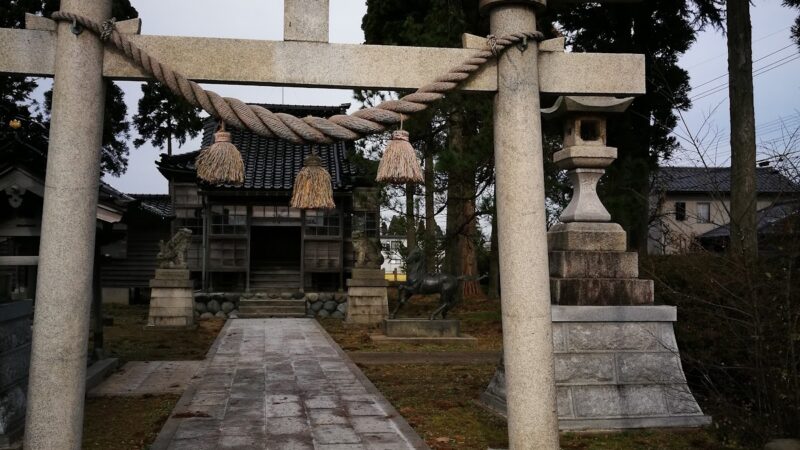
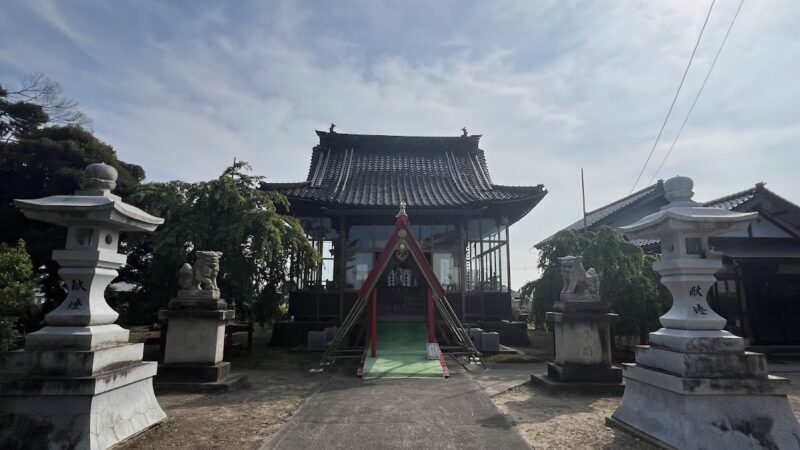
Hiyoshi Shrine’s grounds have the typical layout of a local shrine:
Torii: A sacred gate marking the entrance to the shrine grounds.
Sando: The path leading from the torii to the shrine building. Shrines in the Tonami region are characterized by tranquil sando paths surrounded by cedar groves.
Water Purification Pavilion: A place to purify oneself before worship.
Worship Hall: The building where worshippers offer their prayers.
Main Sanctuary: The most sacred building where the enshrined deity is worshipped.
Atmosphere of the Shrine Grounds
Many shrines in the Tonami region are surrounded by sacred groves scattered throughout the landscape of dispersed villages. Hiyoshi Shrine is no exception, exhibiting a tranquil atmosphere in harmony with its surrounding natural environment.
Cedar and zelkova trees cover the grounds, displaying different expressions throughout the seasons. Especially during the fresh greenery of spring and the vibrant autumn foliage, the grounds are enveloped in beautiful natural colors.
Stone Monuments and Memorials
Like many local shrines, there is a possibility that stone monuments and memorials from various eras remain on the grounds. These are valuable historical materials that convey the history of the shrine and events in the region.
Annual Events and Festivals
Spring Festival
The spring festival is often held to coincide with the start of agricultural work and is an important festival to pray for a bountiful harvest. Local parishioners gather, and the Shinto rituals are performed solemnly.
Autumn Festival
The autumn festival is a festival to express gratitude for the harvest. Thanks are given for the year’s bounty, and prayers are offered for a good harvest in the following year. In some regions, traditional performing arts such as lion dances are offered.
Other Events
- New Year’s Visit: Praying for happiness in the new year
- Setsubun Festival: Praying for protection against evil
- Summer Purification Ceremony: A Shinto ritual to purify oneself of impurities accumulated over the past six months
- Year-End Purification Ceremony: A Shinto ritual to purify oneself of impurities accumulated over the past year
Access Information
Access by Car
From the Hokuriku Expressway:
- Approximately 10 minutes from Tonami IC
- Accessible via the Tokai-Hokuriku Expressway from Oyabe-Tonami JCT
Tonami City is a transportation hub where the Hokuriku Expressway and Tokai-Hokuriku Expressway intersect. Access by car is the most convenient.
Access by Public Transportation
JR Johana Line:
- Tonami Station is the nearest station
- Take a taxi or community bus from the station
Public transportation within Tonami City is limited, so it is recommended to check the timetable in advance.
Parking Information
As this is a local shrine, there may be parking spaces for visitors on or around the shrine grounds. However, congestion is expected during festivals, so it is recommended to visit with plenty of time to spare.
Characteristics of Tonami City and Surrounding Areas
Landscape of Scattered Villages
The Tonami Plain is known as one of Japan’s leading scattered village areas. Scattered villages are a unique settlement form where houses are not densely packed together, but rather scattered, each surrounded by a surrounding grove of trees (kainyo). This landscape has been designated as a nationally important cultural landscape.
History of the Tonami Region
The Tonami region has flourished since ancient times as one of the centers of Etchu Province. In the Middle Ages, Tonami County was home to many manors and was the stage for the Ikkō-ikki uprisings. In the early modern period, it became part of the Kaga Domain and developed as an agricultural area centered on rice cultivation.
Nearby Tourist Attractions
Tonami Tulip Park: 3 million tulips bloom in spring.
Tonami Scattered Village Museum: A facility where you can learn about the history and culture of scattered villages.
Shōgawa Gorge: A scenic spot where you can enjoy the beautiful gorge scenery.
Inami Carving: A visit to Inami, a town of traditional crafts, is also possible.
Other Hiyoshi Shrines in Toyama Prefecture
There are several Hiyoshi Shrines in Toyama Prefecture:
Hiyoshi Shrine (Wakasugi, Kamiichi Town)
The Hiyoshi Shrine, located in Wakasugi, Kamiichi Town, Nakaniikawa District, is one of the well-known shrines in the prefecture. It is historically significant for the fierce anti-Buddhist movement led by Shinto priests during the Meiji Restoration’s separation of Shinto and Buddhism.
Gion-no-miya Hiyoshi Shrine (Himi City)
Located in Minami-Omachi, Himi City, this shrine is a syncretic blend of Gion and Hiyoshi faiths.
Other Hiyoshi Shrines in Toyama Prefecture
Besides these, several other Hiyoshi shrines exist within Toyama Prefecture, each attracting local devotions. Hiyoshi faith is widely distributed throughout the Hokuriku region, including Ishikawa, Fukui, and Niigata prefectures.
Spread of Hiyoshi Faith
Distribution of Hiyoshi Shrines Nationwide
There are 848 Hiyoshi shrines nationwide, making it the 13th most numerous shrine name in Japan. They are particularly concentrated in the Hokuriku, Chubu, and Kanto regions.
By prefecture:
- Hokkaido: Multiple companies
- Tohoku Region: Distributed in Aomori, Iwate, Miyagi, Akita, Yamagata, and Fukushima prefectures
- Kanto Region: Numerous in Ibaraki, Tochigi, Gunma, Saitama, Chiba, Tokyo, and Kanagawa prefectures
- Chubu Region: Widely distributed in Niigata, Toyama, Ishikawa, Fukui, Yamanashi, Nagano, Gifu, Shizuoka, and Aichi prefectures
- Kinki Region: Numerous, mainly in Shiga prefecture where the head shrine is located
- Other: Also distributed throughout Western Japan
Characteristics of Sanno Faith
Hiyoshi faith, also known as Sanno faith, was a representative form of Shinto-Buddhist syncretism. As the guardian deity of Enryaku-ji Temple on Mount Hiei, it spread throughout Japan along with the spread of the Tendai sect.
Monkeys are considered important as divine messengers, and many Hiyoshi shrines feature monkey statues and sculptures. As a “divine monkey (masaru),” it was considered an auspicious being that wards off evil and brings victory.
Manners and Etiquette for Worship
Basic Worship Etiquette
- Bow before passing through the torii gate.
- Avoid walking in the center of the path to the shrine. (The center is the path for the gods.)
- Purify your body and mind at the water basin.
- Hold the ladle in your right hand and purify your left hand.
- Switch the ladle to your left hand and purify your right hand.
- Switch the ladle back to your right hand, receive water in your left hand, and rinse your mouth.
- Finally, hold the ladle upright and purify the handle.
- Offer your donation in front of the main hall.
- Two bows, two claps, one bow.
- Bow deeply twice.
- Clap your hands twice at chest height.
- Finally, bow deeply once.
Attire for Worship
No special formal attire is required, but clean clothing that reflects the sacred nature of the place is desirable. When attending special events such as festivals, slightly formal attire is appropriate.
Regarding Photography
Photography within the shrine grounds is generally permitted, but photography in sacred areas such as the interior of the main hall should be refrained from. Furthermore, when taking photographs during festivals, consideration must be given to avoid disrupting the religious ceremonies.
The Role of Hiyoshi Shrine in the Community
As a Community Center
Hiyoshi Shrine is not merely a religious facility; it has played a central role in the local community. Festivals provide valuable opportunities for local people to gather and serve as a place for intergenerational exchange.
Inheritance of Traditional Culture
Annual events and festivals centered around the shrine play an important role in passing on the region’s traditional culture to future generations. Tangible and intangible cultural heritage, such as traditional performing arts like lion dances, ritual practices, and local history, is preserved through the shrine.
Contemporary Challenges and Prospects
Many local shrines face challenges such as a decline in parishioners due to depopulation and aging, the maintenance of shrine buildings, and a lack of successors for traditional events. However, the importance of shrines as the core of regional identity and a spiritual anchor remains unchanged.
In recent years, new forms of shrine revitalization have been explored, such as utilizing them as tourist resources and collaborating with regional development efforts.
Surrounding Shrines and Temples
Besides Hiyoshi Shrine, many other shrines and temples exist in Tonami City and the surrounding areas.
Major Shrines in Tonami City
Naoka Shrine: One of Tonami City’s representative ancient shrines
Ogami Shrine: A shrine that attracts local faith
Others: Numerous shrines are scattered throughout the city as local guardian deities
Shrines in Surrounding Municipalities
Takaoka City: Many historical shrines, including Imizu Shrine (the Ichinomiya of Etchu Province)
Nanto City: A region with a strong Shinshu Buddhist culture, including Inami Betsuin Zuizenji Temple
Oyabe City: Ishidō Shrine, etc.
By visiting these shrines and temples, you can experience the rich religious culture of Toyama Prefecture.
Summary
Hiyoshi Shrine, located in Miyamura, Tonami City, Toyama Prefecture, is an important local shrine that plays a part in the Hiyoshi faith, which is widespread throughout Japan. Inheriting the history of Sanno faith, it has been revered as the local guardian deity.
Near the Tonami Plain, with its unique landscape of scattered villages, this shrine quietly watches over the area. It is not merely a historical building, but a living center of the local community.
When visiting Tonami City, why not visit not only famous tourist attractions such as tulips and scattered villages, but also these locally rooted shrines? There, you will surely discover another side of Tonami, where the faith and lives of the people of Toyama breathe life into the city.
Through a visit to Hiyoshi Shrine, you can feel the traditional Japanese faith culture, the history of the region, and the bonds of community that continue to this day. The time spent quietly offering prayers in the shrine grounds, which display different expressions in each season, will be a precious experience away from the hustle and bustle of everyday life.
Frequently Asked Questions (FAQ)
Q1: Are there set visiting hours for Hiyoshi Shrine?
A1: In most local shrines, the grounds are open at all times, and you can visit anytime during the day. However, the hours for receiving Goshuin (shrine stamps) at the shrine office may be limited. It is recommended to check in advance for the schedule of special events such as festivals.
Q2: Can I get a Goshuin?
A2: The availability of Goshuin varies depending on the size and management system of the shrine. If there is no resident Shinto priest, it may be difficult to provide a Goshuin. If you wish to receive a Goshuin, it is recommended to check in advance.
Q3: Can I have a wedding ceremony or prayer at Hiyoshi Shrine?
A3: The availability of Shinto wedding ceremonies and various prayers (such as first shrine visits, Shichi-Go-San, and exorcism) varies depending on the size and system of the shrine. If you wish to have these services, you will need to inquire directly with the shrine or the parishioners’ representative.
Q4: When is the annual festival at Hiyoshi Shrine?
A4: The dates of the annual festival vary depending on the shrine, but generally, the spring festival (April-May) and the autumn festival (September-October) are often held. Specific dates are often related to local traditions and agricultural calendars, so it’s best to confirm with locals.
Q5: What is the relationship between Hiyoshi Shrine in Miyamura, Tonami City, and Hiyoshi Taisha in Shiga Prefecture?
A5: Many Hiyoshi Shrines throughout Japan are shrines that received a divided spirit from Hiyoshi Taisha (Sanno Grand Shrine) in Sakamoto, Otsu City, Shiga Prefecture. Hiyoshi Shrine in Miyamura, Tonami City, is also thought to be part of this lineage. However, each Hiyoshi Shrine in different locations is an independent shrine that attracts local devotion.
Q6: Is it difficult to find a shrine in a scattered village?
A6: In scattered settlement areas, houses are dotted, but shrines are often surrounded by sacred groves, making them easy to find using the dense forest as a landmark. Currently, you can use car navigation systems or smartphone map apps to confirm the exact location. Please enter the address (73 Miyamura, Tonami City) and search.
Q7: Are there any statues of monkeys, the divine messengers of Hiyoshi Shrine?
A7: While monkeys are considered divine messengers in Hiyoshi faith, not all Hiyoshi shrines have monkey statues. The main shrine, Hiyoshi Taisha, has many monkey statues, but local branch shrines may not always have them. Visiting and checking for yourself is part of the fun.
Q8: Is it possible to visit during the winter?
A8: Toyama Prefecture is a heavy snowfall area, and snow accumulation can make visiting difficult during the winter. Particular caution is needed from January to February. If you are planning a visit during the winter, please check the weather and road conditions and come prepared with appropriate equipment (warm clothing, non-slip shoes, etc.).