Ayukai Hachimangu Shrine Complete Guide: A Thorough Explanation of its History, Cultural Assets, and Goshuin (Shrine Seal) Information
Ayukai Hachimangu Shrine, located in Shirataka-cho, Nishiokitama-gun, Yamagata Prefecture, is a historic shrine said to have been founded by Minamoto no Yoshiie during the Heian period. Formerly a prefectural shrine, it is currently designated as a special shrine by the Association of Shinto Shrines, and has a long history as a center of local faith. This article comprehensively explains the history, cultural assets, festivals, and goshuin information of Ayukai Hachimangu Shrine—all the information visitors should know.
Basic Information about Ayugai Hachimangu Shrine
Location and Access
Location: 3303-1 Ayugai, Shirataka-machi, Nishiokitama-gun, Yamagata Prefecture
Access:
- Train: Approximately 15 minutes on foot from Shiki-no-Sato Station on the Yamagata Railway Flower Nagai Line
- Car: Approximately 30 minutes from Nanyo-Takahata IC on the Tohoku Chuo Expressway
- Parking: Free parking available for approximately 20 cars on the shrine grounds
Inquiries: Phone number 0238-84-5233
Deities and Divine Virtues
Main Deity: Emperor Ojin
Emperor Ojin is widely worshipped as Hachiman-sama and is revered as the god of military success, national protection, and industrial development.
Enshrined Deity: Ukanomitama-no-Mikoto
Ukanomitama-no-Mikoto is known as Inari-sama and is believed to bestow blessings of abundant harvests and business prosperity.
Divine Blessings: Long-lasting military fortune, victory, protection from evil, family safety, abundant harvests, business prosperity
History of Ayugai Hachimangu Shrine
Origin of the Shrine
There are several legends regarding the founding of Ayugai Hachimangu Shrine. According to the most plausible theory, in 1060 (Kohei 3), Minamoto no Yoshiie, who had descended to Oshu as the Chinju-fu Shogun (Commander-in-Chief of the Northern Defense Headquarters), invited Hachiman-sama to commemorate his victory in the Former Nine Years’ War, and established a shrine site with a brocade banner as the sacred object.
Another theory suggests it was founded in 1059 (Kohei 2), but in any case, it is certain that its founding was related to Minamoto no Yoshiie’s triumphant return. Minamoto no Yoshiie, known as Hachiman Taro Yoshiie, had a deep faith in Hachiman, having undergone his coming-of-age ceremony at Iwashimizu Hachimangu Shrine. He is known for establishing Hachimangu shrines throughout the Tohoku region.
From the Middle Ages to the Edo Period
The site where Ayugai Hachimangu Shrine is located is also the site where Ayugai Castle, the residence of the Ayugai clan, was built during the Middle Ages. Built in 1396 by Ayugai Narimune, Ayugai Castle was a flatland castle utilizing a river terrace at an altitude of approximately 200m, and was a comprehensive fortress encompassing the town of Ayugai.
In the Edo period, Ayugai Hachimangu Shrine came to receive the deep reverence of the Uesugi clan, the lords of the Yonezawa Domain. It was designated as the guardian shrine for 18 villages north of the Nogawa River and held an important position as a place of prayer for the domain. Under the protection of the Uesugi clan, the shrine buildings were improved and festivals were enhanced, developing into a center of regional faith. ### Changes Since the Meiji Era
With the Meiji-era decree separating Shinto and Buddhism, Ayugai Hachimangu Shrine underwent significant changes. In 1871 (Meiji 4), it was ranked as a prefectural shrine under the modern shrine ranking system, establishing its status as an official shrine.
In 1898 (Meiji 31), the main hall was relocated from its original site to its current location on the site of the main keep of Ayugai Castle (or possibly the second keep). This relocation created a unique landscape where the historical castle ruins and the shrine are integrated.
Even after the dismantling of State Shinto by the Shinto Directive of 1946 (Showa 21), it continued to attract worshippers as the local tutelary deity, and is currently one of the representative shrines of Yamagata Prefecture, listed as a special shrine by the Association of Shinto Shrines.
Cultural Properties of Ayugai Hachimangu Shrine
Yamagata Prefecture Designated Tangible Cultural Property: Main Hall
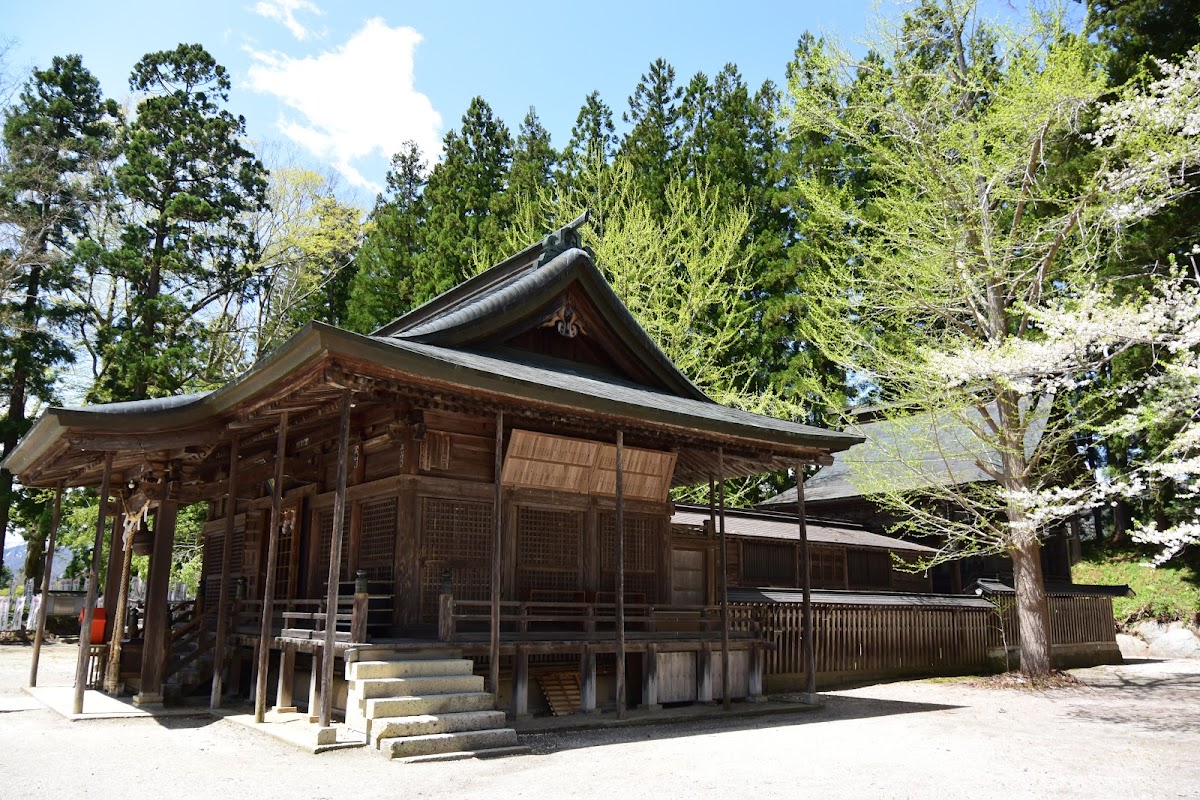
The main highlight of Ayugai Hachimangu Shrine is the main hall, which is designated as a Yamagata Prefecture Designated Tangible Cultural Property.
Construction Date: Tenpo 14 (1843)
Relocation Date: Meiji 31 (1898)
Architectural Style: Sangensha Nagare-zukuri (three-bay nagare-zukuri style)
Roof: Copper plate roofing
Structure: Solid zelkova wood construction
Architectural Features:
- 3 bays (17.3 shaku), 2 bays (11.3 shaku)
- 3 bays (17.3 shaku), 1 bay (9.8 shaku)
- Exquisite carvings of elephants and lions on the wooden brackets of the porch
- Dynamic carvings of dragons on the beams
- Elegant carvings of phoenixes on the gable ends
This main shrine building clearly exhibits the characteristics of large shrine architecture from the late Edo period, with decorative carvings throughout. In particular, the carvings on the wooden brackets of the porch are considered a masterpiece that speaks to the high level of skill of shrine carpenters in the late Edo period. It was designated a Yamagata Prefecture Tangible Cultural Property in 1985 (Showa 60).
Shirataka Town Designated Intangible Cultural Property
At Ayugai Hachimangu Shrine, traditional Shinto rituals and festivals have been passed down to the present day, and some of them are protected as Shirataka Town’s Intangible Cultural Properties. In particular, the devotional performances such as Kagura (sacred dance) and lion dances at the annual festival are carefully preserved as a regional cultural heritage.
Integration with Ayugai Castle Ruins
The site where Ayugai Hachimangu Shrine is located is the site of the main keep (or second keep) of Ayugai Castle, and castle remains such as water moats, dry moats, and earthworks are well preserved in the surrounding area. The second keep site is a Shirataka Town designated historical site, and within the shrine grounds stands a replica model of Ayugai Castle, created as part of the 600th anniversary of the castle’s construction, along with a shrine building housing it.
The landscape, where the shrine and castle ruins are integrated, is a valuable cultural landscape that conveys a sense of historical layering.
Festivals of Ayugai Hachimangu Shrine
Annual Grand Festival
The most important festival of Ayugai Hachimangu Shrine is the Annual Grand Festival, held every year on October 10th.
Date: Every year on October 10th
Main Events:
- Mikoshi Procession
- Lion Dance Performance
- Kagura Performance
- Sumo Wrestling (held in some years)
During the Annual Grand Festival, many worshippers from the surrounding area visit, and the shrine grounds are bustling all day long. Traditional Shinto rituals are solemnly performed, and local traditional performing arts are offered, making it a place for the transmission of culture.
Annual Festivals
In addition to the Annual Grand Festival, Ayugai Hachimangu Shrine holds various festivals throughout the year.
- New Year’s Day Festival: January 1st (A festival celebrating the New Year)
- Setsubun Festival: Around February 3rd (Exorcism of evil spirits, bean-throwing)
- Prayer for a Bountiful Harvest Festival: February 17th (Praying for a bountiful harvest)
- Summer Purification Ceremony: June 30th (Purifying oneself of sins and impurities accumulated over the past six months)
- Annual Grand Festival: October 10th (The largest festival of the year)
- Harvest Festival: November 23rd (A festival of thanksgiving for the harvest)
- Year-End Purification Ceremony: December 31st (Purifying oneself of sins and impurities accumulated over the past year)
Goshuin (Shrine Seal) Information
Issuance of Goshuin
Goshuin are available at Ayugai Hachimangu Shrine.
Format of Issuance: Pre-printed Goshuin (temple/shrine stamp)
Location of Issuance: Shrine Office
Donation Fee: Usually around 300-500 yen
Goshuin are available at the shrine office on the grounds, and visitors can receive them freely. Since they are pre-printed, they are not directly inscribed in goshuin notebooks, but the carefully crafted goshuin are popular as a memento of the visit.
Goshuin Design
The goshuin of Ayugai Hachimangu Shrine features the calligraphy and red seal of “Ayugai Hachimangu,” creating a simple yet dignified design. It’s a goshuin that conveys the dignity of a shrine listed in the special register.
Prayers and Outreach Ceremonies
Prayers
Ayugai Hachimangu Shrine accepts various prayers.
Types of Prayers:
- Family Safety
- Business Prosperity
- Traffic Safety
- Protection from Evil
- Success in Exams
- Safe Childbirth
- First Shrine Visit for a Newborn
- Shichi-Go-San (7-5-3 Festival)
- Other Various Prayers
Reservations: Prayers are by reservation only. Please contact us by phone (0238-84-5233) in advance to schedule a date and time.
Off-site Ceremonies
Ayugai Hachimangu Shrine also accepts off-site ceremonies.
Types of Off-site Ceremonies:
- Groundbreaking Ceremony
- Ridgepole Raising Ceremony
- Completion Ceremony
- Shrine Altar Ceremony
- Purification Ceremony
- Other Various Ceremonies
If you wish to request an off-site ceremony, please contact the shrine office in advance to discuss the date and content.
Highlights of the Shrine Grounds
Shrine Building Layout
The grounds of Ayugai Hachimangu Shrine have a unique layout that utilizes the baileys of Ayugai Castle.
Main Buildings:
- Main Hall: A late Edo period building designated as a prefectural cultural property
- Worship Hall: A building where worshippers offer their prayers
- Shrine Office: Where Goshuin (shrine stamps) are issued and prayer requests are accepted
- Sheath Hall: A storage facility for a replica model of Ayugai Castle
Ayugai Castle Remains
The remains of Ayugai Castle are well-preserved within the shrine grounds and surrounding area.
Remains You Can See:
- Dry Moat: A deep, defensive moat
- Earthwork: An earthen wall built as part of the castle’s defensive line
- Enclosure: A flat, leveled section of the castle
- Stone Wall: Remaining stonework
The integrated landscape of the castle ruins and shrine doubles the enjoyment of a historical walk.
Ayugai Castle Reconstruction Model
This elaborate reconstruction model, created to commemorate the 600th anniversary of the construction of Ayugai Castle, is a valuable resource for understanding the castle’s appearance in its heyday. It is housed in the shrine and is open to the public during designated viewing periods.
Nearby Tourist Attractions
Highlights of Shirataka Town
When visiting Ayugai Hachimangu Shrine, we recommend also visiting other tourist attractions in Shirataka Town.
Main Tourist Attractions in Shirataka Town:
- Safflower Museum: Shirataka Town is known as a safflower producing area, and you can learn about its history here.
- Miyama Kannon-do: A Buddhist hall designated as a National Important Cultural Property.
- Shirataka Ayutake Direct Sales Center: You can purchase local specialty products.
- Shirataka Town Cultural Exchange Center: Introduces the history and culture of the region.
Shrines and Temples in the Okitama Region
The Okitama region has many other historical shrines and temples.
- Kumano Taisha (Nanyo City): One of the three Kumano shrines in Japan.
- Uesugi Shrine (Yonezawa City): A shrine dedicated to Uesugi Kenshin.
- Miyasaka Archaeological Museum (Yonezawa City): Exhibits items related to the Uesugi family.
Manners and Precautions for Visiting Shrines
Proper Etiquette for Visiting Shrines
Please observe the correct etiquette for visiting shrines.
- Bow before passing through the torii gate.
- Purify your body and mind at the water basin.
- Hold the ladle in your right hand and purify your left hand.
- Switch the ladle to your left hand and purify your right hand.
- Switch the ladle back to your right hand, receive water in your left hand, and rinse your mouth.
- Finally, hold the ladle upright and purify the handle.
- Bow twice, clap twice, and bow once in front of the main hall.
- Bow deeply twice.
- Clap your hands twice at chest height.
- Pray with all your heart.
- Finally, bow deeply once.
Notes on visiting the shrine
- Smoking is prohibited on the shrine grounds.
- Please be considerate if you are bringing a pet.
- Photography is permitted, but photography may be prohibited inside the main hall.
- Please maintain silence and be considerate of other visitors.
- Prayers require advance reservations.
Seasonal Highlights
Spring (March-May)
In spring, the cherry blossoms in the grounds of Ayugai Hachimangu Shrine are in full bloom. During the season of fresh greenery, the surrounding mountains are vibrantly green, making for a refreshing visit.
Summer (June-August)
In summer, the greenery deepens, and the shrine grounds become cool and shady. On June 30th, during the Summer Purification Ceremony, you can purify yourself of the sins and impurities accumulated over the past six months by passing through a ring of reeds.
Autumn (September-November)
Autumn is beautiful with its autumn foliage, and the shrine grounds are especially lively around October 10th, the time of the annual festival. The surrounding mountains are also adorned with autumn colors, offering a spectacular view.
Winter (December-February)
The snow-covered shrine grounds are enveloped in a solemn atmosphere. The shrine is bustling with worshippers on New Year’s Day. Visiting the shrine in the crisp winter air offers a refreshing and cleansing experience for the soul.
Ayugai Hachimangu Shrine and the Local Community
Relationship with the Parishioners
Ayugai Hachimangu Shrine has been the guardian shrine for 18 villages north of the Nogawa River since the Edo period, attracting faith from a wide area. Even today, it is supported by parishioners centered around the Ayugai district of Shirataka Town, with local residents actively involved in festivals and the maintenance of the shrine.
As a Place for Cultural Inheritance
Traditional Kagura (sacred dance) and lion dances are performed during festivals, including the annual grand festival, playing an important role in passing on the region’s traditional culture to the next generation. Children also have the opportunity to learn about the region’s history and culture by participating in the festivals.
Value as a Tourism Resource
Ayugai Hachimangu Shrine is also an important tourist resource for Shirataka Town. With its main hall designated as a prefectural cultural property, its integration with the Ayugai Castle ruins, and the legend of Minamoto no Yoshiie, it is an attractive spot for history buffs and shrine enthusiasts.
The Future of Ayugai Hachimangu Shrine
Cultural Property Protection
Protecting and passing on valuable cultural properties, including the main hall which is a prefecturally designated cultural property, is a crucial challenge for the future. Efforts to pass them on to future generations through regular repairs and preservation management are ongoing.
Contribution to Regional Revitalization
As a central hub of the local community, the shrine is expected to continue contributing to regional revitalization. Through festivals and events, it plays a role in deepening the bonds among local residents and preserving traditional culture.
Tourism Promotion
Ayugai Hachimangu Shrine also occupies an important position in promoting tourism in Shirataka Town. By widely disseminating its historical value and welcoming more worshippers and tourists, it is expected to contribute to the revitalization of the local economy.
Summary
Ayugai Hachimangu Shrine is a venerable shrine with a history of over 960 years since its founding by Minamoto no Yoshiie. It possesses many historical values, including the main hall which is a prefecturally designated cultural property, its integration with the Ayugai Castle ruins, and its deep connection with the Uesugi clan. While a prestigious shrine designated as a special shrine, it also possesses a friendly, community-oriented atmosphere, warmly welcoming visitors. You can receive Goshuin (shrine stamps) and prayers, and various festivals are held throughout the year.
When you visit Shirataka Town in Nishiokitama District, Yamagata Prefecture, be sure to visit Ayugai Hachimangu Shrine and experience its history and culture. Standing on the grounds, you will feel the weight of its long history, which dates back to the Heian period, and the deep faith of the local people.
Ayugai Hachimangu Shrine, a spiritual pillar of the community that connects the past, present, and future, will undoubtedly continue to be cherished by many people.