Complete Guide to Awa Kokubunji Temple: The Charm of a Nationally Designated Scenic Garden and the 15th Temple of the Shikoku Pilgrimage
What is Awa Kokubunji Temple?
Awa Kokubunji Temple is a Soto Zen Buddhist temple located in Yano, Kofu-cho, Tokushima City, Tokushima Prefecture. Its official name is “Yakuozan Konjōin Kokubunji,” and its principal image is Yakushi Nyorai (Medicine Buddha). As the 15th temple managed by the Shikoku 88 Temple Pilgrimage Association, it is a sacred site visited by many pilgrims.
Founded in 741 AD (Tenpyo 13), it was one of the 66 (or 68) Kokubunji temples built throughout Japan following an imperial decree issued by Emperor Shomu to establish Kokubunji temples. It is said to have been founded by the Nara period high priest Gyōki Bodhisattva, and as an imperial prayer temple for the protection of the nation, it was initially a magnificent temple boasting a temple grounds of two chō square and a seven-story pagoda.
The greatest attraction of Awa Kokubunji Temple today is its garden, which is designated a National Place of Scenic Beauty. This garden, characterized by its magnificent arrangement of standing blue stones, is particularly renowned for being highly praised by Shigemori Mirei, a leading authority on the history of Japanese gardens. Among the Kokubunji temples, one in each prefecture of Shikoku, Awa Kokubunji stands out for its exceptional garden beauty.
History of Awa Kokubunji Temple
Founding and the Nara Period
In 741 AD (Tenpyo 13), Emperor Shomu, the 45th emperor, was a devout Buddhist and ordered the construction of Kokubunji and Kokubun-niji temples throughout the country, praying for peace throughout the land, abundant harvests, national security, unity of religion and government, and the advancement of local culture. Following this imperial decree, Gyoki Bodhisattva directed the construction, and Awa Kokubunji Temple was founded.
The original Awa Kokubunji Temple was called “Hōyōzan Konjōin Kokubunji,” and it is said to have housed a statue of Shakyamuni Buddha and the Great Prajnaparamita Sutra, with the main hall enshrining the memorial tablets of Emperor Shōmu and Empress Kōmyō. The temple grounds covered an area of two square blocks, and it was a large temple complex with a seven-story pagoda.
Decline and Ruin in the Middle Ages
From the Kamakura period to the Muromachi period, Awa Kokubunji Temple gradually fell into ruin. After a period of warfare, it was particularly destroyed by fire during the Tenshō era (1573-1592) by the Chōsokabe army, losing its former magnificent complex. It is believed that many cultural artifacts and records were also lost during this period.
Reconstruction in the Edo Period
From the mid-Edo period onward, Awa Kokubunji Temple underwent a full-scale reconstruction. The current main hall and other major temple buildings were constructed during this period. Furthermore, it is believed that the garden, originally created during the Momoyama period, underwent a major renovation in the late Edo period.
Although no definitive documents remain, a comprehensive analysis of various documents suggests that the basic structure of the garden as it exists today was formed during the Azuchi-Momoyama period (1568-1603), and that a large-scale renovation was carried out in the late Edo period in conjunction with the reconstruction of the main hall.
Modern Era
The impact of the anti-Buddhist movement during the Meiji era was relatively minor, and Awa Kokubunji Temple survived. In the Showa era, the cultural value of the garden was re-evaluated, and research and studies were conducted by Shigemori Mirei and others during this period.
On March 30, 2000, the Awa Kokubunji Garden was designated a National Place of Scenic Beauty, officially recognized as an important cultural property representing Japanese garden culture. Currently, it is managed by the Shikoku 88 Temple Pilgrimage Association, ensuring appropriate preservation and public access.
Highlights of the Temple Grounds and Precincts
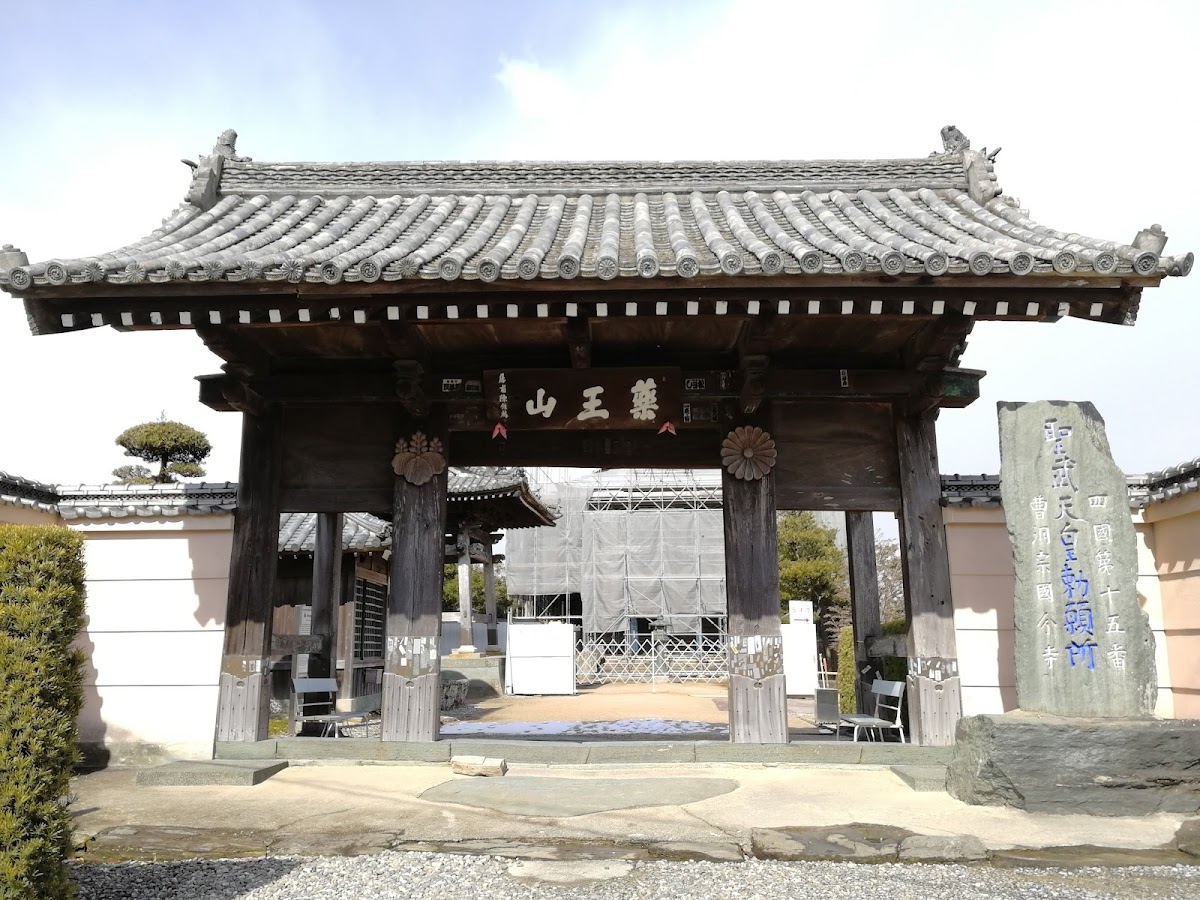
Main Gate
The main gate of Awa Kokubunji Temple has a dignified structure that welcomes visitors. Passing through the gate, a well-maintained precinct unfolds, with the main hall directly ahead and various other halls arranged around it. As a pilgrimage site of the Shikoku Pilgrimage, many pilgrims can be seen visiting in white robes.
Main Hall
The main hall houses the principal image, Yakushi Nyorai (Medicine Buddha). Rebuilt during the Edo period, the main hall has a tranquil atmosphere, allowing visitors to quietly offer their prayers. It is said that items related to Emperor Shomu and Empress Komyo are also enshrined inside the main hall.
Daishi Hall
As a pilgrimage site of the Shikoku Pilgrimage, the Daishi Hall, which enshrines Kobo Daishi (Kukai), is also an important building. It is customary for pilgrims to visit both the main hall and the Daishi Hall.
Pagoda Foundation Stone
Within the temple grounds, the foundation stone of the seven-story pagoda, originally built during the Nara period, still exists. This foundation stone is a valuable relic that evokes the magnificent temple complex of yesteryear and serves as important evidence of the Kokubunji temple site. Although the pagoda was lost in the wars of the medieval period, this foundation stone conveys the architectural techniques and scale of the temple at that time.
National Scenic Spot “Awa Kokubunji Garden”
Garden Overview
The Awa Kokubunji Garden is a pond-style garden designated as a national scenic spot in 2000. It is believed to have been created during the Momoyama period and extensively renovated in the late Edo period, occupying an important position in the history of Japanese gardens.
The most distinctive feature of this garden is its magnificent and dynamic stonework using blue stone (chlorite schist), a specialty of Tokushima Prefecture. The standing stones, arranged as if gushing from a small hill, leave a powerful impression on the viewer. Among the many Japanese gardens, Mirei Shigemori particularly valued and considered the Awa Kokubunji Garden to be of great importance.
Blue Stone Standing Arrangement
The garden is characterized by its standing stone arrangement using blue stone, which is quarried in Tokushima Prefecture. This blue stone is formally known as chlorite schist, a metamorphic rock characterized by its beautiful blue-green color and layered exfoliation properties. The standing stones, made from this material, rise powerfully at near-vertical angles, creating a dramatic landscape that seems to represent mountains.
The placement of the standing stones is meticulously calculated, maximizing the visual effect when viewed from the main hall. The stone arrangement is not merely decorative; it is also interpreted as having symbolic meaning, expressing a Buddhist worldview and cosmology.
Pond and Planting
The garden features a pond, and the water’s surface reflecting the standing stones creates a tranquil atmosphere. Trees, including pine, are planted around the pond, allowing visitors to enjoy the changing seasons. Especially during the seasons of fresh greenery and autumn leaves, the blue stones and the green and red of the plants create a beautiful contrast.
Period and Style of Garden Construction
While there are no definitive documents indicating the exact period of construction, studies of various documents by garden researchers suggest that the basic structure was formed during the Azuchi-Momoyama period (1568-1603). Later, a large-scale renovation was carried out during the reconstruction of the main hall at the end of the Edo period, resulting in the garden’s current appearance.
Stylistically, it strongly retains the characteristics of the magnificent stonework techniques of the Momoyama period, and the addition of refined Edo-period techniques gives it a unique beauty. This historical transformation further enhances the cultural value of the Awa Kokubunji Garden.
Points to Note During Your Visit
When visiting the garden, the view from in front of the main hall is considered the most beautiful. To grasp the overall structure of the standing stones, it is recommended to view it from a slightly further distance. Furthermore, observing the stonework from different angles allows you to understand the three-dimensional composition intended by the garden’s designer.
The garden is open year-round and displays different expressions in each of the four seasons. The fresh greenery of spring, the deep green of summer, the vibrant autumn foliage, and the crisp winter scenery make it worth visiting in every season.
Cultural Property
Nationally Designated Place of Scenic Beauty
Awa Kokubunji Garden was designated a National Place of Scenic Beauty on March 30, 2000. It is also registered in the Cultural Properties Online database, officially recorded as being located in Kofu-cho, Tokushima City, Tokushima Prefecture, with a designated managing organization. It is a cultural property recognized by the government as a garden of particularly outstanding artistic and historical value among Japanese gardens.
Other Cultural Properties
The foundation stone of the pagoda remaining on the temple grounds is of high historical value as a remnant from the Nara period, the time of its founding, and serves as important evidence of the Kokubunji temple site. Furthermore, the main hall and other buildings are valuable examples that convey the characteristics of Edo period temple architecture.
As the 15th Temple of the Shikoku 88 Temple Pilgrimage
Positioning as a Sacred Site
Awa Kokubunji Temple is the 15th temple of the Shikoku 88 Temple Pilgrimage, an important sacred site visited by many pilgrims. Within Tokushima Prefecture (Awa Province), there are temples 1 through 23, and Awa Kokubunji Temple is located in the middle of this list.
Preceding and Following Temples
- Temple No. 14: Jorakuji Temple
- Temple No. 15: Kokubunji Temple (This Temple)
- Temple No. 16: Kannonji Temple
On the pilgrimage route, the distance from Temple No. 14 (Jorakuji Temple) is approximately 0.8 km, and from Temple No. 16 (Kannonji Temple) is approximately 1.5 km, making it possible to complete the pilgrimage on foot.
Proper Etiquette for Visiting Temples
When visiting the Shikoku Pilgrimage sites, the general procedure is to bow at the main gate before entering the grounds and purify oneself at the water basin. Afterward, you visit the main hall and then the Daishi Hall, and receive your temple stamp (Goshuin) at the temple office. At Awa Kokubunji Temple, you can also visit the nationally designated scenic garden between your pilgrimage, making it a valuable site where you can enjoy both pilgrimage and cultural appreciation simultaneously.
Transportation Information and Access
Location
Address: Yano, Kofu-cho, Tokushima City, Tokushima Prefecture
Access by Public Transportation
- By JR: Approximately 25 minutes by Tokushima Bus from JR Tokushima Station, get off at “Kofu” bus stop, then approximately 10 minutes on foot.
- Route Bus: Use Tokushima City Bus or Tokushima Bus bound for Kofu.
Access by Car
- Approximately 15 minutes from the Aizumi IC on the Tokushima Expressway
- Approximately 20 minutes from central Tokushima City via National Route 11 and prefectural roads
- Parking: Parking space available for visitors on the temple grounds (free)
Information on Nearby Parking
As this is a pilgrimage site, it can get crowded, especially on weekends, holidays, and during the spring and autumn holiday seasons. Visiting early in the morning is recommended.
Related Historical Sites and Points of Interest in the Surrounding Area
Awa Kokubun-niji Temple Ruins
The site of the Kokubun-niji Temple, built together with the Kokubun-ji Temple, is currently being developed as a historical park. An information board has been installed at the site, allowing visitors to learn about the scale and layout of the nunnery during the Nara period. Located within walking distance of the Kokubun-ji Temple, it is an important historical site for understanding the Buddhist culture of ancient Awa Province.
Awa Provincial Government Ruins
The provincial government, the center of politics and administration in ancient Awa Province, is presumed to have been located around Kannon-ji Temple (the 16th temple on the pilgrimage) and Omiwa Shrine in Kokufu-cho. While no clear remains have been discovered, the existence of the provincial government is inferred from place names and the surrounding topography, making it an important area for ancient history research.
Kannon-ji Temple (the 16th temple on the pilgrimage)
This is the next temple on the pilgrimage, located approximately 1.5 km from Awa Kokubun-ji Temple. Located in the center of Kokufu-cho, it is a temple frequently visited by pilgrims.
Omiwa Shrine
This ancient shrine is representative of Kofu Town and has been revered as the principal shrine of the ancient Awa Province. It has deep ties to the site of the provincial capital, making it ideal for historical walks.
Points to Note and Manners When Visiting
Visiting Hours
- The temple grounds are generally open during the day, but the reception hours for the temple office are generally from 7:00 to 17:00 (may vary depending on the season).
- Garden viewing is also recommended during the same hours.
Dress Code and Manners
- Please behave quietly within the temple grounds and be considerate of other visitors.
- Entry into the garden may be prohibited; please view from designated viewing areas.
- Photography is permitted, but please check in advance regarding the use of flash and tripods.
Estimated Visiting Time
- Approximately 20-30 minutes for worship only.
- Allow about 1 hour if you wish to thoroughly appreciate the garden.
The Four Seasons of Awa Kokubunji Temple
Spring (March-May)
The temple grounds are vibrant during cherry blossom season, and the garden is beautiful with its fresh greenery. The contrast between the blue standing stones and the young leaves is striking.
Summer (June-August)
The temple grounds, enveloped in deep green, are filled with tranquility, and the garden’s greenery is at its most vibrant during this time. Early morning visits are recommended to avoid the heat.
Autumn (September-November)
The autumn foliage season is when the garden is at its most beautiful. The harmony of the blue stones and autumn leaves is exceptional, attracting many tourists.
Winter (December-February)
In the crisp air, the structure of the stone arrangements stands out even more during this season. There are relatively few visitors, allowing for quiet appreciation of the garden.
Summary
Awa Kokubunji Temple is an ancient temple with a history of nearly 1300 years since its founding in the Nara period. It has attracted many worshippers as the 15th temple of the Shikoku 88 Temple Pilgrimage. Combining its historical significance—founded by Gyoki at the behest of Emperor Shomu—with the cultural value of its nationally designated scenic garden, it is a representative temple of Tokushima Prefecture.
The magnificent standing stone arrangement using blue stones in the garden is particularly noteworthy in the history of Japanese gardens, and its high artistic merit is evident from the fact that it was highly praised by Mirei Shigemori. The unique beauty, a fusion of Momoyama period gardening techniques and Edo period renovations, continues to captivate viewers.
Whether you visit as part of the Shikoku Pilgrimage, to admire a masterpiece of Japanese garden design, or to explore ancient historical sites, Awa Kokubunji Temple is a treasure of Kofu-cho, Tokushima City, possessing diverse attractions. It is a must-see when visiting Tokushima Prefecture.