
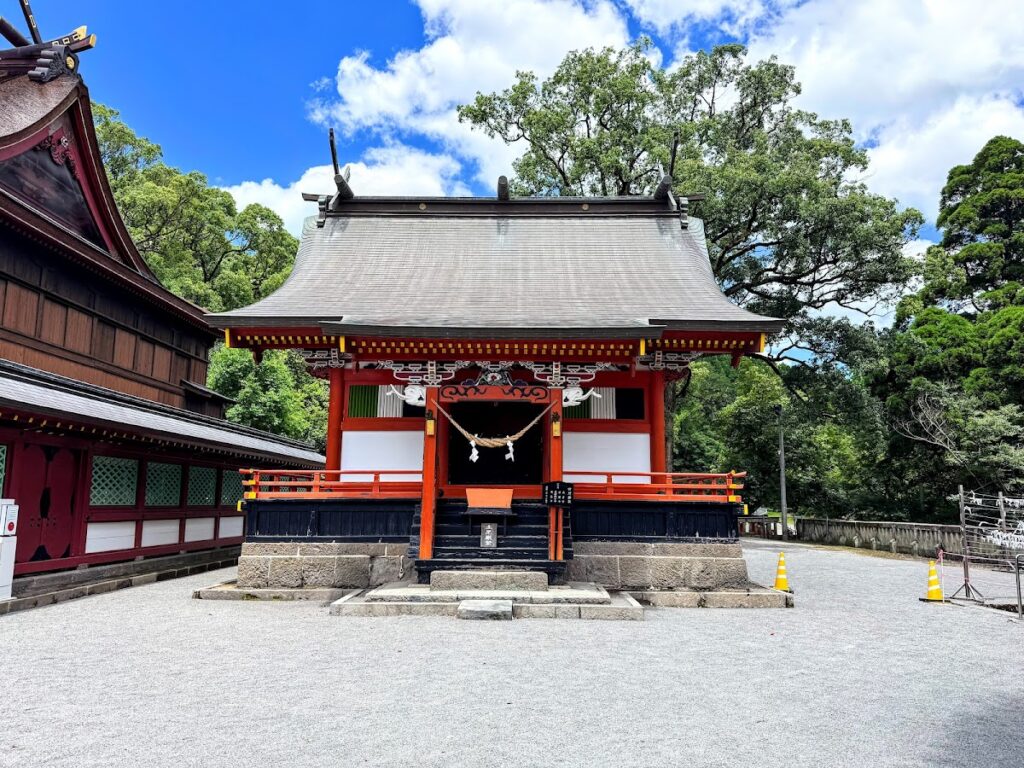
Complete Guide to Kagoshima Shrine | History, Blessings, Hatsuumasai Festival, and Access – Thorough Explanation
Located in Hayato-cho, Kirishima City, Kagoshima Prefecture, Kagoshima Shrine is a venerable shrine that has been revered since ancient times as the Ichinomiya (first-ranked shrine) of Osumi Province. Known as the site of the myth of Umisachihiko and Yamasachihiko, it has a history as the fundamental shrine of Hachiman worship, also known as “Osumi Sho Hachiman.” This article comprehensively explains everything you need to know before visiting Kagoshima Shrine, from its history and highlights to festivals and access information.
History and Origins of Kagoshima Shrine
Founding from the Age of the Gods and the Legend of Yamasachihiko
The founding of Kagoshima Shrine is said to date back to the age of the gods, and is also said to be during the reign of Emperor Jimmu, the ancestor of the imperial family. The enshrined deity is Hikohodemi-no-Mikoto, also known as Yamasachihiko, the protagonist of the Japanese myth of Umisachihiko and Yamasachihiko.
According to the myths recorded in the Kojiki and Nihon Shoki, Yamasachihiko lost a fishing hook he borrowed from his brother Umisachihiko, and went to the palace of the sea god where he married Toyotamahime. Afterward, he returned to land and, as the ancestral deity of the development of the land of Tsukushi, established Takachiho Palace (the imperial palace) in this area. It is said that he lived to the ripe old age of 580, guiding the way of agriculture, livestock farming, and fishing, and laying the foundation for stable government.
The current grounds of Kagoshima Shrine are considered to be the site of this Takachiho Palace and are revered as a sacred place of origin for the imperial ancestors.
The Engishiki Jinmyocho and the Ichinomiya of Osumi Province
The Engishiki Jinmyocho, compiled in 927 AD, lists Kagoshima Shrine as “Osumi Province’s Ichinomiya, Kagoshima Shrine,” indicating its importance as an officially recognized shrine since ancient times. As the Ichinomiya of Osumi Province, it has been positioned as the most prestigious shrine in the region.
According to shrine tradition, it was founded in 708 AD, making it an ancient shrine with a history of over 1300 years. From the medieval period onward, it was also known as “Osumi Sho Hachiman-gu” and developed as one of the centers of Hachiman worship.
Relationship with Hachiman and “Osumi Sho Hachiman”
Kagoshima Shrine is known as “Osumi Sho Hachiman” and is said to be the fundamental shrine of Hachiman shrines. As the character “Sho” (正) indicates, it occupies an important position as one of the origins of Hachiman worship that spread throughout Japan.
While Hachiman is a deity whose principal deity is Emperor Ōjin, Kagoshima Shrine has developed a unique form of worship that fuses with Hachiman faith, even though its principal deity is Yamasachihiko (Hikohohodemi-no-Mikoto). This is due to the overlapping history of the shrine as a place of worship for the ancestral deity of the Imperial family and its role as a guardian deity of the region.
Deities and Benefits
Principal Deity: Amatsuhidaka Hikohohodemi-no-Mikoto
The principal deity of Kagoshima Shrine is Amatsuhidaka Hikohohodemi-no-Mikoto, also known as Hikohohodemi-no-Mikoto or Yamasachihiko. He is the son of Ninigi-no-Mikoto, the grandson of Amaterasu Ōmikami, and the grandfather of Emperor Jimmu.
Yamasachihiko married Toyotama-hime, the daughter of the sea god, and is said to have bestowed upon people the techniques of agriculture, fishing, and animal husbandry. Therefore, he is worshipped as a god of abundant harvests, industrial development, and good fortune.
Enshrined Deity: Toyotama-hime
Enshrined alongside the main deity is Toyotama-hime. A goddess who was the daughter of the sea god and the consort of Yamasachihiko, she is revered as a goddess of safe childbirth and child-rearing.
The myth of Toyotama-hime’s childbirth is known as one of the most memorable scenes in Japanese mythology, and this legend gave rise to the belief in her as a goddess of safe childbirth.
Diverse Blessings
Kagoshima Shrine is believed to offer a variety of blessings, including:
- Abundant Harvests and Agricultural Prosperity: Based on the legend of Yamasachihiko guiding the way of agriculture.
- Fishing and Maritime Safety: As a guardian deity of the sea, due to its connection with the sea god.
- Good Fortune and Protection from Evil: The divine virtues of Yamasachihiko, who lived to the ripe old age of 580.
- Safe Childbirth and Child-Rearing: The divine virtues of Toyotama-hime no Mikoto.
- Good Relationships and Marital Harmony: As the divine couple Yamasachihiko and Toyotama-hime no Mikoto.
- Business Prosperity and Industrial Development: As the ancestral deity of the development of Osumi Province.
Due to these blessings, the shrine receives deep faith from the local people and is cherished as a shrine that grants all kinds of wishes.
Important Cultural Property Shrine Architecture
Main Hall and Worship Hall Rebuilt in 1756
The current shrine buildings of Kagoshima Jingu Shrine were constructed starting in 1755 (Horeki 5) with a donation from Shimazu Shigetoshi, the lord of the Satsuma domain, and completed in 1756 (Horeki 6) during the time of Shimazu Shigehide. They were designated as a National Important Cultural Property on February 9, 2022.
The main hall is a three-bay nagare-zukuri style building, and the worship hall is an irimoya-zukuri style building; both are elegant structures with cypress bark roofs. Located on a hill overlooking the Amorigawa River, which flows into Kagoshima Bay, in the central part of Kagoshima Prefecture, they present a majestic presence in harmony with the surrounding natural environment.
Characteristics of Edo Period Shrine Architecture
The shrine buildings of Kagoshima Jingu Shrine retain many characteristics of mid-Edo period shrine architecture, making them a valuable cultural asset demonstrating the wealth and technical prowess of the Satsuma Domain. They possess a unique beauty, a fusion of ornate decorations based on vermilion paint and architectural styles characteristic of southern Kyushu.
Besides the main hall and worship hall, the shrine grounds also include buildings such as the Imperial Messenger Hall, Kagura Hall, and shrine office, preserving the dignified layout of a shrine.
Highlights of the Shrine Grounds and Subsidiary Shrines
Shakutai Shrine, Deity of Safe Childbirth
Within the grounds of Kagoshima Jingu Shrine is the Shakutai Shrine, a subsidiary shrine particularly famous for prayers for safe childbirth. It enshrines Toyotama-hime no Mikoto and is known for its blessings of safe childbirth, fertility, and child-rearing.
At Ishitai Shrine, there has been a long-standing custom of praying for safe childbirth. Pregnant women borrow a small stone to pray for a safe delivery, and after giving birth, they return it with another stone. This custom of “borrowing and lending stones” continues to this day, and many pregnant women visit the shrine.
The Sacred Horse “Seiran-go”
One of the unique features of Kagoshima Shrine is that it houses a living sacred horse, a rarity in Japan. Currently, a white horse named “Seiran-go” is kept there, and visitors can actually see the sacred horse.
Sacred horses are considered vehicles for the gods and have been offered to shrines since ancient times. Even today, shrines that keep live horses are rare nationwide, making them a precious sight. Especially in the Year of the Horse, many visitors come to pay their respects to the sacred horse. The Year of the Horse in 2026 will be a special opportunity for worship.
Takachiho Palace Ruins and Historic Sites
The shrine grounds are believed to be the site of Takachiho Palace, built by Yamasachihiko, and are designated as a historical site as a sacred place of origin for the imperial ancestors. Stone monuments and explanatory plaques detailing the history are placed throughout the grounds, allowing visitors to experience the world of mythology while offering prayers.
Ancestral Hall and Columbarium
Kagoshima Shrine has an Ancestral Hall, a facility for enshrining the spirits of the ancestors of parishioners and devotees. A columbarium is also available, used by those who wish to perform Shinto funerals or ancestral memorial services.
Hatsuumasai Festival – Kagoshima Shrine’s Largest Festival
One of Kyushu’s Three Great Festivals
The Hatsuumasai Festival at Kagoshima Shrine is the largest festival at Kagoshima Shrine, held on the first Sunday after the 18th day of the first month of the lunar calendar. It is considered one of Kyushu’s three great festivals and attracts over 200,000 visitors every year.
Hatsuumasai Festival – Kagoshima Shrine’s Largest Festival
One of Kyushu’s Three Great Festivals
The Hatsuumasai Festival at Kagoshima Shrine is the largest festival at Kagoshima Shrine, held on the first Sunday after the 18th day of the first month of the lunar calendar. It is considered one of Kyushu’s three great festivals and attracts over 200,000 visitors annually. The Hatsuumasai Festival has ancient origins, dating back to the Shimazu clan era. It’s a deeply rooted local festival, praying for a bountiful harvest and family safety.
Bell-Hanging Horse Dance and Hamashita Procession
The highlight of the Hatsuumasai Festival is the “Bell-Hanging Horse Dance.” Dancers in colorful costumes, riding horses adorned with bells, parade through the streets, dancing to the sounds of drums and shamisen. Its splendor and grandeur are breathtaking, captivating many spectators.
The festival’s climax is the Hamashita Procession, a Shinto ritual where the portable shrine is carried to the riverbank of the Tenkōgawa River, where a purification ceremony is performed. This ritual is said to originate from the myth of Yamasachihiko returning from the sea god’s palace.
Hatsuumasai Festival in the Reiwa Era
Even in the Reiwa era, the Hatsuumasai Festival remains as lively and is positioned as an important event for preserving the region’s traditional culture. On the day of the festival, many stalls line the streets, offering local specialties and regional cuisine.
The date of the festival is determined based on the lunar calendar, so it changes every year. Those planning to visit are advised to check the official Kagoshima Shrine website for the date beforehand.
Other Festivals and Annual Events
Annual Festival (Lunar August 15th)
The annual festival of Kagoshima Shrine is held on the 15th day of the 8th month of the lunar calendar. This is the most important festival day for the shrine, and solemn religious ceremonies are performed. Because it is held according to the lunar calendar, the date changes every year in the Gregorian calendar, but it has the character of a festival of thanksgiving for a bountiful harvest, coinciding with the autumn harvest season.
Other Major Festivals
- New Year’s Day Festival: January 1st, a festival celebrating the New Year
- Setsubun Festival: Around February 3rd, prayers for protection from evil and good fortune
- Spring Grand Festival: Around the Vernal Equinox
- Summer Purification Ceremony: June 30th, purification of sins and impurities accumulated over the past six months
- Autumn Grand Festival: Around the Autumnal Equinox
- Niiname-sai Festival: November 23rd, a festival of thanksgiving for the harvest
- Year-End Purification Ceremony: December 31st, purification of sins and impurities accumulated over the past year
Information on Prayer Ceremonies
Acceptance of Various Prayers
Kagoshima Shrine accepts various prayers according to life’s milestones and wishes:
- Prayer for Safe Childbirth: Special prayers are also available at Ishitai Shrine
- First Shrine Visit: Prayers for the healthy growth of the baby
- Shichi-Go-San Pilgrimage: Expressing gratitude for a child’s growth and praying for their future health.
- Exorcism Prayer: Praying for protection from misfortune during unlucky years and for safety.
- Family Safety and Business Prosperity: Praying for the prosperity of family and business.
- Traffic Safety: Car blessings are also performed.
- Prayer for Success in Exams and Academic Achievement: Praying for success in exams and academics.
- Recovery from Illness: Praying for recovery from illness.
Prayer Reception Hours and Reservations
Prayer reception hours are usually from 8:30 AM to 5:00 PM. Reservations are not mandatory, but during festival periods such as the Hatsuumasai festival and on weekends, it is expected to be crowded, so it is recommended to contact the Kagoshima Jingu Shrine office in advance.
Kagoshima Jingu Shrine Office
Phone: 0995-42-0020
Access and Transportation
Location
Address: 2496-1 Hayato-cho, Kirishima City, Kagoshima Prefecture 899-5116
Access by Public Transportation
By JR:
- Get off at Hayato Station on the JR Nippo Main Line, approximately 15 minutes on foot
- Approximately 5 minutes by taxi from Hayato Station
By Bus:
- Approximately 40 minutes by bus from Kagoshima Airport
- Approximately 50 minutes by express bus from Kagoshima Chuo Station, get off at Hayato, approximately 15 minutes on foot
Access by Car
- Kyushu Expressway: Approximately 15 minutes from Mizobe Kagoshima Airport IC
- Higashi-Kyushu Expressway: Approximately 10 minutes from Hayato-Nishi IC
- From Kagoshima City: Approximately 40 minutes via National Route 10
Parking
Kagoshima Shrine has a free parking lot for visitors. While there is usually ample parking space, temporary parking lots are set up during busy periods such as the Hatsuumasai festival and the first three days of the New Year. However, on the day of the Hatsuumasai festival, surrounding roads become extremely congested, so the use of public transportation is recommended.
Nearby Tourist Attractions and Local Products
Highlights of the Kirishima Area
Kirishima City, where Kagoshima Shrine is located, is a naturally rich area spreading at the foot of the Kirishima mountain range. Spots to visit in conjunction with your pilgrimage:
- Kirishima Shrine: The central shrine of the six Kirishima shrines, situated on the slopes of the Kirishima mountain range.
- Kirishima Onsenkyo: A hot spring resort with diverse spring qualities.
- Takachiho-mine: A sacred mountain known as the site of the descent of the gods.
- Inukai Falls: A scenic spot located upstream of the Tenkōgawa River.
Fukuyama Black Vinegar
The Fukuyama area, about a 15-minute drive from Kagoshima Shrine, is famous as a black vinegar production area. Black vinegar made using traditional pot-making methods is known nationwide as a health food. Dining at a black vinegar restaurant or visiting a black vinegar factory is also recommended.
Hayato’s History and Culture
Hayato Town’s name originates from the ancient Hayato people, and it is dotted with historical sites and cultural properties. Uenohara Jomon Forest and Hayatozuka Historical Park are interesting spots for those interested in ancient history.
Manners and Precautions for Visiting a Shrine
Etiquette for Visiting a Shrine
- Bow before passing through the torii gate: A courtesy before entering the sacred area.
- Purify your body and mind at the water basin: Purify your left hand, right hand, and mouth in that order.
- Avoid walking in the center of the path: The center is the path of the gods.
- Etiquette at the main hall: Two bows, two claps, and one bow are the basics.
Photography
Photography is generally permitted within the shrine grounds, but please refrain from taking photos inside the main hall during prayers or during Shinto rituals. Also, please be considerate of other worshippers.
Attire
No special attire is required for a regular visit, but if you are receiving a prayer, it is preferable to wear attire that is not too casual. Especially for formal visits or special prayers, a suit or formal attire is appropriate.
Goshuin (Shrine Seals) and Items Offered
Goshuin (Shrine Seals)
Kagoshima Shrine offers goshuin as proof of worship. Applications can be made during the shrine office’s reception hours (8:30 AM to 5:00 PM). The offering fee is usually around 300 to 500 yen.
During special periods such as the Hatsuumasai festival and New Year’s, limited edition goshuin may be offered.
Main Items Offered
- Amulets: Various types for traffic safety, academic success, safe childbirth, etc.
- Sacred Talismans: Talismans to be enshrined in the home
- Ema (Votive Tablets): For writing wishes and offering them
- Hama-ya (Demon-Repelling Arrows): Auspicious items for warding off evil
- Omikuji (Fortune Slips): Fortune telling
The Four Seasons of Kagoshima Shrine
Spring (March to May)
The cherry blossoms in the shrine grounds bloom, announcing the arrival of spring. In the season of fresh greenery, the surrounding mountains are beautiful, making for a refreshing visit to the shrine.
Summer (June-August)
During the rainy season, the greenery deepens, and the summer purification ceremony cleanses away the impurities accumulated over the past six months. The shrine grounds, filled with the sound of cicadas under the summer sun, have a distinctly summery atmosphere.
Autumn (September-November)
This is the season for the annual festival, where thanks are offered for the harvest. During the autumn foliage season, the trees on the shrine grounds change color, creating a beautiful landscape.
Winter (December-February)
The year-end purification ceremony takes place, and preparations for the New Year begin. Many worshippers visit for Hatsumode (first shrine visit of the year), praying for safety in the new year. The Hatsuumasai festival in the first month of the lunar calendar is a winter tradition that enlivens the community.
Summary
Kagoshima Shrine has a long history dating back to the age of the gods, serving as the setting for the myth of Umisachihiko and Yamasachihiko, and as the Ichinomiya (first-ranked shrine) of Osumi Province. It has attracted the faith of local people throughout its long history. It boasts numerous attractions, including its important cultural property shrine buildings, a living sacred horse, the Ishitai Shrine for safe childbirth, and the Hatsuumasai Festival, one of Kyushu’s three major festivals.
It is believed to offer various blessings, such as abundant harvests, good fortune, safe childbirth, and successful relationships, making it a shrine worth visiting at various milestones in life. When visiting Kirishima City in Kagoshima Prefecture, be sure to visit Kagoshima Shrine and experience its timeless history and mythology.
Combining a visit to the nearby Kirishima Onsenkyo (hot spring resort) and Fukuyama (known for its black vinegar) will allow you to enjoy a more fulfilling Kirishima sightseeing experience.

