Gassan Shrine Complete Guide | Visiting, Access, and Opening Period of Tohoku’s Only Former Kanpei Taisha Shrine
Gassan Shrine, located on the summit of Mount Gassan (1,984m above sea level) in Yamagata Prefecture, is known as the only former Kanpei Taisha shrine in the Tohoku region. Along with Mount Haguro and Mount Yudono, it forms the Dewa Sanzan (Three Mountains of Dewa), and for over a thousand years has attracted widespread devotion from the imperial court to common people as a sacred site of Shugendo (mountain asceticism). This article comprehensively introduces the historical background of Gassan Shrine, its enshrined deities, methods of worship, climbing routes, and practical information you should know before visiting.
What is Gassan Shrine? | The Core of Dewa Sanzan Faith
Gassan Shrine is a Myojin Taisha (a major shrine) listed in the Engishiki Jinmyocho (a list of shrines compiled in the Heian period), and was recognized as an important sacred site from the Heian period onward. Under the modern shrine ranking system of the Meiji era, it was ranked as the only Kanpei Taisha in the Tohoku region, demonstrating its high status.
Mount Gassan is a semicircular aspide-type volcano with an elevation of 1,984m, possessing a globally rare topography. The Gassan Shrine main sanctuary is located at the summit, in a place called “Omuro,” and enshrines Tsukuyomi-no-Mikoto, the guardian deity. In the Kojiki (Records of Ancient Matters), Tsukuyomi-no-Mikoto is described as “the ruler of the night realm,” and has been revered as the god who governs the night and as the guardian deity of the Pure Land where the souls of the dead find peace.
The Role of Mount Gassan in the Dewa Sanzan (Three Mountains of Dewa)
In the Dewa Sanzan faith, Mount Haguro symbolizes worldly benefits, Mount Gassan symbolizes the afterlife (the past), and Mount Yudono symbolizes rebirth (the future). It is believed that visiting these three mountains grants the miraculous power of symbolic death and rebirth, and during the Edo period, pilgrimages were so popular among common people that they were referred to as “the Ise pilgrimage of the west, the Oku pilgrimage of the east.”
In Yamagata City, there remains a Gassan Gathering Monument bearing the inscription of the 7th year of the Jōji era (1368) during the Nanboku-chō period, indicating the existence of a mountain pilgrimage group of over 100 people in the village. This is valuable historical evidence showing that the Gassan faith was deeply rooted in the local community.
The Deities and History of the Faith at Gassan Shrine
Tsukuyomi-no-Mikoto
Tsukuyomi-no-Mikoto, the deity enshrined at Gassan Shrine, is an important god in Japanese mythology, considered one of the Three Noble Children along with Amaterasu-Ōmikami and Susanoo-no-Mikoto. According to the Kojiki and Nihon Shoki, he was born from Izanagi-no-Mikoto’s purification ritual and is positioned as the god who governs the night.
Tsukuyomi-no-Mikoto was also worshipped as a god of agriculture and the calendar, and was an extremely important figure for ancient people who knew the time by the phases of the moon and determined the timing of agricultural work. Furthermore, the reason Mount Gassan was revered as the “Land of the Dead” stems from ancient documents stating that Amida Buddha, the Buddha of the Land of the Dead, appeared on Mount Gassan.
Development as a Sacred Site of Shugendo
Mount Gassan has long been an object of mountain worship, and from the Heian period onward, it developed as a sacred site for Shugendo. Shugendo in the Dewa Sanzan mountains developed uniquely as the “Haguro-ha Ancient Shugendo,” and its traditions are still passed down today.
Shugendo practitioners sought to train their minds and bodies and gain supernatural powers through rigorous mountain asceticism. Mount Gassan’s rugged terrain and harsh climate conditions made it an ideal place for training, and many Shugendo practitioners undertook mountain asceticism there. The environment of Mount Gassan, where perpetual snow remains even in summer, creates an atmosphere of a sacred place far removed from the secular world.
Hiking Routes and Access to Gassan Shrine
Visiting Gassan Shrine requires hiking. The main climbing route starts from the 8th station of Mt. Gassan and is relatively safe even for beginners.
Main Route from the 8th Station of Mt. Gassan
The most common route starts from Midagahara (approximately 1,400m above sea level) at the 8th station of Mt. Gassan. Midagahara has the Gassan Otahara Pilgrimage Lodge, where climbers pray for safety before beginning their ascent.
Climbing Time: Approximately 2 hours 30 minutes to 3 hours from the 8th station to the summit
Descent Time: Approximately 2 hours
Trail Characteristics: While some sections have paved paths and wooden walkways, there are also rocky areas and snowfields.
Midagahara Marshland is designated as a national park, and in summer, you can enjoy the beautiful scenery of alpine plants in full bloom. Approximately 130 species of alpine plants, including daylilies, dwarf rhododendrons, and anemones, grow naturally here.
How to Access Mt. Gassan’s 8th Station
Using Public Transportation:
- Approximately 110 minutes by Shonai Kotsu bus bound for “Mt. Gassan’s 8th Station” from JR Tsuruoka Station
- Operates only during the climbing season (early July to mid-September)
- Buses may require reservations, so advance confirmation is necessary.
Using a Private Car:
- Approximately 45 minutes from the Yamagata Expressway “Gassan IC” to the Mt. Gassan’s 8th Station parking lot
- Parking is charged (approximately 500 yen for a regular car)
- It gets crowded on weekends and holidays, so early morning arrival is recommended.
Other Hiking Routes
Ubasawa Route: Recommended for those who are not confident in their physical fitness, as you can gain altitude using the lift.
Hijiori Route: A long course for those with strong legs.
Yudonosan Route: A course that traverses from Mt. Yudonosan (for advanced hikers).
Gassan Shrine’s Opening Period and Visiting Hours
Gassan Shrine is located at a high altitude and is closed off by deep snow during the winter, so the period during which visitors can visit is limited.
Opening Period
Gassan Shrine Main Sanctuary: July 1st – September 15th
Gassan Mitahara Shrine (8th Station): July 1st – September 23rd
The opening period may vary depending on weather conditions. Especially immediately after opening and just before closing, there is a possibility of remaining snow or early snowfall, so it is important to check the latest information.
Visiting Hours and Presence of Priests
During the opening period, priests are present at Gassan Shrine Main Sanctuary, performing prayers for visitors and granting Goshuin (shrine seals).
Visiting Hours: Approximately 6:00 AM to 4:00 PM (until sunset)
Prayer Reception Hours: Approximately 9:00 AM to 3:00 PM
Contact Information: Gassan Shrine Main Sanctuary 090-8921-9151 (during the climbing season only)
Because the weather at the summit is unpredictable, it is recommended to climb in the early morning. Clouds tend to form in the afternoon, often resulting in poor visibility, so visiting in the morning is ideal for safety reasons.
Etiquette and Precautions for Visiting Gassan Shrine
Flow of Visiting
Gassan Shrine has unique etiquette that differs from typical shrine visits.
- Preparation before entering the mountain: Pray for safety at the Gassan Mitahara Shrine at the 8th station.
- Climbing: Aim for the summit while prioritizing safety.
- After reaching the summit: First, pay the worship fee at the shrine office (500 yen).
- Purification: Receive purification from a Shinto priest.
- Worship: Proceed to the main shrine and worship with two bows, two claps, and one bow.
- Goshuin (shrine stamp): Receive a Goshuin if desired (300 yen).
Clothing and Equipment
Appropriate equipment is necessary for climbing Mount Gassan.
Essential Equipment:
- Hiking boots (trekking shoes or better)
- Rainwear (separate top and bottom)
- Warm clothing (fleece or down jacket)
- Hat, gloves
- Drinking water (1 liter or more)
- Snacks
- Headlamp
- Map and compass (or GPS)
Recommended Equipment:
- Trekking poles
- Sunscreen
- Sunglasses
- First-aid kit
- Portable toilet
Even in summer, temperatures near the summit can drop below 10 degrees Celsius, and strong winds can make it feel even colder. Adequate cold weather gear is necessary to prepare for sudden weather changes.
Dealing with Remaining Snow and Snowfields
From early to mid-July, there may be remaining snow on the hiking trails. Especially on steep snowfields, there is a risk of falling, so the following equipment and precautions are necessary.
- Lightweight crampons (6 points or more)
- Trekking poles or ice axe
- Cross snowfields carefully; if unsure, follow an experienced climber.
Attractions around Gassan Shrine
Midagahara Marshland
Midagahara Marshland, located at the 8th station of Mount Gassan, is a valuable high-altitude marshland designated as a Ramsar Convention wetland. A boardwalk is maintained, allowing you to enjoy the marshland’s nature on a roughly one-hour walk.
From July to August, the yellow flowers of the Nikko daylily cover the marshland, creating a landscape like a golden carpet. You can also observe different alpine plants depending on the season, such as the dwarf rhododendron, skunk cabbage, and cotton grass.
View from the summit of Mount Gassan
If the weather is good, a 360-degree panoramic view unfolds from the summit of Mount Gassan.
- North Side: The majestic view of Mount Chokai
- East Side: Asahi Mountain Range, Zao Mountain Range
- South Side: Iide Mountain Range
- West Side: Shonai Plain and the Sea of Japan
The sunrise in the early morning and the scenery at sunset are particularly mystical, captivating the beauty of many climbers.
Gassan Ski Resort
Gassan is known as one of the few ski resorts in Japan where “summer skiing” is possible. It operates from April to July, allowing visitors to enjoy skiing and snowboarding using the abundant remaining snow.
In early July, when the ski season and climbing season overlap, you can witness the rare sight of skiers and climbers coexisting.
Relationship with Dewa Sanzan Shrine
Gassan Shrine is positioned as part of Dewa Sanzan Shrine. Dewa Sanzan Shrine is a group of shrines centered around the Sanjin Gosaiden (Three Gods Combined Shrine) at the summit of Mount Haguro, and is a collective term including Gassan Shrine and Yudono-san Shrine.
Relationship with Mount Haguro
Mount Haguro houses the Sanjin Gosaiden, the main shrine of the Dewa Sanzan Shrines, where the three deities of Mount Haguro, Mount Gassan, and Mount Yudono are enshrined together. There is a belief that even during the winter months when it is not possible to visit Mount Gassan or Mount Yudono, visiting the Sanjin Gosaiden at Mount Haguro is equivalent to visiting all three mountains.
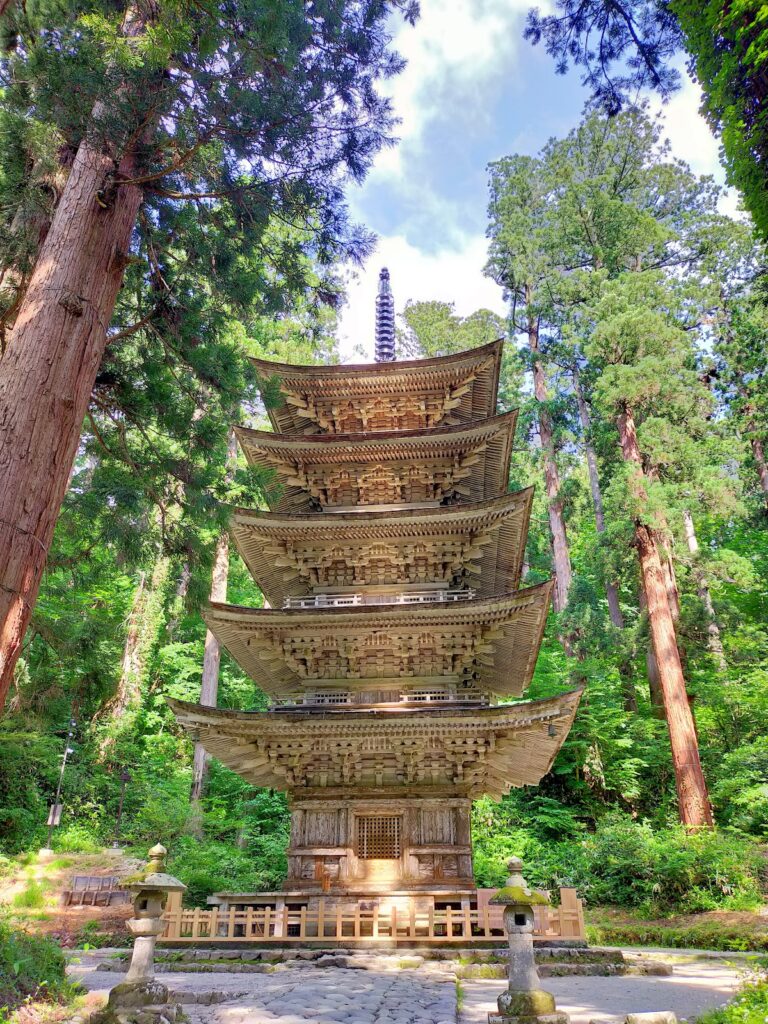
Mount Haguro is relatively easy to access, about a 30-minute drive from Tsuruoka city center, and buses also operate there. It boasts numerous attractions, including a national treasure five-story pagoda and 2,446 stone steps.
Order of Visiting the Three Mountains
Traditional pilgrimages to the three mountains recommend visiting them in the following order:
- Hagurosan (Worldly Benefits): Praying for present happiness
- Gassan (Afterlife): Ancestor worship and spiritual purification
- Yudonosan (Rebirth): Praying for a new beginning and rebirth
This order symbolizes the past, present, and future of life, and it is believed that visiting all three mountains brings complete spiritual blessings.
Historical Episodes of Visiting Gassan Shrine
Basho’s Narrow Road to the Deep North
Matsuo Basho visited the Dewa Sanzan mountains during his journey described in “The Narrow Road to the Deep North,” and also wrote about Gassan. After staying at Hagurosan, Basho climbed Gassan and composed a haiku describing his rigorous ascetic training.
“How many cloud peaks crumble, on the moonlit mountain?”
This haiku is known to express the ruggedness and mystique of Gassan.
Connection to the Imperial Family
Gassan Shrine, as a Kanpei Taisha (Grand Imperial Shrine), has received deep reverence from the Imperial Family. During the reign of Emperor Meiji, an imperial envoy was dispatched, and offerings were made. Even today, offerings from the Imperial Household Agency are sometimes made for important Shinto rituals.
Practical Advice for Visiting Gassan Shrine
Best Time to Visit
Mid-July to Early August: The time when alpine plants are at their most beautiful. However, crowds are expected.
Mid-August to Early September: Relatively uncrowded, and the weather tends to be stable.
Mid-September: You can enjoy the beginning of the autumn foliage, but temperatures are low and the weather tends to be unstable.
Accommodation
There is a lodging facility at the 8th station of Mount Gassan where you can stay overnight (reservations required). If you are planning an early morning departure or a sunrise climb, it is recommended to stay overnight the day before.
Gassan Otahara Pilgrimage Lodge
- Phone: 090-2367-9037
- Operating Period: July 1st – September 23rd
- Options include lodging only, overnight stay with two meals, etc.
Furthermore, there are numerous accommodations in Tsuruoka City and Shonai Town at the foot of the mountain, including many hot spring inns.
Safety Management
Gassan has harsh weather conditions, and accidents occur every year. Please pay attention to the following points:
- Always check the weather forecast, and cancel your climb if bad weather is expected.
- Avoid solo climbing; climb in a group whenever possible.
- Submit a climbing plan (can be submitted at the trailhead or police station).
- Plan to descend in the morning, as weather tends to deteriorate in the afternoon.
- Cell phone reception is relatively good even near the summit, but bring a spare battery.
For those who are not confident in their physical fitness
The round trip climb of Gassan takes 5-6 hours and requires a certain level of physical fitness. If you have concerns about your physical fitness, you have the following options:
- Participate in a guided tour (organized by the local tourism association)
- Train for mountain climbing regularly
- Choose the Ubasawa route, which allows access to the lift
- Visit the Sanshin Gosaiden (Three Gods’ Shrine) on Mount Haguro during the winter
Items Offered at Gassan Shrine
Gassan Shrine offers various items during the climbing season.
Goshuin (Shrine Seals)
Goshuin are available at both Gassan Shrine Honmiya and Gassan Otahara Shrine. Many visitors receive them as a memento of their climb and as proof of their faith.
Amulets and Talismans
- Mountain Climbing Safety Amulet
- Traffic Safety Amulet
- Family Safety Amulet
- Gassan Shrine Talisman
These items are cherished by visitors as they are believed to contain the sacred energy of Mount Gassan.
Summary: The Significance of Visiting Gassan Shrine
Gassan Shrine is not merely a tourist destination, but a sacred site with a history of over a thousand years. Climbing to the summit of Mount Gassan, at an altitude of 1,984 meters, and offering prayers is a valuable opportunity for spiritual cultivation even in modern times.
In the context of the Dewa Sanzan faith, Mount Gassan symbolizes the “afterlife” and is considered a place for expressing gratitude to ancestors and purifying one’s own spirit. Walking the rugged mountain trails allows one to escape the worries of everyday life and become one with nature, leading to a refreshing experience for both mind and body.
When planning a visit to Gassan Shrine, be sure to prepare thoroughly and prioritize safety, so that you can fully enjoy the precious experience that awaits you at this sacred site. Gassan Shrine, the only former Kanpei Taisha (Grand Imperial Shrine) in Tohoku, will surely give visitors a deep sense of awe and spiritual fulfillment.
The climbing season is limited, but that only makes the joy of being able to visit all the more profound. Spend a time of spiritual cleansing at Gassan Shrine, surrounded by magnificent nature, and experience the world of ancient Japanese mountain worship.