Complete Guide to Kōmineji Temple: History, Highlights, and Visiting Information for the 27th Temple of the Shikoku 88 Temple Pilgrimage
About Kōmineji Temple
Kōmineji Temple is a Shingon sect (Toyozan branch) temple located in Karahama, Yasuda-cho, Aki-gun, Kochi Prefecture. Its formal name is Chikurinzan Jizōin, and its principal image is an eleven-faced Kannon Bodhisattva. As the 27th temple of the Shikoku 88 Temple Pilgrimage, it is an important sacred site on the Tosa Road, attracting many pilgrims and visitors throughout the year.
The temple grounds spread across the mountainside of Mt. Kōmine, at an altitude of approximately 450 meters, offering a magnificent panoramic view of the Pacific Ocean. Located just below Kōmine Shrine, it has long been a place of worship where Shinto and Buddhism are syncretized.
History of Kamineji Temple
Founding and Origin
The founding of Kamineji Temple is linked to a legend concerning Empress Jingu. In 730 AD, when Gyoki Bodhisattva visited this area, he learned of an ancient legend that Empress Jingu had enshrined Amaterasu Omikami and other deities here to pray for victory during her conquest of the Three Kingdoms of Korea. He was deeply moved by this legend.
It is said that Gyoki, sensing the spiritual energy of Mount Kamine, carved an eleven-faced Kannon Bodhisattva statue in this place and enshrined it as the principal image. This is considered the beginning of Kamineji Temple, and since then, it has attracted worshippers as an ancient temple with a history of nearly 1300 years.
Connection with Kobo Daishi
During the Konin era (810-824 AD), Kobo Daishi (Kukai) is said to have visited this temple and practiced asceticism during his pilgrimage around Shikoku. The Great Master deeply revered the Eleven-Faced Kannon, the principal image of worship, and built a temple, developing it as a sacred site. Because of this connection, Kamine-ji Temple was designated as the 27th temple of the Shikoku 88 Temple Pilgrimage.
Changes Since the Middle Ages
During the Middle Ages, the temple maintained its influence under the patronage of powerful warlords in Tosa, but it temporarily declined due to the fires of war during the Sengoku period. In the Edo period, it was revived under the protection of the Tosa Domain, and with the rise of pilgrimage culture, many worshippers began to visit.
Although separated from Kamine Shrine by the Meiji-era Shinto-Buddhist Separation Order, it remains located directly below Kamine Shrine, and the two maintain a close relationship.
The Approach Known as the “Straight” Difficult Pass
One of the Most Difficult Passes on the Tosa Road
Kamine-ji Temple is known for its steep approach known as “Straight,” and has long been feared as one of the most difficult passes on the Shikoku Pilgrimage. Located on the slopes of Mt. Kamine, at an altitude of 569.9 meters, the path to the Niomon Gate is a steep climb of over one kilometer.
This arduous pilgrimage route is also known as the “Tosa Checkpoint Temple” and has been a major challenge for pilgrims on foot. It was once said that “if you can’t climb Kamine-ji Temple, you can’t walk the Tosa Road.”
The Story of Iwasaki Yataro’s Mother
A famous anecdote related to Kamine-ji Temple tells the story of the mother of Iwasaki Yataro, the founder of the Mitsubishi zaibatsu. During the late Edo period, Yataro’s mother is said to have made daily pilgrimages of approximately 20 kilometers round trip from her home to Kamine-ji Temple for 21 consecutive days to pray for her son’s success.
This mother’s devoted prayers became widely known after Yataro’s great success and are passed down as an anecdote demonstrating the miraculous power of Kamine-ji Temple. This is one of the reasons why many worshippers still visit the temple today, praying for good fortune and success in life.
Current Access
Since the road was improved in the Heisei era, it is now possible to visit the temple by car. The distance from the parking lot to the temple grounds has also been shortened, making it easier to visit than before. However, those who value the tradition of walking the pilgrimage still climb the steep stone steps to visit the temple.
Highlights of the Temple Grounds
Niomon Gate
The Niomon Gate, guarding the entrance to Kamineji Temple, is a magnificent gate standing at the top of the approach path. Impressive Kongo Rikishi statues are enshrined on either side of the gate, welcoming worshippers. Passing through this Niomon Gate, one is immediately enveloped in a sacred atmosphere.
Main Hall
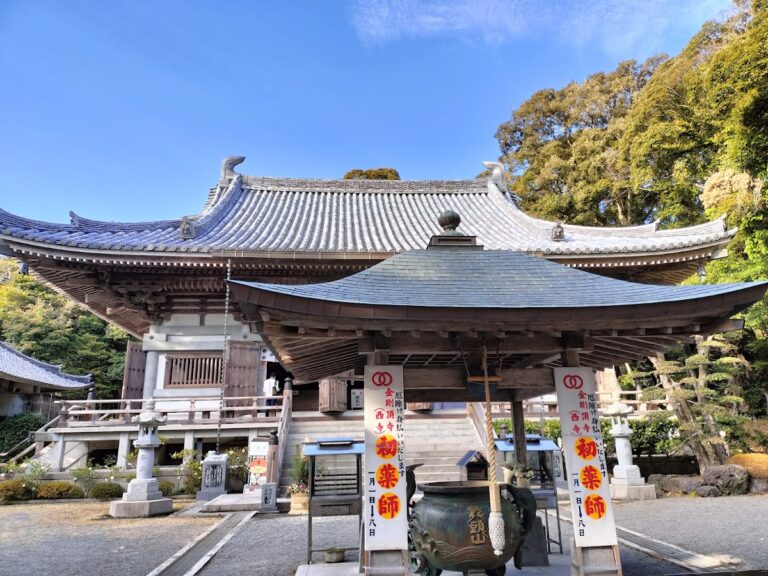
The main hall houses the principal image, the Eleven-Faced Kannon Bodhisattva. This Kannon statue, said to have been carved by Gyoki Bodhisattva, is believed to bring good fortune, heal illnesses, and especially cure eye diseases, attracting many worshippers. Standing before the main hall, a breathtaking panoramic view of the Pacific Ocean unfolds.
The interior of the main hall is filled with a solemn atmosphere, allowing visitors to quietly clasp their hands together and feel the compassion of Kannon (Goddess of Mercy).
Daishido Hall
Adjacent to the main hall stands the Daishido Hall, which houses a statue of Kobo Daishi (Kukai). On the Shikoku Pilgrimage, it is customary to visit both the main hall and the Daishido Hall at each temple. At the Daishido Hall, one prays for gratitude to Kobo Daishi and for safe passage.
Japanese Garden and Seasonal Flowers
Within the grounds of Kamineji Temple lies a beautifully maintained Japanese garden. Seasonal flowers are planted on both sides of the long stone staircase, allowing visitors to enjoy different scenery depending on the time of year.
Especially during plum blossom season, the temple grounds are covered in blooming plum blossoms, and the sound of nightingales signals the arrival of spring. Furthermore, during the autumn foliage season, the entire mountain is ablaze with color, further enhancing the beauty of the garden.
The soothing sound of water in the garden creates a tranquil space that makes you forget the hustle and bustle of the city.
Toilets dedicated to Ususama Myoo
One of the distinctive features of Kamine-ji Temple is the enshrinement of Ususama Myoo in the toilets. Ususama Myoo is known as a Buddha who purifies impurities, and there is a belief that toilets should be places of purity.
Such consideration demonstrates Kamine-ji Temple’s attention to detail and its care for its visitors.
Views and the Pacific Ocean
From the temple grounds, located at an altitude of 450 meters, you can enjoy a panoramic view of the Pacific Ocean. On a clear day, you can see all the way to the horizon, and this magnificent scenery cleanses the hearts of visitors. It’s a wonderful view that makes you forget the fatigue of climbing the steep slopes.
Relationship with Kamine Shrine
Kamine Shrine is located just above Kamine-ji Temple. This shrine is said to have originated from Empress Jingu’s enshrinement of Amaterasu Omikami, and has long formed a unified religious sphere with Kamine-ji Temple.
Until the separation of Shinto and Buddhism in the Meiji era, it was a syncretic blend of Shinto and Buddhism, and even today, the two maintain a close relationship. Many visitors visit Kamine Shrine before heading to Kamine-ji Temple, and visiting both allows one to experience the spirituality of this place more deeply.
Information on Visiting and Sutra Copying
Basic Information
- Official Name: Chikurinzan Jizoin Konomineji
- Sect: Shingon-shu Buzan-ha
- Principal Image: Eleven-faced Kannon Bodhisattva
- Founder: Gyoki Bodhisattva
- Established: Tenpyo 2 (730 AD)
- Pilgrimage Site: Shikoku 88 Temple Pilgrimage, No. 27
Sutra Copying Hours
Normally, sutra copying is accepted from 7:00 AM to 5:00 PM. However, this may change depending on the season or events, so it is recommended to check in advance.
Goshuin (Temple Seal) and Image of the Principal Image
At the sutra copying office, you can receive a Goshuin (temple seal) and an image of the principal image. The temple’s official seal (Goshuin) features the calligraphy of “Eleven-faced Kannon Bodhisattva” and a red stamp indicating “Number 27.”
Etiquette for Visiting the Temple
- Bow at the Niomon Gate before entering the temple grounds.
- Cleanse your hands and mouth at the water basin.
- At the main hall, clasp your hands together in prayer, offer your donation, and recite the sutras.
- Pray similarly at the Daishido Hall.
- Receive your temple stamp at the sutra office.
- Bow again when leaving the temple grounds.
Access and Information
Location
781-6422 Karahama, Yasuda-cho, Aki-gun, Kochi Prefecture
Access by Car
- From Kochi City: Approximately 60km east on National Route 55, about 90-100 minutes by car.
- From Nankoku IC on the Kochi Expressway: Approximately 90 minutes via National Route 55.
- From the center of Yasuda-cho: Approximately 15 minutes (climbing a mountain road).
A parking lot is available near the temple grounds, accommodating approximately 20 regular cars. However, the mountain road is narrow and steep, so extreme caution is required when driving.
Access by Public Transportation
- Tosa Kuroshio Railway: Get off at Yasuda Station
- Taxi from Yasuda Station: Approximately 15-20 minutes (approximately 3,000 yen one way)
- Walking: Approximately 10 km from Yasuda Station, approximately 3-4 hours on foot (steep mountain path)
For those walking the pilgrimage, the journey from the previous temple, No. 26 Kongōchōji, is approximately 28 km, taking approximately 8-9 hours on foot.
Pilgrimage Route Information
For those walking the pilgrimage, you will enter the mountain road from National Route 55 and climb a steep slope known as “Massate.” Those who are not confident in their physical strength are advised to use a taxi. Also, it is important to prepare by lightening your luggage and bringing plenty of water.
Nearby Attractions
Tourist Spots in Yasuda Town
- Yasuda River: Known for its clear waters, a popular spot for ayu (sweetfish) fishing.
- Yasuda Morning Market: A market selling fresh local agricultural and marine products.
- Yasuda Townscape Exchange Center “Wa”: A facility where you can learn about the history and culture of Yasuda Town.
Nearby Pilgrimage Sites
- Temple No. 26, Kongōchōji: The temple before Kōmineji Temple, located approximately 28km west.
- Temple No. 28, Dainichiji: The temple after Kōmineji Temple, located approximately 40km east.
Inner Sanctuary and Related Sacred Sites
The inner sanctuary of Kōmineji Temple is located near the summit of Mt. Kōmine. It is located further up the mountain path from the main hall and has long been used as a place for deeper spiritual training. Those with sufficient physical strength can extend their visit to the inner sanctuary to experience a deeper spiritual connection.
Annual Events
Main Ceremonies and Events
- New Year’s Day: Shushō-e (New Year’s Ceremony)
- Spring: Spring Grand Festival
- August: Segaki Ceremony
- Autumn: Autumn Grand Festival
During these events, many worshippers and local believers gather, and the temple grounds are enveloped in a special atmosphere.
Guidelines and Preparations for Visiting the Temple
Clothing and Equipment
For visiting Kamineji Temple, especially if you are walking the pilgrimage route, the following preparations are recommended:
- Comfortable Shoes: Non-slip shoes are essential for climbing steep slopes.
- Comfortable Clothing: Light clothing appropriate for the season.
- Drinking Water: Bring a sufficient amount.
- Towel: For wiping away sweat.
- Rain Gear: Mountain weather is unpredictable.
- Walking Stick: Use a Kongo-jo (staff) if you are walking the pilgrimage route.
Stamina and Time Management
The steep, vertical slopes are more physically demanding than you might imagine. It’s important not to overestimate your stamina and to climb at a comfortable pace. We recommend taking breaks as needed and visiting the temple slowly.
Faith and Benefits of Kamineji Temple
The Compassion of the Eleven-Faced Kannon
The principal image, the Eleven-Faced Kannon Bodhisattva, has eleven faces and is a Buddha that watches over and saves all sentient beings from all directions. The Eleven-Faced Kannon of Kamineji Temple is said to offer the following benefits in particular:
- Good Fortune and Prosperity: Opening up good fortune in life
- Career Advancement: Derived from the story of Iwasaki Yataro’s mother
- Healing from Illness: Particularly effective for eye diseases
- Family Safety: Health and happiness of the family
- Business Prosperity: Success in business
Significance on the Pilgrimage Route
Kamineji Temple has been considered an important checkpoint temple on the Tosa Road, a place that tests the spirit of pilgrims. Climbing the steep slopes is a place of spiritual training where one can shed worldly desires and purify their mind.
Overcoming this difficult section gives pilgrims confidence and a sense of accomplishment, providing encouragement for the remaining journey.
Accommodation Information
Nearby Temple Lodgings and Guesthouses
There are several pilgrim lodgings and guesthouses around Kamineji Temple:
- Guesthouses in Yasuda Town: Several accommodations that welcome pilgrims with a spirit of hospitality.
- Pilgrim Lodgings: Accommodations specializing in the Shikoku Pilgrimage.
Advance reservations are recommended. Also, camping (sleeping outdoors) is not recommended, so please be sure to use accommodation facilities.
Points to Note When Visiting Kamineji Temple
Safety Precautions
- Driving on Mountain Roads: Drive carefully as the roads are narrow and have many sharp curves.
- Walking Precautions: Watch your step as stone steps and slopes can be slippery.
- Check the Weather: Consider refraining from visiting in bad weather.
- Health Management: Do not overexert yourself; rest or cancel if you are feeling unwell.
Manners and Etiquette
- Quietness: Please be quiet within the temple grounds.
- Photography: Please be aware of areas where photography is prohibited, such as inside the main hall.
- Garbage: Please take all your trash with you.
- Smoking: Smoking is strictly prohibited outside of designated areas.
Cultural Assets and Architecture of Kamineji Temple
The buildings of Kamineji Temple are mainly those built or restored from the Edo period to the modern era. The main hall and Daishi Hall, while maintaining the style of traditional temple architecture, underwent large-scale restorations in the Heisei era and remain beautiful today.
The temple grounds are continuously maintained, with care taken to care for the gardens and repairs to the stone steps, ensuring that visitors can worship safely and comfortably.
Summary: The Significance of Visiting Kamineji Temple
Kamineji Temple is the 27th temple of the Shikoku 88 Temple Pilgrimage, known for its challenging “straight-up” route. Located on the slopes of Mt. Kamine at an altitude of 450 meters, it boasts a spectacular view of the Pacific Ocean and is a sacred site with a history associated with Gyoki Bodhisattva and Kobo Daishi.
The hardship of climbing the steep approach to the temple is a precious opportunity to experience the true essence of pilgrimage. The story of the devoted prayers of Iwasaki Yataro’s mother continues to give courage and hope to many people today.
While road improvements in the Heisei era have made it possible to visit by car, visiting on foot will provide a deeper experience of faith and a greater sense of accomplishment. The beautifully maintained temple grounds, the seasonal flowers, and the compassionate presence of the principal image, the Eleven-Faced Kannon Bodhisattva, offer a truly purifying experience for both mind and body.
When visiting Kochi Prefecture, be sure to stop by Kamineji Temple and experience the challenging Tosa Road firsthand. The magnificent view of the Pacific Ocean from the temple grounds will make you forget all your hardships.