
Complete Guide to Kehi Shrine: History, Benefits, and Everything You Need to Know About Visiting the Hokuriku Road’s Guardian Shrine
Kehi Shrine, located in Tsuruga City, Fukui Prefecture, is the guardian shrine of the Hokuriku Road and the Ichinomiya (first-ranked shrine) of Echizen Province, affectionately known locally as “Keisan.” With a history spanning over 2000 years, and mentioned in the Kojiki and Nihon Shoki, it is a venerable ancient shrine that attracts many worshippers.
This article comprehensively explains everything you need to know before visiting Kehi Shrine, including its history, enshrined deities, benefits, highlights within the grounds, and access methods.
What is Kehi Shrine?: The Status and History of the Guardian Shrine of the Hokuriku Road
Status as the Ichinomiya of Echizen Province
Kehi Shrine has been revered as the “Ichinomiya,” the highest-ranking shrine in Echizen Province (present-day eastern Fukui Prefecture). Listed in the Engishiki Jinmyocho (a list of shrines compiled in the Heian period) as a Shikinaisha (a shrine listed in the Engishiki), it was elevated to the rank of Kanpei Taisha (a high-ranking government-supported shrine) during the Meiji era. Currently, it is a special shrine of the Association of Shinto Shrines and is considered one of the leading shrines in the Hokuriku region.
The title of “General Guardian Shrine of the Hokuriku Road” indicates its importance as a shrine protecting the entire Hokuriku region, and it has a history of being deeply revered by the imperial court since ancient times.
History and Legends of its Founding
While the founding of Kehi Shrine is said to date back to the second year of the Taiho era (702 AD), its actual origins are believed to be even older, dating back more than 2000 years. It was formerly known as “Tsunuga Shrine” and is deeply connected to the origin of the place name Tsuruga.
The Kojiki and Nihon Shoki record its connection to Emperor Chuai, Empress Jingu, and Yamato Takeru, giving it the character of a sacred site that has continued since the age of mythology. In particular, the legend of the exchange of divine names when Emperor Chuai visited Kehi Shrine is famous, and this is said to be the origin of the shrine’s name, “Kehi.”
The Deep Connection Between Tsuruga and Kehi Shrine
Tsuruga has flourished since ancient times as an important port city on the Sea of Japan coast, serving as a gateway for exchange with the continent. Kehi Shrine has been closely intertwined with the local community as a deity protecting the safety of maritime traffic and as the tutelary deity watching over Tsuruga’s development.
Even today, locals affectionately call the shrine “Keisan,” and their faith remains deeply rooted in their lives, with visits made at important life events such as New Year’s visits, Shichi-Go-San (a traditional rite of passage for children), and exorcisms.
Deities and Divine Virtues: The Blessings Brought by the Seven Gods
Main Deity: Izasawake-no-Mikoto
The main deity of Kehi Shrine is Izasawake-no-Mikoto, also known as Kehi-no-Okami and Miketsu-no-Okami. He is revered as the god who presides over food, maritime safety, and the source of life force, and is believed to bestow blessings of abundant harvests, maritime safety, and longevity.
The Seven Deities and Their Divine Virtues
Kehi Shrine enshrines the following seven deities, including the principal deity:
- Izasawake-no-Mikoto: God of Food, Maritime Safety, Longevity
- Emperor Chuai: 14th Emperor, Long-lasting Military Fortune, National Peace and Security
- Empress Jingu: Empress of Emperor Chuai, Safe Childbirth, Child-rearing, Victory
- Yamato Takeru-no-Mikoto: Valor, Good Fortune, Protection from Evil
- Emperor Ojin: 15th Emperor, Excellence in Both Military and Cultural Arts, Industrial Development
- Tamahime-no-Mikoto: Mother of Emperor Chuai, Family Safety, Matchmaking
- Takeuchi-no-Sukune-no-Mikoto: Legendary Loyal Subject, Longevity, Success and Advancement
It is believed that the enshrinement of these seven deities together bestows a variety of blessings.
Main Benefits
The main benefits you can receive at Kehi Shrine are as follows:
- Safety at Sea and Navigation: As the guardian deity of the port town of Tsuruga
- Longevity and Good Health: The divine virtue of the Water of Longevity
- Protection from Evil and Good Fortune: Powerful protection as the guardian deity of the Hokuriku region
- Long-lasting Military Fortune and Prayer for Victory: The divine power of Yamato Takeru
- Safe Childbirth and Child-rearing: The protection of Empress Jingu
- Matchmaking and Family Safety: The divine virtue of Tamahime-no-Mikoto
- Career Advancement and Business Prosperity: The benefits of Takenouchi-no-Sukune-no-Mikoto
One of Japan’s Three Great Wooden Torii Gates: The Great Torii Gate Designated as a National Important Cultural Property
An Impressive Height of 11 Meters
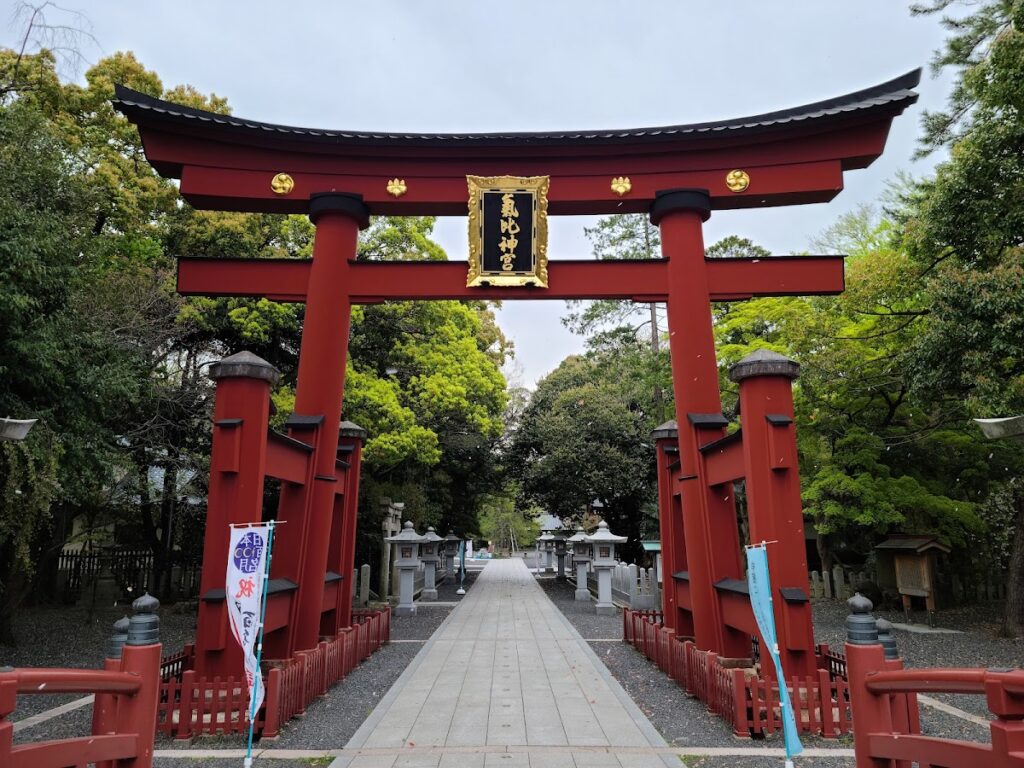
The symbol of Kehi Shrine is the Great Torii Gate that stands majestically at the entrance to the approach to the shrine. Boasting a magnificent scale of approximately 11 meters in height and 7.5 meters between pillars, its appearance is striking even from afar.
This great torii gate is counted as one of the Three Great Wooden Torii Gates of Japan, alongside those of Kasuga Taisha Shrine in Nara Prefecture and Itsukushima Shrine in Hiroshima Prefecture, and is designated as a National Important Cultural Property.
The Legend of the Sacred Tree Washed Ashore from Sado Island
An intriguing legend surrounds the construction of the great torii gate. It is said to have been built using a giant “muro” (nezuko) tree that washed ashore from Sado Island, and there is a belief that this sacred tree was brought to Tsuruga by divine will.
The current torii gate was rebuilt in 1645, and even after more than 370 years, it still maintains its majestic appearance. The beauty of its vibrant vermilion color and the warmth unique to wooden construction harmonizes with visitors and continues to captivate them.
Etiquette When Passing Through the Torii Gate
The large torii gate is the entrance to the sacred area. When passing through it, please observe the following etiquette:
- Bow before the torii gate.
- The center of the path is the path of the gods, so walk to either the left or right.
- Compose your mind before entering the shrine grounds.
Highlights and Power Spots within the Shrine Grounds
Chomeisui: Sacred Water for Longevity
Located on the east side of the shrine grounds, Chomeisui (Longevity Water) is a representative power spot of Kehi Shrine. This spring, where groundwater gushes forth, has been revered as “the water of life” since ancient times, and it is believed that drinking it brings the benefit of longevity.
There is a legend that Takeuchi no Sukune no Mikoto lived to be 300 years old thanks to this water, and visitors can freely draw and drink the water. The clear and pure water makes you feel the blessings of Tsuruga’s abundant nature.
Main Shrine and Worship Hall
The current main shrine was rebuilt in 1950. Kehi Shrine suffered significant damage during the air raids of World War II, with many buildings, including the main shrine, being destroyed. However, post-war reconstruction restored it to its current form.
The main shrine, with its cypress bark roof, embodies the beauty of traditional shrine architecture. In the worship hall, one can offer gratitude and prayers to the seven deities.
Dokou
Within the shrine grounds is a place called “Dokou,” which is also considered an important power spot. Dokou is a place where the god of the land is enshrined, and it is believed that one can feel the energy of the earth there.
Sarutahiko Shrine
Sarutahiko Shrine, one of the shrines within the grounds, enshrines Sarutahiko-no-Okami, the god of opening paths. It is said to be a good place to visit when you want to forge a new path in life or pray for safe travels.
Matsuo Basho’s Haiku Monument
Kehi Shrine appears in Matsuo Basho’s “Oku no Hosomichi” (The Narrow Road to the Deep North). Basho visited Tsuruga in 1689 (Genroku 2) and paid his respects at Kehi Shrine. Within the shrine grounds is a haiku monument to Basho, and “Keino Myojin (Kehi Shrine grounds)” is designated as a “scenic spot from Oku no Hosomichi.”
The moon is clear, on the sand where the wandering monk stands.
This haiku expresses Basho’s emotion upon visiting the Kehi Shrine grounds on a moonlit night.
Annual Events and Festivals
Grand Festival (September 4th)
The most important festival of Kehi Shrine is the Grand Festival, held annually on September 4th. The portable shrine parades through the parish area, and the entire town of Tsuruga is enveloped in the excitement of the festival.
Monthly Festivals and Seasonal Festivals
Monthly festivals are held on the 1st and 15th of each month. In addition, the following festivals are held throughout the year:
- Saitansai (January 1st): A festival celebrating the New Year
- Setsubunsai (February 3rd): Bean-throwing and prayers for warding off evil
- Kinensai (February 17th): A festival praying for a bountiful harvest
- Natsukoshi no Oharae (June 30th): A purification ceremony for the sins and impurities accumulated over the past six months
- Niinamesai (November 23rd): A festival expressing gratitude for the harvest
- Toshikoshi no Oharae (December 31st): A purification ceremony for the sins and impurities accumulated over the past year
Goshuin and Amulets
Goshuin Information
In addition to regular goshuin, seasonal goshuin are also available at Kehi Shrine. They can be obtained during the shrine office’s reception hours (9:00 AM to 5:00 PM).
The prestigious Goshuin (temple/shrine seal) of Echizen Province’s Ichinomiya (first-ranked shrine) is highly popular among Goshuin collectors, and its meticulous ink writing and red seal make it a beautiful piece.
Popular Amulets and Items Offered
Kehi Shrine offers a variety of amulets:
- Longevity Amulet: An amulet for longevity imbued with the divine blessings of the Longevity Water
- Maritime Safety Amulet: Popular among those involved in shipping and fishing
- Exorcism Amulet: Powerful protection against evil from the guardian shrine of the Hokuriku region
- Traffic Safety Amulet: Protects the safety of cars and bicycles
- Academic Success Amulet: For students and those taking exams
- Matchmaking Amulet: For those wishing for a good relationship
In addition, sacred talismans and protective arrows are also offered.
Etiquette and Manners for Visiting a Shrine
Basic Etiquette for Visiting a Shrine
The following steps are followed when visiting Kehi Shrine:
- Bow at the Great Torii Gate: Prepare your mind before entering the sacred area.
- Purify yourself at the Water Basin: Purify your left hand, right hand, and mouth in that order, and finally wash the handle of the ladle.
- Walk along the Path: Avoid walking in the center.
- Bow twice, clap twice, and bow once in front of the Main Hall:
- Bow deeply twice.
- Clap your hands twice.
- Pray sincerely.
- Bow deeply once.
- Visit the Subsidiary Shrines: If time permits, visit the subsidiary shrines within the grounds.
- Drink the Water of Longevity: Drink the sacred water in prayer for long life.
Clothing and Items to Bring When Visiting a Shrine
There are no specific dress code requirements, but clean clothing that is respectful to the gods is desirable. Even in summer, avoid wearing overly revealing clothing.
If you plan to receive a Goshuin (temple/shrine stamp), bring your Goshuincho (stamp book). If you wish to take home the Chomeisui (water of longevity), bring a clean container.
Access and Visiting Information
Basic Information
- Location: 11-68 Akebono-cho, Tsuruga City, Fukui Prefecture 914-0075
- Phone: 0770-22-0794
- Visiting Hours:
- April to September: 5:00 AM to 5:00 PM
- October to March: 6:00 AM to 5:00 PM
- Closed Days: Open all year round
- Admission Fee: Free
- Parking: Available (Free, approximately 100 spaces)
Access by Train
From JR Tsuruga Station:
- Approximately 15 minutes on foot (approximately 1.2 km)
- Take the community bus “Gurutto Tsuruga Loop Bus” and get off at the “Kehi Shrine” bus stop.
The route from Tsuruga Station to Kehi Shrine is flat and you can walk through the shopping street. There are restaurants and souvenir shops along the way, so you can enjoy strolling around before and after your visit to the shrine.
Access by Car
- From Tsuruga IC on the Hokuriku Expressway: Approximately 10 minutes
- From Tsuruga Minami Smart IC on the Maizuru-Wakasa Expressway: Approximately 15 minutes
Please enter “Kehi Shrine” or the phone number “0770-22-0794” into your car navigation system.
Parking Information
Kehi Shrine has free parking for visitors. Temporary parking lots are also opened during busy periods such as New Year’s Day and the annual festival, but we recommend using public transportation whenever possible.
Nearby Tourist Attractions
Kehi Pine Grove
A scenic spot counted as one of Japan’s three great pine groves. The beautiful coastline of white sand and green pines stretches for approximately 1.5 km, making it ideal for strolls and picnics. Approximately 10 minutes by car from Kehi Shrine.
Kanazaki Shrine
A shrine that was the stage for a tragedy during the Nanboku-cho period. Also known as a famous cherry blossom viewing spot, it is bustling with many visitors in spring. It is also popular as a power spot for romantic fulfillment.
Tsuruga Red Brick Warehouse
A tourist facility utilizing red brick warehouses built during the Meiji era. It features a diorama museum and a restaurant, allowing visitors to enjoy Tsuruga’s history and food culture.
Japan Sea Fish Market
A market offering fresh seafood from the Japan Sea. Enjoy Tsuruga’s unique cuisine, such as seafood bowls and sushi. It’s also ideal for purchasing souvenirs.
Tsuruga’s Gourmet Food and Souvenirs
Recommended Gourmet Food Around Kehi Shrine
Tsuruga Ramen: Tsuruga’s soul food, characterized by its soy sauce-based pork bone broth. Many famous restaurants are scattered around Kehi Shrine.
Echizen Soba: A representative soba noodle dish of Fukui Prefecture. “Oroshi Soba,” cold soba noodles topped with plenty of grated daikon radish, is a classic.
Seafood Cuisine: Dishes using fresh seafood from the Sea of Japan. Winter Echizen crab is especially exquisite.
Sauce Katsu Don: A local specialty of Fukui Prefecture. Thinly sliced pork cutlet topped with a sweet and savory sauce.
Recommended Souvenirs
- Gyūhi Konbu: A famous confection from Tsuruga, made by wrapping gyūhi (a type of mochi) in konbu (kelp).
- Habutae Mochi: A representative Japanese confection from Fukui Prefecture.
- Heshiko: A traditional preserved food made by pickling mackerel in rice bran.
- Kombu Products: Tsuruga is famous as a center for konbu (kelp).
The Four Seasons of Kehi Shrine
Spring: Cherry Blossoms and Fresh Greenery
The shrine grounds are home to cherry trees, and in spring, pale pink blossoms bloom profusely. The beauty of the fresh greenery is exceptional, making for a refreshing visit.
Summer: Deep Greenery and Festivals
The shrine grounds, enveloped in deep greenery, offer a refreshing coolness that makes you forget the summer heat. The entire town comes alive in preparation for the annual festival in early September.
Autumn: Autumn Leaves and Moon Viewing
The trees in the shrine grounds change color, allowing you to enjoy the autumn scenery. The moon, which Basho also admired, shines beautifully in the autumn night sky.
Winter: Snowscapes and Silence
The large torii gate and shrine grounds, covered in snow, possess a dignified beauty. A quiet winter visit brings deep peace to the heart.
Summary: Points to Note When Visiting Kehi Shrine
Kehi Shrine, with a history of over 2000 years, is the Ichinomiya (first-ranked shrine) of Echizen Province and a representative shrine of the Hokuriku region. It is full of sights to see and power spots, including the large torii gate (one of Japan’s three largest wooden torii gates), the longevity-promoting water, and the diverse blessings bestowed by the seven deities.
Its convenient location within walking distance of Tsuruga Station is also a major attraction, making it a sacred place you should definitely visit when traveling in the Hokuriku region. In the warm atmosphere of this shrine, affectionately known as “Keisan” by locals, offer your prayers in peace and receive the divine blessings of the guardian deity of the Hokuriku region.
When visiting, be sure to bow at the large torii gate, purify yourself at the water basin, and follow the proper etiquette. Drinking the water of longevity and receiving a goshuin (shrine stamp) or amulet will make your visit even more fulfilling.
The rich nature and history of Tsuruga, along with the sacred atmosphere of Kehi Shrine, will surely create lasting memories.

