Complete Guide to Mikami Shrine | A Shiga Ancient Shrine Dedicating the National Treasure Main Hall and Mount Omi Fuji
Mikami Shrine, located in Mikami, Yasu City, Shiga Prefecture, is a historic shrine that enshrines Mount Mikami, affectionately known as “Omi Fuji,” as its sacred mountain. It houses numerous valuable cultural assets, including the main hall designated as a National Treasure, and the worship hall and gate tower, both designated as Important Cultural Properties, conveying the history of faith that has continued since ancient times.
This article comprehensively introduces information you should know before visiting Mikami Shrine, from its historical background and architectural highlights to visiting information and nearby tourist spots.
What is Mikami Shrine? | An Ancient Shrine with the Status of the Third Shrine of Omi Province
Mikami Shrine is a shrine located at the western foot of Mount Mikami, which stands 432 meters above sea level on the southern shore of Lake Biwa. This shrine is listed in the Engishiki Jinmyocho (a list of shrines compiled in the Heian period) as a Shikinaisha (a major shrine of high status), and is known as a prestigious shrine that receives official offerings from the imperial court during its monthly and Niiname-sai (harvest festivals).
Deity and Origin of Founding
The deity enshrined at Mikami Shrine is Ame-no-Mikage-no-Mikoto. According to shrine tradition, during the reign of Emperor Korei, the 7th emperor, Ame-no-Mikage-no-Mikoto descended to the summit of Mount Mikami, and the shrine originated when priests called Mikami-no-Hafuri worshipped him as a sacred mountain.
Ame-no-Mikage-no-Mikoto is associated with blacksmithing and iron production, and is thought to have had a deep connection to the industrial development of ancient Omi Province. The Kojiki (Records of Ancient Matters) also mentions “Mikami-no-Hafuri,” suggesting that important rituals were performed in this region from ancient times.
The Faith of Mount Mikami as a Sacred Mountain
Mount Mikami, with its beautiful conical shape, is known as “Omi Fuji” and stands out prominently in the flat Lake Biwa plain. It has been revered as a sacred mountain since ancient times, and for approximately 1,000 years, the mountain itself has been worshipped as a sacred place.
Before the current shrine buildings were constructed, the summit of Mount Mikami itself was the object of worship, retaining a strong form of mountain worship. This sacred mountain worship is a valuable example that conveys the original form of Japanese Shinto.
The Architectural Beauty of National Treasures and Important Cultural Properties
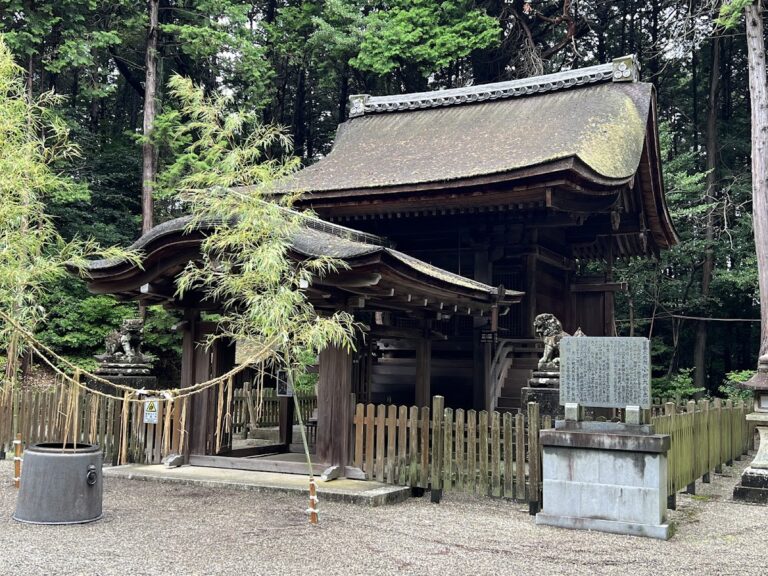
The greatest highlights of Mikami Shrine are the main hall, designated a National Treasure, and the worship hall and gate tower, designated Important Cultural Properties. Each represents an architectural style from a different era and holds extremely important value in the history of Japanese architecture.
National Treasure – Main Hall | Unique “Mikami-zukuri” Style
The main hall of Mikami Shrine is believed to have been built in the early Kamakura period (early 13th century) and was designated a National Treasure in 1952. Its most distinctive feature is its unique architectural style called “Mikami-zukuri.”
Structural Characteristics of Mikami-zukuri
Mikami-zukuri is characterized by its hip-and-gable roof with eaves at both the front and back, creating a double-layered triangular gable when viewed from the front. This style is rare and is known as the representative style of the Mikami Shrine’s main hall.
While the main hall is based on the three-bay nagare-zukuri style, it has developed uniquely by adding eaves to the rear. The roof is covered with cypress bark, and its deep, aged color creates a solemn atmosphere. The detailed carvings and brackets also show characteristics of the Kamakura period, making it a valuable historical site for architectural research.
Influence of Buddhist Architecture
One of the characteristics of the Gojōzukuri style is that, at first glance, it gives the impression of Buddhist architecture. This is thought to be an influence of the syncretism of Shinto and Buddhism that progressed during the Kamakura period, and it reflects the architectural trend of the time that incorporated temple elements into shrine architecture.
Important Cultural Property – Worship Hall
The worship hall is believed to be a building from the mid-Muromachi period and was designated a national important cultural property in 1902 (Meiji 35). While it has a simple form with a wooden veranda surrounding all four sides, it possesses a beautifully balanced proportion.
The worship hall is a place where worshippers offer prayers, and its position relative to the main shrine is carefully calculated. The interior is floored with wooden planks and plays an important role during Shinto rituals.
Important Cultural Property – Tower Gate
The tower gate, like the worship hall, is a building from the mid-Muromachi period and was designated an important cultural property in 1902. This gatehouse is a three-bay, single-entrance structure, characterized by its elegant form with a railing surrounding the upper level.
The gatehouse serves as a symbolic entrance to the shrine grounds, welcoming visitors. Its symmetrical beauty contributes to the overall landscape of the grounds.
Layout and Landscape of the Shrine Grounds
The shrine grounds are arranged with the main hall at the center, the worship hall and gatehouse in a straight line, and subsidiary shrines symmetrically positioned on either side. This symmetrical arrangement adheres to the principles of ancient shrine architecture while creating a visually harmonious and beautiful landscape.
Nestled in a deep forest along National Route 8, the shrine grounds maintain a sacred atmosphere even in today’s increasingly urbanized world.
History and Cultural Value of Mikami Shrine
Status as an Engishiki Shrine
Mikami Shrine is a Shikinaisha (a shrine listed in the Engishiki Jinmyocho, compiled in 927) listed as “Mikami Shrine, Myojin-taisha, Omi Province, Yasu District.” Myojin Taisha was a rank bestowed upon shrines considered particularly efficacious, indicating deep reverence from the imperial court.
During monthly festivals (Tsukinami-sai) and harvest festivals (Niiname-sai), the shrine received official offerings, and national-level rituals were performed. This tradition has been passed down to the present day, with various Shinto ceremonies solemnly performed throughout the year.
Status as the Third Shrine of Omi Province
Mikami Shrine is considered to have held the rank of the third shrine of Omi Province, following Takebe Taisha (Ichinomiya) and Hiyoshi Taisha (Ninomiya). As one of the centers of faith in Omi Province, it has served as a spiritual pillar for the local people.
Transition from the Medieval to the Early Modern Period
The current main hall was built during the Kamakura period, and the worship hall and gate tower were developed during the Muromachi period. While it may have suffered damage from fire during the Sengoku period, it was maintained under the patronage of the Hikone Domain during the Edo period.
Following the Meiji-era decree separating Shinto and Buddhism, the shrine was ranked as a Kanpei Chusha (a medium-ranking government-supported shrine) and held an important position under the State Shinto system. After World War II, it continued to attract local devotion as a Beppyo Jinja (a special shrine listed in the Association of Shinto Shrines).
Annual Events and Festivals
At Mikami Shrine, various Shinto rituals and festivals are held throughout the year, preserving ancient traditions.
Main Annual Events
Annual Festival (May 5th): The most important festival at Mikami Shrine, featuring ancient and elegant rituals. Many local people attend, and traditional performing arts are offered.
Niiname-sai (November 23rd): A festival expressing gratitude for a bountiful harvest, an important Shinto ritual dating back to the Engishiki era.
Hatsumode (January 1st-3rd): Many worshippers visit to welcome the New Year. The New Year at the foot of Mount Omi-Fuji has a particularly special charm.
Characteristics of the Shinto Rituals
Many of the rituals at Mikami Shrine retain ancient forms of worship, making them noteworthy from the perspective of Shinto studies. In particular, the belief in Mount Mikami as a sacred mountain embodies a uniquely Japanese religious culture, a fusion of mountain worship and Shinto.
Visiting Information and Access
Basic Information
Location: 838 Mikami, Yasu City, Shiga Prefecture
Phone Number: 077-587-0383
Visiting Hours: Grounds are freely accessible (Shrine office is open from 9:00 to 17:00)
Admission Fee: Free
Parking: Available (Free, approximately 30 spaces)
Access Methods
Access by Train and Bus
- From JR Biwako Line “Yasu Station”, take the Omi Railway bus and get off at “Mikami Jinja-mae” bus stop, then walk for approximately 5 minutes.
- Approximately 7 minutes by taxi from Yasu Station.
- Approximately 25-30 minutes on foot from Yasu Station.
Access by Car
- Approximately 15 minutes from Meishin Expressway “Ritto IC” via National Route 8.
- Approximately 20 minutes from Meishin Expressway “Ryuo IC” via National Route 8.
- Located along National Route 8, and with well-maintained signage, it’s relatively easy to find.
Points to Note When Visiting
The shrine grounds are surrounded by a deep forest, creating a mystical atmosphere, especially in the early morning and evening. While the National Treasure main hall is usually only viewable from the outside, you can observe its unique roof shape and intricate decorations up close.
The view of the main hall from the worship hall is considered the most beautiful and is a popular spot for photography. However, remember that this is a sacred place and be sure to observe proper etiquette during your visit.
Recommended Tourist Spots Around Mikami Shrine
Hiking Mount Mikami (Omi Fuji)
If you visit Mikami Shrine, we highly recommend hiking Mount Mikami. Although relatively low at 432 meters, the summit offers spectacular views of Lake Biwa and the Kotō Plain. The trailhead is near Mikami Shrine, and the round trip takes approximately 2-3 hours.
At the summit, there is an inner shrine and ancient rock formations (iwakura). This will be a valuable experience where you can feel firsthand the faith associated with the sacred mountain.
Yasushi City Historical and Folk Museum (Bronze Bell Museum)
Yasushi City is known as the site where one of Japan’s largest bronze bells (dotaku) was unearthed. The Yasushi City Historical and Folk Museum exhibits local historical materials, including the national treasure bronze bell unearthed from Mt. Oiwayama. It’s about a 10-minute drive from Mikami Shrine.
Hyōzu Taisha Shrine
Another Shikinaisha shrine located in Yasushi City, its gate tower is designated as a national important cultural property. Many people visit this shrine along with Mikami Shrine.
Ōmi Fuji Flower and Green Park
A nature park spreading at the foot of Mt. Mikami, where you can enjoy seasonal flowers and greenery. It’s also a perfect spot for a family picnic.
Gourmet Information around Mikami Shrine
Ōmi Beef Restaurants
There are several restaurants in Yasushi City where you can enjoy Ōmi beef, a representative brand of beef from Shiga Prefecture. Enjoying a luxurious Omi beef lunch after your visit is highly recommended.
Local Japanese Restaurants
There are many restaurants offering lake fish dishes utilizing the bounty of Lake Biwa, as well as local cuisine using local vegetables. Funazushi (fermented crucian carp sushi) is particularly well-known as a traditional fermented food of Shiga Prefecture.
Cafes and Sweet Shops
There are cafes where you can relax while enjoying the view of Mount Mikami, and sweet shops perfect for a break after visiting the shrine. Sweets made with locally sourced ingredients are also popular.
Visitor Trends at Mikami Shrine
Mikami Shrine is especially popular with history buffs, architecture enthusiasts, and those who enjoy visiting shrines and temples. Visitors from all over Japan flock to see the National Treasure main hall.
Best Season to Visit
Spring (March-May): The fresh greenery is beautiful, and the shrine is especially lively during the annual festival (May 5th). It’s also the perfect season for climbing Mount Mikami.
Summer (June-August): The temple grounds, surrounded by a deep forest, are relatively cool, making it a comfortable summer retreat. However, hiking requires precautions against the heat.
Autumn (September-November): The autumn foliage is beautiful, and the Niiname-sai festival (November 23rd) is held. The weather is mild, making it ideal for sightseeing.
Winter (December-February): The temple is bustling with many visitors during the New Year’s pilgrimage season. The snow-covered Mikami Mountain offers a deeply picturesque view.
Estimated Time Required
For a visit to the temple grounds only, 30 minutes to 1 hour is sufficient. If you wish to carefully observe the architecture, allow 1-2 hours. If you plan to hike Mikami Mountain, it is recommended to allocate half a day.
Other Shrines and Temples in Shiga Prefecture to Visit
Takebe Taisha Shrine (Ichinomiya of Omi Province)
The Ichinomiya of Omi Province, located near Seta no Karahashi Bridge. This shrine enshrines Yamato Takeru and is revered as a god of success and good fortune.
Hiyoshi Taisha (Second Shrine of Omi Province)
Located at the foot of Mount Hiei in Sakamoto, this is the head shrine of all Hiyoshi, Hie, and Sanno shrines nationwide. Its vast grounds contain the East and West Main Halls, both designated National Treasures.
Ishiyama-dera Temple
An ancient temple where Murasaki Shikibu is said to have written “The Tale of Genji.” Its main hall is a National Treasure, and it is also known as a scenic spot overlooking Lake Biwa.
Mii-dera Temple (Onjo-ji Temple)
The head temple of the Tendai Jimon sect, it houses numerous National Treasures and Important Cultural Properties. It also has an observation spot offering panoramic views of Lake Biwa.
Photography Tips at Mikami Shrine
Recommended Photo Spots
- View from the main gate towards the main shrine: You can enjoy a panoramic view of the beautifully symmetrical layout of the shrine grounds.
- View of the main shrine beyond the worship hall: The unique Mikami-style roof stands out.
- Side and back views of the main shrine: You can clearly see the structural features of the Mikami-style architecture, such as the eaves on the back.
- Giant trees in the shrine grounds: Large trees that tell the story of a long history are scattered throughout the grounds.
- View of Mount Mikami beyond the torii gate: A composition with the sacred mountain in the background is unique to Mikami Shrine.
Precautions when taking photos
Remember that this is a sacred place and be considerate of other worshippers. Photography is prohibited inside the main shrine. Please avoid using tripods during crowded times and only use them in a way that does not inconvenience other worshippers.
Cultural Property Preservation Activities at Mikami Shrine
Mikami Shrine, which houses national treasures and important cultural properties, is committed to the preservation and transmission of cultural properties. Regular re-roofing of the cypress bark roof and repair and preservation work on the building are carried out under the supervision of experts.
Donations from worshippers are also used for these cultural property preservation activities, and efforts to pass on Japan’s valuable cultural heritage to future generations continue.
Guidelines for Visiting Mikami Shrine
Etiquette for Worship
- Bow before passing through the torii gate
- Cleanse your hands and mouth at the water basin
- Bow twice, clap twice, and bow once in front of the main hall
- Quietly walk around the grounds and feel the atmosphere of the sacred area
- Bow once again at the torii gate on your way out
About Goshuin (Shrine Seals)
Goshuin (shrine seals) can be obtained at Mikami Shrine. They will be carefully written at the shrine office, so it is a good idea to bring your goshuincho (seal book). The offering fee is generally around 300 yen.
Summary | A World of Faith Woven from a National Treasure and a Sacred Mountain
Mikami Shrine is an extremely valuable shrine, blending the architectural value of its National Treasure main hall with the ancient faith that considers Mount Mikami a sacred mountain. Its unique architectural style, the Mikami-zukuri of the Kamakura period, is unparalleled and occupies an important position in the history of Japanese architecture.
Spending time quietly offering prayers in the shrine grounds, enveloped in a deep forest, while gazing upon the beautiful form of Mount Omi Fuji, will be a special experience away from everyday life. When visiting Shiga Prefecture, be sure to visit Mikami Shrine and experience its timeless history and culture.
It is easily accessible from National Route 8, making it ideal for day trips from Kyoto and Osaka. Combining it with a climb of Mount Mikami will allow you to enjoy an even more fulfilling Shiga sightseeing experience. Spend a soul-cleansing time at Mikami Shrine, where history, nature, and architectural beauty harmonize.