Complete Guide to Nagaoji Temple | History, Highlights, and Access Information for the 87th Temple of the Shikoku 88 Temple Pilgrimage
About Nagaoji Temple
Nagaoji Temple is an ancient Shingon Buddhist temple located in Nagao-nishi, Sanuki City, Kagawa Prefecture. Its mountain name is Fudarakusan, its temple name is Kannon-in, and its principal image is the Holy Kannon Bodhisattva. As the 87th temple of the Shikoku 88 Temple Pilgrimage, it is an important temple visited by many pilgrims.
Locally, it is affectionately known as “Nagao no Kannon-san” and is widely known as the temple where Shizuka Gozen, the beloved concubine of Minamoto no Yoshitsune, took Buddhist vows. Located facing the Nankaido, an ancient main road, it has a history of flourishing as a transportation hub.
History of Nagao-ji Temple
Founding and Early Period
Nagao-ji Temple is said to have been founded in 739 AD (Tenpyo 11). It is a historically significant temple, said to have been established by Gyoki Bodhisattva at the behest of Emperor Shomu. Gyoki carved a statue of the Holy Kannon Bodhisattva from a sacred willow tree at this location and enshrined it as the principal image.
Initially called “Nagao Kannon-do,” it was a center of Kannon worship, attracting the faith of local people. From the Nara period to the Heian period, its location along the Nankaido, an official road, meant it was bustling with many pilgrims, as recorded.
Connection with Kobo Daishi
During the Konin era (810-824), Kobo Daishi Kukai, while traveling through Shikoku, visited Nagao-ji Temple. It is said that the Daishi performed a 21-day goma (fire ritual) prayer at this site and designated it as a sacred place. At this time, Kobo Daishi is said to have worshipped the principal image, a statue of the Holy Kannon Bodhisattva, and was deeply impressed by its miraculous power.
Kobo Daishi designated Nagao-ji Temple as one of the sacred sites of the Shikoku Pilgrimage, and thereafter it developed into an important pilgrimage site. As a temple associated with Kobo Daishi, it also flourished as a training ground for Shingon Esoteric Buddhism.
Shizuka Gozen and Nagao-ji Temple
A noteworthy aspect of Nagao-ji Temple’s history is its deep connection to Shizuka Gozen, the beloved concubine of Minamoto no Yoshitsune. In 1186, after separating from Yoshitsune, Shizuka Gozen returned to Nagao in Sanuki Province, her mother’s hometown, with her mother, Iso-Zenni.
It is said that Shizuka Gozen shaved her head and became a nun at Nagao-ji Temple. The story of Shizuka Gozen, who entered the Buddhist priesthood after a tragic love affair, touched the hearts of many, and Nagao-ji Temple became widely known as “the temple associated with Shizuka Gozen.” Within the temple grounds is a burial mound dedicated to Shizuka Gozen, and it continues to attract many worshippers.
From the Medieval to the Early Modern Period
During the Kamakura period, Nagao-ji Temple flourished as one of the leading temples in Sanuki Province. The sutra tower standing in front of the gate is a valuable cultural asset that conveys the splendor of this era.
Although it was caught in the ravages of war during the Sengoku period, it recovered its strength during the Edo period under the patronage of the Ikoma and Matsudaira clans, the lords of Takamatsu Domain. Matsudaira Yorishige, in particular, was a devout follower of Nagao-ji Temple, and contributed to the repair of the temple buildings and donated temple lands.
Progress Since the Modern Period
After the Meiji Restoration, affected by the anti-Buddhist movement, the main hall of Nagao-ji Temple was temporarily used as a public facility such as a school, police station, and county office. While this contributed to the local community, it was also a difficult period for the temple.
With the revival of the Shikoku Pilgrimage during the Showa era, Nagao-ji Temple once again became bustling with visitors. Currently, as the 87th temple of the Shikoku 88 Temple Pilgrimage, it attracts many pilgrims and tourists throughout the year.
An official website has been launched, actively providing the latest information and resources to visitors. Furthermore, the temple’s main kitchen offers lunch, making it a popular place to enjoy both worship and a meal.
Nagao-ji Temple’s Buildings and Highlights
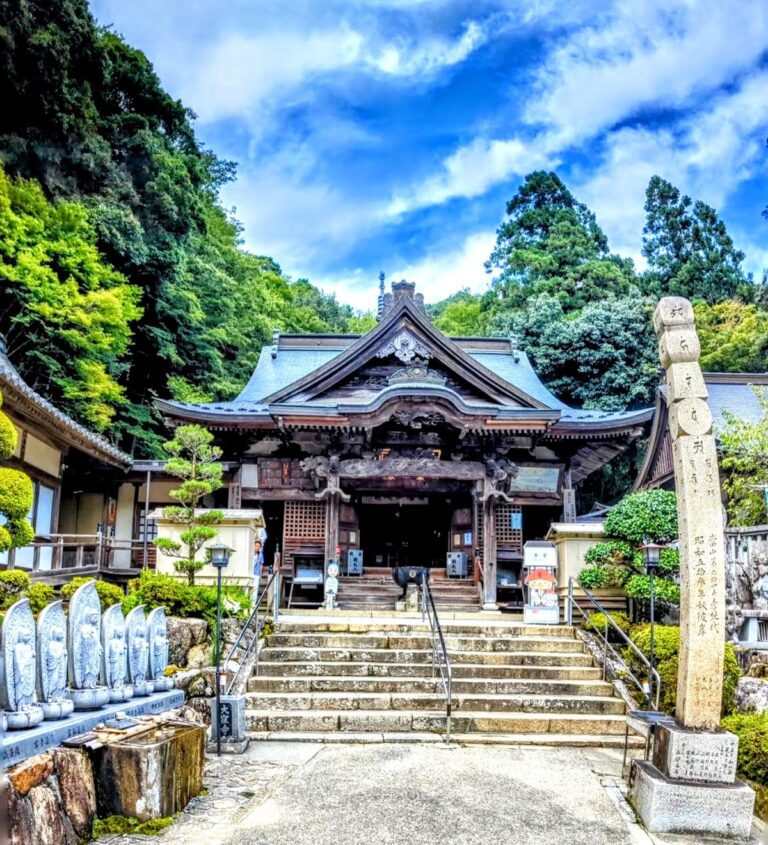
Main Hall
The main hall of Nagao-ji Temple is the central building housing the principal image, the Holy Kannon Bodhisattva. The current main hall, rebuilt during the Edo period, is a magnificent building with a hipped roof. Inside the inner sanctuary, the principal image, said to have been created by Gyoki, is enshrined as a hidden Buddha, and a smaller principal image is worshipped in front of the shrine.
The main hall houses the memorial tablets of Shizuka Gozen and her mother, Iso-Zenni, preserving the temple’s history as a place associated with Shizuka Gozen. Pilgrims offer their sutras in the main hall and chant the Heart Sutra and other sutras during their visit.
Daishi-do Hall
Located to the left of the main hall, the Daishi-do Hall enshrines a statue of Kobo Daishi. Visiting the Daishi-do Hall, along with the main hall, is considered fundamental for pilgrims, and many offer their gratitude to the Daishi and pray for safe passage.
In front of the Daishi-do Hall, there are boxes for offerings and incense burners, and it is always bustling with worshippers.
Kyodo (Sutra Tower)
The Kyodo, standing in front of the gate of Nagao-ji Temple, is a valuable stone structure designated as a National Important Cultural Property. Built in 1286 (Koan 9) during the late Kamakura period, it is a hexagonal stone tower approximately 4 meters tall.
The sutra inscriptions on the sutra tablet are from the Lotus Sutra and are important historical documents for understanding the state of Buddhist faith at the time. As a cultural artifact that tells the story of Nagao-ji Temple’s prosperity during the Kamakura period, it attracts many researchers and history enthusiasts.
Shizuka Gozen’s Hair-Shaving Mound
In a corner of the temple grounds is the Hair-Shaving Mound, where it is said that Shizuka Gozen buried her hair after shaving her head. Although a small mound, it is a place to remember Shizuka Gozen’s tragic fate, and many visitors come to offer flowers.
The story of Shizuka Gozen is a particularly moving episode in Japanese history, and this Hair-Shaving Mound is one of the important points of interest when visiting Nagao-ji Temple.
Nagao Tenjin Shrine
Adjacent to Nagao-ji Temple is Nagao Tenjin Shrine. This shrine is a Tenmangu shrine dedicated to Sugawara no Michizane, and is worshipped by local people as the god of learning. Nagao-ji Temple and Nagao Tenjin Shrine have a deep historical connection, preserving the remnants of the syncretism of Shinto and Buddhism.
Many visitors come to both Nagao-ji Temple and Nagao Tenjin Shrine, forming a unified place of worship.
Gardens and Grounds
Nagao-ji Temple’s grounds are spacious and enveloped in a quiet, peaceful atmosphere. Seasonal flowers are planted throughout the grounds, allowing visitors to enjoy the beautiful scenery of each season: cherry blossoms in spring, fresh greenery in early summer, and autumn leaves in fall.
A garden is also maintained around the main hall, allowing visitors to enjoy a leisurely stroll after their visit.
Cultural Properties of Nagao-ji Temple
Nationally Designated Important Cultural Property
Sutra Canopy
As mentioned above, the sutra canopy standing in front of the temple gate is designated as a Nationally Important Cultural Property. It is highly regarded as a masterpiece of stone art from the late Kamakura period.
Prefecturally Designated Cultural Properties
Nagao-ji Temple also houses several cultural properties designated by Kagawa Prefecture. The architectural style of the main hall and the Daishi Hall, as well as the stone structures remaining on the grounds, are recognized for their historical value.
Temple Treasures
Nagaoji Temple possesses numerous temple treasures, including the memorial tablets of Shizuka Gozen and Iso Zenni, as well as Buddhist statues, paintings, and ancient documents passed down through generations of abbots. These are usually not open to the public, but may be displayed on special occasions.
Annual Events at Nagaoji Temple
New Year’s Events
The temple is bustling with visitors for the first shrine visit of the new year. From January 1st to the third day, many visitors come to pray for good health and protection from illness in the new year.
Spring Equinox Service
During the spring equinox period, a memorial service for ancestors is held. Local parishioners gather to express gratitude and offer prayers for their ancestors.
Shizuka Gozen Memorial Service
On the anniversary of Shizuka Gozen’s death, a memorial service is held to commemorate her. Sutras are chanted in front of the burial mound, and prayers are offered for Shizuka Gozen’s peaceful repose.
Summer Segaki Ceremony
In summer, a Segaki ceremony is held to commemorate the spirits of those without relatives and ancestors. Many parishioners participate, making it a grand memorial service.
Autumn Equinox Ceremony
Similar to the spring ceremony, a memorial service for ancestors is held during the autumn equinox and the surrounding period.
New Year’s Eve and the Ringing of the Temple Bell
On New Year’s Eve, the temple bell is rung to cleanse away the worldly desires of the past year. Visitors can also ring the bell, preparing to welcome the new year.
Lunch Experience at the Main Temple Kitchen
One of the distinctive features of Nagao-ji Temple is the provision of lunch at the Main Temple Kitchen. It’s unusual for a temple to have an attached restaurant, and it’s highly regarded by visitors.
Vegetarian Cuisine and Local Ingredients
At the Main Temple Kitchen, dishes are served using local ingredients from Kagawa Prefecture, while respecting the traditions of Buddhist vegetarian cuisine. The healthy menu, centered on seasonal vegetables, offers a gentle taste for both body and mind. ### How to Use
Reservations are recommended for using the main temple’s dining hall. You can check reservation information and operating days on the official website. Enjoying a meal along with your visit to Nagao-ji Temple will make your visit even more fulfilling.
Nagao-ji Temple’s Place in the Shikoku Pilgrimage
As the 87th Temple
Nagao-ji Temple is the 87th temple of the Shikoku 88 Temple Pilgrimage, and the temple just before the final temple, the 88th temple, Okubo-ji. For pilgrims, it is a place where they truly feel that their long pilgrimage is finally coming to an end.
Pilgrimage Route and Waka Poem
The pilgrimage route from the 86th temple, Shido-ji, to Nagao-ji Temple is approximately 7 kilometers long. It is a relatively flat route, characterized by many sections walking through towns.
The waka poem for Nagao-ji Temple is “Ashibiki no yamadori no o no Nagao-ji, chant your name throughout the autumn night.” This poem, playing on the long tail feathers of a mountain bird and the name of Nagao-ji Temple, encourages chanting the name of Kannon (Goddess of Mercy) during the long autumn nights.
Sutra Copying and Temple Seal
At Nagao-ji Temple, you can receive a temple seal at the sutra copying office. The calligraphy includes the name of the principal deity, “Holy Kannon,” and the mountain name, “Fudarakusan,” while the red seal is stamped with the pilgrimage number, “No. 87.”
Access to Nagao-ji Temple
Access by Train
Using the Kotoden Nagao Line
- Approximately 3 minutes on foot from Kotoden Nagao Station
- Approximately 40 minutes from Takamatsu-Chikko Station to Kotoden Nagao Station
Kotoden Nagao Station is the closest station to Nagao-ji Temple. The temple is very close to the station, making it easily accessible on foot. There are also signs in front of the station, so you won’t get lost.
Access by Car
From Takamatsu
- Approximately 15 minutes from Shido IC on the Takamatsu Expressway
- Approximately 20 minutes via National Route 11
From Tokushima
- Head west on National Route 11 to the Nagao area of Sanuki City
Parking
Nagao-ji Temple has a free parking lot for visitors. There is space for approximately 30 regular cars, and large buses can also be parked. However, it can get crowded during peak seasons, so early arrival is recommended.
Walking the Pilgrimage Route
From Temple No. 86, Shido-ji
- Approximately 2 hours on foot (approx. 7 km)
- Relatively flat path along National Route 11
To Temple No. 88, Okubo-ji
- Approximately 4 hours on foot (approx. 15 km)
- A hilly pilgrimage route including mountain paths
Visiting Information
Basic Information
- Official Name: Fudarakusan Kannon-in Nagao-ji
- Sect: Shingon Buddhism
- Principal Image: Holy Kannon Bodhisattva
- Founder: Gyoki Bodhisattva
- Founded: Tenpyo 11 (739)
- Pilgrimage Site: 87th Temple of the Shikoku 88 Temple Pilgrimage
Visiting Hours
- Temple Grounds: Open all day
- Temple Nomu Office: 7:00 AM – 5:00 PM (Hours may vary depending on the season)
- Honbo Zensho: Reservations required (Check the official website)
Admission Fee
Admission to the temple grounds is free. The usual fee for receiving a sutra copy is 300 yen (for inscription in the sutra book).
Manners for Visiting
- Bow at the main gate before entering the grounds.
- Cleanse your hands and mouth at the water basin.
- Offer your votive slip at the main hall, and chant sutras and pray.
- Pray similarly at the Daishi Hall.
- Receive your temple stamp at the sutra office.
- Bow when leaving the main gate.
Nearby Attractions
Nagao Tenjin Shrine
As mentioned above, this Tenmangu shrine is adjacent to Nagao-ji Temple. It is worshipped as the god of learning, and many people visit both shrines.
Sanuki City Historical and Folk Museum
Located about a 5-minute drive from Nagao-ji Temple, it exhibits historical and folk materials of Sanuki City. You can also learn in detail about the history of Nagao-ji Temple.
Shido-ji Temple (Temple No. 86)
The temple just before Nagao-ji Temple. A historic temple known for the legend of the ama (female diver) retrieving the jewel, it is visited by many pilgrims.
Okubo-ji Temple (Temple No. 88)
The final temple of the Shikoku Pilgrimage. Located in the mountains about 15km from Nagao-ji Temple, it is an important temple that marks the end of the pilgrimage.
The Charm and Characteristics of Nagao-ji Temple
The Charm as a Temple Associated with Shizuka Gozen
The greatest characteristic of Nagao-ji Temple is its historical background as the temple where Shizuka Gozen took her vows. The tragic love story of Minamoto no Yoshitsune and Shizuka Gozen is deeply etched in the hearts of the Japanese people, and Nagao-ji Temple holds special significance as the place where Shizuka Gozen took refuge in the end.
Visiting the burial mound and reflecting on Shizuka Gozen’s life will be a profound experience that goes beyond mere sightseeing.
Convenient Access
Nagaoji Temple boasts exceptional accessibility, being just a 3-minute walk from Kotoden Nagao Station. Even without a car, it’s easily accessible, making it a safe and convenient place for elderly pilgrims and those with limited physical strength to visit.
Dining Experience at the Temple’s Main Kitchen
Enjoying a meal based on vegetarian cuisine at a temple is a unique feature of Nagaoji Temple. This integrated experience of worship and dining provides a deeper understanding of Buddhist culture.
A Temple Rooted in the Community
Nagaoji Temple, affectionately known as “Nagao’s Kannon-san” by the local community, is not merely a tourist destination but a living place of faith. Witnessing the daily worship of local people is another of Nagaoji Temple’s charms.
Summary
Nagaoji Temple is a venerable temple with a history of nearly 1300 years, serving as the 87th temple of the Shikoku 88 Temple Pilgrimage. With its historical significance—founded by Gyoki, designated a sacred site by Kobo Daishi, and the ordination of Shizuka Gozen—Nagao-ji Temple continues to fascinate many visitors.
Nagao-ji Temple boasts diverse attractions, including cultural assets such as the Sutra Canopy (a nationally important cultural property), the tomb of Shizuka Gozen where she had her hair shaved, and the opportunity to dine at the temple’s main kitchen. When visiting Sanuki City in Kagawa Prefecture, be sure to stop by Nagao-ji Temple and experience its history and culture.
The official website provides the latest information, event schedules, and reservation information for the main kitchen, so it’s recommended to check it before your visit. At Nagao-ji Temple, the 87th temple on the Shikoku Pilgrimage, nearing its end, you can quietly offer prayers to Kannon and reflect on your journey so far.