
Complete Guide to Nagoji Temple: History, Highlights, and Visiting Information for the Final Temple of the Bando Thirty-Three Kannon Pilgrimage
What is Nagoji Temple?: A Sacred Site Reaching the Completion of the Bando Thirty-Three Kannon Pilgrimage
Nagoji Temple is an ancient temple of the Shingon Chizan sect located in Nago, Tateyama City, Chiba Prefecture. Its mountain name is Fudarakusan, and its principal image is Senju Kannon Bodhisattva. As the 33rd temple of the Bando Thirty-Three Kannon Pilgrimage, it plays an important role as the final temple of the pilgrimage. It is affectionately known as Nago Kannon by the local people, and as the first temple of the Awa Province Thirty-Four Kannon Pilgrimage, it is known as a special sacred site where the beginning and end of the pilgrimage intersect.
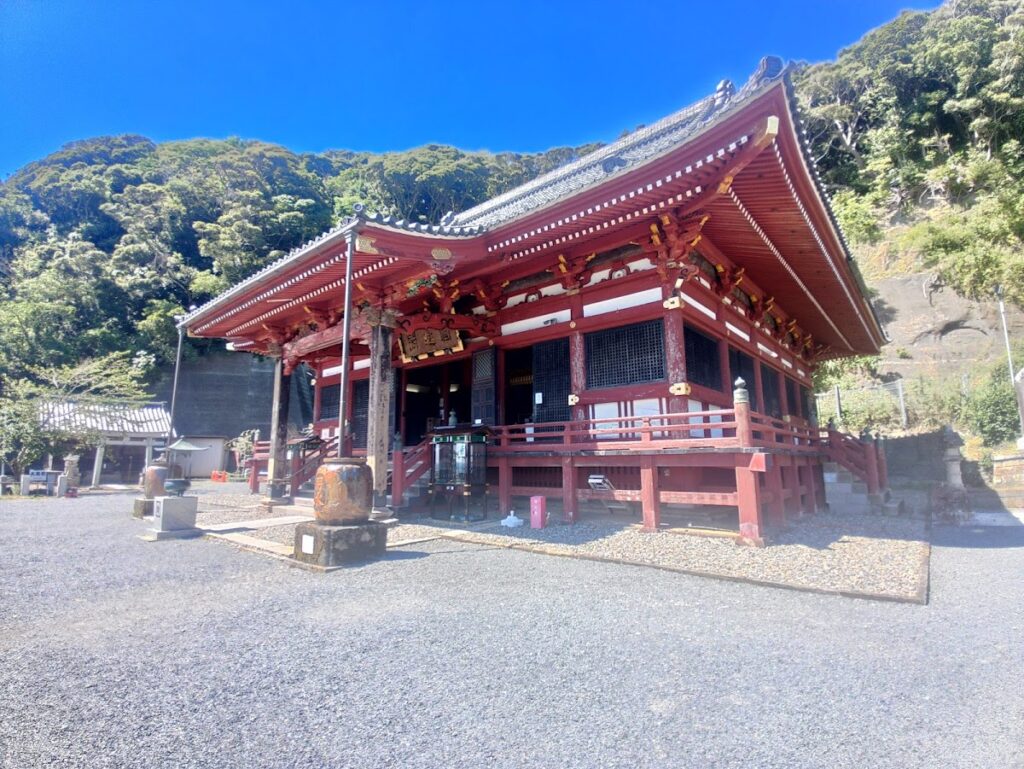
Located on the slopes of Mount Nagoyama, the temple grounds are surrounded by a rich natural forest where warm-climate trees such as Castanopsis sieboldii, Machilus thunbergii, and Camellia japonica grow together. It is said that in the Edo period, the waves of the bay reached right up to the foot of the Kannon Hall, and it was revered as a scenic and sacred place, so much so that it was recorded, “This mountain should be called Mount Fudaraku, and it is the place where Kannon manifested.”
Even today, the calm waters of Kagami-ga-ura (Tateyama Bay) can be seen from the temple grounds, and the view from the Shion-dai (Tide Sound Platform) in particular continues to captivate visitors.
History of Nagoji Temple: From its founding in the first year of the Yōrō era to the present day
Origin of the Temple and the Legend of Gyōki
Nagoji Temple is said to have been founded in the first year of the Yōrō era (717 AD). According to temple tradition, it was founded by the high-ranking priest Gyōki of the Nara period, and a dramatic story remains surrounding its founding.
In 721 AD, when Empress Gensho was suffering from a serious illness, Gyōki prayed to the Thousand-Armed Kannon Bodhisattva for her recovery. He received a divine message instructing him to pray at Nago Bay in Awa Province. Gyōki visited this location, carved a statue of the Thousand-Armed Kannon, enshrined it, and offered prayers. It is said that the Empress’s illness was immediately cured. Deeply moved by this miraculous event, Empress Genshō ordered the temple to be formally established.
This legend demonstrates that Nago-ji Temple was not merely a local temple, but a historically significant sacred site with deep ties to the imperial court.
Deep Connections with the Samurai Government
From the medieval period onward, Nago-ji Temple attracted the fervent faith of the samurai class. In particular, Minamoto no Yoritomo, who founded the Kamakura Shogunate, designated Nago-ji Temple as the final temple when establishing the Bandō Thirty-Three Kannon Pilgrimage. Yoritomo emphasized Kannon worship as the spiritual foundation for his rule over eastern Japan, and Nagoji Temple played a crucial role as a key point in that faith network.
During the Sengoku period (Warring States period), it received protection from the Satomi clan, who ruled Awa Province. The Satomi clan patronized Nagoji Temple for generations, repairing the temple buildings and donating temple lands. This connection with samurai power formed the basis for maintaining Nagoji Temple’s complex and establishing its status as a sacred site.
Prosperity in the Edo Period and its Continuation to the Present
During the Edo period, the Bando Thirty-Three Kannon Pilgrimage spread among the common people, and Nagoji Temple, as the final temple on the pilgrimage, bustled with many pilgrims. Many temple buildings were constructed during this period, forming the foundation of the temple complex seen today.
Having weathered the storm of the anti-Buddhist movement of the Meiji era, Nagoji Temple has continued to uphold its religious traditions to this day. From the Showa to the Heisei period, the temple was designated as an Important Cultural Property, and the grounds were improved, ensuring a balance between its historical value and religious function.
Highlights of the Temple Grounds: Exploring the Temple Buildings and Cultural Assets
Niomon Gate: A Powerful Gate Guarding the Approach
Upon entering the grounds of Nagoji Temple, the first thing that catches the eye is the magnificent Niomon Gate. This gate houses Kongo Rikishi statues, which ward off evil spirits and welcome visitors. Passing through the Niomon Gate, a approach lined with cherry trees leads to the main hall. In spring, the cherry blossoms are in full bloom, creating the beautiful scenery of Nagoji Temple, which is also known as a famous cherry blossom viewing spot.
Kannon-do Hall (Main Hall): The Center of Faith
Located in the center of the temple grounds, the Kannon-do Hall is the core building of faith at Nagoji Temple. Here, the principal image, a wooden statue of the Thousand-Armed Kannon, is enshrined. The hall is filled with a solemn atmosphere, and many visitors clasp their hands together, seeking the compassion of Kannon.
At the Kannon Hall, pilgrims who have completed the Bandō Thirty-Three Kannon Pilgrimage can be seen offering prayers of gratitude. The expressions of relief and joy on the faces of those who have finished their long pilgrimage are a sight unique to this place.
Tahōtō Pagoda: Beautiful Buddhist Pagoda Architecture
The most striking feature of the temple grounds is the beautiful vermilion-painted Tahōtō Pagoda. This pagoda is one of the symbolic buildings of Nagoji Temple, exhibiting an elegant form characteristic of esoteric Buddhist architecture. The Tahōtō Pagoda has a two-tiered structure, with a unique shape of a circular upper tier and a square lower tier, expressing the Buddhist worldview.
The Tahōtō Pagoda against the blue sky is a popular photo spot and a memorable scene for visitors.
Ryūōdō Hall and the Great Cycad Tree of the Main Temple
The temple grounds also contain the Ryūōdō Hall, a place of worship where people pray for maritime safety and abundant catches. It preserves a form of worship unique to Tateyama, a location close to the sea.
Furthermore, the main temple building boasts a magnificent cycad tree. This tree is said to be several hundred years old and exudes a tropical atmosphere. It symbolizes the climate and natural features of Nagoji Temple, where warm-climate plants thrive.
Chōondai: A scenic spot overlooking Kagamigaura Bay
Climbing further up the stone steps from the Kannon Hall, you arrive at an observation deck called Chōondai. From here, you can enjoy a panoramic view of Kagamigaura Bay (Tateyama Bay), and as its name suggests, the calm surface of the sea shines like a mirror, creating a breathtaking spectacle.
On clear days, you can even see Mount Fuji, and the magnificent scenery created by the sea, mountains, and sky is truly reminiscent of the Pure Land of Kannon. As the temple’s hymn, “Fudaraku is not far away; even as you gaze upon the waves crashing against the shore of Nago Temple,” suggests, one can truly feel that this place is a sacred site worthy of the name of Mount Fudaraku, the Pure Land of Kannon Bodhisattva.
Nago Mountain Walking Trail: Strolling through the Natural Forest
A walking trail is maintained behind the main hall, leading to the summit of Mount Nago. This path, through a forest of Japanese oak and Machilus thunbergii trees, offers a peaceful time surrounded by abundant nature. Forest bathing while listening to the birdsong is perfect for refreshing both mind and body.
Important Cultural Properties and Possessions
Nationally Designated Important Cultural Property: Bronze Standing Statue of the Thousand-Armed Kannon
The most valuable cultural property possessed by Nago Temple is the Bronze Standing Statue of the Thousand-Armed Kannon (Nationally Designated Important Cultural Property). This statue was created in imitation of the main image of worship and is estimated to date from the late Heian period to the early Kamakura period. Although a small statue, approximately 30 centimeters tall, it is characterized by its exquisite craftsmanship and graceful expression, making it a valuable example demonstrating the high level of Buddhist sculpture techniques of the time. The image of the Thousand-Armed Kannon, with its thousand arms, symbolizes the compassion of Kannon Bodhisattva who saves all sentient beings.
Chiba Prefecture Designated Cultural Property: Wooden Amida Buddha Statue
The Wooden Amida Buddha Statue is designated as a Chiba Prefecture Designated Tangible Cultural Property. This statue is also believed to be a work from the Heian period, and is characterized by its serene expression and graceful drapery. Amida Buddha is the principal deity of the Western Pure Land, indicating that Nagoji Temple was a place of not only Kannon worship but also Pure Land Buddhism.
Other Cultural Properties
Nagoji Temple also houses many other cultural properties. Ancient documents, Buddhist paintings, Buddhist implements, and other temple treasures accumulated over a long history speak to the religious and cultural importance of Nagoji Temple.
These cultural artifacts are not usually open to the public, but may be viewable on special occasions. Please contact the temple office for details.
The Bando Thirty-Three Kannon Pilgrimage and Nagoji Temple
What is the Bando Thirty-Three Kannon Pilgrimage?
The Bando Thirty-Three Kannon Pilgrimage is a pilgrimage route that visits 33 Kannon temples spread across the Kanto region (Bando). It is said to have been established by Minamoto no Yoritomo, modeled after the Saigoku Thirty-Three Kannon Pilgrimage, and is one of Japan’s representative Kannon pilgrimages, continuing since the Kamakura period.
It begins at Sugimoto-dera Temple (No. 1) in Kanagawa Prefecture, visits Kannon temples throughout the Kanto region, and concludes at Nagoji Temple (No. 33) in Tateyama City, Chiba Prefecture.
The Significance of Nagoji Temple as the Final Temple
A final temple is the temple visited at the end of a pilgrimage. Nagoji Temple, as the final temple of the Bandō Thirty-Three Kannon Pilgrimage, holds special significance for pilgrims.
Upon arriving at Nagoji Temple after completing their long pilgrimage, pilgrims offer prayers of gratitude at the Kannon Hall, reporting to Kannon that they have successfully completed their pilgrimage. This sense of accomplishment and relief is unique to the final temple of the pilgrimage.
Nagoji Temple bestows a special certificate of completion upon pilgrims who have reached the end of their pilgrimage. This serves as proof of completing the pilgrimage and becomes a lifelong treasure for the pilgrim.
About Goshuin (Temple Seals)
Nagoji Temple bestows Goshuin upon visitors. Goshuin are proof of worship, and their unique designs vary from temple to temple.
The Goshuin for the Bandō Thirty-Three Kannon Pilgrimage feature a different Kannon seal, the temple name, and the date of visit at each temple. The Goshuin (temple stamp) at Nagoji Temple features calligraphy of “Number 33,” “Fudarakusan,” and “Nagoji Temple,” along with a magnificent seal befitting a final pilgrimage site.
The Goshuin is available at the sutra copying office near the Kannon Hall during sutra copying hours (8:00 AM to 5:00 PM). You can bring your own Goshuincho (stamp book) or purchase one on-site.
First Temple of the Awa Province Thirty-Four Kannon Pilgrimage
Nagoji Temple is both the final temple of the Bando Thirty-Three Kannon Pilgrimage and the first temple of the Awa Province Thirty-Four Kannon Pilgrimage. This gives it a very unique position, marking both the end of one pilgrimage and the beginning of another.
Many people continue their Awa Province pilgrimage after completing the Bando Thirty-Three Kannon Pilgrimage, and Nagoji Temple warmly welcomes both types of pilgrims.
Annual Events and Prayers
Main Annual Events
Nagoji Temple holds various Buddhist events throughout the year. The main annual events include:
- First Three Days of the New Year: Many worshippers visit for Hatsumode (first shrine visit of the year)
- Setsubun Festival: Around February 3rd, events such as bean-throwing
- Spring Equinox Festival: Buddhist services centered around the spring equinox in March
- Flower Festival (Buddha’s Birthday): April 8th, events celebrating the birth of Buddha
- Obon Festival: Buddhist services during the Obon period in August
- Autumn Equinox Festival: Buddhist services centered around the autumn equinox in September
- New Year’s Eve Bell Ringing: On New Year’s Eve
Special Buddhist services are held during these events, attracting many parishioners and worshippers.
About Prayers
Nagoji Temple accepts various prayers. The Thousand-Armed Kannon Bodhisattva is a compassionate Buddha said to “save all people with a thousand hands” and to grant all wishes.
Common prayers include those for family safety, good health, recovery from illness, traffic safety, academic success, business prosperity, and finding a good partner. Those wishing to offer prayers are advised to contact the temple office in advance.
Visiting Information: Access, Visiting Hours, Parking
Basic Information
- Temple Name: Fudarakusan Nagoji Temple (Nago Kannon)
- Sect: Shingon-shu Chizan-ha
- Location: 1125 Nago, Tateyama City, Chiba Prefecture
- Phone: 0470-27-2444
- Temple Hours: 8:00 AM – 5:00 PM
- Admission Fee: Free entry to the grounds (some facilities require a fee)
Access Methods
Access by Train:
- Get off at Nagofunagata Station on the JR Uchibo Line, approximately 15 minutes on foot
- Approximately 10 minutes by taxi from Tateyama Station on the JR Uchibo Line
Access by Car:
- Approximately 10 minutes (approximately 3 km) from Tomiura IC on the Futtsu-Tateyama Expressway
- From Tokyo, it takes approximately 90 minutes via the Tokyo Bay Aqua-Line.
Parking: There is a free parking lot adjacent to the temple grounds (approximately 30 spaces for regular cars). Please note that it may be full during peak seasons such as cherry blossom season and New Year’s.
Estimated Time Required for Visiting
If you wish to visit the temple grounds at a leisurely pace, it will take approximately 30 minutes to 1 hour. Climbing to Shiondai or strolling along the Nagoyama walking trail will require more time.
Nearby Tourist Attractions
Nagoji Temple is surrounded by several tourist attractions in Tateyama City:
- Tateyama Castle (Tateyama City Museum): Approximately 10 minutes by car
- Tateyama Bay (Kagamigaura): Within walking distance of the coast
- Shiroyama Park: Famous for its cherry blossoms
- Okinoshima Island: A natural park on an uninhabited island
You can enjoy Tateyama’s rich nature and history in conjunction with your visit to Nagoji Temple.
The Four Seasons of Nagoji Temple: Seasonal Charms
Spring: A Famous Cherry Blossom Spot
Nagoji Temple’s approach is known as a famous cherry blossom spot. From late March to early April, the cherry trees planted on both sides of the stone steps leading from the Niomon Gate to the Kannon Hall bloom all at once.
Visiting Nagoji Temple in spring, passing through a tunnel of cherry blossoms, is exceptionally beautiful. The contrast between the Tahoto Pagoda and the cherry blossoms is also magnificent, attracting many photography enthusiasts.
Summer: Lush Green Natural Forest
In summer, Nagoji Temple is covered in lush green evergreen broad-leaved trees such as Castanopsis sieboldii and Machilus thunbergii, creating cool shade. Walking along the Nagoyama walking trail, you can enjoy a peaceful time in nature while experiencing forest bathing.
From Shiondai, you can enjoy a spectacular view of Kagamigaura, with its vast blue summer sea.
Autumn: Autumn Leaves and Tranquility
In autumn, some of the trees on the temple grounds change color, creating a tranquil atmosphere for worship. While there aren’t many spectacular autumn leaves due to the abundance of evergreen trees, this allows for a quieter, more refined autumnal ambiance.
During the autumn equinox, many people visit to pay respects to their ancestors, creating a solemn atmosphere.
Winter: Mild Climate of Southern Boso
Nagoji Temple, located in Southern Boso, enjoys a relatively mild climate even in winter. The blooming camellias and the lush green leaves of warm-climate plants create a vibrant, tropical atmosphere even in winter.
The view of Mount Fuji from the Shiondai observation deck in the crisp winter air is particularly beautiful and deeply moving for visitors.
Etiquette and Manners for Visiting Nagoji Temple
Basic Etiquette for Visiting
- Bow at the Niomon Gate: Before entering the temple grounds, bow at the Niomon Gate to compose yourself.
- Purify at the Water Basin: Purify your hands and mouth before praying.
- Pray at the Kannon Hall: Offer your donation and quietly clasp your hands together in prayer.
- Receive a Goshuin (Temple Stamp): After praying, receive a Goshuin at the temple office.
- Stroll around the Temple Grounds: Visit the temple grounds to see the sights, such as the Tahoto Pagoda and the Chōondai (Chōon-dai).
Regarding Photography
Photography is generally permitted on the temple grounds, but please note the following:
- Photography inside halls is generally prohibited.
- Please be considerate of other visitors.
- Use a tripod only after assessing the surrounding circumstances.
- Photography of Buddhist statues and cultural artifacts may be restricted.
Regarding Attire
While there are no specific dress code requirements, it is desirable to dress appropriately, as this is a sacred place like a temple. Especially if you are receiving prayers, we recommend dressing formally.
If you plan to visit Shiondai or the Nagoyama walking trail, we recommend wearing comfortable shoes.
Nagoji Temple’s Connection to the Community
Nagoji Temple has a history of over 1300 years, deeply intertwined with the local community. For the local people, “Nago Kannon-sama” is not only an object of worship but also a symbol of the region.
During New Year’s and festivals, local residents collectively support the temple, preserving tradition. During cherry blossom season, it becomes a popular spot for families to enjoy the blossoms.
In recent years, its aspect as a tourist resource has also attracted attention, playing an important role in promoting tourism in Tateyama City. As the final temple of the Bando Thirty-Three Kannon Pilgrimage, pilgrims from all over Japan visit, contributing to Tateyama’s economy and cultural exchange.
Summary: Experience the Charm of Nagoji Temple
Nagoji Temple is a historic temple with a history of over 1300 years since its founding in 717 AD. As the final temple of the Bandō Thirty-Three Kannon Pilgrimage and the first temple of the Awa Province Thirty-Four Kannon Pilgrimage, it has continuously attracted the faith of pilgrims.
Nagoji Temple boasts many elements that captivate visitors, including precious cultural assets such as the bronze standing statue of the Thousand-Armed Kannon (a designated Important Cultural Property), beautiful temple buildings such as the Tahōtō pagoda and Niomon gate, breathtaking views from the Chōondai observation deck overlooking Kagami-ga-ura, the beauty of its cherry blossoms, and a tranquil environment surrounded by lush natural forests.
Nagoji Temple is a must-see spot for pilgrims on the Bandō Thirty-Three Kannon Pilgrimage, tourists visiting Tateyama, those interested in history and cultural assets, and those seeking a peaceful time in nature.
On the slopes of Mt. Nagoyama, overlooking the calm waters of Kagamigaura, why not experience the compassion of the Thousand-Armed Kannon Bodhisattva and feel the stories woven by its long history? Nagoji Temple quietly awaits your visit.

