Complete Guide to Okayama Prefecture Gokoku Shrine | History, Access, Goshuin (Shrine Seals), and Annual Rituals
Okayama Prefecture Gokoku Shrine is a Gokoku Shrine located in Okuichi, Naka-ku, Okayama City, Okayama Prefecture. It enshrines approximately 56,718 spirits of those from or connected to Okayama Prefecture who sacrificed their lives during national crises after the Meiji Restoration, and is known as a shrine of deep significance to the people of Okayama Prefecture.
This article comprehensively provides information useful for visitors, from the historical background to the current state of Okayama Prefecture Gokoku Shrine.
History and Origins of Okayama Prefecture Gokoku Shrine
Origin of Founding and Lord Ikeda Akimasa, Lord of Bizen Domain
The history of Okayama Prefecture Gokoku Shrine dates back to 1869 (Meiji 2). The origins of Okayama Shokonsha date back to April 3, 1869 (Meiji 2), when Lord Ikeda Akimasa, the lord of the Bizen Domain, held a memorial service at Takeda-gawara behind the Gokoen (Korakuen) garden to commemorate those who died in the Boshin War.
At this memorial service, 34 spirits of fallen soldiers, including the commander Sasabe Hachiro Tokiyoshi-no-mikoto, who died in the Ou War, were enshrined. Later, in June of the same year, a shrine and monument were erected at Heitateyama in Kadota Village, Kamimichi District (present-day Higashiyama Park, Okayama City), formally enshrining 55 soldiers who died in both the Ou and Hakodate Wars. This marked the beginning of Okayama Prefectural Gokoku Shrine.
Recognition as an Officially Sacred Shokonsha and Development
On March 17, 1874 (Meiji 7), Okayama Shokonsha was designated an officially sacred Shokonsha, becoming a facility officially recognized by the government. This elevated it from a mere local memorial to a shrine of national significance.
Throughout the Meiji era, the number of war dead from Okayama Prefecture during national crises such as the Satsuma Rebellion, the First Sino-Japanese War, and the Russo-Japanese War was steadily increasing as more and more were enshrined there.
History of Shrine Relocation and Development
Okayama Shokonsha Shrine has since undergone several relocations.
Relocation in 1915
On November 10, 1915, the shrine was relocated from Higashiyama Park to Kadotayashiki, Okayama City (present-day Marunouchi, Kita-ku, Okayama City). This relocation was a measure to accommodate more worshippers.
Name Change in the Early Showa Period
On March 31, 1939, it became a Gokoku Shrine designated by the Minister of Home Affairs and was renamed from “Okayama Shokonsha Shrine” to “Okayama Prefecture Gokoku Shrine.” This was part of a nationwide trend where all Shokonsha shrines were renamed Gokoku Shrines.
Relocation to Current Location
In 1972 (Showa 47), the shrine was relocated to its current location in Okuichi, Naka-ku, Okayama City. The quiet environment, surrounded by the greenery of Mt. Misao, east of the Asahi River, was chosen as a suitable place to commemorate the war dead. This location is also close to the city center, making it easily accessible for visitors.
Post-War History and Special Shrine Status
After World War II, the old shrine ranking system was abolished in 1946 (Showa 21). However, Okayama Prefecture Gokoku Shrine was designated as a Special Shrine by the Association of Shinto Shrines, and has maintained its status as an important shrine representing Okayama Prefecture to this day.
About the Deities Enshrined
The Heroic Spirits Enshrined
Okayama Prefectural Gokoku Shrine enshrines approximately 56,718 heroic spirits from or related to Okayama Prefecture who sacrificed their precious lives for their country during national crises from the Meiji Restoration to the Greater East Asia War (World War II).
These heroic spirits include those who died in the following wars and incidents:
- Boshin War (Oshu War/Hakodate War)
- Satsuma Rebellion
- First Sino-Japanese War
- Russo-Japanese War
- World War I
- Manchurian Incident
- Sino-Japanese War
- Greater East Asia War (Pacific War)
- Those who died in other national crises
The Significance of Heroic Spirits
“Heroic spirits” is a respectful term for the spirits of those who sacrificed their lives for their country or the public. The spirits of those enshrined at Okayama Prefectural Gokoku Shrine are individuals who sacrificed their lives to protect their homeland in their respective eras. They are worshipped with respect and gratitude as those who laid the foundation for present-day peace in Japan.
Highlights and Spots within the Shrine Grounds
Torii Gate and Approach
A magnificent torii gate stands at the entrance to Okayama Prefectural Gokoku Shrine. Passing through the gate, a quiet approach surrounded by the greenery of Mt. Misao unfolds. The approach is a gentle slope, allowing visitors to cleanse their minds as they walk among the trees.
Shrine Building
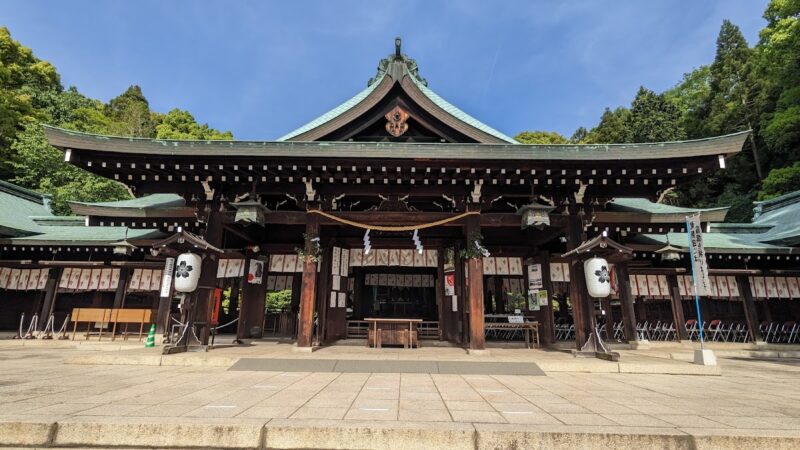
The current shrine building, constructed in 1972 during the relocation of the shrine, is a majestic structure that incorporates modern elements while adhering to traditional shrine architectural styles. In the worship hall, one can quietly offer prayers of gratitude to the spirits of the fallen and prayers for peace.
Memorial Monuments
Numerous memorial monuments are erected within the shrine grounds, commemorating various battles, units, and specific incidents.
Main Memorials:
- Siberian Internees Memorial: Commemorates those from Okayama Prefecture who were interned in Siberia after World War II and died under harsh conditions.
- Kikusui Memorial: Commemorates the seventeen brave soldiers who launched a suicide attack with Vice Admiral Matome Ugaki on August 15, 1945, just before the end of the war.
- Memorials for Fallen Soldiers of Various Units: Commemorates those who died in various units of the Army and Navy, or in specific battles.
These memorials are important records that convey their respective historical backgrounds and play a role in passing on the tragedy of war and the preciousness of peace to future generations.
Natural Environment of the Temple Grounds
Located at the foot of Mt. Misao, the temple grounds are blessed with nature that changes with the seasons. Cherry blossoms in spring, fresh greenery in early summer, and autumn leaves in fall, each season offers a different view, soothing the hearts of visitors. The tranquil environment provides an ideal space for commemorating the war dead and praying for peace.
List of Annual Shinto Rituals
Okayama Prefectural Gokoku Shrine holds various Shinto rituals throughout the year.
Major Annual Shinto Rituals
January
- New Year’s Day Festival (January 1st): A celebration to welcome the new year and pray for national peace and world peace.
- First Shrine Visit of the Year: Many worshippers visit the shrine.
February
- National Foundation Day Festival (February 11th): A festival coinciding with National Foundation Day.
April
- Spring Grand Festival: An important festival to express gratitude to and commemorate the war dead.
- Origin Festival of the War Dead: Commemorating the War Dead Festival, which marked the origin of the shrine’s founding.
May
- Memorial Grand Festival: A large-scale festival to commemorate those who died in the war.
August
- End of War Memorial Day Festival (August 15th): A festival to commemorate the war dead and pray for peace on the anniversary of the end of the war.
October
- Autumn Grand Festival: An important festival, comparable to the Spring Grand Festival.
November
- Niiname-sai Festival (November 23rd): Harvest Thanksgiving Festival coinciding with Labor Thanksgiving Day
These Shinto rituals are attended by bereaved families, related organizations, and general worshippers, who offer gratitude to the war dead and prayers for peace. The spring and autumn grand festivals and the end-of-war memorial service, in particular, attract large crowds.
Access and Visiting Information
Location
Address: 3-21 Okuichi, Naka-ku, Okayama City, Okayama Prefecture 703-8272
Access by Public Transportation
By Bus from JR Okayama Station
- Take the Ryobi Bus bound for “Saidaiji” from the JR Okayama Station East Exit Bus Terminal
- Get off at the “Gokoku Jinja-mae” bus stop (approximately 20 minutes)
- Approximately 10 minutes on foot from the bus stop
The path from the bus stop to the shrine is a gentle slope, so comfortable shoes are recommended.
Using the Tram (Okayama Electric Tramway)
Take the Higashiyama Line from Okayama Station and get off at the “Higashiyama” tram stop. From there, you can access the shrine by taxi or on foot (approximately 20 minutes).
Access by Car
From the Sanyo Expressway
- Approximately 15 minutes from Okayama IC
From the City Center
- Approximately 15 minutes from central Okayama City via National Route 250
Parking: Free parking available on the shrine grounds (accommodates approximately 50 regular cars)
During peak seasons such as New Year’s Day and the annual festival, the parking lot may be full. Please consider using public transportation.
Visiting Hours and Shrine Office
Visiting Hours: Grounds are freely accessible (24-hour visitation possible)
Shrine Office Hours: 9:00 AM to 5:00 PM (normal hours)
Closed Days: None
Goshuin (shrine stamps) and amulets are available only during shrine office hours.
Goshuin (Shrine Seals) and Gifts
About Goshuin
At Okayama Prefectural Gokoku Shrine, you can receive a goshuin as proof of your visit. Goshuin are available at the shrine office, and the offering fee is usually around 300 to 500 yen.
The goshuin will have the words “Okayama Prefectural Gokoku Shrine” written in ink and stamped in red, and the date of your visit will also be included. If you do not have a goshuincho (goshuin notebook), you can purchase one at the shrine office.
Items Offered
The shrine office offers the following items:
- Amulets: Various types for family safety, traffic safety, academic success, etc.
- Talismans: Talismans for enshrinement at home or in the workplace
- Ema (votive tablets): For writing wishes and offering
- Goshuincho (stamp books): Original design stamp books
Manners and Etiquette for Visiting the Shrine
Basic Etiquette for Visiting the Shrine
Visiting Gokoku Shrine follows the same etiquette as visiting any other shrine.
- When passing through the torii gate: Bow before entering the shrine grounds.
- Purifying at the water basin: Purify your left hand, then your right hand, then your mouth, and finally the handle of the ladle.
- How to walk along the approach to the shrine: Walk along the sides, as the center is considered the path of the gods.
- Etiquette at the main hall: Two bows, two claps, one bow (two bows, two claps, one bow)
- Bow deeply twice
- Clap twice
- Bow deeply once
Specific etiquette for visiting Gokoku Shrines
Gokoku Shrines are special shrines that enshrine the spirits of war dead. When visiting the shrine, please keep the following points in mind:
- Visit with gratitude towards the war dead.
- Maintain a quiet and reverent demeanor.
- Offer a moment of silence in front of the memorial monument.
- Refrain from loud noises or disrespectful behavior within the shrine grounds.
Nearby Tourist Attractions
Surrounding Okayama Gokoku Shrine are several of Okayama’s most representative tourist attractions.
Okayama Korakuen Garden
One of Japan’s three most famous gardens, located about 10 minutes by car from the shrine. Designated as a National Special Place of Scenic Beauty, it was originally a daimyo garden from the Edo period. Enjoy the beautiful scenery throughout the four seasons.
Okayama Castle
A symbol of Okayama, adjacent to Korakuen Garden. Its black exterior has earned it the nickname “Ujo” (Crow Castle). From the castle tower, you can enjoy a panoramic view of Okayama city.
Misaoyama Mountain
A mountain rising 169m above sea level, towering behind the shrine. Hiking trails are well-maintained, and from the summit, you can enjoy views of Okayama city and the Seto Inland Sea.
Saidaiji Temple
Located approximately 5km east of the shrine, this ancient temple is known for the Saidaiji Eyo (Naked Festival), one of Japan’s three most unusual festivals. Visitors can admire the historical temple architecture.
The Modern Significance of Okayama Prefectural Gokoku Shrine
As a Place for Peace Education
Okayama Prefectural Gokoku Shrine plays a vital role as a place to convey the history of war and learn about the preciousness of peace. The memorial monuments within the grounds are valuable resources for preventing the memories of war from fading, and have particular educational significance in conveying the tragedy of war and the importance of peace to younger generations.
As part of school education, local elementary and junior high school students sometimes visit for social studies field trips and peace studies, providing them with an opportunity to learn about the history of war while actually viewing the memorial monuments.
Center of the Local Community
The Shinto rituals and festivals held throughout the year also serve as a place for interaction among local communities, including bereaved families’ associations. Especially during the spring and autumn festivals, many worshippers gather from all over the prefecture, creating a space to share gratitude to the war dead.
Value as a Tourist Resource
As a shrine of high historical and cultural value, it attracts many worshippers and tourists from both within and outside the prefecture. It is particularly bustling during the New Year’s period and the annual festivals, making it an important tourist resource in Okayama.
Precautions When Visiting
Regarding Attire
While there are no strict dress code regulations, it is desirable to wear clean and respectful clothing, considering it is a sacred place. For formal Shinto rituals such as the annual festivals, formal attire such as suits or ceremonial clothing is recommended.
Regarding Photography
Photography is generally permitted on the shrine grounds, but please note the following:
- Photography may be prohibited inside the main hall or during religious ceremonies.
- Please be considerate of other worshippers.
- Please photograph the memorial monument with respect.
- Commercial photography requires prior permission.
Regarding Pets
Policies vary by shrine, but generally, it is considered good manners to refrain from bringing pets onto the grounds. Please inquire at the shrine office for details.
Summary
Okayama Prefectural Gokoku Shrine has a history of over 150 years since its founding in 1869 (Meiji 2), and is an important shrine that enshrines 56,718 war dead with ties to Okayama Prefecture. The quiet grounds, surrounded by the greenery of Mt. Misao, are a fitting place to offer gratitude to the war dead and prayers for peace.
Its history, beginning with the memorial service held by Lord Ikeda Akimasa of the Bizen Domain and continuing through several relocations to its current location, reflects the very history of modern Japan. The numerous memorial monuments erected within the shrine grounds are precious witnesses that convey the memories of each era.
The Shinto rituals and festivals held throughout the year provide opportunities to renew gratitude to the war dead and reaffirm the preciousness of peace. Easily accessible from central Okayama City, the shrine is bustling with many visitors during New Year’s and the annual festival.
When visiting Okayama, we highly recommend visiting Okayama Prefectural Gokoku Shrine to offer gratitude to the war dead and prayers for peace. As you join your hands in prayer in the tranquil grounds, you will surely realize that the peace we enjoy today is built upon the sacrifices of many precious people.