Complete Guide to the Three Great Shrines | The Wisteria of Kusatsu City, Shiga Prefecture, and Everything About Japan’s Three Great Shrines
What are the Three Great Shrines?
It’s understandable that many people are confused when they hear the term “Three Great Shrines.” In fact, “Three Great Shrines” has two different meanings. One is the name of a specific shrine located in Shina-cho, Kusatsu City, Shiga Prefecture, and the other is a general term referring to prestigious shrines and grand shrines that represent Japan.
This article provides detailed information about the Three Great Shrines in Kusatsu City, Shiga Prefecture, and several candidate shrines known as Japan’s Three Great Grand Shrines, explaining everything from their historical background to actual visiting information, more thoroughly than anywhere else.
The Three Great Shrines in Kusatsu City, Shiga Prefecture
History and Origins of the Three Great Shrines
The Three Great Shrines, located in Shina-cho, Kusatsu City, Shiga Prefecture, are ancient shrines standing in the heart of the Yoshida settlement, surrounded by rural scenery, approximately 3.5 km north of JR Kusatsu Station. The exact date of its founding is unknown, but according to shrine tradition, it was established in the 4th year of Emperor Tenji’s reign (665 AD), making it a venerable shrine with a history of over 1300 years.
Located in the former Yoshida Jori 26-tsubo Ibuki no Sato, now Shina-cho, Kusatsu City, this shrine has been a central presence in the remains of the Jori settlement and has attracted the faith of the local community. The Jori system was an ancient land division system, illustrating the historical importance of this region.
Deities and Blessings
The deities enshrined at the Sandai Shrine are Shinatsuhiko-no-mikoto and Shinatsuhime-no-mikoto. These two deities are known as gods of wind and are believed to grant blessings for safe voyages, abundant harvests, and protection from evil.
Shinatsuhiko-no-Mikoto and Shinatsuhime-no-Mikoto are deities who appear in the Kojiki and Nihon Shoki, and are considered wind gods born from the divine creation of Izanagi and Izanami. In an era centered on agriculture, wind greatly influenced crop growth, making them important objects of worship for the people of this region.
Sand-Rubbing Wisteria – The Biggest Highlight of the Three Great Shrines
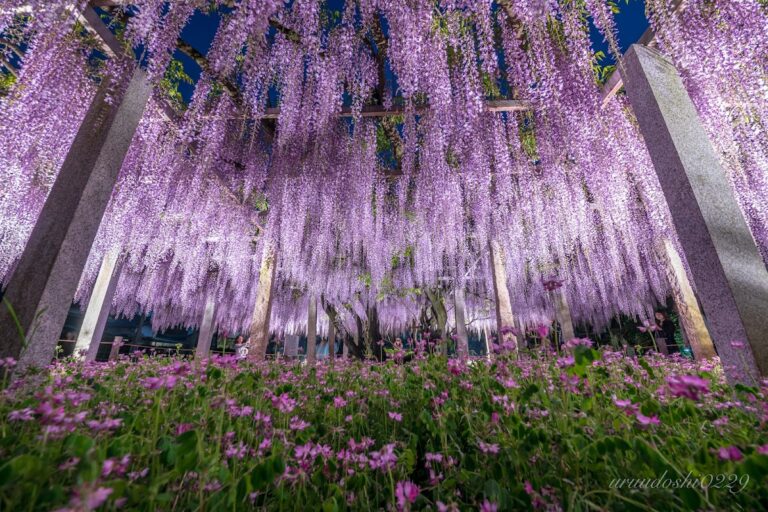
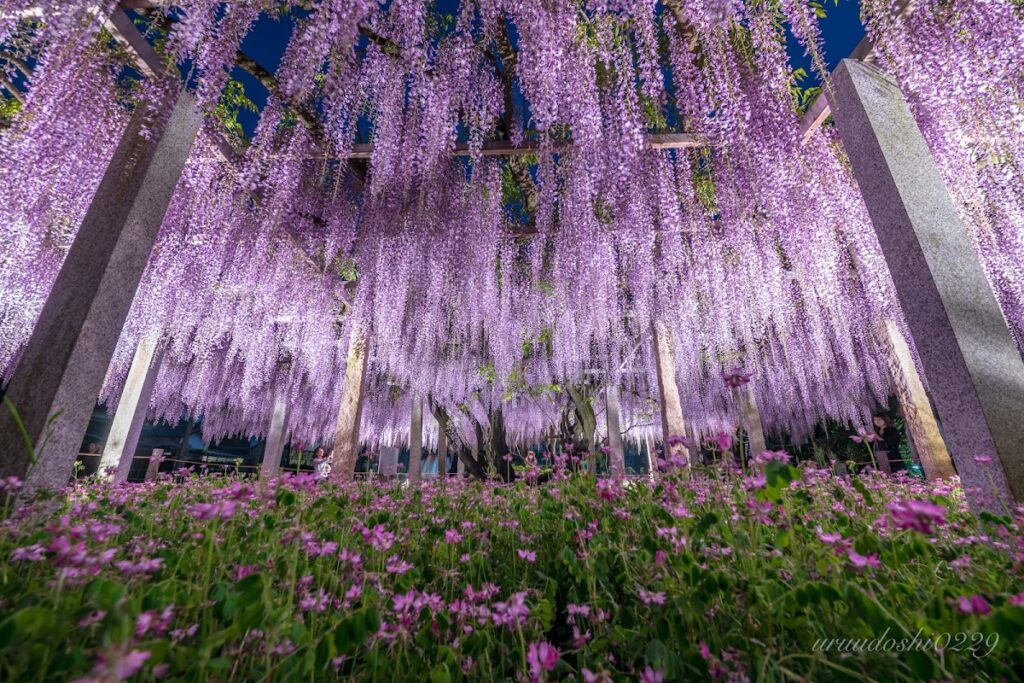
The main reason the Three Great Shrines have become nationally known is the magnificent ancient wisteria blooming on the shrine grounds, commonly known as the “Sand-Rubbing Wisteria.” This ancient Noda wisteria tree blooms every year from late April to early May, and its flower clusters reach over 2 meters in length, becoming so long that they almost touch the ground, hence the name “Sand-Rubbing Wisteria.”
Characteristics of the Wisteria at Sunazuri
- Flower Scatter Length: Over 2 meters at its longest
- Best Viewing Period: Mid-April to Early May
- Age: Estimated over 300 years
- Variety: Noda Wisteria
- Color: Pale purple
When in bloom, the wisteria blossoms hang down like a purple curtain, covering the temple grounds and creating a fantastical landscape that feels like stepping into another dimension. During this time, many visitors come from all over the Kinki region, making the temple grounds very lively.
The local Wisteria Preservation Society carefully manages the tree, ensuring that it continues to bloom beautifully every year. The sweet fragrance of the wisteria blossoms and the graceful sight of the flower spikes swaying in the wind are well worth seeing.
Stone Lantern, a Nationally Designated Important Cultural Property
Beside the main hall stands a valuable stone lantern, representative of Kamakura period stone art. This stone lantern, approximately 2 meters tall and made of granite, features a rare hexagonal column shape, including the hexagonal cap.
It bears an inscription from 1291 (Shoō 4), confirming it as a late Kamakura period work. Recognized for its artistic and historical value, it has been designated a National Important Cultural Property. Hexagonal column stone lanterns are rare throughout Japan, and this piece holds an important place in art history as a representative example of the high level of stonework technology of the time.
Highlights of the Main Hall and Grounds
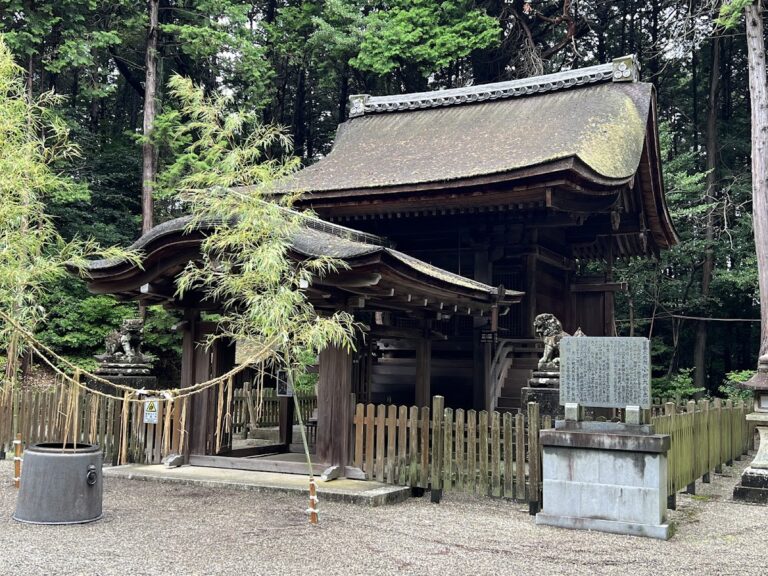
The main hall of the Sandai Shrine preserves the traditional style of shrine architecture. While the grounds are not particularly large, the quiet environment surrounded by rural scenery allows for peaceful worship.
Besides the main hall, the grounds also include a worship hall and a purification fountain, and are carefully preserved as the local guardian shrine. Especially outside of the wisteria blooming season, there are few visitors, allowing for a tranquil and peaceful worship experience.
Access Information
Access by Public Transportation
- From JR Kusatsu Station: Approximately 3.5km north
- Bus: Take a bus from the west exit of Kusatsu Station, get off at “Shinamachi” bus stop, and walk for approximately 5 minutes.
- Travel Time: Approximately 15 minutes by bus from Kusatsu Station.
Access by Car
- Approximately 15 minutes from the Meishin Expressway “Ritto IC”
- Parking: Temporary parking available only during the wisteria blooming season (parking space is limited during normal times).
Basic Information
- Location: 309 Shinamachi, Kusatsu City, Shiga Prefecture
- Opening Hours: Grounds are freely accessible (shrine office is open irregularly).
- Admission Fee: Free
- Inquiries: Kusatsu City Tourism and Products Association
- Best Season: Late April to early May (wisteria blooming season)
What are Japan’s Three Great Shrines?
When you search using the keyword “Three Great Shrines,” you’ll find a lot of information about “Japan’s Three Great Shrines,” along with information about the three great shrines in Kusatsu City, Shiga Prefecture. From here, we’ll explain in detail about these prestigious shrines and temples that represent Japan.
Definition and Historical Background of Japan’s Three Great Shrines
There is actually no clear definition of Japan’s Three Great Shrines. This is a common characteristic of many expressions like “Japan’s Three Great ○○,” but several candidates have been proposed based on historical documents and traditional status.
There are two important historical documents to consider when thinking about candidates for Japan’s Three Great Shrines.
Three Great Shrines Based on the Nihon Shoki
The Nihon Shoki is Japan’s first imperial history book (compiled by order of an emperor or retired emperor), completed in 720. The following three shrines are listed as major shrines in this work.
- Ise Grand Shrine
- Izumo Grand Shrine (Izumo Taisha)
- Isonokami Shrine
The Three Great Shrines Based on the Engishiki Jinmyocho
The Engishiki Jinmyocho is a list of shrines throughout Japan compiled in the mid-Heian period (927). Among them, the following three shrines are listed as particularly high-ranking:
- Ise Grand Shrine
- Kashima Shrine
- Katori Shrine
The Special Status of Ise Grand Shrine Appearing in Both
It is noteworthy that Ise Grand Shrine is the only shrine that appears in both the Nihon Shoki and the Engishiki Jinmyocho. This indicates that Ise Grand Shrine has been the most prestigious and exceptional shrine in Japan from ancient times to the present day.
Ise Grand Shrine is the only shrine referred to simply as “Jingu” (Grand Shrine); other shrines are formally called “○○ Jingu.” This difference highlights the special status of Ise Grand Shrine.
Five Candidates for Japan’s Three Great Shrines
Based on historical documents, the following five shrines are candidates for Japan’s Three Great Shrines. Here, we will explain each shrine in detail.
Ise Grand Shrine (Ise City, Mie Prefecture)
Overview and History
Ise Grand Shrine, officially called “Jingu,” is considered the pinnacle of Japanese Shinto shrines. It is the largest shrine complex in Japan, consisting of 125 shrines centered around the Inner Shrine (Kotai Jingu) and the Outer Shrine (Toyouke Daijingu).
Founded approximately 2000 years ago, the Inner Shrine, dedicated to Amaterasu Omikami, has been revered since ancient times as the most sacred place to worship the ancestral deity of the Imperial Family.
Deities and Blessings
- Inner Shrine: Amaterasu Omikami – National peace and security, good fortune, family safety
- Outer Shrine: Toyouke Omikami – Abundant harvests, industrial development, protection of clothing, food, and shelter
Shikinen Sengu (Periodic Relocation Ceremony)
The most distinctive feature of Ise Grand Shrine is the Shikinen Sengu, which takes place every 20 years. This is a ceremony in which the shrine buildings are rebuilt and the sacred object is moved to the new building, and it has been continued for over 1300 years. This tradition ensures that the shrine is always kept in a new state, and the architectural techniques are passed down through generations.
Points to Note When Visiting
- The proper order of worship is to visit the Outer Shrine (Geku) first, then the Inner Shrine (Naiku).
- Early morning visits are recommended (to experience the sacred atmosphere).
- Enjoy Ise’s local specialties at Okage Yokocho.
Izumo Taisha Shrine (Izumo City, Shimane Prefecture)
Overview and History
Izumo Taisha Shrine is an ancient shrine mentioned as “Izumo Daijingu” in the *Nihon Shoki* (Chronicles of Japan). While the exact date of its founding is unknown, its appearance in the myths of the *Kojiki* and *Nihon Shoki* confirms its existence since ancient times.
It enshrines Okuninushi-no-Okami and is nationally known as the god of matchmaking.
Deities and Benefits
- Okuninushi-no-Okami: God of matchmaking, good fortune, and guardian deity of agriculture, commerce, and medicine.
Architectural Features
The main hall of Izumo Taisha Shrine is built in the Taisha-zukuri style, the oldest style of shrine architecture in Japan. The current main shrine was built in 1744 and is designated a National Treasure.
There is a legend that the ancient Izumo Taisha was a massive structure reaching 48 meters in height (equivalent to a 16-story building), and recent archaeological excavations have uncovered remains that support this possibility.
Points to Note When Visiting
- Unlike typical shrines, worship is performed using the “two bows, four claps, one bow” method.
- The Kamiari Festival, where gods from all over Japan gather, is held during the Kamiari-zuki (October in the lunar calendar).
- The large shimenawa (sacred rope) is one of the largest and most impressive in Japan.
Isonokami Jingu (Tenri City, Nara Prefecture)
Overview and History
Isonokami Jingu is one of the oldest shrines in Japan, located in Tenri City, Nara Prefecture. It is mentioned in the *Nihon Shoki* (Chronicles of Japan) and has been revered since ancient times as the tutelary deity of the Mononobe clan.
Founded in the 7th year of Emperor Sujin’s reign (91 BC), it boasts a history of over 2000 years. In ancient times, it also served as the imperial court’s armory.
Deities and Blessings
- Futsu-no-Mitama-no-Okami: Long-lasting military fortune, good luck, and health and longevity
- Furu-no-Mitama-no-Okami
- Futsushi-no-Okami
Features
Isonokami Shrine houses numerous ancient sacred swords and treasures, with the national treasure “Seven-Branched Sword” being particularly famous. This sword is believed to have been made in the 4th century and is a valuable historical artifact demonstrating exchange between Japan and the Korean Peninsula.
Chickens roam freely within the shrine grounds, considered messengers of the gods. This sight is unique and not seen at other shrines.
Points to Note During Your Visit
- Interact with chickens roaming freely on the shrine grounds
- The National Treasure, the Seven-Branched Sword (normally not on public display, only during special exhibitions)
- A sacred atmosphere surrounded by a tranquil forest
Kashima Shrine (Kashima City, Ibaraki Prefecture)
Overview and History
Kashima Shrine, located in Kashima City, Ibaraki Prefecture, is the oldest shrine in eastern Japan. It is listed in the “Engishiki Jinmyocho” (a historical record of shrines) as a shrine of the second highest rank after Ise Grand Shrine.
It is said to have been founded in the first year of Emperor Jimmu’s reign (660 BC), and is considered a shrine deeply involved in the founding of Japan. In ancient times, it played an important role as a base for pacifying eastern Japan and for foreign defense.
Deities and Blessings
- Takemikazuchi-no-Okami: Improvement in martial arts, good fortune in competitions, protection from evil, protection from earthquakes
Characteristics
Takemikazuchi-no-Okami is considered the strongest warrior god in Japanese mythology and is worshipped as the god of martial arts and competitions. This shrine is particularly revered by those involved in martial arts such as kendo and judo.
Near the inner sanctuary within the shrine grounds is a mysterious stone called the “Keystone.” Legend says this stone is buried deep underground and is holding down a giant catfish that causes earthquakes.
Points to Note During Your Visit
- Praying for protection against earthquakes at the foundation stone
- The sacred tree, 1300 years old
- A stroll through the vast shrine grounds and forest
Katori Shrine (Katori City, Chiba Prefecture)
Overview and History
Katori Shrine is the Ichinomiya (first-ranked shrine) of Shimosa Province, located in Katori City, Chiba Prefecture. Along with Kashima Shrine, it is listed in the “Engishiki Jinmyocho” (a list of shrines compiled in the Heian period) and has been revered as one of the two great shrines of eastern Japan.
It is said to have been founded in the 18th year of Emperor Jimmu’s reign (643 BC), and along with Kashima Shrine, it served as a base for the pacification of eastern Japan.
Deities and Blessings
- Futsunushi-no-Okami: Improvement in martial arts, good fortune in victory, traffic safety, industrial development
Features
Futsunushi-no-Okami is known as the deity who negotiated the transfer of the land together with Takemikazuchi-no-Okami, and is also worshipped as the god of swords and thunder.
The main hall was built in 1700 by the Tokugawa Shogunate and is characterized by its imposing architecture with black lacquer finish. It is designated as a National Important Cultural Property.
Points to Note When Visiting
- Visiting together with Kashima Shrine is traditional
- Kanameishi (the keystone, which is paired with the Kanameishi of Kashima Shrine)
- View from the Tower Gate
Comparison and Selection of Japan’s Three Great Shrines
If Choosing Based on Prestige and History
The most prestigious and historically important is undoubtedly Ise Grand Shrine. Deeply connected to the Imperial Family, it can be considered a spiritual home for the Japanese people. Many Japanese people visit it as a shrine they want to visit at least once in their lifetime.
For those wishing for a successful relationship
Izumo Taisha is famous for its blessings in matchmaking. It is worshipped not only for romantic relationships, but also as a deity that fosters good fortune in all kinds of relationships, including those between people and in work.
For those wishing for success in martial arts and competitions
If you wish for improvement in martial arts or success in competitions, Kashima Jingu and Katori Jingu are recommended. Both shrines enshrine war gods and have long attracted the faith of those involved in martial arts.
For those interested in history and sacred treasures
If you are interested in ancient sacred treasures and historical artifacts, Isonokami Jingu is ideal. It houses numerous valuable cultural properties, including the national treasure, the Seven-Branched Sword.
Manners and Etiquette for Visiting the Three Great Shrines and Grand Shrines
Basic Worship Etiquette
- Bow before passing through the torii gate.
- Purify yourself at the water basin.
- Purify your left hand, right hand, and mouth in that order.
- Cleanse the handle of the ladle and return it to its original position.
- Walk along the edge of the path. (The center is the path for the gods.)
- Two bows, two claps, one bow. (Izumo Taisha uses two bows, four claps, and one bow.)
Clothing and Belongings
- Dress in clean clothing.
- Avoid revealing clothing.
- Wear comfortable shoes (for walking around the large grounds).
- Bring a Goshuincho (stamp book) if you plan to collect Goshuin stamps.
Photography Manners
- Photography is often prohibited inside the main hall.
- Be considerate of other worshippers.
- Avoid using flash photography.
- Remember that this is a sacred place.
Seasonal Highlights
Spring (March-May)
- Shiga Prefecture’s Three Great Shrines: Sunazuri Wisteria (Best viewing time: late April to early May)
- Ise Grand Shrine: Cherry blossom season, beautiful fresh greenery
- Isonokami Shrine: Cherry blossoms and fresh greenery within the shrine grounds
Summer (June-August)
- Various Shrines: Summer Purification Ceremony (June 30th)
- Kashima Shrine & Katori Shrine: Lush green forests within the shrine grounds
Autumn (September-November)
- Various Shrines: Autumn foliage season
- Izumo Taisha Shrine: Kamiari Festival (October in the old calendar)
- Ise Grand Shrine: Kanname-sai Festival (October)
Winter (December-February)
- Various Shrines: New Year’s visit
- Ise Grand Shrine: A Silent Winter Visit
Summary
We learned that the keyword “Three Great Shrines” has two meanings: the three great shrines of Kusatsu City, Shiga Prefecture, and the three great shrines of Japan.
The three great shrines of Kusatsu City, Shiga Prefecture, are beautiful, locally rooted shrines possessing valuable cultural assets such as wisteria blossoms and a hexagonal stone lantern from the Kamakura period. The wisteria blooming season, especially from late April to early May, makes it a highly worthwhile place to visit.
On the other hand, the three great shrines of Japan include five candidates: Ise Grand Shrine, Izumo Taisha (Izumo Daijingu), Isonokami Shrine, Kashima Shrine, and Katori Shrine, each with its own distinct history and characteristics. Ise Grand Shrine is in a class of its own, a sacred place that every Japanese person wishes to visit at least once.
Each shrine is a valuable presence that conveys the history and culture of Japan to the present day. Understanding the characteristics of each and choosing a place to visit according to your purpose and interests will allow for a deeper experience.
Visiting a shrine is not merely sightseeing; it’s a valuable opportunity to experience traditional Japanese culture and spirituality. By observing proper etiquette and visiting with reverence, you can surely find peace of mind and renewed energy.