
Doryuji Temple Complete Guide | History, Benefits, and Visiting Information for the 77th Temple of the Shikoku 88 Temple Pilgrimage
About Doryuji Temple
Doryuuji Temple is a Shingon sect Daigo school head temple located in Tadotsu-cho, Nakatado-gun, Kagawa Prefecture. Its official name is Sotazan Myooin Doryuji, and as the 77th temple of the Shikoku 88 Temple Pilgrimage, it has long been cherished by many pilgrims and visitors.
The principal image is Yakushi Nyorai (Medicine Buddha), and it is particularly known as the “Eye-Healing Yakushi,” attracting worshippers for its blessings of healing eye diseases. Located on the north side of the Marugame Plain, the surrounding area has long been a thriving center for mulberry cultivation and silk production.
Basic Information
- Sect: Shingon-shu Daigo-ha, Head Temple
- Mountain Name: Sotazan
- Temple Name: Myooin
- Temple Name: Doryuji
- Principal Image: Yakushi Nyorai (Medicine Buddha)
- Pilgrimage Site: 77th Temple of the Shikoku 88 Temple Pilgrimage
- Location: 1-3-30 Kitakamo, Tadotsu-cho, Nakatado-gun, Kagawa Prefecture
History of Doryuji Temple
Origin of Founding and the Legend of Wake no Michitaka
Doryuji Temple is said to have been founded in Wado 5 (712 AD). According to the temple’s history, the temple’s origins lie in a sad story related to Wake no Michitaka, the lord of this region.
One day, while Lord Wake no Michitaka was hunting, a tragedy occurred when an arrow he accidentally shot killed his wet nurse. Deeply saddened, Lord Michitaka carved a small statue of Yakushi Nyorai (Medicine Buddha) from a large mulberry tree growing in the area to pray for his wet nurse’s soul, and built a thatched hut. This is said to be the origin of Doryuji Temple.
This legend is also the reason why Doryuji Temple has the mountain name “Kuwata-san” (Mulberry Mountain), and it tells the story of how this area was once a vast mulberry plantation. Mulberry trees are essential for silk production, indicating that this region prospered from sericulture since ancient times.
Connection with Kobo Daishi Kukai
In 815 (Kōnin 6), Kobo Daishi Kukai, who was traveling around Shikoku, visited this area. The Great Master was impressed by the miraculous power of the small statue of Yakushi Nyorai carved by Lord Wake no Michitaka, and he himself carved a new statue of Yakushi Nyorai using the ritual of one stroke and three bows. It is said that a small statue carved by Michitaka was placed inside the main image and enshrined as the principal deity.
At this time, Kobo Daishi is said to have renovated the temple buildings and named it Kuwata-san Myooin Doryuji. Since then, Doryuji has developed as a training ground for Shingon Esoteric Buddhism and as an important sacred site on the Shikoku Pilgrimage.
Transition from the Medieval to the Early Modern Period
Throughout the medieval period, Doryuji flourished as an important Shingon Buddhist temple in Sanuki Province. Although it suffered damage from war during the Sengoku period, it was restored and renovated during the Edo period through the efforts of successive feudal lords and local faith.
In particular, during the late Edo period, there is a legend that a man named Kyogoku Samanosuke was cured of an eye disease by the compassion of the Yakushi Nyorai (Medicine Buddha) at Doryuji. After his recovery, Kyogoku Samanosuke studied medicine and became a court physician, becoming particularly known as a renowned ophthalmologist. On his deathbed, he vowed, “I shall leave my soul at Doryuji Temple to save the people of the world,” and his tomb is enshrined within the temple grounds.
This legend further spread the faith in Doryuji Temple as the “Yakushi Buddha who heals eyes,” and people suffering from eye diseases began to visit from all over the country.
Doryuji Temple in the Modern Era
Despite being affected by the anti-Buddhist movement of the Meiji era, Doryuji Temple survived, supported by the fervent faith of the local community. During the Showa era, the temple grounds were renovated, and to this day, it welcomes many visitors as a pilgrimage site on the Shikoku Pilgrimage and as a sacred place for healing eye diseases.
As the head temple of the Shingon Daigo sect, it holds an important position within the sect, and various religious services and events are held throughout the year.
Temple Grounds and Buildings
Niomon Gate
A magnificent Niomon gate stands at the entrance to Doryuji Temple. On either side of the gate stand the Agyo and Ungyo Nio statues, welcoming visitors. Passing through this Nio Gate reveals a scene unique to Doryuji Temple.
Bronze Kannon Statues
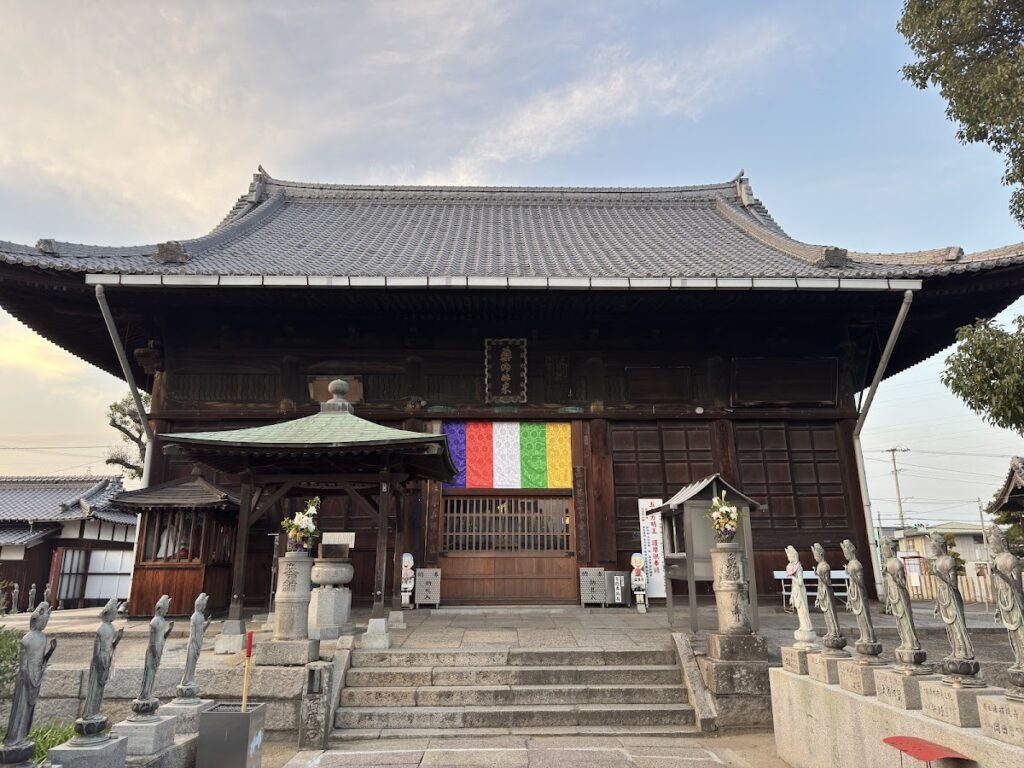
After passing through the Nio Gate, you’ll see a row of bronze Kannon statues lining both sides of the approach to the temple. This is one of Doryuji Temple’s most distinctive features; the sight of so many Kannon Bodhisattva statues welcoming visitors is unique and not seen at other temples.
These Kannon statues were donated by believers, each embodying the donor’s wishes. Many visitors say they feel a sense of purification as they walk along the path lined with these serene Kannon statues.
Main Hall
The main hall houses the principal image, Yakushi Nyorai (Medicine Buddha). The statue, said to have been carved by Kobo Daishi, is considered a hidden Buddha and is usually kept in a shrine. The main hall is a place where you can offer sutras and chant scriptures, and it is constantly visited by pilgrims on the Shikoku Pilgrimage.
In front of the main hall is an incense burner, and smoke rises from the incense. It is customary for worshippers to apply this smoke to the parts of their bodies that are ailing, praying for recovery from illness.
Daishi Hall
Adjacent to the main hall is the Daishi Hall, where a statue of Kobo Daishi is enshrined. On the Shikoku Pilgrimage, it is considered proper etiquette to visit both the main hall and the Daishi Hall, and at Doryuji Temple, many pilgrims chant scriptures in both halls.
Grave of Kyogoku Samanosuke
Within the temple grounds is the grave of Kyogoku Samanosuke, known for the legend of healing eye diseases. Kyogoku Samanosuke, a physician in the late Edo period, is said to have been cured of an eye disease by the compassion of Yakushi Nyorai (Medicine Buddha) at Doryuji Temple. He later studied medicine and became a renowned ophthalmologist.
It is said that on his deathbed, he vowed, “I will leave my soul at Doryuji Temple to save the people of the world,” and his tomb remains a place of worship for those praying for healing from eye diseases. Many worshippers visit this tomb to pray for the healing of eye diseases and the restoration of their eyesight.
Other Temple Buildings and Facilities
In addition to the above, the temple grounds also contain buildings such as a Goma Hall, a bell tower, and a sutra copying office. The temple grounds are well-maintained, and visitors can enjoy the flowers and trees of each season. Especially during the cherry blossom season in spring and the autumn foliage season, beautiful scenery awaits visitors.
Cultural Properties of Doryuji Temple
Important Cultural Properties
Doryuji Temple houses valuable cultural properties. In particular, the following are designated as Important Cultural Properties:
Wooden Seated Statue of Yakushi Nyorai: The principal image, a statue of Yakushi Nyorai, is a Buddhist statue from the Heian period, said to have been created by Kobo Daishi. Carved from a single piece of cypress wood, this statue is characterized by its gentle expression and elegant form. Although it is not usually on public display as a hidden Buddha, its miraculous powers have been known since ancient times.
Other Cultural Assets
Within the temple grounds, there are also Buddha statues, paintings, scriptures, and furnishings donated by successive chief priests and believers. These are valuable historical materials that tell the story of Doryuji Temple’s long history.
Benefits and Faith
The Eye-Healing Yakushi Buddha
The most famous benefit of Doryuji Temple is the healing of eye diseases. Widely known as the “Eye-Healing Yakushi Buddha,” people suffering from eye ailments come to worship from all over the country.
The origin of this faith is based on the legend of Kyogoku Samanosuke, mentioned above. Kyogoku Samanosuke, whose eye disease was cured by the compassion of Yakushi Nyorai (the Medicine Buddha), became a renowned ophthalmologist. On his deathbed, he vowed to remain at Doryuji Temple to save people, and thus, the Yakushi Nyorai of Doryuji Temple became particularly revered for its miraculous powers in curing eye diseases.
Even today, people suffering from eye diseases such as vision loss, cataracts, and glaucoma, as well as those praying for good eye health, visit the temple. In modern society, with the increased use of computers and smartphones, the number of visitors praying for good eye health is on the rise.
Benefits of Yakushi Nyorai
Yakushi Nyorai, formally known as “Yakushi Rurikō Nyorai,” is the principal deity of the Eastern Pure Land of Lapis Lazuli, a Buddha who heals people’s illnesses and protects their health. The Yakushi Nyorai of Doryuji Temple is believed to offer benefits not only for the healing of eye diseases, but also for the healing of all kinds of illnesses, longevity, and protection from evil.
As a Temple on the Shikoku Pilgrimage
As the 77th temple of the Shikoku 88 Temple Pilgrimage, Doryuji Temple is an important sacred site for pilgrims. People visit to follow in the footsteps of Kobo Daishi, reflect on themselves, and seek spiritual purification through the Shikoku pilgrimage.
During the pilgrimage, it is customary to receive a stamp (nokyo) and a Goshuin (temple seal) at each temple. At Doryuji Temple, you can also receive a Goshuin and a Goshiki (sacred image) at the temple’s nokyo office.
Visiting Information
Visiting Hours and Nokyo Hours
- Visiting Hours: The temple grounds are generally open for free visits.
- Nokyo Hours: 7:00 AM to 5:00 PM (may vary depending on the season)
While the temple is open year-round, please note the reception hours of the nokyo office. Those on the Shikoku pilgrimage should especially visit during nokyo hours.
Admission Fee
Entry to the temple grounds is free. However, a separate donation is required at the temple office for receiving temple stamps (Goshuin), images of the deity, and amulets.
Proper Worship Etiquette
The formal worship etiquette for the Shikoku Pilgrimage is as follows:
- Bow at the main gate (Nio-mon): Bow with clasped hands before entering the temple grounds.
- Purify yourself at the water basin: Cleanse your hands and mouth.
- Ring the bell at the bell tower: Ring the bell before praying (do not ring it on your way out).
- Pray at the main hall: Place your offering slip, make a donation, and chant sutras.
- Pray at the Daishi Hall: Pray in the same way as at the main hall.
- Receive your sutra at the sutra office: Receive your temple stamp.
- Bow at the main gate: Bow with clasped hands as you leave the temple grounds.
General visitors may simply pray at the main hall and the Daishi Hall and make a wish.
Access
Access by Public Transportation
By JR:
- Get off at Tadotsu Station on the JR Yosan Line, approximately 15 minutes on foot.
- Approximately 1.2 km north from Tadotsu Station. The route is relatively easy to follow, and there are signs.
By Bus:
- Approximately 5 minutes by taxi from Tadotsu Station.
Tadotsu Station is a limited express train stop, making it convenient to access from Takamatsu and Matsuyama. When walking from the station, the most common route is to go north through the shopping street.
Access by Car
By Expressway:
- Approximately 15 minutes from Zentsuji IC on the Takamatsu Expressway.
- Approximately 20 minutes from Sakaide IC on the Seto-Chuo Expressway.
By General Road:
- Accessible via National Route 11 and a prefectural road.
Parking
There is a free parking lot for visitors on the temple grounds. Approximately 20 regular-sized cars can be parked here. However, it can get crowded during long holidays and festivals, so we recommend visiting with plenty of time to spare.
If you are visiting by pilgrimage bus or tour bus, we recommend contacting the temple in advance to confirm parking availability.
Distance to surrounding temples
- Temple No. 76, Goshōji: Approximately 4km, about 1 hour on foot, about 10 minutes by car
- Temple No. 78, Goshōji: Approximately 5km, about 1 hour 15 minutes on foot, about 15 minutes by car
Those undertaking the Shikoku Pilgrimage on foot should use these distances as a reference when planning their trip.
Preceding and Following Temples
Temple No. 76, Konzōji
The temple before Dōryūji is Konzōji, located in Zentsūji City. It is known as the birthplace of Chishō Daishi Enchin, and the well where Enchin was given his first bath remains on the temple grounds. The route from Kanakura-ji Temple to Doryu-ji Temple heads north across the Marugame Plain.
Temple No. 78: Gosho-ji Temple
The next temple after Doryu-ji Temple is Gosho-ji Temple, located in Utazu Town. Known as “Yakuyoke Utazu Daishi” (Exorcism Utazu Great Master), it is famous for its efficacy in warding off evil. The route from Doryu-ji Temple to Gosho-ji Temple heads east along the coast.
Annual Events
Doryu-ji Temple holds various Buddhist services and events throughout the year.
Main Annual Events
- New Year: Shusho-e (New Year’s Day Ceremony), Hatsumode (First Shrine Visit of the Year)
- Spring: Spring Equinox Ceremony, Hana Matsuri (Flower Festival) (April 8th)
- Summer: Segaki-e (Feeding of Hungry Ghosts Ceremony)
- Autumn: Autumn Equinox Ceremony
- December: Osame-no-Yakushi (Yakushi Nyorai Memorial Service at the end of the year)
During these events, special Buddhist services are held, attracting many worshippers.
Attractions in Tadotsu Town and Surrounding Areas
About Tadotsu Town
Tadotsu Town is a port town located in the western part of Kagawa Prefecture, in the northern part of the Marugame Plain. It has flourished since ancient times as a key point for maritime traffic, and during the Edo period, it was a bustling gateway for pilgrims visiting Konpira Shrine. Even today, it remains a port town serving as a gateway to the sea for Shikoku.
Nearby Tourist Attractions
Tōryō Park: A park located on a hill in Tadotsu Town, offering beautiful views of the Seto Inland Sea. It’s also known as a famous cherry blossom viewing spot, with approximately 1,500 cherry trees in bloom during the spring.
Shōrinji Kempo Headquarters: Tadotsu Town is also known as the headquarters of Shōrinji Kempo. Those interested in Shōrinji Kempo should consider visiting.
Kotohira Shrine: Located about 20 minutes by car from Dōryūji Temple, this nationally famous “Konpira-san” offers many attractions, including the stone steps leading to the shrine and the views from the inner sanctuary.
Points to Note When Visiting Dōryūji Temple
Clothing and Items to Bring
While there are no specific dress code requirements for visiting, it is advisable to dress appropriately for a sacred place. Those on a Shikoku pilgrimage often wear pilgrimage attire such as a white robe, straw hat, and walking stick.
During the summer months, the sun is strong, so we recommend bringing a hat, parasol, and plenty of water. In winter, the wind can be cold due to its proximity to the sea, so warm clothing is necessary.
Regarding Photography
Photography is generally permitted within the temple grounds, but please refrain from taking photos inside the main hall or the sutra copying office. Also, please be considerate of other visitors.
Regarding Manners
- Please maintain quiet within the temple grounds.
- Smoking is permitted only in designated areas.
- Please take your trash with you.
- Please be considerate of other visitors.
The Charm and Characteristics of Doryuji Temple
Uniqueness as a Sacred Site for Healing Eye Diseases
Among the 88 temples of the Shikoku Pilgrimage, Doryuji Temple has a unique reputation as the “Yakushi Buddha who heals eyes.” In modern society, eye health is a concern for many people, and in this respect, Doryuji Temple can be said to be a sacred site that resonates with people across generations.
The Bronze Kannon Statues on the Approach
The numerous bronze Kannon statues lining the approach leading from the Niomon Gate are a major feature of Doryuji Temple. This sight is unique to this temple and leaves a deep impression on visitors.
The History of Mulberry and Silk
As its mountain name, “Kuwata-san,” suggests, Doryuji Temple has deep ties to the thriving sericulture industry in this region since ancient times. The founding legend, which tells of a Yakushi Nyorai statue carved from a mulberry tree, is an intriguing story intertwined with the industrial history of this region.
The Status of a Head Temple of the Shingon Daigo School
Doryuji Temple is not merely a pilgrimage site; it holds the status of a head temple of the Shingon Daigo School. Therefore, important religious services and events of the sect are held here, and the traditions of Shingon Esoteric Buddhism continue to thrive.
Shikoku Pilgrimage and Doryuji Temple
Positioning within the Shikoku Pilgrimage
The Shikoku 88 Temple Pilgrimage consists of sacred sites associated with Kobo Daishi, scattered across the four prefectures of Shikoku: Tokushima (Awa), Kochi (Tosa), Ehime (Iyo), and Kagawa (Sanuki). Doryuji Temple, located in Sanuki Province (Kagawa Prefecture), is situated towards the end of the pilgrimage.
The number 77 signifies that it is only 11 temples away from the completion of the pilgrimage, making it a temple where many pilgrims visit with the feeling of “almost at the finish line.”
History of the Pilgrimage Route
The pilgrimage route to Doryuji Temple has been walked by many pilgrims since ancient times. It was even mentioned in pilgrimage guidebooks during the Edo period, and many pilgrims followed this path. Even today, walking pilgrims continue to walk the same path as their predecessors.
The Culture of Hospitality
The Shikoku Pilgrimage has a unique culture called “Osettai.” This is the custom of local people offering food, drink, and sometimes lodging to pilgrims, and this warm culture is still practiced in and around Tadotsu Town.
Summary
Doryu-ji Temple is a venerable temple with a history of over 1300 years, and as the 77th temple of the Shikoku 88 Temple Pilgrimage, it has welcomed many pilgrims. Beginning with the sad story of the memorial service for the wet nurse of Wake no Michitaka, and later renovated by Kobo Daishi Kukai, Doryu-ji Temple has fostered its own unique faith as the “Yakushi Buddha who heals eyes,” making it a sacred site deeply intertwined with history and faith.
There are many sights to see, including the bronze Kannon statues lining the temple grounds, the tomb of Kyogoku Samanosuke, and the principal image of Yakushi Nyorai. It is a temple that warmly welcomes those praying for healing from eye diseases, pilgrims on the Shikoku Pilgrimage, and all those seeking peace of mind.
When you visit Tadotsu Town, be sure to stop by Doryuji Temple and experience its history and faith. The time you spend praying in its tranquil grounds will be a precious moment that will allow you to forget the hustle and bustle of everyday life.

