Genmonji Temple (Kanazawa City, Ishikawa Prefecture) Complete Guide | History and Highlights of a Jodo Sect Temple Enshrining Kanazawa’s Four Great Buddhas and Akiba Daigongen
Located in Higashiyama, Kanazawa City, Ishikawa Prefecture, Genmonji Temple is a historic Jodo Sect temple dating back to the Edo period. It enshrines a standing statue of Amida Buddha, one of Kanazawa’s Four Great Buddhas, and Akiba Daigongen, known as the god of fire prevention, and has long been a center of local faith. This article provides detailed information you should know before visiting Genmonji Temple, including its history, highlights within the temple grounds, cultural assets, and access information.
Basic Information about Genmonji Temple
Sect: Jodo-shu (Pure Land Buddhism)
Principal Image: Amida Buddha
Address: 2-14-33 Higashiyama, Kanazawa City, Ishikawa Prefecture 920-0831
Chief Priest: Ichiro Asai
Visiting: Temple grounds and buildings are accessible (free, advance reservation required)
Parking: Available (please inquire in advance for details)
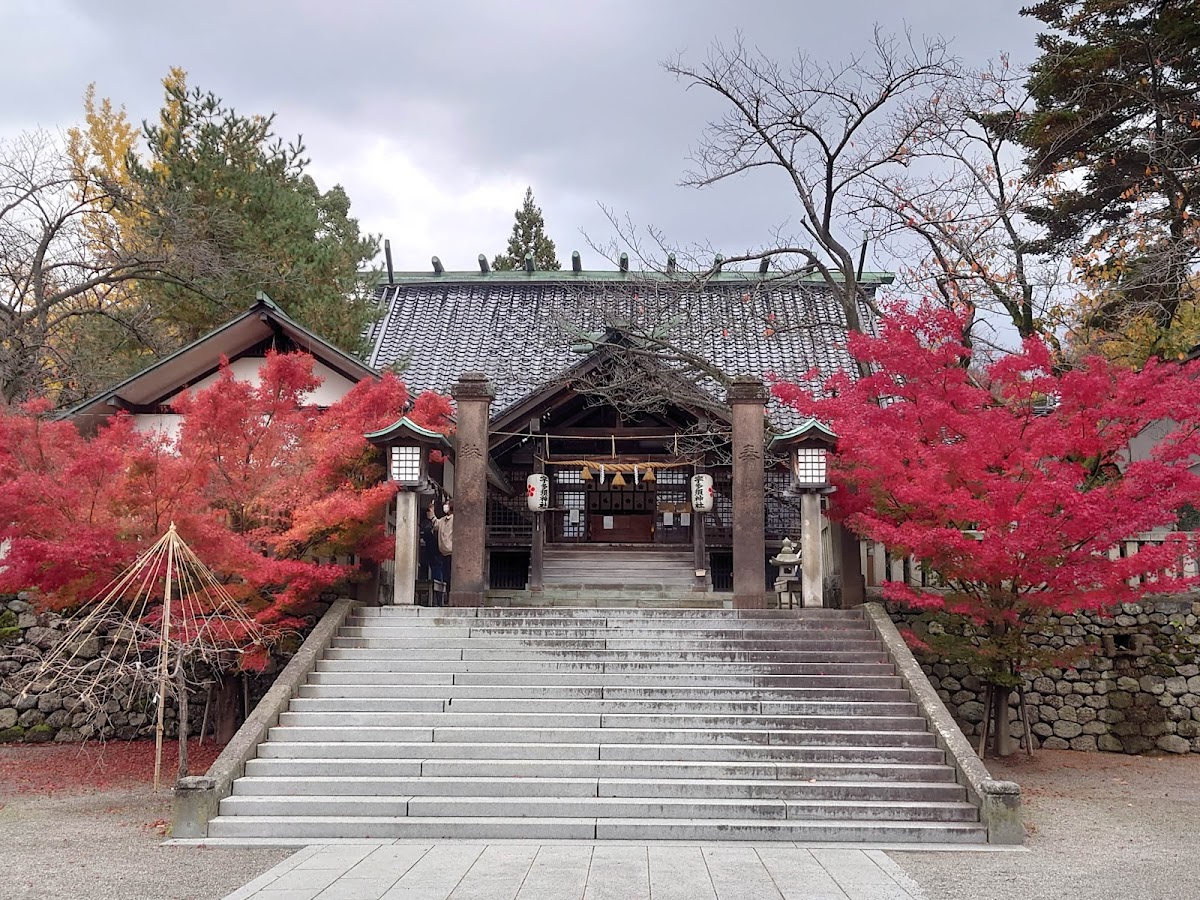
Genmonji Temple is located in the Higashiyama area of Kanazawa City, close to the Higashi Chaya District and the Asano River. Currently, a kindergarten is also located on the temple grounds, making it a beloved temple deeply rooted in the community.
History and Origins of Genmonji Temple
Founding History
Genmonji Temple was founded during the Genroku era (1688-1704). The temple’s origins are said to date back to when Naito Zensai, a samurai of the Kaga Domain, received the temple grounds from Maeda Toshitsune, the third lord of the Kaga Domain. This grant of land was a recognition of Naito Zensai’s achievements and faith, and is one example of the deep connection between the samurai class and Buddhist temples during the Edo period.
Fire Prevention Beliefs and Akiba Daigongen
One of the distinguishing features of Genmonji Temple is its enshrinement of Akiba Daigongen as a fire prevention deity. Kanazawa during the Edo period was a castle town densely populated with wooden buildings, and fire was a constant threat. Therefore, faith in fire prevention deities was very prevalent, and Genmonji Temple played a significant role in this.
Akiba Daigongen is a fire prevention deity based on Mount Akiba in Shizuoka Prefecture, and is worshipped throughout Japan. In Kanazawa, too, it was revered by both townspeople and samurai as a god who protected homes and the town from fire. Genmonji Temple has served as a center of Akiba worship and a place for praying for the safety of the region.
Connection with the Kaga Domain
The Kaga Domain was a large domain ruled by the Maeda family, and it also focused on promoting culture and art. Genmonji Temple developed through its connection with the domain, and its grounds and cultural properties were maintained through donations from samurai and townspeople. It is said that the construction of the standing Amida Buddha statue, in particular, attracted the wishes and donations of many believers.
Highlights and Cultural Properties on the Temple Grounds
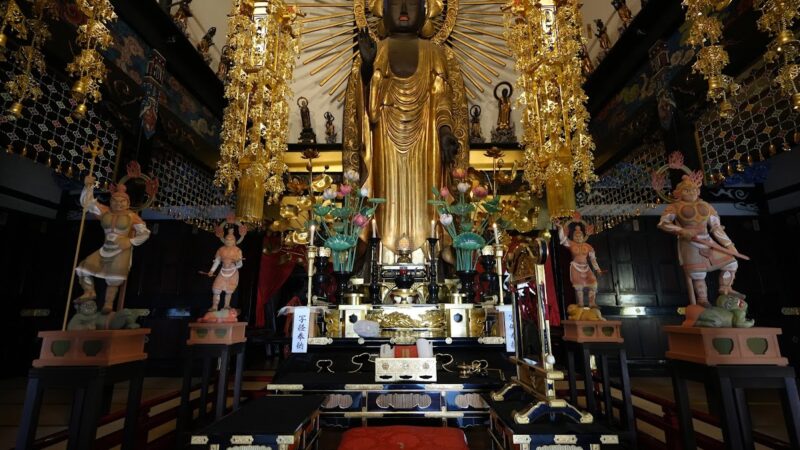
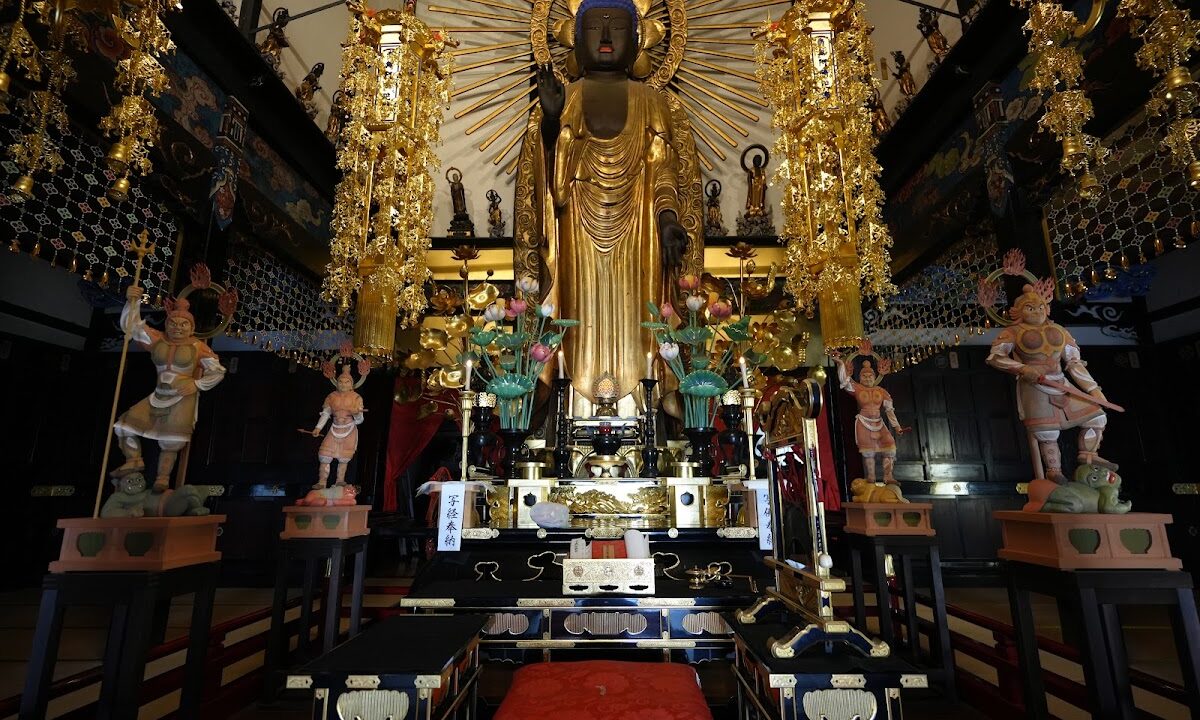
One of Kanazawa’s Four Great Buddhas: Standing Amida Buddha Statue
The greatest highlight of Genmonji Temple is the standing Amida Buddha statue, one of Kanazawa’s four great Buddhas. This large Buddha is made using the joined-wood technique and boasts an overwhelming size of 16 feet (approximately 4.8 meters).
History of its Creation
The standing Amida Buddha statue was commissioned and created in 1758 (Hōreki 8). It is a masterpiece representing the pinnacle of Buddhist sculpture techniques from the mid-Edo period, made using the advanced technique of joining multiple pieces of wood. This technique minimizes distortion, even in large statues, resulting in a structure that can withstand long-term preservation.
What are the Four Great Buddhas of Kanazawa?
The Four Great Buddhas of Kanazawa are a collective term for four large Buddhist statues located within Kanazawa City. These include the standing Amida Buddha statue at Genmonji Temple, the seated Shakyamuni Buddha statue at Daijōji Temple, the seated Amida Buddha statue at Hōenji Temple, and the seated Amida Buddha statue at Saiyōji Temple. These are important cultural assets symbolizing Kanazawa’s Buddhist culture, attracting many worshippers and tourists.
Points to Note During Viewing
The standing Amida Buddha statue is enshrined in the main hall, allowing visitors to admire its majestic form up close. Pay attention to the exquisite craftsmanship, evident in the statue’s benevolent expression, the flowing drapery, and the gleam of the gold leaf. Advance reservations are required for viewing the interior of the building, so be sure to contact them before your visit.
Ceiling Painting: The Artistry of the Dragon Painting
A magnificent dragon painting adorns the ceiling of the main hall. This dragon painting is by Azuma Toyo, an official painter of the Sendai domain who studied under Maruyama Okyo.
About Azuma Toyo
Azuma Toyo was a painter in the Kano school tradition, having learned realistic painting techniques from Maruyama Okyo. Okyo was one of the leading painters of the Edo period, known for his style that combined realistic depiction with decorative elements. Azuma Toyo mastered these techniques and served as an official painter for the Sendai domain.
Characteristics of the Dragon Painting
The dragon painted on the ceiling is characterized by its powerful brushstrokes and dynamic composition. The image of a dragon soaring through the clouds inspires awe in those who behold it. This dragon painting underwent restoration in Kyoto in 2009, reviving its original vibrant colors and brushwork. The restoration has further enhanced its value as a precious cultural artifact, conveying the skill and artistry of Edo-period painters to the present day.
Atmosphere of the Temple Grounds
Genmonji Temple’s grounds are located in a quiet residential area of Higashiyama. While a kindergarten is currently located on the premises, and the cheerful voices of children can sometimes be heard on weekdays, the temple grounds themselves maintain a tranquil atmosphere.
While it is possible to visit from outside, if you wish to view the main hall and cultural artifacts in detail, it is recommended to make a reservation in advance. Spending time contemplating the historical Buddhist statues and paintings in this peaceful environment will bring you inner peace.
Access Information
Access by Public Transportation
Hokuriku Railway Bus
- Take the Hokuriku Railway bus bound for “Hashibacho” or “Tobu Depot” from JR Kanazawa Station.
- Get off at the “Hashibacho” bus stop and walk for approximately 5 minutes.
Hokuriku Railway Asanogawa Line
- Take the Asanogawa Line from Hokuriku Kanazawa Station.
- Within walking distance from Hokuriku Kanazawa Station (approximately 15-20 minutes).
If taking a taxi from Kanazawa Station, it will take approximately 10 minutes.
Access by Private Car
- Approximately 15 minutes from the Hokuriku Expressway “Kanazawa East IC”
- Approximately 10 minutes from the center of Kanazawa City
Parking is available on the temple grounds, but spaces are limited, so it is recommended to check in advance. It may be particularly crowded on days with events or memorial services.
Nearby Tourist Attractions
There are many of Kanazawa’s representative tourist attractions around Genmonji Temple.
- Higashi Chaya District: Approximately 10 minutes on foot. A charming teahouse district designated as a National Important Preservation District for Groups of Traditional Buildings.
- Kazue-machi Chaya District: Approximately 8 minutes on foot. A quiet teahouse district along the Asano River.
- Kanazawa Castle Park: Approximately 10 minutes by car. The site of the former castle of the Kaga Domain.
- Kenrokuen Garden: Approximately 10 minutes by car. One of Japan’s three most famous gardens.
When visiting Genmonji Temple, combining your visit with these sightseeing spots will allow you to experience Kanazawa’s history and culture more deeply.
Manners and Precautions for Visiting the Temple
Regarding Reservations for Visiting
While you are free to visit the temple grounds, advance reservations are required for detailed tours of the main hall and cultural properties. Please inquire by phone or email to arrange a visit date and time. Especially for group visits or if you wish to take photographs, please be sure to consult in advance.
Regarding the Kindergarten
Since there is a kindergarten on the temple grounds, weekday daytime hours may overlap with the children’s activity times. Please pray quietly and be considerate so as not to disturb the children and their guardians.
Photography
Photography is generally permitted within the temple grounds, but there may be restrictions on photography inside the main hall and of cultural artifacts. If you wish to take photographs, please be sure to obtain permission in advance. We also recommend checking the temple’s policy regarding posting on social media.
Clothing and Belongings
When visiting a temple, please dress appropriately. Especially when visiting inside the main hall, it is considered good manners to avoid revealing or flashy clothing. Also, since you will need to remove your shoes inside the main hall, footwear that is easy to take off and put on is convenient.
What You Can Experience at Genmonji Temple
Buddhist Services and Events
Genmonji Temple holds annual Buddhist services and events of the Jodo sect. Many parishioners and believers visit, especially during the spring and autumn equinoxes and Obon period. There are also events that the general public can participate in, so please inquire in advance if you are interested.
Goshuin (Temple Seals)
In recent years, collecting Goshuin has become a popular pastime during temple and shrine visits. You may be able to obtain a Goshuin at Genmonji Temple. However, this is not always available, so it is recommended to check in advance if you wish to receive one.
Perpetual Memorial Services and Cemeteries
Genmonji Temple also accepts consultations regarding perpetual memorial services and cemeteries. In today’s society, where the birthrate is declining and the population is aging, perpetual memorial services are an important option for those without successors or those who do not want to burden their descendants. For costs and details, please contact the temple directly.
The Buddhist Culture of Kanazawa and the Role of Genmonji Temple
Temple Culture of Kaga Domain
Kanazawa flourished as a castle town of the Kaga Domain, and many temples were built. The Maeda family focused on cultural promotion, and temples benefited from this and developed. Genmonji Temple is one such temple, and it has a long history under the patronage of the Kaga Domain.
Role as a Jodo Sect Temple
The Jodo sect is a Buddhist sect founded by Honen Shonin, and it seeks rebirth in the Pure Land by chanting the Nembutsu, “Namu Amida Butsu.” Genmonji Temple, as a Jodo sect temple, has spread the teachings of Nembutsu to the local people and served as a spiritual haven.
Even today, it plays an important role as a place for funerals, memorial services, and ancestral worship, as well as a place of worship for those seeking peace of mind.
Pilgrimage to the Four Great Buddhas of Kanazawa
When visiting Kanazawa, a pilgrimage to the four great Buddhas of Kanazawa, including Genmonji Temple, is highly recommended. Each temple has a different history and characteristics, allowing you to experience the diversity of Kanazawa’s Buddhist culture. By visiting the four great Buddhas, you will gain a deeper understanding of Kanazawa’s history and the depth of its faith.
Visitor Voices and Reputation
A Quiet Worship Space
Many visitors have commented, “I was able to worship in a quiet and peaceful atmosphere,” and “I was moved to see one of the four great Buddhas of Kanazawa up close.” Because it hasn’t been commercialized for tourism, visitors appreciate being able to experience the authentic atmosphere of a temple.
Value of Cultural Assets
High praise for its cultural assets is evident, with comments such as, “I was overwhelmed by the size and beauty of the standing Amida Buddha statue,” and “The dragon painting on the ceiling is magnificent.” It’s a temple well worth visiting, especially for those interested in Buddhist statues and paintings.
Access and Reservations
On the other hand, some visitors have mentioned visiting without realizing that reservations are required. If you wish to view the inside of the main hall, it is crucial to contact the temple in advance. Also, because a kindergarten is located on the premises, there have been cases where visitors were only able to worship from outside.
Recommended Itinerary for Visiting Genmonji Temple
Half-Day Course: Exploring the Higashiyama Area
Morning
- 10:00 Visit Genmonji Temple (pre-booked)
- 11:00 Stroll through Higashi Chaya District
- 12:00 Lunch near the Chaya District
Afternoon
- 13:30 Stroll through Kazue-machi Chaya District
- 14:30 Walk along the Asano River
- 15:30 Visit Kanazawa Castle Park or Kenrokuen Garden
This plan allows you to efficiently explore the Higashiyama area of Kanazawa, starting from Genmonji Temple.
Buddhist Statue Pilgrimage Course: Conquering Kanazawa’s Four Great Buddhas
To visit all four great Buddhas of Kanazawa, it’s recommended to take a full day to slowly tour them. Make reservations in advance at each temple and adjust your visiting times accordingly. Comparing the differences in style and historical context of the statues will lead to a deeper understanding.
Summary: Rediscovering the Charm of Genmonji Temple
Genmonji Temple is a historic Jodo sect temple that enshrines the standing statue of Amida Buddha, one of Kanazawa’s four great Buddhas, and Akiba Daigongen, the god of fire prevention. As a place of worship that has continued since the Edo period, and as a place to preserve and pass on valuable cultural assets, it continues to be deeply rooted in the community.
The grandeur of the 16-foot-tall Buddha, the artistry of the dragon painting on the ceiling in both Eastern and Eastern styles, and the tranquil atmosphere of the temple grounds—Genmonji Temple is filled with elements that allow you to experience Kanazawa’s history and culture.
When visiting Kanazawa, be sure to visit not only famous tourist spots, but also local temples like Genmonji Temple. Remember to make a reservation in advance, and by taking your time to visit, you’re sure to discover the profound charm of Kanazawa.
The time spent praying in the quiet temple grounds and contemplating historical cultural assets will surely remain in your heart as a travel memory. We hope that Genmonji Temple will enrich your trip to Kanazawa.