Complete Guide to Hiyoshi Taisha Shrine: The Charm and Highlights of the 2100-Year-Old Sanno Head Shrine
Hiyoshi Taisha Shrine, located in Sakamoto, Otsu City, Shiga Prefecture, is an ancient shrine with a magnificent sacred area spreading out at the foot of Mount Hiei. As the head shrine of approximately 3800 Hiyoshi, Hie, and Sanno shrines nationwide, it boasts a history of over 2100 years and has long been revered as a powerful shrine for warding off evil and protecting the northeast direction of Heian-kyo (Kyoto), attracting fervent devotion from the imperial court, samurai, and common people alike.
This article comprehensively introduces information you should know before visiting Hiyoshi Taisha Shrine, including its history, highlights within the grounds, cultural properties, festivals, and access information.
Overview and History of Hiyoshi Taisha Shrine
What is Hiyoshi Taisha Shrine?
Hiyoshi Taisha Shrine is a shrine located in Sakamoto 5-chome, Otsu City, Shiga Prefecture. Its official name is “Sanno Sohongu Hiyoshi Taisha.” The vast grounds, spanning approximately 400,000 square meters, are home to the West and East Main Shrines, surrounded by numerous subsidiary shrines, the majority of which are designated as national historic sites.
The soothing sound of flowing water and the ever-changing natural beauty of the grounds captivate visitors. Especially during the autumn foliage season, approximately 3,000 maple trees adorn the grounds, making it one of the most renowned autumn foliage spots in the Kansai region.
Founding and Ancient History
The history of Hiyoshi Taisha Shrine is extremely ancient. The Kojiki (712 AD) already records that Oyamakui-no-kami resided at a sacred rock near the summit of Hachioji Mountain at the eastern foot of Mount Hiei. This is the oldest record concerning Hiyoshi Taisha Shrine.
Currently, Hiyoshi Taisha Shrine is said to have been founded in the 7th year of Emperor Sujin’s reign (around 91 BC), giving it a history dating back approximately 2,100 years. Initially, it is believed to have been a primitive form of Shinto ritual linked to the mountain worship of Mount Hiei, with the sacred rock formation at the summit being worshipped as a vessel for the gods.
The Relocation of the Capital to Otsu and the Establishment of the West Main Shrine
A crucial turning point in the history of Hiyoshi Taisha Shrine was the relocation of the capital to Otsu in 667. When Emperor Tenji constructed the Otsu Palace in Omi Province, he invited Ōnamuchi-no-kami (another name for Ōkuninushi-no-kami) from Mount Miwa in Nara Prefecture, and the present West Main Shrine was founded.
This resulted in Hiyoshi Taisha Shrine having a unique structure with two main shrines: the East Main Shrine (Ōyamakui-no-kami), based on ancient mountain worship, and the West Main Shrine (Ōnamuchi-no-kami), which enshrines the gods of the Yamato court. This two-shrine system symbolizes the layered nature of the faith at Hiyoshi Taisha Shrine.
Guardian Deity of Heian-kyo and the Northeast (Omote-kimon) Gate
The relocation of the capital to Heian-kyo in 794 holds even greater significance in the history of Hiyoshi Taisha Shrine. Because Hiyoshi Taisha Shrine is located in the northeast (Omote-kimon) direction of Heian-kyo, it came to be deeply revered by the imperial court as a shrine to pray for protection against evil and disaster in the capital.
In Onmyodo (Japanese esoteric cosmology), the northeast (Omote-kimon) is considered the direction from which evil spirits enter, and shrines protecting this direction were considered extremely important. Hiyoshi Taisha Shrine, as the guardian deity of Heian-kyo, became known for its miraculous powers of protection against evil and misfortune, attracting widespread devotion from the imperial family, nobility, and commoners alike.
Pre-Meiji Era Beliefs: Deep Ties with the Tendai Sect
Integration with Enryaku-ji Temple
An essential aspect of the history of Hiyoshi Taisha Shrine is its deep relationship with Enryaku-ji Temple on Mount Hiei. Since Dengyo Daishi Saicho founded Enryaku-ji Temple on Mount Hiei in 788, Hiyoshi Taisha Shrine has been positioned as a guardian deity of the Tendai sect, developing into a typical form of syncretism of Shinto and Buddhism.
The monks of Enryaku-ji Temple called Hiyoshi Taisha Shrine “Sanno Gongen” and revered it as the guardian deity of the Tendai sect. The name “Sanno” is said to derive from the meaning of “King of the Mountains of Mount Hiei” and from Sanno Yuanpi Zhenjun, a guardian deity of the Chinese Tendai sect.
Spread of Sanno Worship
With the development of the Tendai sect, Sanno worship spread throughout Japan. It became customary to invite the divine spirit from Hiyoshi Taisha Shrine as the guardian deity when Tendai sect temples were built, forming the basis for the network of over 3,800 Hiyoshi, Hie, and Sanno shrines nationwide.
Especially during the Edo period, Hie Shrine (Chiyoda Ward, Tokyo) was established as the guardian shrine of Edo Castle, and was revered as the tutelary deity of the Tokugawa shogunate, thus deeply permeating samurai society.
The Burning of Mount Hiei and Suffering
In 1571, Oda Nobunaga’s burning of Mount Hiei was the greatest suffering for Hiyoshi Taisha Shrine. Many of Hiyoshi Taisha’s buildings, along with Enryaku-ji Temple, were destroyed, and the treasures and records accumulated over many years were reduced to ashes.
However, with the support of Toyotomi Hideyoshi and Tokugawa Ieyasu, the reconstruction of the shrine buildings progressed. Many of the current main shrine buildings were rebuilt from the Momoyama period to the early Edo period, and are valuable cultural assets that convey the architectural style of that time.
Developments After the Meiji Restoration
Separation of Shinto and Buddhism and Changes in the Shrine’s Name
With the separation of Shinto and Buddhism following the Meiji Restoration, Hiyoshi Taisha Shrine underwent a major transformation. Following the 1868 Shinto-Buddhist Separation Order, the shrine severed its ties with Enryaku-ji Temple and restarted as a purely Shinto shrine.
The Buddhist designation “Sanno Gongen” was abolished, and the shrine was renamed “Hiyoshi Shrine.” Later, in 1871, it was designated a Kanpei Taisha (Grand Imperial Shrine), establishing its status as a prestigious shrine receiving national protection. In 1916, it was renamed “Hiyoshi Taisha,” its current name.
Post-War History and the Present
After World War II, shrines were separated from state control and began a new chapter as religious corporations. After the turbulent post-war period, Hiyoshi Taisha continues to fulfill its role as the local tutelary shrine and the head shrine of all Hiyoshi, Hie, and Sanno shrines nationwide.
In recent years, efforts have been made to preserve and utilize cultural properties and develop the shrine as a tourist resource, making it a representative shrine of Shiga Prefecture, attracting many worshippers and tourists throughout the year.
Highlights of the Shrine Grounds
West Main Shrine Area
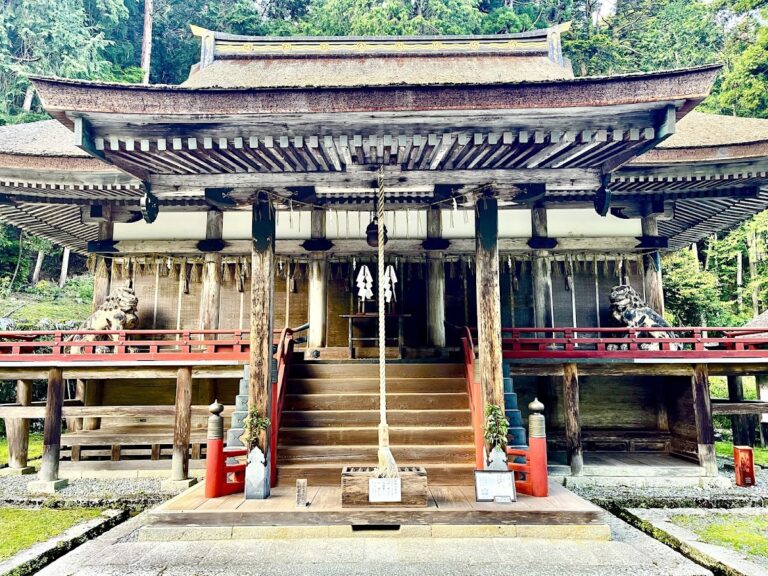
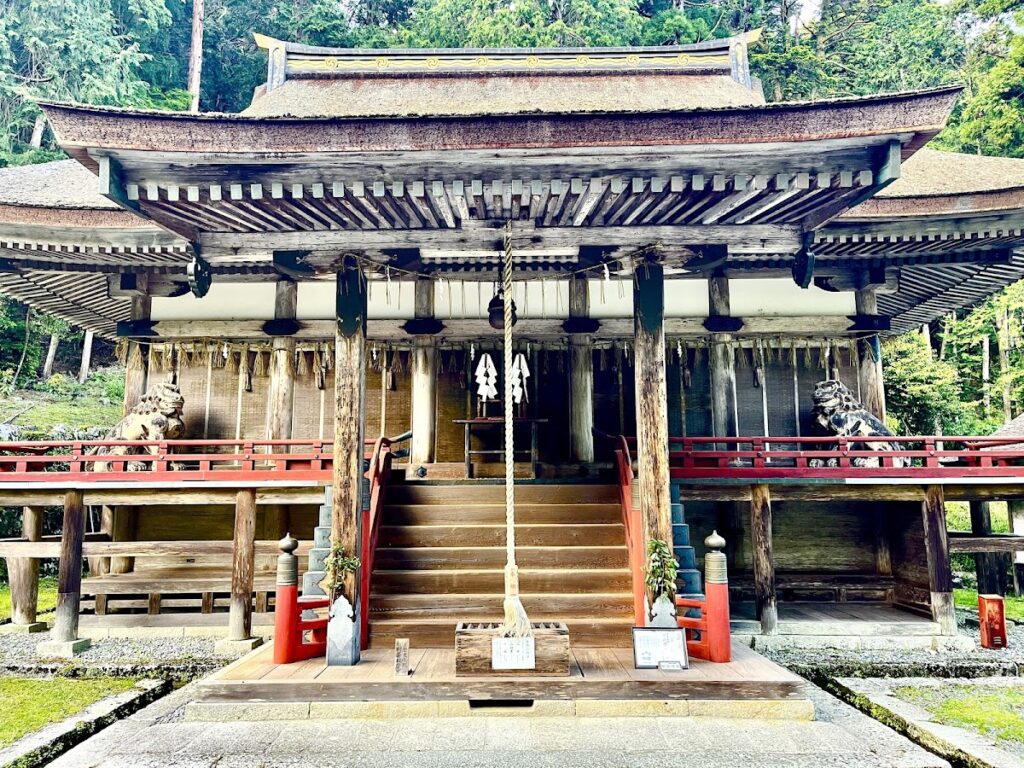
West Main Shrine Main Hall (National Treasure)
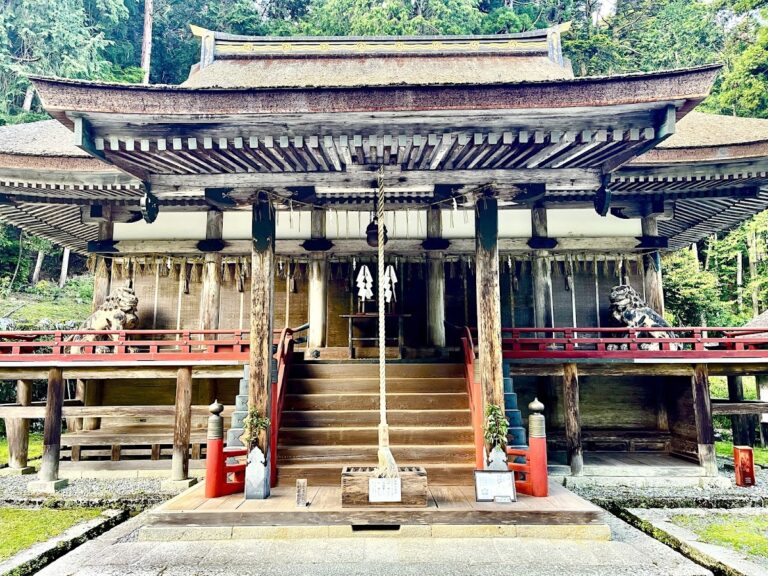
The West Main Shrine Main Hall is one of the central shrine buildings of Hiyoshi Taisha, dedicated to Ōkuninushi-no-kami. Rebuilt in 1586, this main hall features a unique architectural style called “Hiyoshi-zukuri” and is designated a National Treasure.
The Hiyoshi-zukuri style is characterized by a gabled main hall with an overhanging eaves and a separate roof above it. This style is unique to Hiyoshi Taisha and holds an important position in the history of shrine architecture. The cypress bark roof and vermilion-painted pillars harmonize beautifully, conveying the architectural beauty of the Momoyama period.
West Main Shrine Tower Gate (Important Cultural Property)
The vermilion tower gate standing in front of the West Main Shrine was rebuilt in 1586 and is designated an Important Cultural Property. It is a two-story building with a hipped roof, and its vibrant vermilion color is striking.
A particularly noteworthy feature of this gate is the monkey carvings on the gable. At Hiyoshi Taisha Shrine, monkeys have been revered since ancient times as divine messengers (sacred monkeys, or “masaru”), and are considered auspicious symbols associated with “warding off evil” and “overcoming.” The monkey carvings on the gate symbolize this belief.
East Main Shrine Area
East Main Shrine Main Hall (National Treasure)
The East Main Shrine Main Hall enshrines Oyamakui-no-kami and is the center of Hiyoshi Taisha Shrine’s original faith. Rebuilt in 1595, this main hall also exhibits the Hiyoshi architectural style and is designated a National Treasure.
While its structure is almost identical to the West Main Shrine Main Hall, differences in the details of the design are evident, and comparing the two halls allows one to appreciate the high level of architectural technology of the Momoyama period. The East Main Shrine is a sacred site directly connected to the mountain worship of Mount Hiei, and it preserves an older form of faith.
East Main Shrine Gate (Important Cultural Property)
The East Main Shrine Gate, rebuilt in 1595, is also an Important Cultural Property. While it shares a similar structure with the West Main Shrine Gate, it exhibits unique details in its decorations and carvings.
Sanno Torii
The Sanno Torii is a distinctive torii gate symbolizing Hiyoshi Taisha Shrine. It features a gable-like, clasped-hands-shaped decoration at the top of a typical torii gate, and is also called a “clasped-hands torii.”
This shape is said to represent the unification of the Womb Realm and Diamond Realm in Buddhism, or to symbolize the shape of a mountain, making it a valuable relic that conveys the history of Shinto-Buddhist syncretism. There are several Sanno Torii within the shrine grounds, forming an iconic landscape of Hiyoshi Taisha Shrine.
Hiyoshi Three Bridges
Three beautiful bridges span the stream flowing through the shrine grounds. The Omiya Bridge, Ninomiya Bridge, and Hashirii Bridge are collectively known as the “Hiyoshi Three Bridges,” and all are designated as Important Cultural Properties.
The Omiya Bridge, in particular, is a granite arched bridge and is considered a masterpiece of stone bridge architecture from the Muromachi period. The bridge’s scenery, surrounded by a clear stream and lush greenery, is beautiful throughout the seasons, and is especially spectacular during the autumn foliage season.
Sacred Monkey House
At Hiyoshi Taisha Shrine, monkeys are revered as messengers of the gods, and within the shrine grounds is a sacred monkey house where sacred monkeys (masaru) are actually kept. Visitors can admire the sacred monkeys, find solace in their adorable appearance, and are believed to receive protection from evil.
The name “masaru” (神猿) is read as “sacred monkey” and carries the meanings of “warding off evil” and “surpassing all things,” making them cherished as auspicious beings.
Cultural Properties of Hiyoshi Taisha Shrine
National Treasure Buildings
Hiyoshi Taisha Shrine has two national treasure buildings.
- West Main Shrine (Rebuilt in 1586): A representative example of Hiyoshi-style architecture
- East Main Shrine (Rebuilt in 1595): The central shrine of mountain worship
Both are valuable relics that convey the architectural style of the Momoyama period and occupy an important position in the history of Japanese shrine architecture.
Important Cultural Properties
Hiyoshi Taisha Shrine has numerous important cultural properties, numbering over a dozen buildings alone.
Buildings
- West Main Shrine Gate
- East Main Shrine Gate
- Hiyoshi Three Bridges (Omiya Bridge, Ninomiya Bridge, Hashirii Bridge)
- Shrine buildings of each subsidiary shrine
Art and Crafts
- Portable Shrine
- Divine Statues
- Ancient Documents
- Swords
These cultural properties are valuable materials that tell the story of Hiyoshi Taisha Shrine’s long history and the depth of its faith.
Designated Historic Site
Most of the shrine grounds are designated as a national historic site, protecting its historical landscape. The shrine grounds, seamlessly integrated with the natural beauty of Mount Hiei, convey the atmosphere of a place of worship that has continued since ancient times.
Main Festivals and Annual Events
Sanno Festival (April 12th-14th)
The most important festival of Hiyoshi Taisha Shrine is the Sanno Festival, held every April. This festival is considered one of the “Three Great Festivals of Lake Biwa” and is said to have a history of over 1200 years.
The highlight of the festival is the portable shrine procession, where seven portable shrines are carried down Mount Hiei and then crossed Lake Biwa by boat in a magnificent ritual. As the slogan “Portable shrines running down the mountain and crossing the lake” suggests, it is a unique festival that fuses mountain worship and water worship.
In particular, the “Yoimiyaotoshi Ritual” (evening descent ritual) features a magnificent scene of the portable shrines being carried down a steep stone staircase, captivating many spectators.
Autumn Leaves Festival (November)
During the autumn foliage season, approximately 3,000 maple trees on the temple grounds change color, making it one of the most famous autumn foliage spots in the Kansai region. During the Autumn Leaves Festival, the trees are illuminated at night, allowing visitors to enjoy a magical view.
Known since ancient times as “Hiyoshi of the Maple Leaves,” Hiyoshi Taisha Shrine’s autumn leaves were celebrated in poetry by poets of the Heian period. The combination of the stream flowing through the temple grounds and the autumn leaves is a quintessential Japanese autumn landscape, attracting many photographers and tourists.
Other Major Festivals
- Setsubun Festival (February 3rd): Bean-throwing and prayers for warding off evil
- Otaue Festival (May): A Shinto ritual praying for a bountiful harvest
- Oharai Ceremony (June 30th, December 31st): A Shinto ritual to cleanse away the sins and impurities accumulated over the past six months
- Reisai Festival (October): A festival expressing gratitude for the autumn harvest
Various festivals are held throughout the year, making it the center of the religious life of the local people.
Deities and Blessings
Deities of the West Main Shrine
Ōnamuchi-no-kami
Another name for Ōkuninushi-no-kami, known as the god of nation-building. Believed to bring blessings for matchmaking, business prosperity, and good fortune.
Deity enshrined at Higashi Hongu
Oyamakui-no-kami
Revered as the god of mountains and water, and the guardian deity of Mount Hiei. Believed to offer protection against misfortune, warding off evil, and ensuring family safety.
Benefits of Hiyoshi Taisha Shrine
Hiyoshi Taisha Shrine is particularly known for the following benefits:
- Protection from evil and misfortune: As a shrine protecting the northeast (demon’s gate) of Heian-kyo (ancient Kyoto)
- Family safety: “Evil spirits depart” due to the belief in sacred monkeys
- Business prosperity: Divine virtue of Ōkuninushi-no-kami
- Matchmaking: Faith in Ōkuninushi-no-kami
- Good fortune and prosperity: As the head shrine of Sannō worship
Access and Visiting Information
Location
5-1-1 Sakamoto, Ōtsu City, Shiga Prefecture 520-0113
Transportation Access
Access by train
- Approximately 20 minutes on foot from JR Kosei Line “Hieizan Sakamoto Station”
- Approximately 10 minutes on foot from Keihan Ishiyama Sakamoto Line “Sakamoto Hieizanguchi Station”
From Kyoto, the Keihan Railway is convenient, and from Sakamoto Hieizanguchi Station, you can stroll through the temple town of Sakamoto while visiting the shrine.
Access by Car
- Approximately 20 minutes from the Kyoto East Interchange on the Meishin Expressway
- Approximately 5 minutes from the Sakamoto North Interchange on the Kosei Road
There is a paid parking lot on the temple grounds (approximately 50 spaces). It gets crowded during the autumn foliage season and festivals, so using public transportation is recommended.
Visiting Hours and Admission Fees
Visiting Hours
- 9:00 AM – 4:30 PM (may vary depending on the season)
Admission Fees
- Adults: 300 yen
- Children: 150 yen
While there is an admission fee to the temple grounds, it is very reasonable considering the vast grounds and the numerous cultural artifacts you can see.
Estimated Time Required for Visiting
The temple grounds are very large, and a thorough visit will require 2-3 hours. Even if you only visit the main shrine buildings, allow at least 1 hour.
If you plan to visit Sakamoto in conjunction with other nearby attractions such as the temple town of Sakamoto and Hiyoshi Toshogu Shrine, we recommend allocating about half a day.
Nearby Tourist Attractions
Sakamoto Temple Town
The Sakamoto district, which flourished as a temple town for Hiyoshi Taisha Shrine, retains a beautiful townscape of stone walls. The stonework technique known as “Sakamoto’s Anō-shū style” is a highly advanced technique also used in the construction of castles during the Sengoku period, and you can see magnificent stone walls everywhere you walk through the town.
Hiyoshi Toshogu Shrine
Adjacent to the grounds of Hiyoshi Taisha Shrine is Hiyoshi Toshogu Shrine, dedicated to Tokugawa Ieyasu. It is said to be the prototype of Nikko Toshogu Shrine and preserves the magnificent architectural style of the Momoyama period.
Enryaku-ji Temple on Mount Hiei
Enryaku-ji Temple on Mount Hiei can be accessed from Hiyoshi Taisha Shrine in about 30 minutes by taking a cable car and then a ropeway. Enryaku-ji Temple, the head temple of the Tendai sect, has deep historical ties to Hiyoshi Taisha Shrine and is a must-visit spot.
Lake Biwa
The Sakamoto area is located on the shores of Lake Biwa, offering beautiful lake views. From the walking paths along the lake, you can enjoy views of the mountains on the opposite shore and boats on the lake, experiencing the scenery of each season.
Points and Manners for Visiting the Shrine
Order of Visiting
While it’s common to begin visiting the West Main Shrine at Hiyoshi Taisha, the East Main Shrine is officially the center of ancient worship. If you have time, respectfully visit both main shrines.
There are also numerous subsidiary shrines within the grounds, each enshrining a different deity. If you are interested in any of these shrines, it’s a good idea to visit them as well.
Photography
Photography is generally permitted within the grounds, but there may be restrictions on photography inside the shrine buildings or during festivals. Please follow the instructions of the staff and be considerate of other visitors.
Clothing and Belongings
The shrine grounds are spread across a mountainside, so there are many stone steps and slopes. We recommend wearing comfortable shoes and clothing suitable for walking. Especially during the autumn foliage season, it gets crowded, so please plan your visit with plenty of time to spare.
Summary: The Charm of Hiyoshi Taisha Shrine
Hiyoshi Taisha Shrine, with its 2100-year history, is the head shrine of over 3800 shrines nationwide and one of the central figures in Japanese Shinto worship. Its location at the foot of Mount Hiei, its role in protecting the northeast (demon’s gate) of Heian-kyo (Kyoto), its deep connection with the Tendai sect, and its history of syncretism of Shinto and Buddhism make it a rare sacred site where a multi-layered history of faith intertwines.
National treasure shrine buildings, important cultural property buildings, unique scenery such as the Sanno Torii gate and Hiyoshi Sanbashi bridges, the worship of sacred monkeys, the magnificent Sanno Festival, and the natural beauty of the four seasons—Hiyoshi Taisha Shrine is filled with diverse attractions that captivate visitors.
When visiting Kyoto or Otsu, be sure to stop by Hiyoshi Taisha Shrine and experience its timeless history and sacred atmosphere. Listen to the soothing sound of the pure water flowing through the grounds and feel the presence of the gods as people of ancient times perceived it.
Offering blessings for protection against misfortune and evil, Hiyoshi Taisha Shrine offers a refreshing experience for both mind and body, making it an important spiritual haven for us living in the modern age.