
Hofu Tenmangu Shrine Complete Guide | History, Blessings, and Visiting Information for Japan’s First Tenjin Shrine
What is Hofu Tenmangu Shrine?
Hofu Tenmangu Shrine, located in Matsuzaki-cho, Hofu City, Yamaguchi Prefecture, is a shrine dedicated to Sugawara no Michizane, known as the god of learning. Founded in 904 AD (Engi 4), it holds a special place among the approximately 12,000 Tenmangu shrines nationwide as the “First Tenjin Shrine in Japan” (Fusō Kanbyō Saisho).
Alongside Kitano Tenmangu Shrine in Kyoto and Dazaifu Tenmangu Shrine in Fukuoka, it is considered one of the “Three Great Tenjin Shrines of Japan” and is a leading tourist spot in Yamaguchi Prefecture, attracting many visitors throughout the year.
Hofu Tenmangu Shrine is one of the “Three Great Tenjin Shrines of Japan,” and along with Kitano Tenmangu Shrine in Kyoto and Dazaifu Tenmangu Shrine in Fukuoka, it is a popular tourist destination in Yamaguchi Prefecture. ### Basic Information on Hofu Tenmangu Shrine
Location: 14-1 Matsuzaki-cho, Hofu City, Yamaguchi Prefecture 747-0029
Phone: 0835-23-7700
Shrine Rank: Former Prefectural Shrine, currently a Special Shrine of the Association of Shinto Shrines
Main Deity: Sugawara no Michizane
Founded: Engi 4 (904)
History and Origin of Hofu Tenmangu Shrine
The Connection Between Sugawara no Michizane and Hofu
The history of Hofu Tenmangu Shrine dates back to January of Shotai 4 (901). Sugawara no Michizane, who was unjustly demoted to Dazaifu Gon no Sochi (Provisional Governor-General of Dazaifu) due to slander by the powerful Fujiwara no Tokihira, stopped at Katsumagaura in Suo Province (present-day Katsumagaura area of Hofu City) on his way from Kyoto to Kyushu.
It is said that in this place, Sugawara no Michizane received warm hospitality from the local people and declared, “Though my body may perish in Tsukushi, my soul will surely return to this land.” These words became the origin of the founding of Hofu Tenmangu Shrine.
A Mysterious Founding Story
On February 25th, 903 (Engi 3), when Michizane passed away in Dazaifu, a divine light appeared that night over Katsuma Bay in Hofu, and auspicious clouds drifted over Sakatareyama (the mountain where the Tenmangu Shrine now stands).
Following this mystical event, in the following year, 904 (Engi 4), a shrine was built on Sakatareyama to enshrine the spirit of Michizane. This marked the founding of Hofu Tenmangu Shrine, the first Tenmangu shrine in Japan dedicated to Sugawara no Michizane.
Reverence from Successive Lords
During the Edo period, the shrine received deep reverence from successive lords of the Hofu domain, including the Mori clan, and the shrine buildings were repeatedly constructed and repaired. The current magnificent vermilion-lacquered shrine buildings, in particular, convey this tradition to the present day.
Benefits of Hofu Tenmangu Shrine
Faith as the God of Learning
The most famous benefit of Hofu Tenmangu Shrine is the granting of academic success and passing exams. Sugawara no Michizane was known as a child prodigy from a young age and left behind outstanding achievements as a scholar and politician. Seeking to emulate his knowledge and talent, students and those preparing for exams visit from all over the country.
The shrine grounds are overflowing with ema (votive tablets) praying for success in exams and academic achievements, each bearing a wealth of wishes. After passing their exams, many people visit to offer thanks by dedicating ema or returning their headbands.
Other Diverse Blessings
Besides academic success, Hofu Tenmangu Shrine is believed to offer the following blessings:
- Prayers for Safe Childbirth: It is also revered as a god of safe childbirth.
- Business Prosperity: Many visitors pray for business success and prosperity.
- Exorcism: People visit to ward off evil during their unlucky years.
- Family Safety: Prayers are offered for the health and happiness of the family.
- Traffic Safety: Car blessings are also available.
Highlights of the Shrine Grounds
Romon Gate
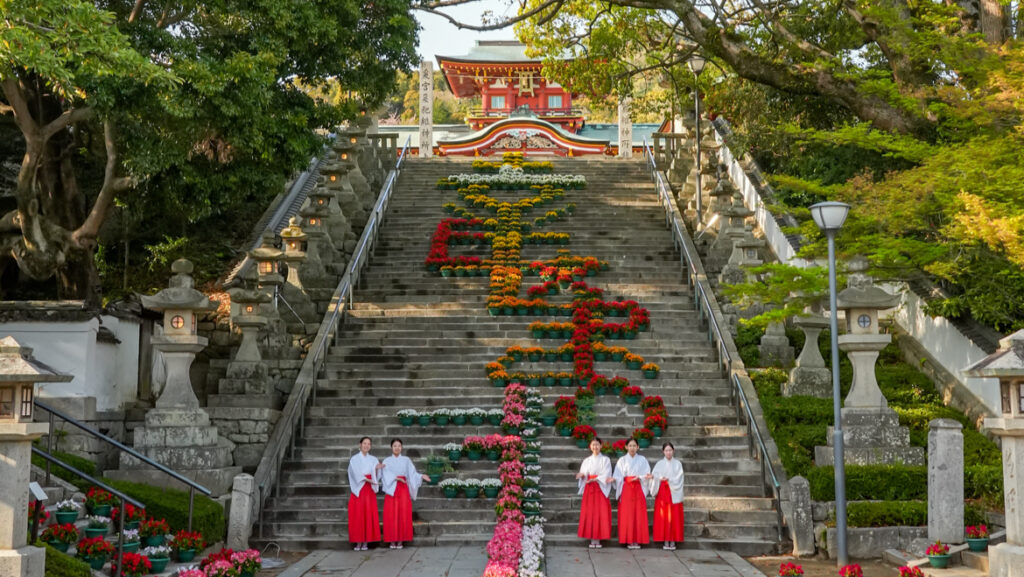
The vermilion-lacquered Romon Gate, a symbol of Hofu Tenmangu Shrine, stands majestically at the end of the approach to the shrine. Its vibrant vermilion color stands out against the blue sky, welcoming visitors. Passing through this gate leads to the sacred grounds.
Main Hall and Worship Hall
The magnificent vermilion-lacquered shrine buildings speak to the high status of Hofu Tenmangu Shrine. The main hall, adorned with intricate carvings and decorations, leaves a deep impression on visitors. In the worship hall, many worshippers offer prayers for academic success and passing exams.
Shunpu-ro (Spring Breeze Pavilion)
Located on a hill within the shrine grounds, Shunpu-ro offers panoramic views of Hofu city and the Seto Inland Sea. Especially on clear days, the scenery is beautiful, allowing visitors to relax and enjoy the view after their prayers.
History Museum and Treasure Hall
The Hofu Tenmangu History Museum displays items related to Sugawara no Michizane and valuable cultural artifacts passed down through the shrine. Visitors can view materials that tell the history of Hofu Tenmangu, such as the “Matsuzaki Tenjin Engi Emaki” (Illustrated Scroll of the Origins of Matsuzaki Tenjin Shrine), gaining a deeper understanding of the shrine’s history.
Kanko-byo (Sugawara no Michizane Shrine)
Located at the back of the shrine grounds is the Kanko-byo, where the spirit of Sugawara no Michizane is enshrined. Visitors can offer their prayers in a tranquil atmosphere.
Approach to the Shrine and Torii Gates
The approach to Hofu Tenmangu Shrine is lined with numerous torii gates. Walking along the stone-paved path, you can gradually feel yourself entering a sacred space. Souvenir shops and restaurants line the path, offering plenty of enjoyment after your visit.
Annual Events and Festivals
New Year’s Visit
Hofu Tenmangu Shrine’s New Year’s visit is one of the largest in Yamaguchi Prefecture. Every year at midnight on New Year’s Day, the “first drum” is struck, and the large doors are opened. Many worshippers visit to make their first visit of the new year, creating a lively atmosphere.
Approximately 400,000 worshippers visit during the first three days of the year alone, praying for academic success, passing exams, family safety, and more.
Goshinkosai (Divine Procession) “Hadakabo Matsuri”
The most famous festival at Hofu Tenmangu Shrine is the Goshinkosai, commonly known as the “Hadakabo Matsuri,” held on the fourth Saturday of November. This festival is a traditional event with over a thousand years of history and is known as one of the most boisterous festivals in Western Japan.
Approximately 5,000 men in white robes (Hadakabo) parade through the city carrying a portable shrine called a Miajirokoshi, chanting “Kyodai Wasshoi!” At night, the shrine and the Hadakabo illuminated by lanterns create a fantastical atmosphere.
Girls called “Hanamiko,” dressed in colorful costumes, also participate in the festival, adding to its splendor.
Tenjin Market
Every 25th of the month (the anniversary of Sugawara no Michizane’s death), the “Tenjin Market” is held on the temple grounds. Antiques, handmade goods, and local agricultural products are on display, attracting both locals and tourists.
Other Main Events
- Plum Blossom Festival (late February to early March): Held when the plum blossoms on the temple grounds are in full bloom.
- Summer Purification Festival (June 30th): A ritual of passing through a straw ring to purify oneself of the impurities accumulated over the past six months.
- Chrysanthemum Exhibition (November): A magnificent display of chrysanthemums.
- New Year’s Eve Festival (December 31st): A festival marking the end of the year.
Goshuin (Temple Seals) and Amulets
Goshuin Information
At Hofu Tenmangu Shrine, you can receive beautiful goshuin (temple seals). In addition to regular goshuin, seasonal limited-edition goshuin are also available, making it popular among goshuin collectors.
The Goshuincho (stamp book) at Hofu Tenmangu Shrine also features original designs, including plum blossoms and motifs related to Sugawara no Michizane.
Amulets and Souvenirs
A variety of souvenirs are available, including amulets for academic success, pencils for passing exams, and ema (votive tablets). The shrine office is especially bustling during exam season with visitors seeking “success amulets” and “academic success amulets.”
In addition, amulets for various blessings, such as safe childbirth and traffic safety, are also available.
Access
Access by Train
From JR Sanyo Main Line “Hofu Station”:
- Approximately 15 minutes on foot
- Approximately 5 minutes by taxi
- Immediately after alighting at “Hofu Tenmangu” bus stop (Bocho Bus)
From Hofu Station, there are well-maintained signs directing you to the shrine, so you can arrive without getting lost.
Access by Car
From the Sanyo Expressway:
- Approximately 10 minutes from Hofu East IC
- Approximately 10 minutes from Hofu West IC
From the Kitakyushu area: It is convenient to take the Sanyo Expressway and exit at Hofu East IC.
Parking Information
Hofu Tenmangu Shrine has several parking lots for visitors:
- Parking Lot 1 (around the shrine grounds)
- Parking Lot 2
- Temporary Parking Lot (during New Year’s visits and major festivals)
During busy periods such as New Year’s visits and the Mikoshi Festival, temporary parking lots are opened, but using public transportation is recommended.
Nearby Tourist Attractions
Hofu City Machi-no-Eki “Umeterrace”
A tourist exchange facility within walking distance of Hofu Tenmangu Shrine. You can purchase local specialties and souvenirs, and obtain tourist information.
Mori Clan Garden & Mori Museum
A museum showcasing a beautiful Japanese garden designated as a national scenic spot and valuable cultural artifacts passed down through the Mori family. Located approximately 10 minutes by car from Hofu Tenmangu Shrine.
Hofu City Cultural Properties and Local History Museum
A museum where you can learn about the history and culture of Hofu. Artifacts excavated from the Suo Provincial Government site are also on display.
Amida-ji Temple
An ancient temple famous as a hydrangea temple. In June, approximately 4,000 hydrangea plants of about 80 varieties bloom.
Manners and Points for Visiting a Shrine
Etiquette for Visiting a Shrine
- Bow before passing through the torii gate: This is a courtesy before entering the sacred area.
- Purify yourself at the water basin: Purify your left hand, then your right hand, then your mouth.
- Walk along the edge of the path: The center is considered the path of the gods.
- Two bows, two claps, one bow: This is the basic etiquette for visiting a shrine.
Recommended Time to Visit
Weekday mornings are relatively uncrowded, allowing for a peaceful visit. Weekends, holidays, and exam seasons are expected to be crowded, so it is recommended to visit with plenty of time to spare.
Regarding Attire
While there are no strict dress code regulations, it is desirable to dress appropriately for a sacred place like a shrine. For New Year’s visits or when receiving prayers, overly casual attire is preferable.
Special Experiences at Hofu Tenmangu Shrine
Prayers
You can receive various prayers, such as prayers for academic success, passing exams, safe childbirth, and protection from evil. Reservations are not required and prayers are accepted at any time, but advance notice is recommended for groups.
Shinto Wedding Ceremony
At Hofu Tenmangu Shrine, you can hold a traditional Shinto wedding ceremony. The ceremony, held in a solemn atmosphere, is a special experience befitting the beginning of a new life.
Tea Ceremony Experience
There is also a tea ceremony room on the shrine grounds, where you can experience traditional Japanese culture (reservations required; varies by season).
The Four Seasons of Hofu Tenmangu Shrine
Spring (March-May)
The shrine grounds have approximately 1,100 plum trees, which are in full bloom from late February to early March. The sight of white and red plum blossoms in full bloom is breathtaking, and a plum blossom festival is held. During cherry blossom season, the contrast between the cherry blossoms and the vermilion-lacquered shrine buildings creates a beautiful scene. ### Summer (June-August)
A beautiful season of fresh greenery. The Natsukoshi Festival on June 30th features the Chino-wa Kuguri (passing through a ring of reeds). The shrine grounds offer plenty of shade, making it relatively cool even in summer.
Autumn (September-November)
The highlight is the Goshinkosai (Naked Man Festival) in November. A chrysanthemum exhibition is also held, allowing visitors to enjoy a magnificent display of chrysanthemums. During the autumn foliage season, the trees on the shrine grounds begin to change color.
Winter (December-February)
The New Year is welcomed with the lively atmosphere of Hatsumode (first shrine visit of the year). A quiet visit in the crisp winter air is also recommended. Early-blooming plum blossoms begin to bloom in February, signaling the arrival of spring.
Hofu Tenmangu Shrine’s Connection to the Community
Hofu Tenmangu Shrine is not merely a tourist spot; it is deeply connected to the local community as a spiritual haven for the citizens of Hofu. Hofu Tenmangu Shrine is a beloved place visited across generations for important life events such as New Year’s visits, Shichi-Go-San (a traditional rite of passage for children), and prayers for success in exams.
The shrine’s procession involves the entire community, preserving a tradition that has continued for over a thousand years. It also contributes to community building through events such as the Tenjin Market.
Summary
Hofu Tenmangu Shrine boasts a history of over 1,100 years as Japan’s first Tenmangu shrine, and the devotion to Sugawara no Michizane, the god of learning, remains strong today. The magnificent vermilion-lacquered shrine buildings, the view from the Shunpu-ro (Spring Breeze Pavilion), and the various events held throughout the year leave a deep impression on visitors.
In addition to prayers for academic success and passing exams, the shrine offers a variety of blessings, including prayers for safe childbirth and business prosperity, attracting worshippers from all over Japan, not just the local area. The procession in November (Naked Man Festival) is a must-see, considered one of the most boisterous festivals in Western Japan.
When you visit Yamaguchi Prefecture, be sure to stop by Hofu Tenmangu Shrine and experience the history, traditions, and sacred atmosphere of Japan’s first Tenjin shrine. Students taking exams should visit to pray for success, and after passing, they should visit again to express their gratitude for the protection of Sugawara no Michizane.

