Honjo Hachimangu Shrine (Kurashiki City, Okayama Prefecture) Complete Guide | History, Cultural Properties, and Visiting Information
About Honjo Hachimangu Shrine
Honjo Hachimangu Shrine is a historic shrine located in Kojima Kayō, Kurashiki City, Okayama Prefecture. Situated on the summit of Miyayama Mountain overlooking Mizushima Sea, it is known as an ancient shrine said to have been founded in 701 AD.
It holds the rank of a village shrine and, during the Heian period, served as the guardian shrine for 12 villages in the Kayō-shō estate of Bizen Province, attracting local devotion. The place name Honjo is thought to originate from “Honjo,” the central estate of the Kayō-shō estate.
Currently, its stone torii gate, which exhibits the style of the early Muromachi period, is designated as a National Important Cultural Property, and the shrine is attracting attention for its high academic value as a benchmark work in the study of stone torii gates nationwide.
Deities and Divine Virtues
Main Deities
Honjo Hachimangu Shrine enshrines three deities central to Hachiman worship.
Honda-wake no Mikoto
The divine name of Emperor Ojin, the 15th emperor, and the principal deity of Hachiman. He is revered as the god of military fortune and victory, and is also believed to bestow divine virtues upon industrial development and cultural advancement.
Tarashinakatsuhiko no Mikoto
The divine name of Emperor Chuai, the 14th emperor. Known as the god of courage and decisiveness, he is believed to grant the strength to face difficulties.
Okinagatarashihime no Mikoto
The divine name of Empress Jingu, the mother of Emperor Ojin. She is widely worshipped as the goddess of safe childbirth, child-rearing, and protection of women.
Divine Virtues
- Long-lasting military fortune and victory
- Family safety and protection from misfortune
- Prayers for safe childbirth and protection of children
- Business prosperity and success
- Academic success and passing exams
History of Honjo Hachimangu Shrine
Founding and Ancient History
Honjo Hachimangu Shrine is said to have been founded in 701 AD (Taiho 1), through the invitation of a deity from Usa Shrine in Buzen Province (present-day Usa Jingu Shrine in Oita Prefecture). This period, the early Nara period, was a time when the Ritsuryo state was being established, and it is believed that the shrine was founded during the process of the central Hachiman faith spreading to the provinces.
Records show that during the Enryaku era (782-806 AD), divine land was donated and distributed as a reward for suppressing bandits in the region. This is a valuable historical document indicating that the imperial court recognized Honjo Hachimangu Shrine as an important shrine.
Development in the Middle Ages
From the Heian period to the Kamakura period, Honjo Hachimangu Shrine became the central shrine of local faith, serving as the guardian shrine for the 12 villages of Tsusho-sho. It adopted a form of syncretism of Shinto and Buddhism, with priests from the Jinguji temple serving as attendants, and functioned as a spiritual pillar of the region.
During the Koan era (1278-1288), the shrine was granted land, establishing its economic base. It is believed that the prototype of the current shrine building was established during this period.
Relationship with the Battle of Mizushima between the Minamoto and Taira Clans
From Miyayama, where Honjo Hachimangu Shrine is located, one can see a panoramic view of Mizushima-nada, the site of the Battle of Mizushima between the Minamoto and Taira Clans. This naval battle, fought in 1183, is known as an important battle in which the Taira clan defeated the Minamoto clan.
At that time, Honjo Hachimangu Shrine was located in a position to observe the battle, and it is said that the generals of both sides prayed for victory there. Given this historical background, Honjo Hachimangu Shrine’s reputation as a god of military fortune grew stronger.
The Trials of the Sengoku Period
During the Tensho era (1573-1592), Honjo Hachimangu Shrine was greatly affected by the turmoil of the Sengoku period. In particular, in 1582, as a preliminary battle to Hashiba Hideyoshi’s (later Toyotomi Hideyoshi) attack on Bitchu Takamatsu Castle, the nearby Minatoyama Castle was attacked, and the shrine’s buildings are said to have suffered damage.
However, thanks to the deep faith of the local people, reconstruction progressed even after the war, and during the Edo period, it regained its position as a central shrine in the region.
From the Early Modern to the Modern Period
From the Keicho era (1596-1615) onward, under the stable rule of the Edo Shogunate, Honjo Hachimangu Shrine established a firm position as the guardian shrine of the region. Regular festivals were held, and the annual grand festival on the second Sunday of the ninth month of the lunar calendar was the largest and most lively event in the region. With the Meiji-era decree separating Shinto and Buddhism, the previous system of shrine priests serving the shrine came to an end, and independent operation as a Shinto shrine began. During the Meiji period, it was ranked as a local shrine, establishing its official position as an important regional shrine.
Important Cultural Property (National Designation)
Honjo Hachimangu Stone Torii Gate
The most culturally valuable structure at Honjo Hachimangu Shrine is the stone torii gate, designated as a National Important Cultural Property.
Date of Designation: June 9, 1951
Architectural Style: Myojin Torii (a type of shrine gate)
Construction Period: Early Muromachi period (first half of the 14th century)
Features:
This stone torii gate is a valuable structure that typically exhibits the style of the early Muromachi period and is known as a benchmark for contemporary stone torii gates throughout Japan. Made of granite, this torii gate perfectly embodies the characteristics of the early Muromachi period in every aspect, from the thickness of the pillars to the balance of the lintel and crossbeam, and the position of the crossbeam.
Originally standing as the third torii gate on the approach to the shrine, it has now been relocated and preserved in a different location within the shrine grounds. Regular preservation and repair work is carried out to prevent deterioration from wind and rain, ensuring that its history of over 600 years is preserved to the present day.
Academic Value:
The stone torii gate of Honjo Hachimangu Shrine is considered an important comparative example in the dating of stone torii gates throughout Japan. It is frequently cited in academic papers and research books as a benchmark work of the early Muromachi period in the study of architectural history and the history of stone art.
Kurashiki City Designated Tangible Cultural Property
Main Hall
The main hall of Honjo Hachimangu Shrine is designated as a Kurashiki City Designated Tangible Cultural Property.
Architectural Style: Sangensha Nagare-zukuri (Three-Bay Nagare-zukuri Style)
Construction Period: Mid-Edo Period (Estimated)
The Sangensha Nagare-zukuri style is a nagare-zukuri style with a facade measuring three bays (approximately 5.4 meters), and is one of the most prestigious styles of Hachiman shrine architecture. The roof is covered with cypress bark shingles, and the portico features elaborate carvings.
Inside the main hall is an inner sanctuary where the sacred object is enshrined, and its decorations represent the pinnacle of Edo period craftsmanship. Regular restorations have preserved its original beauty.
Other Cultural Assets
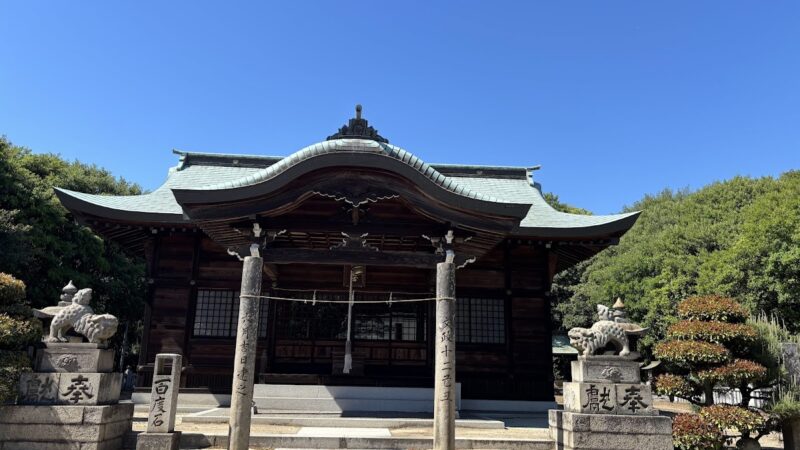
The shrine grounds also contain numerous historically valuable stone structures, including stone lanterns, guardian lion-dogs, and a purification fountain dating from the Edo to Meiji periods. These are carefully preserved as valuable cultural heritage that tells the history of the region.
Highlights of the Shrine Grounds
Approach and Stone Steps
The approach to Honjo Hachimangu Shrine is characterized by a long stone staircase leading from the foot of Miyayama Mountain. Looking back as you climb the steps, a beautiful view of Mizushima-nada unfolds, known since ancient times as the “view of Kojima.”
On both sides of the approach, stone lanterns donated from the Edo period to the early Showa period are neatly lined up, conveying the shrine’s status and historical weight.
Worship Hall
Located in front of the main shrine, the worship hall is where worshippers offer their prayers. It is a magnificent building with a hipped roof, and votive tablets and votive plaques are displayed inside.
From the worship hall, you can admire the elegant form of the main shrine, and the solemn atmosphere, especially when the morning sun shines in, is exceptional.
Shrine Office and Reception Area
The shrine office on the grounds provides goshuin (shrine stamps) and accepts requests for various prayers. Amulets and talismans are also available, with amulets for warding off evil and ensuring safe childbirth being particularly popular among locals.
Shrines within the Precincts
Several subsidiary shrines (subsidiary shrines and minor shrines) are enshrined around the main shrine. Each embodies local beliefs and history, and people can be seen visiting them in addition to the main shrine.
Annual Events and the Grand Festival
Grand Festival (Autumn Grand Festival)
Date: Second Sunday of the 9th month of the lunar calendar (currently around the second Sunday of October)
The Grand Festival is the most important festival of Honjo Hachimangu Shrine. It has long been cherished as the largest festival in the region, attracting many worshippers.
Various Shinto rituals and events are held, including a procession of portable shrines, dedication of sacred dances, and a children’s portable shrine procession. The local parishioners’ representatives and youth association play a central role in supporting the festival and passing on the tradition to the next generation.
First Shrine Visit of the Year
Many worshippers visit the shrine in the new year to pray for peace and safety for their families throughout the year. From January 1st to the third day, sweet sake is served and raffles are held, creating a lively atmosphere for the New Year.
Other Festivals
- Spring Grand Festival (April): A festival to pray for a bountiful harvest
- Summer Purification Ceremony (June 30th): A Shinto ritual to purify oneself of sins and impurities accumulated over the past six months
- Shichi-Go-San Festival (November): A visit to give thanks for the growth of children
- Year-End Purification Ceremony (December 31st): A Shinto ritual to purify oneself of sins and impurities accumulated over the past year and welcome the new year
Relationship with Tsusen-en Garden
To the right of the entrance to Honjo Hachimangu Shrine is a garden called Tsusen-en. This garden is known for its scenic views overlooking the Mizushima Sea and is a popular tourist spot, often visited in conjunction with a visit to Honjo Hachimangu Shrine.
From Tsusen-en Garden, you can enjoy a panoramic view of the Mizushima Sea, the site of the ancient Battle of Mizushima between the Minamoto and Taira clans, and appreciate the historical scenery. The garden is beautiful in spring with cherry blossoms and in autumn with vibrant autumn leaves, delighting visitors with its seasonal beauty.
Access and Visiting Information
Location
1133 Kojima Tsusei, Kurashiki City, Okayama Prefecture 711-0906
Transportation Access
Access by Train
- Approximately 10 minutes by car from JR Seto-Ohashi Line “Kojima Station”
- Approximately 15 minutes on foot from the “Tsusei” bus stop (accessible by bus from JR Seto-Ohashi Line “Kojima Station”)
Access by Car
- Approximately 15 minutes from Seto-Chuo Expressway “Mizushima IC”
- Approximately 10 minutes from Seto-Chuo Expressway “Kojima IC”
- Parking: Free parking available for visitors on the temple grounds
Visiting Hours
Temple grounds are open freely (Shrine office is generally open from 9:00 to 17:00)
Prayer Reception
Advance reservations are recommended for various prayers. We accept prayers for first shrine visits, Shichi-Go-San (7-5-3) celebrations, exorcism, and safe childbirth. Please inquire at the shrine office for details.
Goshuin (Shrine Seal)
Goshuin are available at the shrine office. Please bring your goshuincho (seal book) as pre-printed seals may be available.
Nearby Tourist Attractions
Former Nozaki Residence
A representative tourist attraction in the Kojima area, this was the residence of Nozaki Buzaemon, a wealthy merchant during the Edo period. Designated as a National Important Cultural Property, it boasts a magnificent Japanese garden. Approximately 15 minutes by car from Honjo Hachimangu Shrine.
Washuzan Mountain
Famous for its panoramic view of the Seto Ohashi Bridge. A representative viewpoint of the Seto Inland Sea National Park, the beauty of the sunset is particularly exceptional. Approximately 15 minutes by car from Honjo Hachimangu Shrine.
Kojima Jeans Street
The main street of Kojima, known as the birthplace of Japanese-made jeans. Many jeans shops line the street, offering plenty of shopping opportunities. Approximately 10 minutes by car from Honjo Hachimangu Shrine.
A Summary of the Charms of Honjo Hachimangu Shrine
Honjo Hachimangu Shrine, a venerable shrine with over 1300 years of history, has long been the center of faith in the Kojima district of Kurashiki City, Okayama Prefecture. Its stone torii gate, a nationally designated Important Cultural Property, is a valuable cultural asset representing Muromachi period stone architecture and is highly regarded nationwide.
Located on the summit of Miyayama Mountain overlooking Mizushima Bay, it witnessed the historical event of the Battle of Mizushima between the Minamoto and Taira clans, evoking a sense of historical romance. The three-bay nagare-zukuri style main hall, the tranquil grounds, and the scenery created by nature throughout the seasons offer peace of mind to visitors.
As the guardian shrine of the region, Honjo Hachimangu Shrine continues to attract the faith of local people. Many worshippers visit seeking various divine blessings, such as military success, family safety, and safe childbirth.
When visiting Okayama Prefecture, be sure to visit Honjo Hachimangu Shrine and experience its timeless history, culture, and divine atmosphere. Along with the beautiful scenery of the Seto Inland Sea, this will surely be a memorable pilgrimage experience.