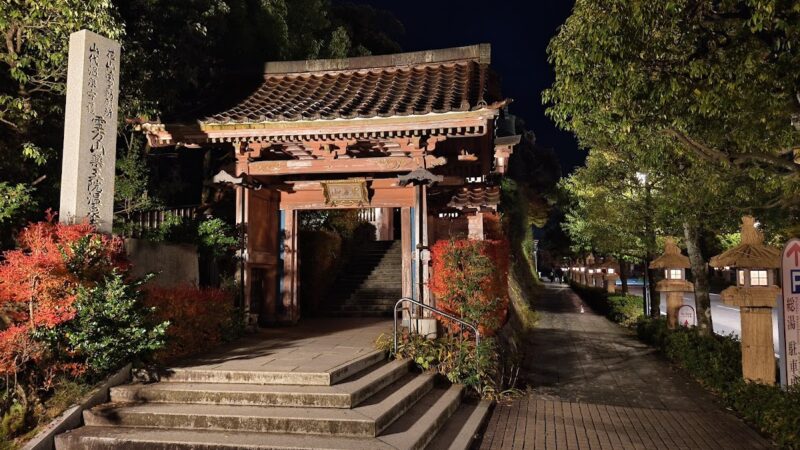
Complete Guide to Daihonzan Hōseiji Temple (Kaga City, Ishikawa Prefecture) | The History of the Giant Kannon Statue and Utopia Kaga no Sato
A colossal 73-meter-tall Kannon statue stands tall in front of Kaga Onsen Station in Kaga City, Ishikawa Prefecture. At its base stands Daihonzan Hōseiji Temple (currently operating as Kannon-in Kaga-dera Temple), which was once the central facility of a grand theme park called “Utopia Kaga no Sato,” built at a total cost of 28 billion yen. This article provides a detailed introduction to the history and current state of this magnificent project, as well as information on visiting and its highlights.
What is Daihonzan Hōseiji Temple? | Basic Information and History
Temple Overview
Daihonzan Hōseiji Temple is a Buddhist temple established in 1987 (Showa 62) in Sakumi-cho, Kaga City, Ishikawa Prefecture. Currently, it operates as an independent (Shingon sect) temple under the name “Kannon-in Kaga-dera Temple.”
Basic Data:
- Official Name: Kannon-in Kaga-dera (formerly known as Daihonzan Toyosei-ji)
- Location: 1-30 Kannon-yama, Sakumi-cho, Kaga City, Ishikawa Prefecture
- Sect: Independent (Shingon sect)
- Principal Image: Holy Kannon Bodhisattva
- Founded: 1987 (Showa 62)
- Phone Number: 0761-73-2580
Background of Construction and Utopia Kaga no Sato
Toyosei-ji was not planned as a standalone temple, but rather as the core facility of a grand Buddhist theme park concept called “Utopia Kaga no Sato.” During the bubble economy of the 1980s, while large-scale leisure facilities were being constructed throughout Japan, a major project with a total construction cost of 28 billion yen (some sources say 17 billion yen) was launched in Kaga City.
Utopia Kaga no Sato was conceived as a complex theme park with a Buddhist theme, but also featuring an amusement park, hot springs, accommodations, and restaurants. The colossal 73-meter-tall Kannon statue and Toyosei-ji Temple were built as its symbol.
The Awe-Inspiring Giant Kannon Statue | One of Japan’s Largest Scales
Details of the Kannon Statue
The Kannon statue, a symbol of the head temple Toyosei-ji, astonishes visitors with its overwhelming scale.
Specifications of the Kannon Statue:
- Height: 73 meters (including pedestal)
- Principal Image: Holy Kannon Bodhisattva
- Material: Reinforced concrete
- Completion Year: 1987 (Showa 62)
- Features: A giant white Buddha statue visible from Kaga Onsen Station
This Kannon statue is known as one of the largest Buddha statues in Japan. On a clear day, it can be seen from afar, making it a landmark of Kaga City. ### Internal Structure of the Kannon Statue
The Kannon statue is not merely an external structure; it also features worship facilities inside. The statue has multiple levels, each housing Buddhist statues and Buddhist art objects. The design allows visitors to experience various aspects of the Buddhist world as they ascend through the interior of the Kannon statue.
The Complete Picture of Utopia Kaga no Sato | The Phantom Theme Park
Facility Composition and Scale
Utopia Kaga no Sato, when it opened in 1987, was a comprehensive theme park with the following facilities:
Main Facilities:
- Toyosei-ji Temple: The central religious facility
- Giant Kannon Statue: A 73-meter-tall symbol
- Amusement Park Area: Various attractions
- Hot Spring Facility: Utilizing the hot springs of Kaga Onsenkyo
- Accommodation: Accommodation buildings for worshippers and tourists
- Restaurants: Multiple dining facilities
- Parking: A vast parking space accommodating large buses
The massive investment of 28 billion yen in total construction costs was an extremely ambitious project even at the time. The attempt to fuse Buddhist teachings with modern entertainment was ahead of its time.
Operating Period and Closure History
Utopia Kaga no Sato opened in 1987 (Showa 62), but its management deteriorated with the collapse of the bubble economy. Contrary to its initial grand vision, it struggled to attract visitors and effectively ceased operations in 1999 (Heisei 11). Its closure after only 12 years is sometimes cited as a symbolic example of the excessive investment during the bubble period.
While many of the facilities were dismantled and removed after the closure, the giant Kannon statue and Toyosei-ji Temple (now Kaga-dera Temple) remain, and operations continue, albeit on a limited basis.
Current Status of Toyosei-ji Temple (Kaga-dera Temple)
Situation Since 2022
As of 2022, most of the facilities of the former Utopia Kaga no Sato have disappeared, but Kaga-dera Temple (formerly Toyosei-ji Temple) continues to operate as a religious facility. However, its scale of operations has been significantly reduced, and it no longer has the same vibrancy as before.
Current Status:
- While the Kannon statue retains its exterior, access to the interior may be restricted.
- Basic worship as a temple is possible.
- Many surrounding facilities have been removed.
- Parking is available.
- Regular religious services and events are limited.
Aspects of Ruin and Tourist Attraction
Daihonzan Toyoseiji Temple, with its massive Kannon statue and traces of past glory, has recently attracted attention as a “ruin spot” and “B-grade tourist spot.” The contrast between its former grand plans and its current tranquil state creates a unique atmosphere.
On the other hand, it still functions as a religious facility and serves as a place of worship for the local community. When visiting, it is expected that visitors will show respect for the religious facility.
Access and Visiting Information
Transportation Access
Access by Train:
- Approximately 15-20 minutes on foot from JR Hokuriku Main Line “Kaga Onsen Station”
- The Kannon statue is visible from Kaga Onsen Station, making it easy to find your way.
Access by Car:
- Approximately 10 minutes from Hokuriku Expressway “Kaga IC”
- Approximately 15 minutes from Hokuriku Expressway “Katayamazu IC”
- Parking available (free)
Address:
1-30 Kannon-yama, Sakumi-cho, Kaga City, Ishikawa Prefecture 922-0242
Points to Note When Visiting
- Checking Business Hours: We recommend checking business hours by phone before visiting (0761-73-2580)
- Inside the Kannon Statue: Whether entry inside is permitted varies depending on the season.
- Photography: Taking photos of the exterior is generally acceptable, but consideration is needed when photographing the interior or religious scenes.
- Attire: As this is a religious site, please dress appropriately for your visit.
- Surrounding Facilities: Since the former affiliated facilities are closed, it is recommended to plan for meals and rest in advance.
Admission Fee and Visiting Hours
- Admission Fee: Generally free (donations are optional)
- Visiting Hours: Daytime is recommended. Specific times should be confirmed in advance.
- Closed Days: Irregular, so advance confirmation is recommended.
Nearby Tourist Spots and the Charms of Kaga City
Kaga Onsenkyo
Kaga City, where the head temple Hoseiji is located, is a hot spring resort known as “Kaga Onsenkyo.” It boasts four hot spring areas: Yamashiro Onsen, Yamanaka Onsen, Katayamazu Onsen, and Awazu Onsen, and has flourished as a therapeutic hot spring resort since ancient times.
Main Hot Spring Areas:
- Yamashiro Onsen: Attractive for its historical hot spring facilities, including the old public bathhouse.
- Yamanaka Onsen: Scenic valleys and a charming hot spring town atmosphere.
- Katayamazu Onsen: A hot spring resort facing Lake Shibayama.
- Awazu Onsen: A hot spring with a 1300-year history.
Historical Spots in Daishoji
Kaga City has the Daishoji district, a former castle town of the Daishoji Domain, and is recognized by the government as a historical city.
Highlights:
- Yamanoshita Temple Group: A temple district with seven temples and one shrine.
- Daishoji Castle Ruins: The site of the castle of the Daishoji Domain, a branch domain of the Kaga Domain.
- Historical Townscape: A townscape that retains the atmosphere of the Edo period.
Other Head Temples in Ishikawa Prefecture
Ishikawa Prefecture also has other famous head temples:
Daihonzan Sojiji Soin (Wajima City):
- Founded in 1321 as the head temple of the Soto Zen sect.
- After the Great Fire of 1898, the head temple relocated to Tsurumi, Yokohama City.
- Currently maintains its historical temple buildings as the Soin.
Compared to these temples, Daihonzan Toyoseiji has a shorter history and differs in scale and prestige, but its unique origins and the giant Kannon statue make it a distinctive presence within Ishikawa Prefecture.
Highlights and Photo Spots of the Head Temple Toyoseiji
Photo Spots from the Exterior
- From in front of Kaga Onsen Station: You can capture the entire Kannon statue from the station square.
- Front Approach: The view looking up at the Kannon statue is impressive.
- Parking Area: It is possible to capture both the Kannon statue and the temple architecture simultaneously.
- Distant View: Taking photos combining the Kannon statue and the Kaga landscape from the surrounding countryside is also appealing.
Architectural Highlights
The architecture of the Head Temple Toyoseiji strongly reflects the characteristics of Buddhist architecture from the 1980s:
- Reinforced Concrete Construction: A large-scale building using modern construction methods.
- White Exterior: The pure white appearance of the Kannon statue is distinctive.
- Geometric Design: A modern form that differs from traditional temple architecture.
- Vast Grounds: A vast space that evokes the remnants of its former life as a theme park.
Seasonal Appearances
- Spring: The contrast between the surrounding cherry blossoms and the Kannon statue
- Summer: The white Kannon statue standing out against the blue sky
- Autumn: The harmony of autumn leaves and the Buddha statue
- Winter: The mystical appearance of the snow-covered Kannon statue
Cultural Significance as a Legacy of the Bubble Era
A Building that Conveys the Memories of an Era
Toyosei-ji Temple and Utopia Kaga no Sato symbolize the characteristics of Japanese society during the bubble economy of the 1980s. Their history of massive investment, grand vision, and short-lived closure tells the story of the zeitgeist and economic conditions of the time.
Value in the Modern Era
In recent years, these “legacies of the bubble economy” have been re-evaluated from the following perspectives:
- Architectural Historical Value: An example demonstrating the architectural technology and aesthetics of the 1980s
- Social Historical Value: A clue to understanding Japanese society during the period of economic growth
- Tourism Resource: Potential to create new tourism value as a unique landscape
- Regional Identity: Etched in the memory of the region as part of the modern history of Kaga City
Visitor Experiences and Reviews
Voices of Actual Visitors
Visitors to the Daihonzan Hoseiji Temple have shared various impressions:
Positive Reviews:
- “Overwhelmed by the power of the giant Kannon statue”
- “A valuable place where you can feel the traces of the grand dreams of the bubble era”
- “Close to Kaga Onsen Station and easily accessible”
- “A unique spot that is great for photos”
Points to Note:
- “Many of the former facilities are closed, creating a desolate atmosphere”
- “Interior tours may be restricted”
- “Few restaurants or rest facilities in the surrounding area”
- “Operating status is unclear, so prior confirmation is necessary.”
Introduction in Travelogues and Blogs
In travelogue websites and blogs, the head temple Hoseiji is often introduced as an “unusual spot” or “B-grade tourist destination,” and its unique atmosphere attracts curious travelers. Many detailed reports with photos are posted on travelogue websites such as FourTravel, which are helpful for gathering information before visiting.
Relationship between the Head Temple Hoseiji and Shingon Buddhism
As an Independent Shingon Temple
Currently, Hoseiji Temple operates as an independent (Shingon Buddhism) temple. “Independent” refers to a temple that operates independently without belonging to a specific head temple of a particular sect. While based on the doctrines and rituals of Shingon Buddhism, it maintains an organizationally independent operational structure.
Principal Image and Beliefs
The principal image is the Holy Kannon Bodhisattva. Kannon Bodhisattva, revered as a compassionate Buddha who hears the cries of suffering and offers salvation, is one of the most beloved Buddhist statues in Japanese Buddhism.
Characteristics of the Holy Kannon Bodhisattva:
- Basic form of Kannon Bodhisattva
- One face and two arms
- Symbol of compassion and salvation
- Worshipped by many Buddhist sects, including Shingon Buddhism
Future Prospects and Preservation Challenges
Facility Maintenance
Maintaining the massive Kannon statue and temple facilities requires considerable expense and effort. Now that the revenue stream from its former theme park status has disappeared, maintaining the facilities solely through religious corporation operations is not easy.
Potential as a Cultural Property
Since the head temple, Hoseiji, is only about 40 years old, designation as a traditional cultural property is difficult. However, if its value as modern architecture and industrial heritage is recognized, it may become a target for preservation in the future.
Utilization as a Tourism Resource
From the perspective of promoting tourism in Kaga City and Ishikawa Prefecture, there is a possibility of positioning and utilizing the head temple, Toyosei-ji, as a unique tourism resource. It is expected that new value will be created not as a “negative legacy,” but as a “legacy of memory” that reflects the times.
Summary | The Charm of Toyosei-ji and the Significance of Visiting
Toyosei-ji (now Kannon-in Kaga-dera) is a remnant of the grand dreams of the bubble economy era remaining in Kaga City, Ishikawa Prefecture. The colossal 73-meter-tall Kannon statue still stands in front of Kaga Onsen Station, leaving a powerful impression on visitors.
The Buddhist theme park, Utopia Kaga no Sato, built at a total cost of 28 billion yen, closed after only 12 years, but Toyosei-ji and the Kannon statue, its central facilities, remain, continuing to convey the memory of that era.
When visiting, you’ll gain a deeper experience by approaching it not merely as a “quirky spot,” but as a place with multifaceted meaning: the atmosphere of the 1980s, grand visions and setbacks, and its continued role as a place of worship.
When traveling to Kaga Onsenkyo, why not pay a visit? The overwhelming presence of the giant Kannon statue and the tranquil grounds vividly reflect a facet of modern Japan.
Points to remember when visiting:
- Check opening hours by phone in advance (0761-73-2580)
- Accessible on foot from Kaga Onsen Station
- Visit with respect as it is a religious site
- Combine your visit with sightseeing in the surrounding Kaga Onsenkyo and Daishoji historical sites
- Focus on exterior photography, and be considerate when taking photos inside
Toyoshoji Temple, the head temple of the Daihonzan school in Kaga City, Ishikawa Prefecture, is a valuable place where you can experience modern Japanese history, and it will undoubtedly continue to attract the interest of many people.