Inada Shrine (Kasama City, Ibaraki Prefecture) Complete Guide | History, Goshuin (Shrine Seal), and Access Information for this Shikinaisha Shrine
Inada Shrine, located in Inada, Kasama City, Ibaraki Prefecture, is a prestigious ancient shrine listed in the Engishiki Jinmyocho (a list of shrines compiled in the Heian period) and ranked as a Myojin Taisha (a major shrine). It enshrines Kushinadahime-no-Mikoto as its main deity and has been known since ancient times as “Hime-no-Miya” or “Inadahime Shrine,” attracting fervent devotion as a guardian deity of women.
This article comprehensively provides useful information for visitors, including the history of Inada Shrine, highlights of the grounds, goshuin information, and access methods.
Table of Contents
- Basic Information about Inada Shrine
- Deities and Mythology
- History of Inada Shrine
- Highlights of the Shrine Grounds
- Subsidiary Shrines
- Inner Shrine (Main Shrine) and Sacred Rocks
- Festivals and Annual Events
- Cultural Properties
- Goshuin (Shrine Seal) Information
- Access and Parking Information
- Nearby Tourist Spots
Basic Information about Inada Shrine
Official Name: Inada Shrine (稻田神社)
Reading: Inada Jinja
Other Names: Inada Hime Shrine, Himenomiya, Himemiya, Inada Himesha
Location: 763 Inada, Kasama City, Ibaraki Prefecture
Shrine Rank: Shikinaisha (Myojin Taisha listed in the Engishiki Jinmyocho), Former Prefectural Shrine
Deities Enshrined: Kushinadahime-no-Mikoto
Founding: Unknown (Ancient)
Annual Festival: Third Sunday of October
Inada Shrine is located in the Inada district of Kasama City, Ibaraki Prefecture, approximately 500 meters west (about a 7-minute walk) from Inada Station on the JR Mito Line. The shrine grounds are enveloped in a tranquil atmosphere, creating a sacred space that evokes a long history of faith.
Deities and Mythology
Main Deity: Kushinadahime-no-Mikoto
The deity enshrined at Inada Shrine is Kushiinadahime-no-Mikoto. In Japanese mythology, she is known as the goddess who saved Susanoo-no-Mikoto when he defeated the Yamata-no-Orochi (eight-headed serpent) in Izumo Province.
Kushiinadahime-no-Mikoto was born as the daughter of Ashinazuchi-no-Mikoto and Tenazuchi-no-Mikoto. She was nearly sacrificed to the eight-headed serpent Yamata no Orochi when she was rescued by Susanoo-no-Mikoto, and later became his wife. From this myth, Kushinadahime-no-Mikoto is worshipped as the goddess of marital harmony, matchmaking, and protection of women.
Enshrined Deities
In 1873 (Meiji 6), when five neighboring shrines were merged, the following deities were enshrined:
- Oyamakui-no-Mikoto
- Ohirume-no-Mikoto
- Sugawara no Michizane
- Other deities
As a result, Inada Shrine, while centered around Kushinadahime-no-Mikoto, has become a shrine with diverse divine virtues.
History of Inada Shrine
Founding and Ancient Times
The exact founding date of Inada Shrine is unknown, but it is said to have been founded by the Niihari no Kuni no Miyatsuko (provincial governor of Niihari Province) in ancient times. The Niihari no Kuni no Miyatsuko shared the same ancestry as the Izumo no Kuni no Miyatsuko, and the enshrinement of Kushinadahime-no-Mikoto, a deity of Izumo lineage, demonstrates the deep connection between this region and Izumo.
The shrine is listed in the Engishiki Jinmyocho (compiled in 927) as “Inada Shrine, Niihari District, Hitachi Province, Myojin Taisha (Great Shrine of Myojin),” indicating that it was already considered a Myojin Taisha (Great Shrine of Myojin) by the imperial court during the Heian period. A Myojin Taisha is a shrine that was particularly efficacious and considered an object of national worship, highlighting the high status of this shrine.
From the Medieval to the Early Modern Period
During the medieval period, it was affectionately known as “Himenomiya” or “Inadahime-sha” by the local people and garnered fervent devotion as a guardian deity of women. Inada Shrine is particularly renowned for its miraculous powers in prayers for safe childbirth, matchmaking, and women’s health, and records show that worshippers came from far and wide.
During the Edo period, while receiving patronage from the Mito domain, it continued to be a deeply rooted part of people’s lives as the local tutelary deity.
Modern Era
With the Meiji-era separation of Shinto and Buddhism and the establishment of the shrine ranking system, Inada Shrine was ranked as a prefectural shrine. In 1873 (Meiji 6), five neighboring shrines were merged into it, resulting in its current form.
After World War II, it became affiliated with the Association of Shinto Shrines, and continues to welcome many worshippers while maintaining its status as a local tutelary deity and a Myojin Taisha (a major shrine listed in the Engishiki).
Highlights of the Shrine Grounds
Approach and Torii Gate
The approach to Inada Shrine begins with a stone staircase after passing through the torii gate. Climbing these steps brings you to the shrine building. Trees line both sides of the approach, creating a quiet and sacred atmosphere.
The torii gate is in the Myojin-style and serves as a boundary leading into the shrine grounds. Worshippers bow here before entering the grounds.
Main Shrine
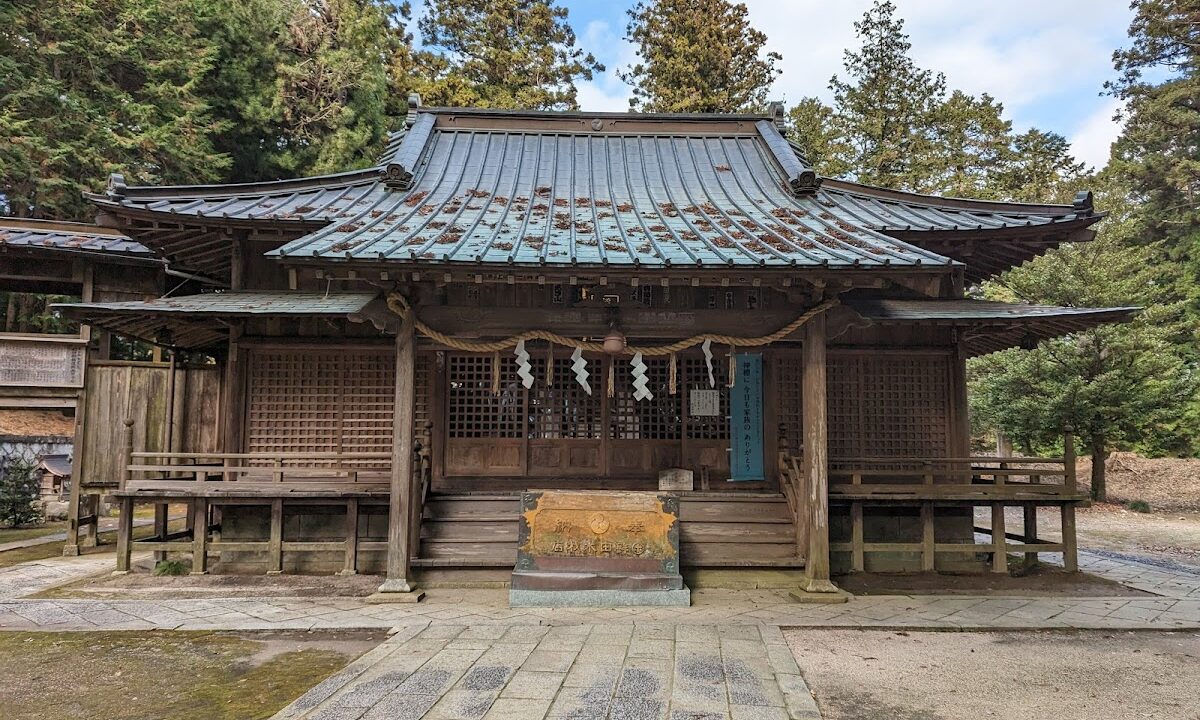
The main shrine of Inada Shrine is built in the traditional style of shrine architecture. Protected by a protective structure, the main shrine is a beautiful building adorned with carvings and decorations.
In front of the main shrine is the worship hall, where worshippers offer their prayers. The worship hall has an open design, allowing visitors to appreciate the beauty of traditional Japanese shrine architecture.
Four Sacred Sites (Parents’ Shrine, Married Couple’s Shrine)
Within the grounds of Inada Shrine are special ritual sites called the “Four Sacred Sites.” These consist of the “Parents’ Shrine” and the “Married Couple’s Shrine,” and are considered central to the shrine’s faith.
- Parents’ Shrine: Dedicated to Ashinazuchi-no-Mikoto and Tenazuchi-no-Mikoto, the parents of Kushinadahime-no-Mikoto.
- Married Couple’s Shrine: Dedicated to Kushinadahime-no-Mikoto and Susanoo-no-Mikoto, a married couple.
These sacred groves symbolize family bonds, marital harmony, and parental love, and are especially revered by female worshippers.
Yoshii Spring
Within the shrine grounds is a spring called “Yoshii.” Located beneath a hundred-branched chinquapin tree, this spring was named “Yoshii” (meaning “good well”) because of the pure, high-quality water that springs forth.
This water has long been considered sacred, and worshippers have used it to purify their hands and pray for healing from illness. It remains a popular and important spot within the shrine grounds.
The Hundred-Branched Chinquapin Tree
Beside the Yoshii Spring is a large chinquapin tree called “The Hundred-Branched Chinquapin Tree.” This giant tree, estimated to be several hundred years old, is cherished as a witness to the history of Inada Shrine and as a symbol of the sacred grounds.
Subsidiary Shrines
Several subsidiary shrines are located within the grounds of Inada Shrine.
Tenmangu Shrine
A Tenmangu shrine, dedicated to Sugawara no Michizane, is located within the grounds. Due to the worship of Michizane, known as the god of learning, it attracts students taking exams and worshippers praying for academic success.
Other Subsidiary Shrines
Due to the Meiji-era consolidation of deities, multiple gods are enshrined in the subsidiary shrines within the grounds. Each is deeply connected to the history and beliefs of the region, demonstrating the diversity of faith at Inada Shrine.
Inner Shrine (Main Shrine) and Iwakura (Sacred Rock)
Location and History of the Inner Shrine
One of the major features of Inada Shrine is the existence of the Inner Shrine (Main Shrine, Inner Sanctuary), located on the mountainside of Mt. Inada, approximately 300 meters northwest of the main shrine.
The inner shrine is considered to be the original shrine of Inada Shrine and is an important sacred site that conveys an older form of worship. Located in a tranquil mountain environment, it retains a strong atmosphere of primitive Shinto rituals.
Iwakura (Sacred Rock)
To the left of the inner shrine’s sanctuary, a massive rock juts out, and this is worshipped as an Iwakura. This Iwakura is said to be the landing place of Kushinadahime-no-Mikoto and is a sacred site that can be considered the origin of Inada Shrine worship.
Iwakura worship is one of the oldest forms of Japanese Shinto, a belief that worships large stones and rocks themselves as vessels for gods. The Iwakura at Inada Shrine is a valuable relic that tells the story of the continuous history of worship in this area since ancient times.
Visiting the inner shrine requires climbing a mountain path, but it is a special experience where you can feel the sacred atmosphere and the beauty of nature.
Festivals and Annual Events
Various festivals and events are held at Inada Shrine throughout the year. ### Annual Festival
Date: Third Sunday of October
The annual festival, the most important festival of Inada Shrine, is held every year on the third Sunday of October. It features a portable shrine procession and offerings, and is an annual event where local people gather.
Other Festivals
- New Year’s Day Festival (January 1st): A festival celebrating the New Year and praying for peace throughout the year.
- Setsubun Festival (around February 3rd): Events such as bean-throwing.
- Spring Festival: A festival celebrating the arrival of spring.
- Summer Purification Ceremony (June 30th): A Shinto ritual to purify oneself of the impurities accumulated over the past six months.
- Year-End Purification Ceremony (December 31st): A Shinto ritual to purify oneself of the impurities accumulated over the past year.
These festivals are still carefully observed and cherished as important events that preserve the traditions and beliefs of the region.
Cultural Properties
Inada Shrine possesses cultural properties of historical and cultural value.
Main Hall Architecture
The main hall of Inada Shrine is a valuable structure that preserves the architectural style from the Edo period to the Meiji period. The detailed carvings and decorations demonstrate the high level of craftsmanship of the time.
Ancient Documents and Records
Descriptions of Inada Shrine can be found in documents from the medieval to early modern periods, including its entry in the Engishiki Jinmyocho (a list of shrines compiled in the Heian period). These are valuable resources for studying the history of our shrine.
Iwakura (Sacred Rock) of the Inner Shrine
As mentioned above, the Iwakura of the Inner Shrine is a valuable relic that conveys the form of ancient beliefs to the present day, and can be considered an important cultural property from a religious and folkloric perspective.
Goshuin (Shrine Seal) Information
Inada Shrine offers Goshuin.
Goshuin Reception Location
Goshuin can be received at the residence of the chief priest located to the right of the stairs leading to the shrine. Please note that this is at the chief priest’s residence, not the shrine office, so consideration is required when visiting. ### Features of the Goshuin (Shrine Seal)
The goshuin at Inada Shrine is handwritten by the chief priest. The shrine’s name, “Inada Shrine,” and the date of visit are written in ink, followed by a red seal.
Sometimes, a seal indicating its status as a Shikinaisha (a shrine listed in the Engishiki) and Myojin Taisha (a major shrine) is also stamped, making it a valuable item for those visiting shrines.
Reception Hours
The reception hours for goshuin are generally during the day (around 9:00 AM to 4:00 PM), but the chief priest may be absent depending on his schedule. To ensure you receive one, it is recommended to call in advance.
Offering Fee
The offering fee for a goshuin is typically around 300 to 500 yen. It is best to prepare the exact amount to avoid needing change.
Access and Parking Information
Access by Public Transportation
Nearest Station: JR Mito Line “Inada Station”
- Approximately 7 minutes on foot from Inada Station (approximately 500 meters)
- Exit the station and head west, following the signs to arrive.
Access from Mito Station:
- Approximately 15 minutes on the JR Mito Line, get off at Inada Station
- Take a train from Mito Station towards Tomobe Station
Access from Tomobe Station:
- Approximately 10 minutes on the JR Mito Line, get off at Inada Station
- Take a train from Tomobe Station towards Mito Station
Access by Car
From the Joban Expressway:
- Approximately 15 minutes from Tomobe IC
- Approximately 20 minutes from Iwama IC
From the Kita-Kanto Expressway:
- Approximately 15 minutes from Tomobe IC
- Approximately 20 minutes from Kasama-Nishi IC
Car Navigation Settings:
- Address: 763 Inada, Kasama City, Ibaraki Prefecture
- When searching by phone number, use Kasama City Hall (0296-77-1101) as a landmark and head towards Inada from there.
Parking
Inada Shrine has parking spaces for visitors, but the number of spaces is limited. During events such as the annual festival, congestion is expected, so please consider using public transportation.
Parking is free.
Access to the Inner Shrine
The inner shrine is located on the mountainside of Mt. Inada, approximately 300 meters northwest of the main shrine. You will need to climb a mountain path, so we recommend wearing comfortable shoes. The path is well-maintained, but it can become slippery after rain, so please be careful.
Nearby Tourist Attractions
Here are some tourist attractions around Kasama City that you might want to visit along with Inada Shrine.
Kasama Inari Shrine
Location: 1 Kasama, Kasama City, Ibaraki Prefecture
Distance: Approximately 15 minutes by car from Inada Shrine
Kasama Inari Shrine, one of Japan’s three major Inari shrines, is a representative shrine of Ibaraki Prefecture, attracting over 3 million visitors annually. It is worshipped as a god of abundant harvests and business prosperity, and a chrysanthemum festival is held every autumn.
Within the shrine grounds are the “Yae-no-Fuji” (double-flowered wisteria), a prefectural designated natural monument, and the “Great Wisteria,” both over 400 years old, where visitors can enjoy magnificent wisteria blossoms in early May. Outside the main gate are enshrined the deities Kushiiwamado-no-Kami and Toyoiwamado-no-Kami, while inside are statues of sacred horses.
Kasama Art Forest Park
Kasama City is a town known for its pottery, specifically Kasama ware. Kasama Art Forest Park houses the Ibaraki Prefectural Ceramic Art Museum, where visitors can appreciate ceramic works and experience pottery making.
Sashiroyama Foothills Park
Sashiroyama Foothills Park, home to the ruins of Kasama Castle, is a spot where you can enjoy historical walks and nature. It’s also known as a famous cherry blossom viewing spot in spring.
Kasama Azalea Park
From late April to early May, approximately 8,500 azalea bushes bloom in this park. The “Kasama Azalea Festival” is held during the peak blooming season.
Summary
Inada Shrine, located in Kasama City, Ibaraki Prefecture, is a shrine listed in the Engishiki Jinmyocho (a historical record of shrines) and is a highly prestigious shrine that has been valued by the imperial court since ancient times.
It enshrines Kushinadahime-no-Mikoto as its main deity and is deeply revered as a god of women’s protection, marital harmony, and matchmaking. The shrine grounds offer many points of interest, including the four sacred enclosures (the shrines of parents and husband and wife), the Yoshii spring, and the Hyakue-no-Shii tree.
Of particular note are the inner shrine and the sacred rock formation located on the mountainside of Mt. Inada, approximately 300 meters from the main shrine. This rock formation is said to be the landing place of Kushinadahime-no-Mikoto, making it a precious sacred site that preserves ancient forms of worship.
The shrine is easily accessible, about a 7-minute walk from Inada Station on the JR Mito Line, and you can receive a handwritten goshuin (shrine stamp) at the priest’s home. Visiting Inada Shrine along with other nearby tourist spots such as Kasama Inari Shrine will allow you to experience the history and culture of Kasama City more deeply.
Please do visit Inada Shrine, where you can feel the history of ancient Japanese faith.