Complete Guide to Iwatakeo Shrine (Nanto City, Toyama Prefecture) | History and Highlights of a National Historic Shrine
Iwatakeo Shrine, located in Nojiri, Nanto City, Toyama Prefecture, is a venerable shrine with a history dating back to the Heian period. It is a National Historic Shrine, mentioned in the “Nihon Sandai Jitsuroku,” the official history of Japan, and has a long history as a center of faith in the region. This article provides detailed information you should know before visiting, including the history of Iwatakeo Shrine, the mysteries of its enshrined deities, highlights of the grounds, and access methods.
Basic Information on Iwatakeo Shrine
Location: 711 Nojiri, Nanto City, Toyama Prefecture
Deity Enshrined: Iwatakeo-no-kami
Former Shrine Rank: Former Village Shrine
Annual Festival Day: Health and Sports Day in October
Access: Located east of the Nojiri-Nishi intersection where National Routes 471 and 143 intersect.
Iwatakeo Shrine is located on the east bank of the Oyabe River, slightly north of the center of Nanto City. The surrounding area is a quiet rural landscape, and it has long been a place of worship for the local people.
History and Origins of Iwatakeo Shrine
Status as a National Historical Shrine
The most distinctive feature of Iwatakeo Shrine is that it is a National Historical Shrine. In 879 (Genkei 3), the Imperial Court bestowed upon Iwatakeo-no-kami the divine rank of Junior Fifth Rank, Lower Grade. This record is clearly documented in the “Nihon Sandai Jitsuroku,” the official history of Japan, proving that it is a historically significant shrine recognized by the imperial court since the Heian period.
A “National History Present Shrine” refers to a shrine mentioned in the Six National Histories (Nihon Shoki, Shoku Nihongi, Nihon Koki, Shoku Nihon Koki, Nihon Montoku Tenno Jitsuroku, and Nihon Sandai Jitsuroku), indicating a shrine that has been considered nationally important since ancient times. Only a limited number of shrines in Toyama Prefecture hold this honor, and Ishitakeo Shrine was the foremost place of worship in this region.
Status as a Former Village Shrine
Under the Meiji era’s shrine ranking system, Ishitakeo Shrine was classified as a former village shrine. A village shrine is a rank given to a shrine revered as the guardian shrine of a village (multiple villages), ranking higher than a village shrine but lower than a prefectural shrine. This indicates that Ishitakeo Shrine attracted worship from a wide area, including not only the Nojiri district but also the surrounding regions.
The Founding and History of Ishitakeo Shrine
The exact founding date of Ishitakeo Shrine is unknown, but since it was granted a divine rank in 879, it is believed to have already had a solid foundation of faith by at least the early Heian period. Subsequently, it continued to be revered as the local tutelary deity from the medieval to the early modern period, and has survived the Meiji era’s shrine consolidation policy to the present day.
The Mystery of the Deity “Ishitakeo-no-Kami”
Who is Ishitakeo-no-Kami?
Ishitakeo-no-Kami, the deity enshrined at Ishitakeo Shrine, is a god whose true identity is the subject of various theories. From the name “Ishitakeo,” it is presumed to be a deity associated with rock worship or martial prowess, but there are few detailed descriptions in ancient documents, and many aspects remain shrouded in mystery.
One theory suggests that the deity was a person who made significant contributions to the development and flood control of this region and was deified, or that an ancient local deity or tutelary deity later came to be called “Ishitakeo-no-Kami.”
Connection to Local Beliefs
In Etchu Province (present-day Toyama Prefecture), including Nanto City, a belief in the sacredness of rocks and megaliths has been deeply rooted since ancient times. The character “石” (ishi, meaning stone) in the name of the deity “Ishitakeo” may suggest a connection to this rock worship. Furthermore, “Takeo” is a word symbolizing bravery and strength, perhaps representing the deity’s character as a powerful protector of the region.
Relationship with Takase Shrine
When discussing the shrines of this region, Takase Shrine, the Ichinomiya (first-ranked shrine) of Etchu Province, is indispensable. Takase Shrine, with Ōkuninushi-no-Mikoto (Ōnamuchi-no-Mikoto) as its principal deity, is the most prestigious shrine in Etchu Province. Ishitakeo Shrine also held an important position second only to Takase Shrine as a National Historic Site. Both shrines have been centers of ancient belief in Etchu Province, supporting the region’s spiritual culture.
Highlights of the Shrine Grounds
Entrance to the Approach and Shrine Name Marker
Visiting Ishitakeo Shrine begins at the shrine name marker located along the national highway. The marker, inscribed with “Gōsha Ishitakeo Shrine,” indicates the shrine’s status. The approach continues from beside the marker, leading through a torii gate into the shrine grounds.
Atmosphere of the Approach
The approach is enveloped in a quiet and peaceful atmosphere. Trees line both sides, offering beautiful scenery, especially during the fresh green of spring and the vibrant autumn foliage. As you walk along the approach, you’ll feel your mind calming as you enter a sacred space, far removed from the hustle and bustle of everyday life.
Worship Hall and Main Sanctuary
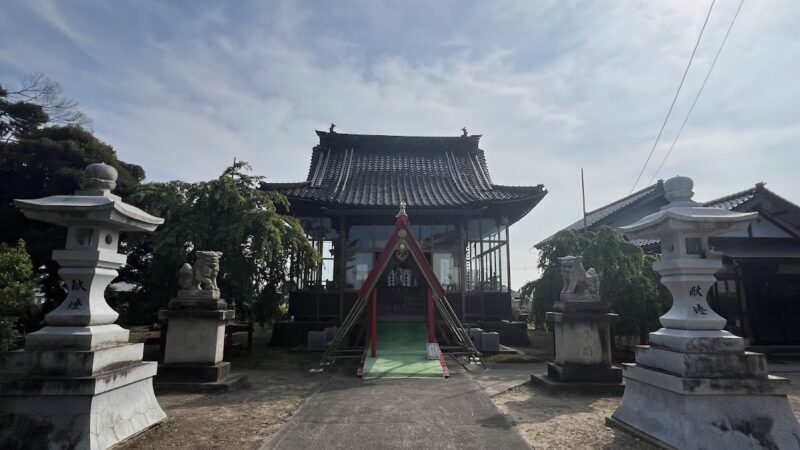
As you proceed along the approach, the worship hall appears directly ahead. The worship hall is a traditional wooden structure, retaining many characteristics of local shrine architecture. Behind the worship hall sits the main sanctuary, where the enshrined deity, Ishitakeo-no-kami, is worshipped.
In front of the main hall, worshippers can be seen quietly offering their prayers. As a place of worship with a long history, it remains a spiritual anchor for the local people.
Komainu and Stone Sculptures
In front of the main hall, a pair of komainu (guardian lion-dogs) are positioned on either side. Exposed to the elements, these komainu have guarded the sacred grounds for many years, each possessing a unique expression that welcomes visitors.
Furthermore, various stone sculptures, such as lanterns and stone monuments, are scattered throughout the grounds. Some of these were dedicated during the Edo and Meiji periods, reflecting the long history accumulated here.
Subsidiary Shrines and Auxiliary Shrines
Besides the main shrine, several subsidiary shrines and auxiliary shrines are enshrined within the grounds. These represent a convergence of various local beliefs, accommodating diverse wishes from people for agriculture, family safety, business prosperity, and more.
Annual Events at Ishitakeo Shrine
Grand Festival (October, Health and Sports Day)
The most important festival at Ishitakeo Shrine is the Grand Festival, held annually on Health and Sports Day in October. On this day, local people gather for a procession of the portable shrine and various offerings. It is a traditional festival expressing gratitude for the autumn harvest and praying for a bountiful harvest in the coming year and peace and prosperity for the community.
Other Festivals
In addition to the Grand Festival, various Shinto rituals are performed throughout the year, including the New Year’s Day Festival, the Spring Prayer Festival, and the Summer Purification Ceremony. These rituals are based on the traditional Japanese calendar and serve to strengthen the bonds of the local community.
Comparison with Other Shrines in Nanto City
Besides Ishitakeo Shrine, Nanto City is home to many other historical shrines.
Ubara Shrine
Located in Iwaki, Nanto City, Ubara Shrine is another shrine that has attracted long-standing devotion. It is revered as the local guardian deity and preserves its unique festival culture.
Hime Shrine
Located in Takamiya, Nanto City, Hime Shrine is known as a shrine dedicated to a goddess. It has a different lineage of worship than Ishitakeo Shrine, demonstrating the diverse religious culture of Nanto City.
Compared to these shrines, Ishitakeo Shrine stands out for its high status as a nationally designated shrine and its solid historical backing dating back to the Heian period.
Relationship with Ishitakeo Shrine in Himi City
It should be noted that, in addition to the Ishitakeo Shrine in Nanto City, there is also an Ishitakeo Shrine in Horita, Himi City, Toyama Prefecture. Although both shrines share the same deity name, they are separate shrines.
The Ishitakeo Shrine in Himi City enshrines Sarutahiko-no-Okami as its main deity and has its own unique traditions, including the legend of the giant snake. On the other hand, the Ishitakeo Shrine in Nanto City is distinguished by its historical record as a National Historic Shrine. The relationship between the two shrines is unclear; it’s not known whether they were originally shrines that enshrined the same deity and were later separated, or whether shrines of different lineages came to bear the same name.
Access to Ishitakeo Shrine
Access by Car
Nearest Interchange: Tokai-Hokuriku Expressway, Fukumitsu IC, or Hokuriku Expressway, Tonami IC
Travel Time: Approximately 10 minutes from Fukumitsu IC, approximately 20 minutes from Tonami IC
The shrine is conveniently located east of the Nojiri-Nishi intersection where National Routes 471 and 143 intersect, making it easily accessible by car. Parking is available near the shrine.
Access by Public Transportation
Nearest Station: JR Johana Line, Fukuno Station or Fukumitsu Station
Travel Time: Approximately 10-15 minutes by taxi from the station
For public transportation, taking a taxi from a Johana Line station is the most practical option. While there are bus routes, the number of services is limited, so it’s recommended to check the timetable in advance.
Manners and Points for Visiting the Shrine
Basic Worship Etiquette
- Bow before passing through the torii gate: This is basic courtesy when entering the sacred area.
- Walk along the edge of the path: The center is considered the path for the gods.
- Purify yourself at the water basin: Cleanse your hands and mouth before praying.
- Etiquette in front of the main hall: Two bows, two claps, and one bow is the basic procedure.
Photography
Photography is generally permitted on the shrine grounds, but there may be restrictions, such as inside the main hall or during religious ceremonies. Please check with the shrine office if you have any questions. Also, please remember to be considerate of other visitors.
Best Time to Visit
Ishitakeo Shrine can be visited throughout the year, but the following times are especially recommended:
- Spring (April-May): Beautiful fresh greenery and pleasant weather
- Autumn (October): The time of the annual festival, offering the possibility of observing the festivities
- New Year’s Visit (January): As a New Year’s visit
Nearby Tourist Attractions
Cultural Properties of Nanto City
Nanto City boasts many cultural properties, including the World Heritage Site, the Gokayama Gassho-zukuri Village. Visiting these tourist spots in conjunction with your visit to Ishitakeo Shrine is highly recommended.
Inami Wood Carving Village
The Inami district of Nanto City is a town of traditional crafts known for its exquisite wood carvings. Developed as a temple town for Zuizenji Temple, Inami is home to numerous wood carving workshops. ### Fukumitsu Art Museum
This museum primarily exhibits the works of Shiko Munakata, a printmaker from Nanto City. It offers a glimpse into the region’s arts and culture.
The Faith and Modern Times of Ishitakeo Shrine
Center of the Local Community
Even now, after the Heisei-era mergers that consolidated former towns and villages into Nanto City, Ishitakeo Shrine remains a spiritual anchor for the residents of the Nojiri district and other areas. Through festivals and cleaning activities, it serves as a place to deepen the bonds of the local community.
Value as a Historical Heritage Site
Ishitakeo Shrine, with its historical value as a National Historical Shrine, is more than just a place of worship; it is a valuable cultural heritage site that conveys the ancient history of Japan to the present day. The facts recorded in the “Nihon Sandai Jitsuroku” (Chronicles of Three Reigns of Japan) prove that this shrine has a history of over 1100 years, and it occupies an important position in local history research.
Passing on to Future Generations
In rural areas facing declining birth rates and an aging population, maintaining traditional shrines is a major challenge. However, thanks to the efforts of the local people, the maintenance of the shrine grounds and the continuation of the festivals at Ishitakeo Shrine continue. This initiative is an important activity in passing on tangible and intangible cultural heritage to future generations.
Summary: The Charm of Ishitakeo Shrine
Ishitakeo Shrine is a nationally recognized shrine dating back to the Heian period and is a central place of worship in Nanto City, Toyama Prefecture. The historical fact that it was granted the rank of Junior Fifth Rank, Lower Grade in 879 (Gangyō 3) speaks to the high status of this shrine.
The enigmatic charm of the enshrined deity, Ishitakeo-no-kami, its importance to the region as a former village shrine, and the tranquil atmosphere of the shrine grounds leave a deep impression on visitors. The space from the entrance to the worship hall and main shrine conveys the sacredness of a place of worship cultivated over a long history.
When visiting Toyama Prefecture, you can experience the deep culture and history of the region by visiting historical shrines like this, in addition to famous tourist spots. Ishitakeo Shrine is a shrine well worth visiting, as it marks the intersection of ancient Japanese history and local beliefs.
Standing quietly in Nojiri, Nanto City, Ishitakeo Shrine offers a profound experience. Stepping onto its grounds, you can feel the weight of faith that has continued for over a thousand years and the history of prayers from the local people.