Isobe Inamura Shrine (Ibaraki Prefecture) Complete Guide | History, Goshuin (Shrine Seals), and Sakuragawa’s Scenic Spots Explained in Detail
Isobe Inamura Shrine, located in Sakuragawa City, Ibaraki Prefecture, is a venerable shrine with a long history dating back to ancient times. It is a sacred site known for the Sakuragawa cherry blossoms, designated as a national scenic spot and natural monument. This article provides a detailed explanation of everything you need to know before visiting, including the history of Isobe Inamura Shrine, its enshrined deities, highlights of the grounds, goshuin information, and access methods.
What is Isobe Inamura Shrine?
Isobe Inamura Shrine is a shrine located at 779 Isobe, Sakuragawa City, Ibaraki Prefecture. It is a historical shrine listed as a minor shrine in the Shikinaisha (a shrine listed in the Engishiki, an ancient Japanese legal text) of Niihari District, Hitachi Province. Its former shrine rank was Gosha (village shrine), and it was formerly known as “Isobe Inamura-gu.”
This shrine, with Amaterasu Omikami as its principal deity and enshrines many other gods, has long been a center of local faith. The Sakuragawa River flowing through the shrine grounds and the surrounding cherry trees were designated a National Place of Scenic Beauty in 1924 (Taisho 13) and a National Natural Monument in 1974 (Showa 49) as “Sakuragawa Cherry Blossoms,” attracting many worshippers and tourists in the spring.
History
Founding and Ancient History
The founding of Isobe Inamura Shrine dates back to the reign of Emperor Keiko. According to the “Ibaraki Prefecture Shrine Records,” its origins date back to the 40th year of Emperor Keiko’s reign, when Yamato Takeru no Mikoto, who had pacified the eastern barbarians, enshrined the great gods of Ise and Kashima.
This area has long been revered as a sacred place, and a keystone, which has been an object of worship for residents since the Jomon period, still remains on the shrine grounds. The founding legend from the reign of Emperor Keikō indicates that this region was an important religious center since ancient times.
From the Medieval to the Early Modern Period
Isobe Inamura Shrine continued to attract local reverence from the medieval period onward. In particular, records show that Tokugawa Mitsukuni (Mito Kōmon), the lord of the Mito domain, visited the shrine during the Edo period, suggesting it received patronage from the lord.
The cherry blossoms along the Sakuragawa River are said to have been celebrated in a waka poem by Ki no Tsurayuki, a poet of the Heian period, and a monument inscribed with his poem stands on the shrine grounds. This monument is a designated cultural property of Ibaraki Prefecture, testifying to the long-standing reputation of the area as a famous cherry blossom viewing spot.
Changes After the Meiji Era
In 1871 (Meiji 4), the shrine suffered a tragedy when its buildings were destroyed by arson. Later, in 1913 (Taisho 2), the shrine buildings were rebuilt, and records indicate that 34 other shrines were merged at this time.
Due to the Meiji-era decree separating Shinto and Buddhism, the Jinguji temple located within the shrine grounds was abolished. Even today, traces of it remain on the grounds, evoking the former syncretism of Shinto and Buddhism.
Under the modern shrine ranking system, it was designated a Gosha (village shrine), positioning it as a central shrine in the region. In 1924, the Sakuragawa River was designated a national scenic spot, and in 1974, it was designated a natural monument, demonstrating its high cultural value.
Deities Enshrined
Isobe Inamura Shrine enshrines Amaterasu Omikami as its principal deity, along with many other gods.
Main Deities
- Amaterasu Omikami: The supreme deity of Japanese mythology, the sun goddess
- Ame-no-Tachikarao-no-Mikoto: The god of strength who played an active role in the Amano-Iwato myth
- Konohanasakuya-hime-no-Mikoto: The goddess of cherry blossoms, a symbol of beauty and prosperity
- Seoritsu-hime-no-Mikoto: The goddess of exorcism and purification
- Tamayori-hime-no-Mikoto: A miko-like figure who houses a divine spirit
- Takuhata-Chichi-hime-no-Mikoto: The goddess of weaving
- Ame-no-Futodama-no-Mikoto: The god who presides over rituals
- Tamabashirayahime-no-Mikoto: Guardian deity of architecture and houses
These deities each possess different divine virtues and are believed to answer the various prayers of worshippers. In particular, Konohanasakuya-hime-no-Mikoto, as the goddess of cherry blossoms, has a deep connection to the cherry blossoms of this area.
Highlights of the Shrine Grounds
Sakuragawa Cherry Blossoms (National Scenic Spot and Natural Monument)
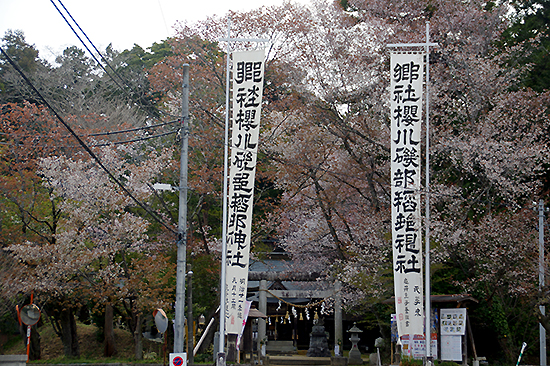
The most distinctive feature of Isobe Inamura Shrine is the cherry blossoms in the shrine grounds, centered around the approach to the shrine, and in the adjacent Isobe Sakuragawa Park. These Sakuragawa cherry blossoms were designated a National Scenic Spot in 1924 and a National Natural Monument in 1974.
Known as the setting for the Noh play “Sakuragawa,” it has long been a beloved cherry blossom viewing spot for writers and artists. In spring, various varieties of cherry blossoms bloom, creating a beautiful tunnel of blossoms in what is believed to have been a former horse riding ground beside the approach to the shrine.
Kanameishi (Keystone)
The Kanameishi (Keystone) stands approximately 5 meters northwest of the main shrine building within the temple grounds. This sacred stone has been an object of worship for the local residents since the Jomon period and has a convex shape.
According to tradition, it is said to have symbolized yin and yang in ancient times and is considered to be a counterpart to the Kanameishi (concave shape) of Kashima Shrine. One theory suggests that this area was once part of Kashima’s sacred territory, and that the Kanameishi of Kashima holds down the head of a giant catfish, while the Kanameishi of Isobe holds down its tail, thus preventing earthquakes.
This Kanameishi is still visited by many worshippers as an object of faith for earthquake protection.
Ki no Tsurayuki’s Poetry Monument
A monument inscribed with a waka poem by Ki no Tsurayuki, a poet of the Heian period, about the cherry blossoms of Sakuragawa, stands within the temple grounds. This monument is a designated cultural property of Ibaraki Prefecture and is a valuable cultural asset that shows that this area has been known as a famous cherry blossom viewing spot since ancient times.
Wooden Komainu (Guardian Lion-Dogs)
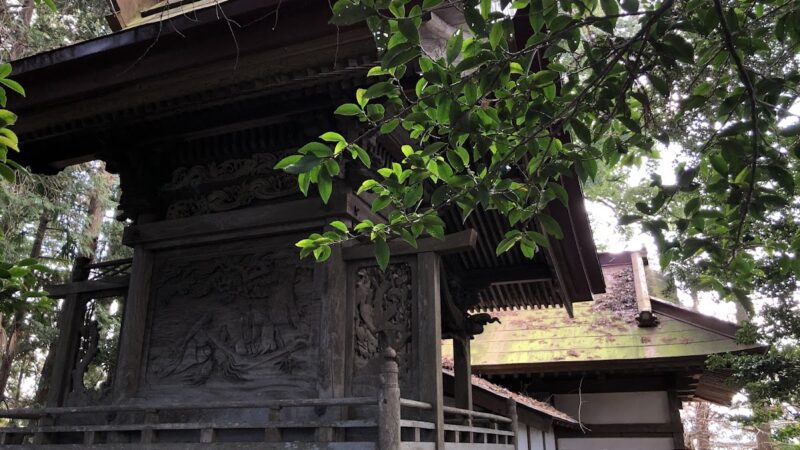
Within the shrine grounds are wooden komainu, designated as a cultural property of Ibaraki Prefecture. These ancient komainu are valued as cultural assets due to their excellent carving techniques and state of preservation.
Site of Jinguji Temple
The site of Jinguji Temple, which was abolished during the Meiji era’s separation of Shinto and Buddhism, remains within the shrine grounds. It is a valuable historical site that conveys the atmosphere of the former era of syncretism between Shinto and Buddhism.
Goshuin (Shrine Seals) and Goshuincho (Shrine Seal Books)
About Goshuin
Goshuin (shrine seals) are available at Isobe Inamura Shrine. They are given out at the shrine office, and many visitors come to obtain them as a memento of their visit.
The goshuin features the shrine’s name, “Isobe Inamura Shrine” or “Sakuragawa Isobe Inamura Shrine,” written in ink, and stamped with the shrine’s seal. Special designs of goshuin may be available during cherry blossom season.
Etiquette for Receiving a Goshuin (Shrine Stamp)
- Please complete your prayers before receiving your Goshuin.
- Prepare your Goshuincho (stamp book) and specify the page you want stamped on.
- Have your offering (the amount to be paid) ready.
- Visit during the shrine office’s reception hours.
- Waiting times may occur during busy periods.
Festivals and Annual Events
Isobe Inamura Shrine holds various festivals and events throughout the year.
Main Festivals
- New Year’s Day Festival: A festival to welcome the new year
- Spring Grand Festival: An important festival held during the cherry blossom season
- Summer Purification Ceremony: A Shinto ritual to purify oneself of the impurities accumulated over the past six months
- Autumn Grand Festival: A festival to give thanks for the harvest
- Year-End Purification Ceremony: A Shinto ritual to purify oneself of the impurities accumulated over the past year
The Spring Grand Festival, especially during the cherry blossom season, is bustling with many worshippers, and the temple grounds are enveloped in a vibrant atmosphere of cherry blossoms and worshippers.
Access
Access by Train
Nearest Station: JR Mito Line “Haguro Station”
- Approximately 20 minutes on foot from Haguro Station (approx. 1.8 km)
- Approximately 5 minutes by taxi from Haguro Station
Access by Car
From Kita-Kanto Expressway “Sakuragawa-Chikusei IC”:
- Approximately 30 minutes by car
Parking: Parking spaces available around the shrine grounds (expect congestion during cherry blossom season)
Address and Basic Information
- Address: 779 Isobe, Sakuragawa City, Ibaraki Prefecture 309-1457
- Latitude and Longitude: 36.368314, 140.140898
- Telephone Number: Please check with the Shrine Association or on-site
Access Information
During the spring cherry blossom season (late March to early April), the surrounding roads and parking lots become crowded due to the large number of tourists. We recommend using public transportation. If walking, it’s approximately a 20-minute walk from Haguro Station, so we recommend wearing comfortable shoes.
Points to Note When Visiting
Best Time to Visit
Cherry Blossom Season (late March to early April): The most popular time. You can enjoy the cherry blossoms, a national scenic spot and natural monument. However, crowds are inevitable.
Fresh Green Season (May to June): After the cherry blossom season, the number of visitors decreases, allowing for a more leisurely stroll through the temple grounds.
Autumn Foliage Season (November): The autumn foliage is also beautiful, allowing for a peaceful visit.
Winter: Fewer visitors, allowing for a tranquil atmosphere.
Estimated Time Required for Visiting the Shrine
- Visiting the shrine only: Approximately 15-20 minutes
- Including a stroll around the grounds: Approximately 30-40 minutes
- Taking your time and including Sakuragawa Park: Approximately 1-2 hours
Nearby Tourist Attractions
The following tourist attractions are located near Isobe Inamura Shrine:
- Isobe Sakuragawa Park: A park adjacent to the shrine, famous for its cherry blossoms
- Makabe Townscape: A traditional townscape with historical buildings (approximately 20 minutes by car)
- Amabiki Kannon: An ancient temple famous for prayers for safe childbirth (approximately 15 minutes by car)
Subsidiary Shrines
In addition to the main shrine, Isobe Inamura Shrine has several subsidiary shrines. Because 34 shrines were merged during the reconstruction in 1913 (Taisho 2), various small shrines dedicated to different deities are scattered throughout the grounds.
These subsidiary shrines enshrine local guardian deities and gods with specific divine virtues, allowing worshippers to pray according to their individual wishes.
Cultural Properties of Isobe Inamura Shrine
The following cultural properties are designated at Isobe Inamura Shrine and its surrounding area:
Nationally Designated Cultural Properties
- Sakuragawa River (Scenic Spot): Designated in 1924 (Taisho 13)
- Sakuragawa Cherry Blossoms (Natural Monument): Designated in 1974 (Showa 49)
Ibaraki Prefecture Designated Cultural Properties
- Ki no Tsurayuki Poetry Monument: A stone monument inscribed with a poem about the Sakuragawa River by a Heian period poet
- Wooden Komainu (Guardian Dogs): Valuable wooden guardian dogs from an ancient period
These cultural properties demonstrate the historical and cultural value of Isobe Inamura Shrine and play an important role in conveying traditional Japanese culture to visitors.
Isobe Inamura Shrine and the Noh Play “Sakuragawa”
The Sakuragawa River at Isobe Inamura Shrine is known as the setting for the Noh play “Sakuragawa.” This play tells the story of a mother searching for her child throughout the country, who, upon seeing the cherry blossoms along the Sakuragawa River, reminisces about her son.
This play made the cherry blossoms of Sakuragawa River famous throughout Japan, attracting many writers and travelers. Even today, Noh enthusiasts and literature fans visit the shrine to pay their respects at the location featured in the play.
Visitor Feedback
The following are some comments from visitors who have actually visited Isobe Inamura Shrine:
- “Even outside of cherry blossom season, I love the atmosphere and feeling of the shrine grounds and have visited many times.”
- “There are always visitors, but there is a reasonable amount of space between them, allowing for a peaceful visit.”
- “I could feel the power of the foundation stone.”
- “In a quiet and peaceful atmosphere, I was able to have a truly refreshing visit.”
Many visitors rate this shrine as worthwhile to visit not only during cherry blossom season, but throughout the year.
Summary
Isobe Inamura Shrine boasts a long history, dating back to its founding during the reign of Emperor Keiko. It features many attractions, including the cherry blossoms of Sakuragawa (designated a national scenic spot and natural monument), the foundation stone (believed to ward off earthquakes), and cultural properties designated by Ibaraki Prefecture.
Enshrining many deities, including Amaterasu Omikami, it is a highly efficacious shrine that grants various prayers, attracting many visitors not only from the local area but also from within and outside the prefecture.
While the vibrant atmosphere of cherry blossom season is appealing, visiting during a quieter season to slowly appreciate the history and cultural assets of the shrine grounds is also highly recommended. When visiting Ibaraki Prefecture, be sure to stop by Isobe Inamura Shrine.
Frequently Asked Questions (FAQ)
Q1: When can I get a Goshuin (shrine stamp) at Isobe Inamura Shrine?
A1: You can get a Goshuin during the hours the shrine office is open. However, the office may be closed, so if you want to be sure to get a Goshuin, we recommend calling ahead or visiting during peak hours such as mornings or weekends. During cherry blossom season, many people seek Goshuin, so there may be a waiting time.
Q2: When is the best time to see the cherry blossoms?
A2: The best time to see the cherry blossoms at Isobe Inamura Shrine is usually from late March to early April. However, this may vary depending on the weather conditions of the year, so we recommend checking the blooming status before visiting. Because there are various varieties of cherry blossoms along the Sakuragawa River, you can enjoy the blossoms for a relatively long period.
Q3: Is there parking?
A3: There is parking space around the shrine grounds, but it gets very crowded during cherry blossom season. Especially on weekends and during peak season, the parking lot is often full, so we recommend using public transportation. If you are visiting by car, it’s best to aim for relatively less crowded times, such as early morning.
Q4: Where is the Kanameishi (foundation stone)?
A4: The Kanameishi is located approximately 5 meters northwest of the main shrine building within the temple grounds. After praying, you can find it by searching behind the main shrine building. There may be a signpost, but if you can’t find it, it’s best to ask at the shrine office.
Q5: How long does it take to visit the shrine?
A5: If you are only praying, it will take about 15-20 minutes. However, if you want to stroll around the grounds, see the Kanameishi and other cultural artifacts, you should allow about 30-40 minutes. If you plan to enjoy Sakuragawa Park as well during cherry blossom season, we recommend allowing 1-2 hours.
Q6: How do I get there from the nearest station?
A6: The nearest station is Haguro Station on the JR Mito Line, and it’s about a 20-minute walk (approximately 1.8 km) from the station. If walking is difficult, you can take a taxi from the station and arrive in about 5 minutes. We recommend wearing comfortable shoes.
Q7: What kind of blessings can I expect?
A7: Isobe Inamura Shrine enshrines many deities, including Amaterasu Omikami, and is therefore believed to offer various blessings. The main blessings include family safety, business prosperity, good fortune, matchmaking, and safe childbirth. The Kanameishi (foundation stone) is also believed to offer protection against earthquakes, and many visitors come to pray for protection from disaster.
Q8: I’d like to know more about the history of the shrine.
A8: Isobe Inamura Shrine is said to have been founded during the reign of Emperor Keiko (around 71-130 AD), and is an ancient shrine with a history of approximately 1900 years. It is said that the shrine originated when Yamato Takeru enshrined the great deities of Ise and Kashima during his campaign to pacify the eastern barbarians. The shrine building was destroyed by arson in 1871, but was rebuilt in 1913. For more details, please check the information boards on the shrine grounds or the materials available at the shrine office.