
Complete Guide to Izumo Taisha Shrine’s Goshuin (Shrine Seals) 2025 Edition | All Types: Reception Locations, Hours, Offering Fees, and Tips for Visiting
Izumo Taisha Shrine is nationally known as the god of matchmaking. Many people want to receive a goshuin as a memento of their visit. Izumo Taisha Shrine offers different goshuin at multiple locations, each with its own unique characteristics. This article provides a detailed explanation of all types of goshuin available at Izumo Taisha Shrine, including reception locations, hours, offering fees, and efficient ways to visit.
All Types of Goshuin Offered at Izumo Taisha Shrine
Within the grounds of Izumo Taisha Shrine, you can receive mainly 5 types of goshuin. Each goshuin is available at a different location, and you can efficiently visit them all by considering the order of your visit.
1. Goshuin at the Main Hall of Izumo Taisha Shrine
This is the main goshuin of Izumo Taisha Shrine, with the words “Izumo Taisha” written in ink and stamped in red in the center. This is the most basic goshuin (temple/shrine stamp) given out at the main shrine dedicated to Okuninushi-no-Okami. Characterized by its powerful brushstrokes, it’s the first stamp you should receive as proof of your visit.
Location: The counter to the right of the main shrine
Fee: 300 yen
Features: Simple yet dignified design
2. Goshuin at the Kagura-den (Sacred Dance Hall)
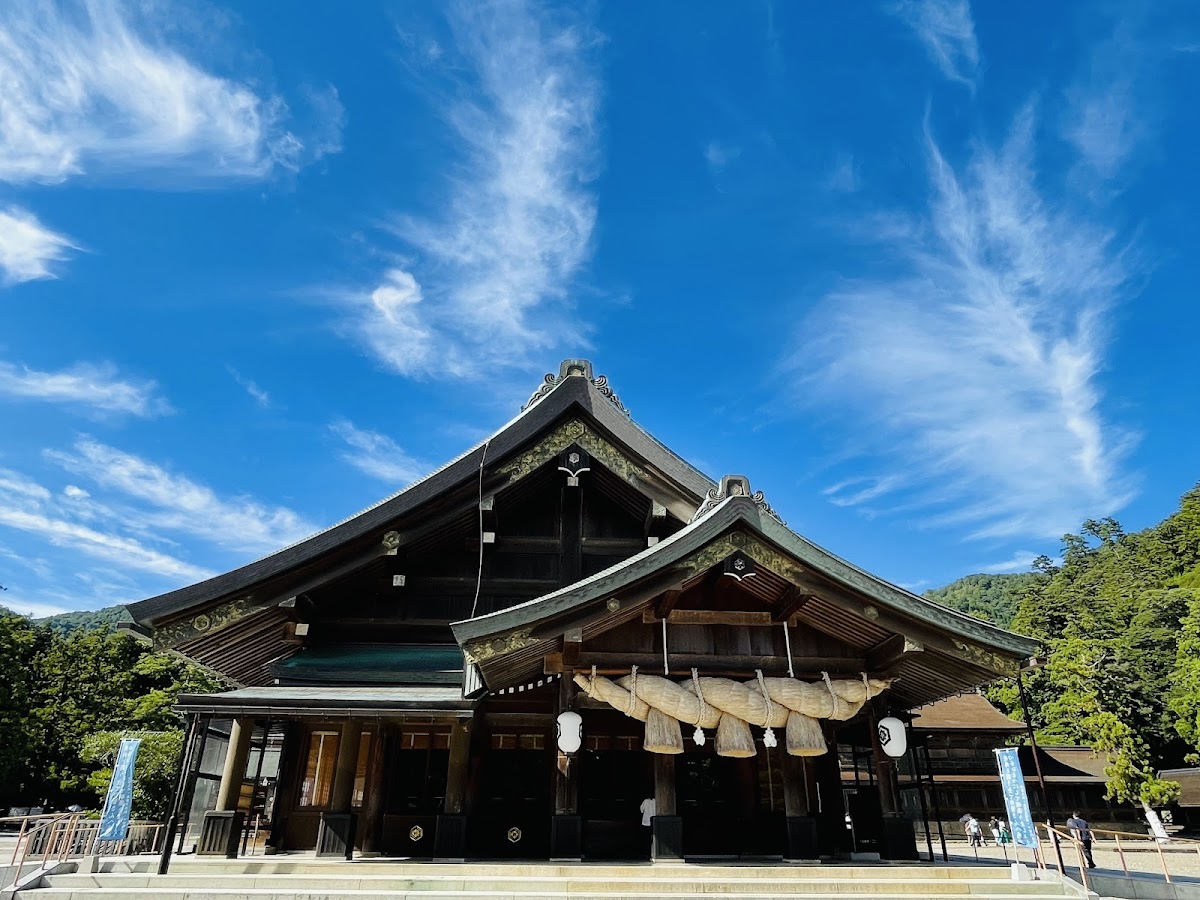
Goshuin are also given out at the Kagura-den, located west of the main shrine. It features the inscription “Izumo Taisha Kagura-den” in ink, and a different red stamp is used compared to the main shrine. The Kagura-den is famous for having one of the largest shimenawa (sacred ropes) in Japan, and it’s recommended to receive the goshuin after viewing its magnificent appearance.
Reception Location: The office inside the Kagura-den (sacred dance hall)
Offering Fee: 300 yen
Features: Perfect as a memento after experiencing the awe-inspiring power of the large Shimenawa (sacred rope)
3. Goshuin (seal) of Kitajima Kokuzokan (Izumo-kyo)
Kitajima Kokuzokan, located east of Izumo Taisha, offers Goshuin of “Izumo-kyo.” While a separate religious corporation from Izumo Taisha, it has a deep historical connection.
Reception Location: Kitajima Kokuzokan Shrine Office
Offering Fee: 300 yen
Features: Goshuin associated with the Izumo Kokuzo family
4. Goshuin of Tenjin Shrine
Goshuin of Tenjin Shrine, located within the grounds of Kitajima Kokuzokan, are also available. This shrine enshrines Sugawara no Michizane, the god of learning.
Reception Location: Kitajima Kokuzokan Shrine Office (same as Izumo-kyo)
Offering Fee: 300 yen
Features: Popular with those praying for academic success
5. Goshuin (Shrine Seal) of Inochi-nushi Shrine
The goshuin of Inochi-nushi Shrine, located slightly east of the main shrine, may also be granted under certain conditions. However, it is not always available, so prior confirmation is necessary.
Goshuin Reception Hours and Precautions
Basic Reception Hours
The reception hours for goshuin at Izumo Taisha vary depending on the season.
March to October: 6:00 AM to 8:00 PM
November to February: 6:30 AM to 8:00 PM
However, goshuin are often only granted until 6:00 PM, so to ensure you receive one, it is recommended to arrive by 5:00 PM.
Busy Seasons and Times
Izumo Taisha Shrine attracts many visitors throughout the year, but it is particularly crowded during the following times:
- First three days of the New Year: The busiest time, with wait times of 1-2 hours for a Goshuin (shrine stamp)
- Golden Week: A concentration of tourists
- Kamiari-zuki (October in the lunar calendar): A time when gods are believed to gather from all over Japan
- Weekends and Public Holidays: More crowded than weekdays
To avoid crowds, weekday mornings (immediately after opening to around 10:00 AM) are ideal. Tuesdays through Thursdays are particularly less crowded.
Mail-Order Service
Izumo Taisha Shrine also offers a mail-order service for Goshuin for those who live far away or find it difficult to revisit the shrine.
Mailing Method:
- Send the offering fee, return postage stamps, and your Goshuincho (stamp book) via registered mail.
- Offering Fee: 300 yen x number of stamps desired
- Return Postage Stamps: Letter Pack Light (370 yen) or equivalent to standard mail
- Clearly indicate the desired Goshuin (stamp) on a memo placed inside your Goshuincho.
Mailing Address:
195 Kitzuki-Higashi, Taisha-cho, Izumo City, Shimane Prefecture 699-0701
Izumo Taisha Shrine Office
However, mailing arrangements may change depending on the time of year, so it is recommended to check the official website or call in advance.
Izumo Taisha’s Original Goshuincho
Izumo Taisha offers original Goshuincho in several designs.
Main Designs
1. Main Hall Design
A navy blue Goshuincho depicting the main hall of Izumo Taisha. This is the most standard and popular design.
Offering Fee: 1,500 yen (including Goshuin stamp)
Size: Large (18cm x 12cm)
2. Inaba’s White Rabbit Design
A cute design based on the myth of Okuninushi-no-Okami and the White Rabbit. Particularly popular with women.
Offering Fee: 1,500 yen (including Goshuin stamp)
Size: Large (18cm x 12cm)
3. Kagura-den’s Large Shimenawa Design
There is also a Goshuin stamp book for Kagura-den featuring a design of the large Shimenawa (sacred rope).
Offering Fee: 1,500 yen (includes Goshuin stamp)
Size: Large (18cm x 12cm)
Points to Consider When Choosing a Goshuincho (Stamp Book)
- Design Preference: Choose a design that will serve as a memento of your visit.
- Size: Large-sized Goshuincho are the mainstream at Izumo Taisha Shrine.
- Stock Availability: Popular designs may be out of stock, so it’s a good idea to have several options in mind.
Efficient Goshuin Pilgrimage Route
If you plan to collect multiple Goshuin stamps at Izumo Taisha Shrine, knowing an efficient route beforehand will allow for a smoother visit.
Recommended Pilgrimage Route
1. Entering from the Seidamari Great Torii Gate
Enter through the main gate and proceed along the approach. It is customary to avoid walking in the center of the approach.
2. Purify your mind and body at the Harae-no-Yashiro (Purification Shrine)
First, purify your mind and body at the small shrine located along the approach to the main shrine.
3. Purify your hands and mouth at the Temizuya (Water Basin)
Before proceeding to the main shrine, purify yourself at the Temizuya using the proper procedure.
4. Worship at the Haiden (Worship Hall) and Honden (Main Shrine)
The proper way to worship at Izumo Taisha is “two bows, four claps, one bow.” Please note that this differs from typical shrines.
5. Receive your first Goshuin (seal) at the Honden’s office
First, receive your Goshuin for the main shrine.
6. Proceed to the Kagura-den (Sacred Dance Hall)
Head to the Kagura-den, located west of the main shrine. Experience the impressive scale of the large Shimenawa (sacred rope).
7. Receive your second Goshuin (seal) at the Kagura-den
Receive your second Goshuin at the office inside the Kagura-den.
8. Proceed to Kitajima Kokuzokan
Head to Kitajima Kokuzokan, located east of the main shrine.
9. Receive Goshuin (3rd-4th type) at Kitajima Kokuzokan
You can receive Goshuin from Izumo-kyo and Tenjin Shrine.
Estimated Time: 30 minutes to 1 hour if only receiving Goshuin; 1.5 to 2 hours if you take your time to pray.
Manners and Etiquette When Receiving Goshuin
Goshuin are not merely stamps; they are sacred items received as proof of worship. Please observe the following manners.
Basic Manners
1. Always pray before receiving Goshuin
It is considered bad manners to receive only Goshuin and leave. Always pray at the main shrine before going to the Goshuin office.
2. Prepare a Goshuincho
Prepare a dedicated Goshuincho, not a notebook or memo pad.
3. Specify the Page
Open your goshuincho (stamp book) and specify the page you would like the stamped on.
4. Use Polite Language
Say “I would like a goshuin, please” and “Thank you” politely.
5. Prepare the Offering
Prepare small change to avoid needing change.
Unique Worship Etiquette at Izumo Taisha Shrine
The worship etiquette at Izumo Taisha Shrine is “Two Bows, Four Claps, One Bow“. This differs from the typical “Two Bows, Two Claps, One Bow” at other shrines.
- Bow deeply twice
- Clap four times
- Bow deeply once
This etiquette is unique and practiced only at Izumo Taisha Shrine and a limited number of other shrines, such as Usa Jingu Shrine.
Amulets and Items to Receive Along with Goshuin
Izumo Taisha Shrine offers various items in addition to goshuin.
Popular Items Offered
Enmusubi no Ito (Thread of Love)
Offering Fee: 1,000 yen
A red and white silk thread, sewn onto clothing or accessories to pray for good fortune in love.
Enmusubi Mamori (Love Charm)
Offering Fee: 1,000 yen
The most popular charm at Izumo Taisha Shrine.
Shiawase no Suzu (Bell of Happiness)
Offering Fee: 1,000 yen
The sound of the bell is believed to bring happiness.
Omamori (Amulet)
Offering Fee: 800 yen to 1,500 yen
Various types are available, including those for traffic safety, family safety, and academic success.
Attractions Around Izumo Taisha Shrine
After receiving your Goshuin (shrine stamp), explore the tourist spots around Izumo Taisha Shrine.
Inasa no Hama (Inasa Beach)
A sacred beach located a 15-minute walk west of Izumo Taisha Shrine. During the Kannazuki (month of the gods), it is believed that all the gods of Japan land on this beach. The sunset over Benten Island is a spectacular sight.
Ancient Izumo History Museum
A museum located adjacent to the east side of Izumo Taisha Shrine. It exhibits the history of Izumo Taisha Shrine and displays actual excavated giant pillars.
Admission Fee: 620 yen for adults
Opening Hours: 9:00 AM – 6:00 PM (until 5:00 PM from November to February)
Izumo Soba
There are many Izumo soba restaurants around Izumo Taisha Shrine. You can enjoy unique Izumo-style soba dishes such as “Wariko Soba” and “Kamaage Soba.”
Popular Shops:
- Arakiya
- Kaneya
- Yakumo Main Store
Access Information
Access by Train
From JR Izumo-shi Station
Approximately 25 minutes by Ichibata Bus “Izumo Taisha, Hinomisaki, Uryu-bound”
Get off at “Seimon-mae” bus stop.
Ichibata Railway
Approximately 10 minutes on foot from Izumo Taisha-mae Station
*Please check the timetable as Ichibata Railway trains are infrequent.
Access by Car
San’in Expressway
Approximately 20 minutes from Izumo IC
Parking
There are several free parking lots around Izumo Taisha.
- Izumo Taisha Main Parking Lot (385 spaces)
- Second Parking Lot
- Third Parking Lot
Parking lots can fill up during peak hours, so early arrival is recommended.
Frequently Asked Questions (FAQ)
Q1. Are the Goshuin (temple/shrine stamps) pre-printed or handwritten?
A. Usually, they are written directly into your Goshuincho (stamp book). However, during busy periods or special times, you may only receive a pre-written goshuin (temple/shrine stamp).
Q2. What should I do if I forget my goshuincho (stamp book)?
A. You can purchase a goshuincho at the reception area. You can also receive a pre-written goshuin on washi (Japanese paper).
Q3. Can I request multiple goshuin at once?
A. The basic rule is to request one type at each reception area. The main shrine, Kagura-den (sacred dance hall), and Kitajima Kokuzo-kan (Kitajima National Land Principality Hall) are in different locations, so you will need to request them at each place.
Q4. Can I pay the goshuin offering fee by credit card?
A. We generally only accept cash. Please prepare some change.
Q5. Can I visit with children?
A. Of course. You can visit with a stroller, but a baby carrier is convenient as there are gravel paths.
Q6. Can I get a goshuin even on a rainy day?
A. We provide goshuin even in rainy weather. However, be careful not to get your goshuincho (stamp book) wet.
Summary: Making Izumo Taisha’s Goshuin a Memorable Memory
At Izumo Taisha, you can receive a total of five types of goshuin at the main hall, the Kagura-den (sacred dance hall), and the Kitajima Kokuzokan (Kitajima National Shrine). Each has its own unique characteristics, and they are all goshuin that you will want to cherish as a memento of your visit.
When receiving a goshuin, it’s important to treat it not merely as a commemorative stamp, but as proof of your visit, and to receive it with sincerity. Feel the sacred atmosphere of Izumo Taisha, pray respectfully, and receive your goshuin.
Visiting on a weekday morning will help you avoid crowds and allow for a more leisurely visit. Also, enjoy the surrounding tourist spots and Izumo soba noodles to make your visit to Izumo Taisha a fulfilling one.
Izumo Taisha is known as a shrine for matchmaking. May wonderful connections be forged along with your goshuin.


