Jūganji Temple (Koto Ward, Tokyo) Complete Guide | History, Access, and Funeral Services Explained in Detail
Jūganji Temple is a Jōdo sect temple located in Sarue, Koto Ward, Tokyo. With a history of over 400 years, it has been cherished by the people of the Fukagawa area since the Edo period. This article provides comprehensive information useful for visitors and those considering using Jūganji Temple, including its history, highlights, funeral services, and access methods.
Basic Information about Jūganji Temple
Official Name: Fukyozan Tōchiin Jūganji
Location: 1-11-15 Sarue, Koto-ku, Tokyo
Sect: Jōdo-shū (Pure Land Buddhism)
Principal Image: Amida Buddha
Founder: Honrensha Ganyo Zetetsu Shōnin
Founder: Fukyo Daizenni (Daughter of Chiba Kunitane)
Jūganji Temple is conveniently located a 5-minute walk from Sumiyoshi Station and is known as one of the most easily accessible temples in Tokyo. It serves as a center of local faith and is widely used for funerals and memorial services.
History and Origins of Jūganji Temple
From Founding to the Edo Period
The history of Jūganji Temple dates back to the late Sengoku period, specifically to Tenshō 18 (1590). It was founded by Fukyo Daizenni, daughter of Chiba Kunitane, at the Nihonbashi County Magistrate’s residence.
In 1629 (Kanei 6), it was formally established by Honrensha Ganyo Zetetsu Shonin, a senior disciple of Fuko Kanchi Kokushi, the 12th abbot of Zojo-ji Temple, and became known as “Tōchi-in Fukyo-san Jūgan-ji.” At this time, Rishoin, wife of Ina Tadazumi, the Kanto County Magistrate, is also listed as a founder.
Initially located in Fukagawa Shimosaga-cho (present-day Saga, Koto-ku, Tokyo), it moved in 1641 (Kanei 18). It subsequently underwent several more moves due to the development of Edo.
Relocation to the Current Location
In 1795 (Kansei 7), during the time of the 10th abbot, Jitsuyo Shonin, it moved to its current location in Sarue due to the land becoming shogunate property. Since then, for over 200 years, this temple has been deeply rooted in the community as a place of worship.
Throughout the Edo period, as a Jodo sect temple in the Fukagawa area, it had many parishioners and played a role as a spiritual pillar of the local community.
Highlights of Jūganji Temple
The Guardian Kannon
Within the temple grounds is a statue of Kannon Bodhisattva called “Guardian Kannon,” built in 1981. This Kannon statue is cherished as a watchful presence for the local people, and many worshippers visit it.
With its compassionate expression, the Kannon statue is a symbolic presence of Jūganji Temple, offering peace and hope to visitors.
Main Hall and Temple Grounds
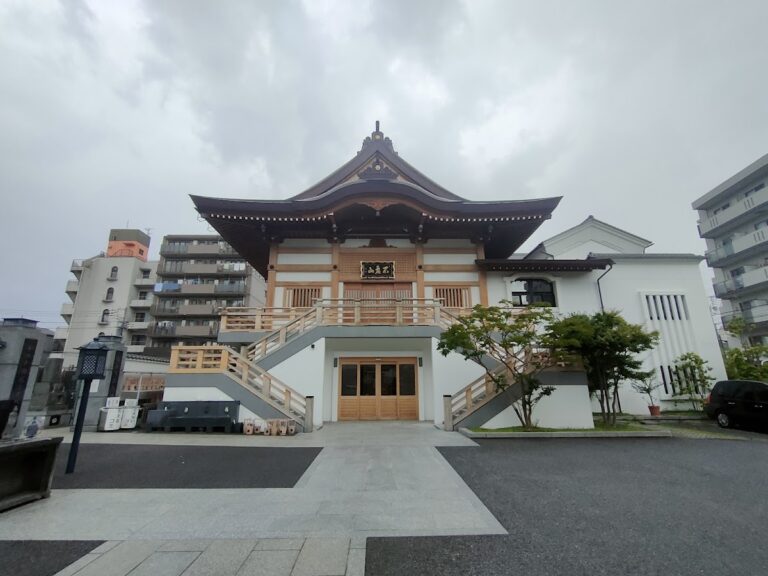
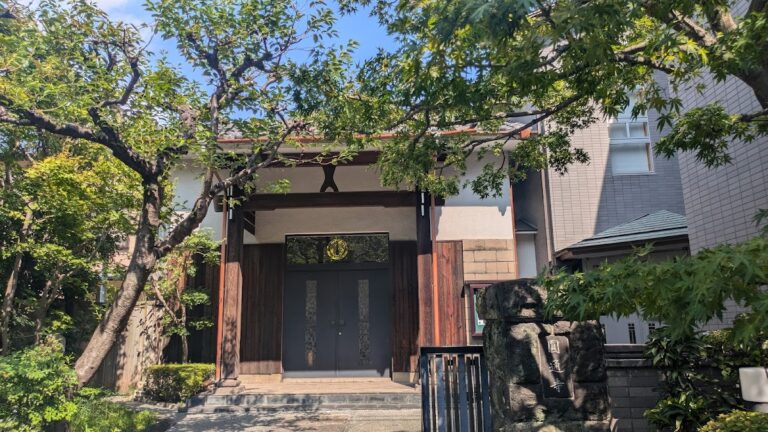
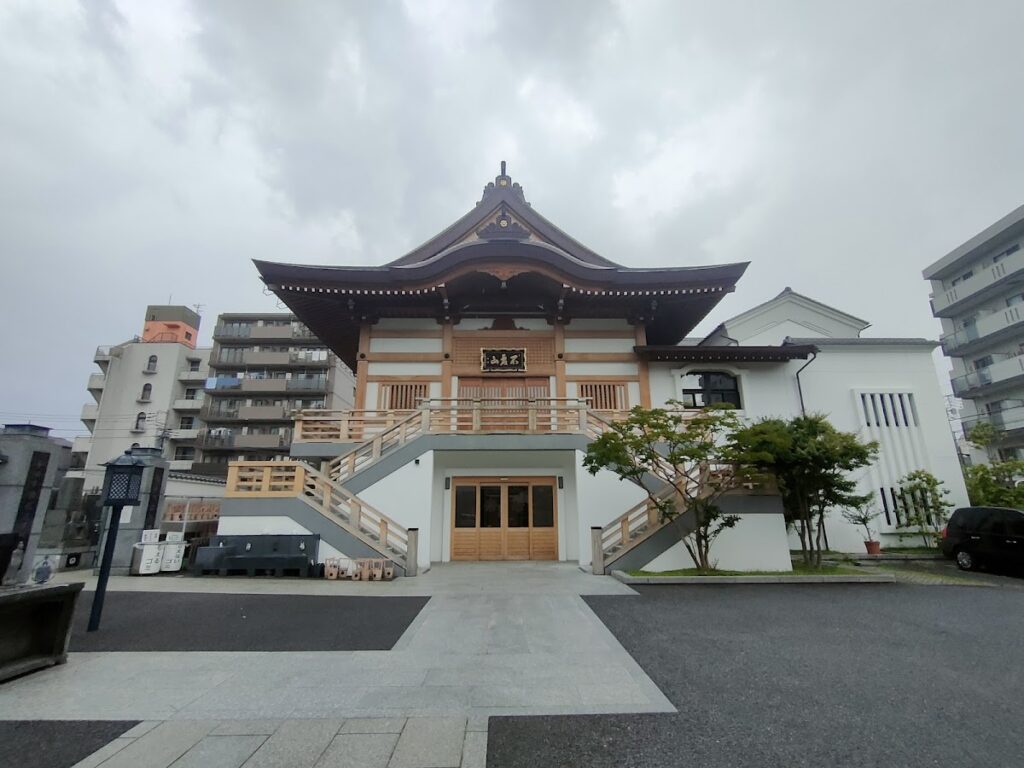
The main hall of Jūganji Temple maintains the style of traditional temple architecture while being a clean space with modern maintenance. Despite being in the heart of the city, the temple grounds are enveloped in tranquility, providing a peaceful environment for worship.
Goshuin (Temple Seal)
You can receive a Goshuin at Jūganji Temple. It features the meticulous calligraphy and red seal characteristic of Jōdo-shū temples, making it popular among Goshuin collectors. When requesting a Goshuin, please speak to the temple office after your visit.
How to Access Jūganji Temple
Access by Train
Jūganji Temple is within walking distance of several stations, making it very convenient to access by public transport.
Nearest Stations:
- Sumiyoshi Station (Tokyo Metro Hanzomon Line/Toei Shinjuku Line): Approximately 5 minutes on foot (shortest route)
- Kikukawa Station (Toei Shinjuku Line): Approximately 10 minutes on foot
- Kinshichō Station (JR Sōbu Line/Tokyo Metro Hanzomon Line): Approximately 13 minutes on foot
Access from Sumiyoshi Station is the most convenient. Exit from Exit A4 and walk along Shin-Ōhashi Street; you will arrive in about 5 minutes. Following the signs, even first-time visitors should be able to arrive without getting lost. ### Access by Car
The temple is approximately 10 minutes from the Kinshicho exit of the Metropolitan Expressway Route 7 Komatsugawa Line. However, since temples may have limited dedicated parking, it is recommended to check in advance if you are visiting by car. There are also several coin-operated parking lots nearby.
Major Facilities in the Surrounding Area
Near Jūganji Temple, there are numerous temples and shrines that allow you to experience the history of the Fukagawa area. It is also conveniently located near major roads such as Shin-Ōhashi Street and Yotsume Street, making it easy to get around within Koto Ward.
Funeral Services at Jūganji Temple
Features as a Temple Funeral Hall
Jūganji Temple has facilities that allow funerals to be held as a temple funeral hall. For those who wish to have a traditional temple funeral, a funeral at a historic Jōdo-shū temple holds great significance.
Advantages of Holding a Funeral at Jūganji Temple:
- Religious Solemnity: A funeral held in the main hall allows for a solemn farewell to the deceased.
- Convenient Access: Located just a 5-minute walk from Sumiyoshi Station, minimizing the burden on attendees.
- Tradition of the Jōdo Sect: A funeral can be conducted according to formal Jōdo Sect rituals.
- Community-Based Trust: The peace of mind of a temple with over 400 years of history.
Available Funeral Formats
Jūganji Temple accommodates various funeral formats, including:
- General Funeral: A traditional funeral inviting a wide range of attendees, such as relatives, friends, and acquaintances.
- Family Funeral: A small-scale funeral held only with relatives and close friends.
- One-Day Funeral: A funeral without a wake, consisting only of a farewell ceremony.
- Direct Cremation: A simple funeral service that omits the ceremony and involves only cremation.
Funeral Costs
Funeral costs at Jūganji Temple vary depending on the funeral plan and scale chosen. As a general guideline, the following pricing structure is available:
- Cremation/Direct Cremation: Approximately 94,000 yen and up
- One-Day Funeral: Approximately 300,000 yen and up
- Family Funeral: Approximately 500,000 yen and up
- Traditional Funeral: Approximately 800,000 yen and up
*The above are guidelines for basic plans. Actual costs will vary depending on the number of attendees, the size of the altar, and return gifts. For a detailed estimate, please contact our affiliated funeral home or temple directly.
Available Funeral Homes
Several funeral homes can handle funerals at Jūganji Temple. Our main affiliated funeral homes include those affiliated with networks such as “Ii Sōgi” and “Yasashii Osōshiki.”
Key Points When Choosing a Funeral Home:
- Transparency of Estimates: Clearly confirm whether there are any additional costs.
- Courteous Service: Explanation and attitude of the funeral director.
- Past Experience: Experience conducting funerals at Jūganji Temple.
- After-Sales Support: Ongoing support system for memorial services, etc.
Nearby Crematoriums
When holding a funeral at Jūganji Temple, the following crematoriums are often used:
- Rinkai Crematorium: A Tokyo Metropolitan Government-run crematorium located in Ōta Ward, Tokyo.
- Kirigaya Crematorium: A Tokyo Metropolitan Government-run crematorium located in Shinagawa Ward, Tokyo.
- Machiya Crematorium: A Tokyo Metropolitan Government-run crematorium located in Arakawa Ward, Tokyo.
The choice is made considering access from Kōtō Ward and availability. Since the funeral home handles the arrangements, the burden on the bereaved family is reduced.
Information around Jūganji Temple
Other Funeral Homes and Crematoriums in Koto Ward
Besides Jūganji Temple, there are several other funeral homes in Koto Ward:
- Fukagawa Hall: Fukagawa, Koto Ward, Tokyo
- Kameido Hall: Kameido, Koto Ward, Tokyo
- Other Temple Crematoriums: There are numerous temples in Koto Ward, each capable of handling funeral services.
Hospitals in the Surrounding Area
The following medical institutions are located near Jūganji Temple:
- Showa University Koto Toyosu Hospital
- Tokyo Rinkai Hospital
- Juntendo Tokyo Koto Elderly Medical Center
Our affiliated funeral homes provide 24-hour service for transporting bodies from these hospitals.
Memorial Services and Ceremonies at Jūganji Temple
Annual Memorial Services
Jūganji Temple can hold various memorial services from the seventh day after death to the 33rd anniversary. We pray for the repose of the deceased’s soul through respectful chanting and memorial services in accordance with the customs of the Jodo sect.
About Graves and Interment
Jūganji Temple has a cemetery, and it is possible to receive perpetual memorial services as a parishioner. Despite being in the city center, it is a quiet environment and conveniently located for visiting graves. Please contact the temple directly regarding cemetery availability and fees.
Manners and Precautions for Visiting
Visiting Hours
Jūganji Temple is generally open during daytime hours. However, funerals and memorial services may be held, so please be mindful of quiet and respectful conduct.
Attire
For regular visits, no special attire is required, but clean and subdued clothing is preferred. If attending a funeral or memorial service, please wear mourning attire or semi-formal attire.
Photography
Photography is generally permitted on the temple grounds, but it should be refrained from during funerals and memorial services. Please also be considerate of other visitors.
The History of Jūganji Temple and Koto Ward
Development of the Fukagawa Area
The Fukagawa area of Koto Ward has developed as a center of commerce and faith since the Edo period. Jūganji Temple has played a part in this history, functioning as a spiritual pillar for the people of the area.
War Damage and Reconstruction
During World War II, Koto Ward suffered significant damage from air raids. Jūganji Temple was also affected by the war damage, but it was rebuilt with the post-war reconstruction and stands in its current form.
Annual Events at Jūganji Temple
As a Jōdo-shū temple, Jūganji Temple holds the following annual events:
- Shūshō-e (January): New Year’s memorial service
- Shunki Higan-e (March): Spring equinox memorial service
- Segaki-e (August): Obon memorial service
- Shūki Higan-e (September): Autumn equinox memorial service
- Jūya Hōyō (November): An important Jōdo-shū memorial service
These events may be open to the general public as well as temple parishioners. Please contact the temple if you are interested.
Regarding Funeral Flowers and Offerings
Funeral Flowers
When sending funeral flowers to a funeral at Jūganji Temple, you can arrange them through our affiliated florist. Flowers for the wake and funeral service hold significant meaning as the final gift to the deceased.
Types of Funeral Flowers:
- Stand Flowers: Large floral arrangements displayed at the entrance of the venue.
- Pillow Flowers: Flowers placed around the coffin.
- Wreaths: A traditional form of floral tribute.
Price Guide
The price of funeral flowers varies depending on the size and type of flowers, but generally ranges from 10,000 to 30,000 yen per arrangement.
Voices of Visitors to Jūganji Temple
Reviews and Reputation
The following comments have been received from visitors and those who have held funerals at Jūganji Temple:
“It’s close to Sumiyoshi Station, making it easy for elderly relatives to attend.”
“The funeral in the main hall was solemn, allowing us to sincerely send off the deceased.”
“The funeral director was very polite and helpful, and we felt at ease entrusting them with the arrangements.”
“The temple grounds were kept clean, making for a pleasant visit.”
As you can see, its convenient access and the temple’s traditional prestige are highly valued.
About the Jūganji Temple’s Parishioner System
Benefits of Becoming a Parishioner
Becoming a parishioner of Jūganji Temple offers the following benefits:
- Priority Use of Funeral Services: As a parishioner, funeral services can be conducted smoothly at the temple.
- Perpetual Memorial Services: Memorial services can be received for generations.
- Use of Cemetery Graves: Possibility of using the temple cemetery.
- Consultation on Memorial Services: Consultation on various memorial services is available at any time.
Costs of Becoming a Parishioner
Becoming a parishioner requires an entrance fee and annual maintenance fees. The amount varies depending on the temple, so please contact Jūganji Temple directly for details.
Tourist Attractions Around Jūganji Temple
When visiting Jūganji Temple, you can also visit nearby tourist attractions:
Fukagawa Fudōdō Temple
A representative temple in Koto Ward, within walking distance of Jūganji Temple. It is bustling with many visitors on the 28th of each month.
Kiyosumi Garden
A metropolitan Japanese garden where you can enjoy beautiful scenery throughout the seasons. It’s about a 15-minute walk from Jūganji Temple.
Kiba Park
A vast urban park, perfect for strolls and picnics. The Museum of Contemporary Art Tokyo is also located next door.
Summary
Jūganji Temple is a historic Jōdo sect temple located in Sarue, Koto-ku, Tokyo. Since its founding in 1590, it has been a center of local faith for over 400 years.
Its convenient location, just a 5-minute walk from Sumiyoshi Station, makes it easily accessible for both worship and funeral services. Within the temple grounds is the “Mimamori Kannon,” which offers peace and tranquility to visitors.
For funeral services, they offer a wide range of options, from traditional funerals to family funerals, with various plans available starting from approximately 94,000 yen. Several funeral homes are available to provide comprehensive support.
For those seeking a memorial service conducted according to traditional Jodo sect rituals, or those wishing for a funeral at an easily accessible temple, Juganji Temple, with its long history dating back to the Edo period, is an ideal choice.
If you are considering visiting or using the temple for funeral services, we recommend you first pay a visit. Even in the heart of the city, you can find peace of mind while offering prayers in the tranquil temple grounds.
Frequently Asked Questions (FAQ)
Q1. What sect does Juganji Temple belong to?
Juganji Temple is a Jodo sect temple. The principal image is Amida Buddha, and memorial services and ceremonies are conducted based on the doctrines of the Jodo sect.
Q2. How do I get to Juganji Temple?
The nearest station is Sumiyoshi Station on the Tokyo Metro Hanzomon Line and Toei Shinjuku Line, approximately a 5-minute walk away. It is also accessible from Kikukawa Station on the Toei Shinjuku Line (approximately a 10-minute walk) and Kinshicho Station on the JR Line (approximately a 13-minute walk).
Q3. How much does it cost to hold a funeral at Jūganji Temple?
Funeral costs vary depending on the plan chosen, but as a guideline, a cremation-only service starts from approximately 94,000 yen, a family funeral from approximately 500,000 yen, and a general funeral from approximately 800,000 yen. For details, please contact our affiliated funeral home or the temple directly.
Q4. Can I get a temple stamp (Goshuin) at Jūganji Temple?
Yes, you can get a temple stamp (Goshuin) at Jūganji Temple. Please speak to the temple office after your visit. Even if you do not have a Goshuin book, we may have pre-printed stamps available.
Q5. Please tell me about the history of Jūganji Temple.
Jūganji Temple was founded in 1590 (Tenshō 18) by Fukyo Daizen-ni, the daughter of Chiba Kunitane, and was opened in 1629 (Kan’ei 6) by Honrensha Ganyo Zetetsu Shōnin. After several relocations, the temple moved to its current location in Sarue in 1795 (Kansei 7), and has been a beloved place of worship in this location for over 200 years.
Q6. Can funerals be held at Jūganji Temple even if I am not a parishioner?
Even if you are not a parishioner, it is possible to hold a funeral at Jūganji Temple through a partner funeral home. However, priority may be given to parishioners, and conditions may differ, so it is recommended to check in advance.
Q7. Does Jūganji Temple have parking?
Temples may have limited parking space, but details should be confirmed in advance. There are also coin-operated parking lots nearby, so please consider using them if you are visiting by car.
Q8. How do I apply for a memorial service at Jūganji Temple?
To apply for a memorial service, please contact Jūganji Temple directly by phone or visit. We handle annual memorial services such as the seventh day, forty-ninth day, and first anniversary. Providing the date and number of attendees in advance will allow for smoother preparation.
Q9. What is the “Mimamori Kannon” at Jūganji Temple?
The “Mimamori Kannon” is a statue of Kannon Bodhisattva erected in 1981 on the grounds of Jūganji Temple. It is cherished as a guardian presence for the local community and is a symbolic landmark of Jūganji Temple, attracting many visitors.
Q10. Are there any recommended tourist spots around Jūganji Temple?
Around Jūganji Temple, there are tourist spots such as Fukagawa Fudōdō (within walking distance), Kiyosumi Garden (approximately 15 minutes on foot), and Kiba Park (approximately 20 minutes on foot). This area allows you to experience the history and culture of Koto Ward, so you can enjoy a stroll in conjunction with your visit to the temple.