Complete Guide to Kanda Shrine (Chiyoda Ward, Tokyo) | History and Visiting Information for Kanda Myojin, the Guardian Shrine of Edo
Kanda Shrine, located in Sotokanda, Chiyoda Ward, Tokyo, is a historic shrine widely known as “Kanda Myojin.” During the Edo period, it was revered by everyone from the shogun to the common people as the “guardian shrine of Edo,” and even today, it continues to watch over the heart of Tokyo as the tutelary shrine for 108 neighborhoods including Kanda, Nihonbashi, Akihabara, Otemachi, and Marunouchi.
This article provides detailed information useful for visiting Kanda Shrine, covering its nearly 1300-year history from its founding to the present day, the origins of its enshrined deities, access methods, highlights, annual events such as the Kanda Festival, and even modern initiatives.
About Kanda Shrine (Kanda Myojin)
Official Name and Common Name
The official name of Kanda Shrine is “Kanda Shrine,” but it is widely known as “Kanda Myojin.” The name “Myojin” originates from the fact that in 1309, when the spirit of Taira no Masakado was enshrined alongside the main deity, the shrine was named “Kanda Myojin.” Even today, it is affectionately known as “Kanda Myojin” by locals and worshippers, and both names are widely used.
Shrine Rank and Status
Kanda Shrine was formerly a quasi-imperial shrine, later a prefectural shrine, and is currently designated as a special shrine by the Tokyo Metropolitan Shrine Association. It is also counted as one of the “Ten Shrines of Tokyo,” and is positioned as an important shrine representing Tokyo. During the Edo period, Kanda Shrine was designated the “General Guardian Shrine of Edo” by the Tokugawa Shogunate, and as the guardian deity of the northeast (Ushitora) direction of Edo Castle, it played a role in protecting the entire city of Edo.
Parishioning Area
Kanda Shrine’s parishioning area encompasses a total of 108 neighborhoods, including Kanda, Nihonbashi (north of the Nihonbashi River), Akihabara, Otemachi, Marunouchi, and the former Kanda Market and Tsukiji Fish Market. These areas are central to Japan’s economy and business, and even today, many companies and shops visit Kanda Shrine for New Year’s prayers and to pray for business prosperity.
History of Kanda Shrine
Founding and Ancient History
Kanda Shrine is said to have been founded in the second year of the Tenpyo era (730 AD), making it a very old shrine with a history of 1300 years since its founding in 2030. Initially, it was located in what is now Otemachi (formerly known as Shibazaki Village). It is believed that the shrine’s origins lie in the enshrinement of the ancestral deity by the Makanda-omi, a powerful local clan in Musashi Province at the time.
Enshrinement of Taira no Masakado
A significant turning point in the history of Kanda Shrine was the enshrinement of Taira no Masakado in 1309 (Enkei 2). Near Otemachi, the founding site of Kanda Shrine, there is a burial mound of Taira no Masakado’s head, and he was enshrined alongside the main deity to appease his spirit. From this time, the name “Kanda Myojin” came into use.
Taira no Masakado was a military commander of the mid-Heian period, known for his attempts to establish independence for the Kanto region. Although he was long treated as a “rebel” for rebelling against the imperial court, he is revered in Kanto as a hero who protected the people, and is enshrined as one of the important deities at Kanda Shrine.
Relocation and Development during the Edo Period
In 1616, with the expansion of Edo Castle, Kanda Shrine was relocated to its current location in Sotokanda. This location was chosen as an important site for protecting Edo Castle and the city of Edo, as it was located in the northeast (the direction of the “demon’s gate”) of Edo Castle.
The Tokugawa Shogunate held Kanda Shrine in particular importance, and successive shoguns visited and made donations to the shrine. Tokugawa Ieyasu, in particular, is said to have prayed for victory at Kanda Shrine before the Battle of Sekigahara, and after his victory, he provided generous protection, including the construction of shrine buildings. During this period, it became widely revered as the “guardian shrine of Edo,” attracting worshippers from samurai to commoners.
The Meiji Restoration and the Separation of Shinto and Buddhism
Kanda Shrine was greatly affected by the separation of Shinto and Buddhism decree following the Meiji Restoration. A particularly problematic issue was the treatment of Taira no Masakado. The Meiji government viewed the enshrinement of Taira no Masakado, who had rebelled against the imperial court, as problematic, and in 1874, he was temporarily removed from the list of enshrined deities.
However, due to strong demands from local people and devotees, Taira no Masakado was officially reinstated as an enshrined deity in 1984, and remains so to this day.
Modern Kanda Shrine
The Kanda Shrine buildings suffered significant damage from the Great Kanto Earthquake and the bombing during World War II, but were rebuilt each time. The current shrine building, rebuilt in 1934, is a combination of traditional and modern architecture, using steel-framed reinforced concrete and cypress wood construction.
In 2018, the cultural exchange center “EDOCCO” opened, showcasing new initiatives that blend tradition and innovation.
Enshrined Deities
Kanda Shrine enshrines three deities.
First Shrine: Ōnamuchi-no-Mikoto
Ōnamuchi-no-Mikoto is another name for Ōkuninushi-no-Mikoto and is also known as the principal deity of Izumo Taisha Shrine. He is a god who presides over a wide range of fields, including land development, agriculture, commerce, and medicine, and is especially revered for his blessings of matchmaking, business prosperity, and protection against evil.
Second Shrine: Sukunahikona-no-Mikoto
Sukunahikona-no-Mikoto is a god who worked with Ōnamuchi-no-Mikoto in nation-building. Possessing great wisdom in a small body, he is known as the god of medicine and sake brewing. He is revered for his blessings of business prosperity, health and longevity, and healing from illness.
Third Shrine: Taira no Masakado-no-Mikoto
Taira no Masakado was a military commander in the mid-Heian period who attempted to establish independence for the Kanto region. After his tragic death, his spirit came to be worshipped as a guardian deity of Kanto. It is believed to offer divine blessings such as protection from disaster and misfortune, good fortune in competitions, and long-lasting military success, and is particularly popular among businessmen and entrepreneurs.
Access Information
Location
2-16-2 Sotokanda, Chiyoda-ku, Tokyo 101-0021
TEL: 03-3254-0753
FAX: 03-3255-8875
Access by Train
Kanda Shrine is accessible on foot from several train stations.
JR Chuo Line/Sobu Line
- 5-minute walk from Ochanomizu Station (Hijiribashi Exit)
JR Keihin-Tohoku Line/Yamanote Line
- 7-minute walk from Akihabara Station (Electric Town Exit)
Tokyo Metro Marunouchi Line
- 5-minute walk from Ochanomizu Station (Hijiribashi Exit)
Tokyo Metro Chiyoda Line
- 5-minute walk from Shin-Ochanomizu Station (Hijiribashi Exit)
Tokyo Metro Ginza Line
- 5-minute walk from Suehirocho Station
Tokyo Metro Hibiya Line
- 7-minute walk from Akihabara Station
The most convenient access is from Ochanomizu Station, Shin-Ochanomizu Station, or Suehirocho Station, all about a 5-minute walk. While it’s a bit further from Akihabara Station, the route through the electric town is also popular.
Access by Car
Approximately 5 minutes from the Kandabashi Exit of the Metropolitan Expressway Inner Circular Route. However, while Kanda Shrine has a parking lot for visitors, the number of spaces is limited, so we recommend using public transportation. Especially on weekends and during festivals, congestion is expected.
Highlights of the Shrine Grounds
Zuishinmon Gate
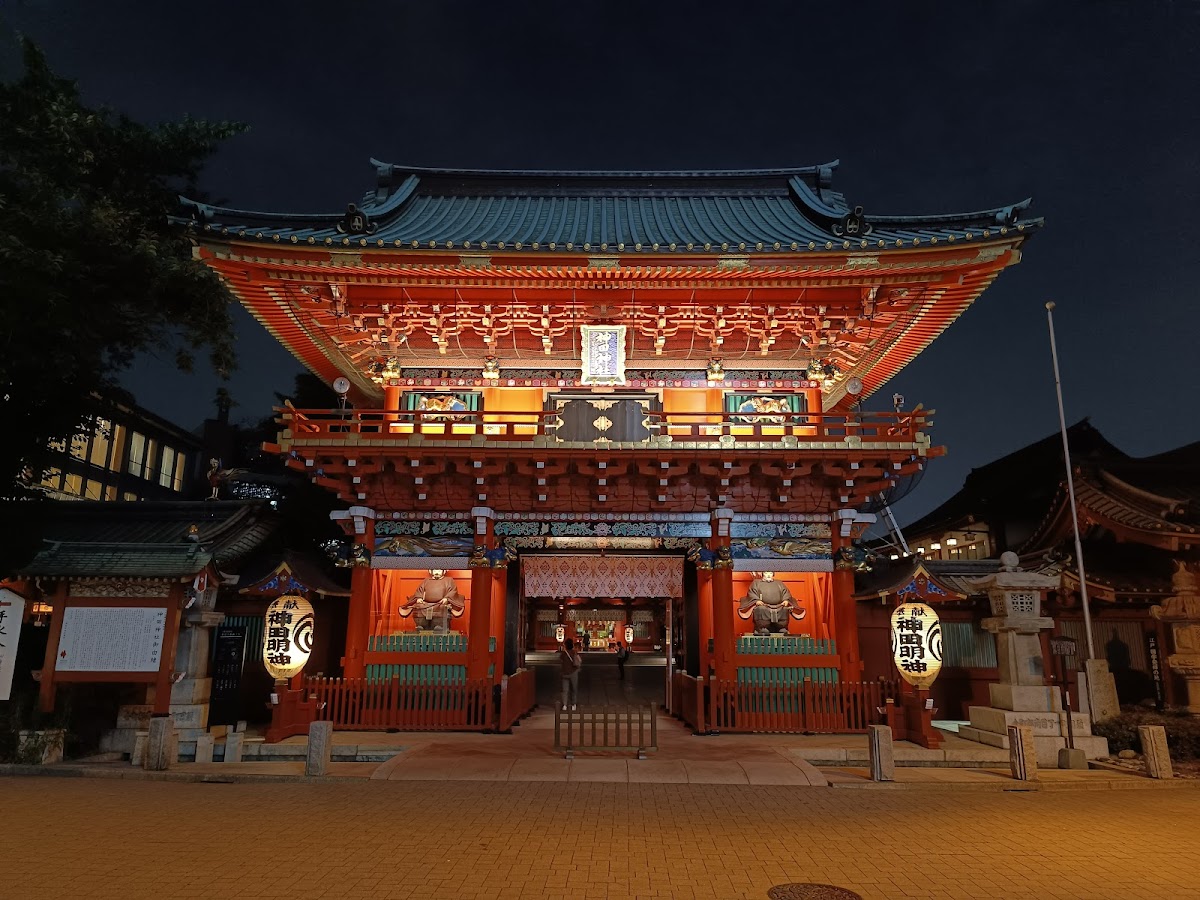
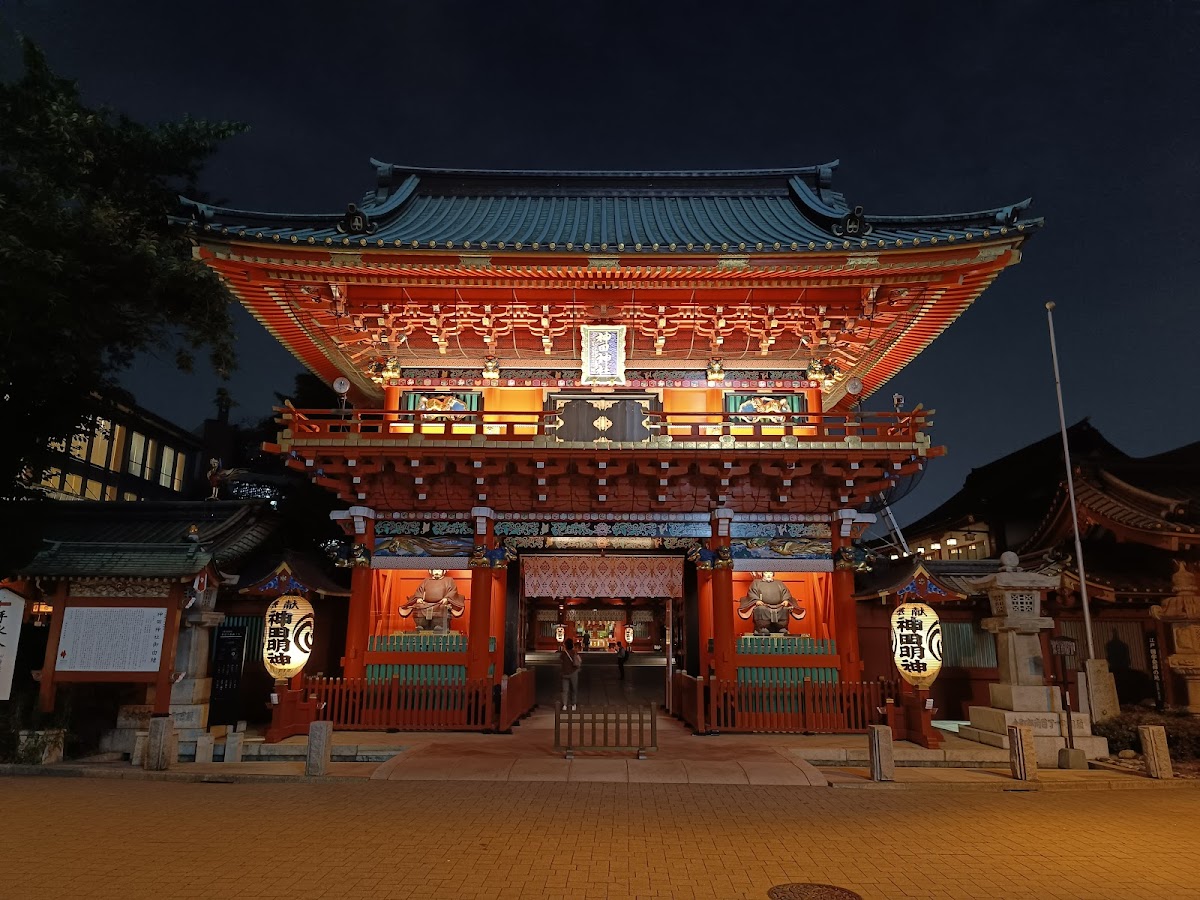
The vermilion-lacquered Zuishinmon Gate, standing at the main entrance of Kanda Shrine, was rebuilt in 2003. It is constructed in a traditional architectural style using cypress wood and a hip-and-gable roof. Statues of guardian deities are enshrined on either side of the gate, welcoming visitors. This gate is a symbolic presence of Kanda Shrine and is featured in many photographs.
Shrine Buildings
The current shrine buildings were rebuilt in 1934. While constructed of steel-framed reinforced concrete, the exterior is entirely made of cypress wood, a fusion of tradition and modern technology. It is built in the Gongen-zukuri style, with the main hall, offering hall, and worship hall integrated into a single structure. The vermilion paint and gold decorations are beautiful, creating a solemn atmosphere that evokes the refined elegance of Edo.
Daikoku-sama Statue
Within the shrine grounds stands a massive stone statue of Daikoku-sama, standing 6.6 meters tall and weighing approximately 30 tons. This is a statue of the enshrined deity, Ōkuninushi-no-Mikoto (Ōnamuchi-no-Mikoto), and is popular with worshippers praying for matchmaking and business prosperity.
Zenigata Heiji Monument
Within the grounds of Kanda Shrine is a monument to Zenigata Heiji, the protagonist of Nomura Kodō’s novel “Zenigata Heiji Torimonocho” (Zenigata Heiji’s Detective Stories). Erected in 1970 (Showa 45), it was created because the novel was set near Kanda Myōjin-shita. It’s a must-see spot for fans of historical dramas and literature.
EDOCCO Cultural Exchange Center
Opened in 2018 (Heisei 30), the EDOCCO Cultural Exchange Center functions as a new cultural hub while preserving the shrine’s traditions. The building houses exhibition spaces showcasing the history and culture of Kanda Myojin Shrine, a cafe, and a souvenir shop, making it ideal for resting and gathering information after visiting the shrine.
Kanda Festival
One of Japan’s Three Great Festivals and Edo’s Three Great Festivals
The Kanda Festival is the most important festival of Kanda Shrine and is counted as one of Japan’s Three Great Festivals and Edo’s Three Great Festivals. Officially called the “Kanda Myojin Festival,” it is held grandly every two years (in odd-numbered years) in mid-May.
History of the Kanda Festival
The Kanda Festival has ancient origins. During the Edo period, it was one of the few festivals allowed to enter Edo Castle as a “Tenka Matsuri” (festival of the realm). Because the Shogun viewed it, it developed into the most prestigious festival in Edo.
Highlights of the Kanda Festival
The biggest highlight of the Kanda Festival is the Shinkosai (procession of the deity). A magnificent procession parades through the approximately 30-kilometer area of the shrine’s parish, including Kanda, Nihonbashi, Otemachi, and Marunouchi. The sight of the procession of palanquins, portable shrines, and floats is breathtaking, attracting large crowds of spectators.
Furthermore, during the portable shrine procession, approximately 200 portable shrines from various neighborhood associations enter Kanda Shrine, filling the grounds with excitement.
Annual Events
Besides the Kanda Festival, Kanda Shrine holds various other annual events.
New Year’s Visit
Kanda Shrine’s New Year’s visit is one of the most popular in Tokyo. Businesspeople and corporate representatives, particularly from the parish areas of Otemachi and Marunouchi, visit to pray for business prosperity, resulting in approximately 300,000 visitors during the first three days of the New Year.
Setsubun Festival
On February 3rd, Setsubun, the Setsubun Festival is held. Sumo wrestlers and celebrities participate in the bean-throwing ceremony, attracting many worshippers.
Summer Purification Ceremony
On June 30th, the Summer Purification Ceremony is held. Participants purify themselves of the sins and impurities accumulated over the past six months by passing through a ring of reeds, and pray for good health and protection from illness for the remaining half of the year.
Annual Grand Festival
In years when the Kanda Festival is not held (even-numbered years), the Annual Grand Festival is held in May. While not as large in scale as the Kanda Festival, it is a solemn and important festival of the shrine.
Goshuin (Shrine Seals) and Amulets
Goshuin (Shrine Seals)
At Kanda Shrine, in addition to regular goshuin, seasonal and special goshuin are available. Goshuin are available at the shrine office for a fee of 500 yen. During special occasions such as the Kanda Festival, limited-edition goshuin (temple/shrine stamps) are sometimes offered, making it popular among goshuin collectors.
Amulets
Kanda Shrine offers a wide variety of amulets, from traditional to modern.
IT Information Security Amulet
Taking advantage of its location near Akihabara, amulets protecting information devices such as computers and smartphones are popular. They are favored by IT company employees and students.
Business Prosperity Amulet
With business districts like Otemachi and Marunouchi as its parish area, business prosperity amulets are particularly popular.
Victory Amulet
This amulet, inspired by the divine virtue of Taira no Masakado’s long-lasting military fortune, is popular among students taking exams and athletes.
Matchmaking Amulet
This amulet, inspired by the divine virtue of Ōkuninushi-no-Mikoto’s matchmaking blessings, is popular among worshippers seeking good relationships.
Prayers and Sorting
Kanda Shrine accepts various prayers and blessings for individuals and businesses.
Prayers for Individuals
- Protection from misfortune and evil influences
- Family safety and good health
- Business prosperity and success
- Success in examinations and academic achievement
- Good fortune in relationships and matchmaking
- Safe childbirth and first shrine visit for a newborn
- Shichi-Go-San (7-5-3) ceremony
Prayers for Businesses
Kanda Shrine, with its parish encompassing the heart of Japan’s business district, also offers many prayers and blessings for businesses.
- Business prosperity and success
- Construction safety and workplace safety
- Success in new ventures
- Employee safety
Prayers and blessings are by reservation only and can be made in advance by phone or through the shrine’s website.
Modern Initiatives
Collaboration with Anime and Games
Due to its location near Akihabara, Kanda Shrine is actively involved in collaborations with anime and games. Having appeared as a setting in the popular anime “Love Live!”, it has become known as a pilgrimage site for anime fans. Furthermore, votive tablets and amulets featuring collaborations with anime and games are regularly offered, attracting many young visitors.
Information Dissemination via Social Media
Kanda Shrine actively disseminates information through its official website and social media (Twitter, Instagram, Facebook). Information on festivals, seasonal events, and the shrine grounds is posted in real time, providing helpful information for visitors.
Introduction of Cashless Payment
Adapting to changing times, Kanda Shrine has introduced cashless payment for the issuance of amulets and goshuin (shrine stamps). Credit cards, electronic money, and QR code payments are accepted, creating a user-friendly environment for foreign tourists and younger generations.
Nearby Tourist Attractions
Akihabara Electric Town
Located within walking distance of Kanda Shrine, Akihabara is a world-famous electronics district and a mecca for otaku culture. It offers a diverse range of entertainment options, including electronics, anime goods, games, and maid cafes.
Yushima Seido
Located about a 10-minute walk from Kanda Shrine, Yushima Seido is a Confucian temple built during the Edo period. Known as the god of learning, it is a popular destination for students preparing for exams.
Nikolai-do
Near Ochanomizu Station, Nikolai-do (Tokyo Resurrection Cathedral) is a cathedral of the Japanese Orthodox Church, showcasing beautiful Byzantine-style architecture.
Jimbocho Used Book District
Jimbocho, known as one of the world’s largest used book districts, is located about a 15-minute walk from Kanda Shrine. With its numerous used bookstores, it’s an irresistible area for book lovers.
Manners and Points for Visiting the Shrine
Visiting Hours
While Kanda Shrine is generally open for worship throughout the day, the shrine office and prayer reception hours are from 9:00 AM to 4:00 PM. The distribution of Goshuin (shrine stamps) and amulets is also during these hours.
Worship Etiquette
Worship at Kanda Shrine follows the same etiquette as at any other shrine.
- Bow before passing through the torii gate.
- Cleanse your hands and mouth at the temizuya (water basin).
- Bow twice, clap twice, and bow once in front of the main hall.
- After worship, turn around and bow before leaving the torii gate.
Photography
Photography is generally permitted on the shrine grounds, but please refrain from taking pictures during prayers or Shinto rituals. Also, please be considerate of other worshippers.
Attire
For those receiving prayers, formal or semi-formal attire is desirable, but there are no specific dress code requirements for regular worship. However, please dress appropriately, as this is a sacred place. ## Summary
Kanda Shrine (Kanda Myojin) is a venerable shrine with a history of nearly 1300 years, having protected the heart of Edo/Tokyo. During the Edo period, it was widely revered as the “General Guardian Shrine of Edo,” from the shogun to the common people. Even today, it attracts the faith of many people as the tutelary shrine of 108 neighborhoods that form the core of the Japanese economy, including Kanda, Nihonbashi, Akihabara, Otemachi, and Marunouchi.
The three enshrined deities—Ōkuninushi-no-Mikoto, Sukunahikona-no-Mikoto, and Taira no Masakado-no-Mikoto—are believed to bestow blessings for business prosperity, matchmaking, and success in competitions, respectively, attracting a wide range of visitors from business people to students and couples.
Its convenient location, just a 5-minute walk from Ochanomizu, Shin-Ochanomizu, and Suehirocho stations, and within walking distance of Akihabara, is also a major draw. While preserving tradition, it also undertakes new initiatives adapted to the times, such as IT information security protection and collaborations with anime, gaining support from a wide range of generations.
The Kanda Festival, held every two years, is one of Japan’s three greatest festivals and one of Edo’s three greatest festivals, offering a rare opportunity to witness a magnificent and splendid festival procession. Annual events such as New Year’s visits and Setsubun festivals are also celebrated on a grand scale, each offering a different charm depending on the season.
When sightseeing in Tokyo or strolling through Akihabara, be sure to stop by Kanda Shrine and experience the history and culture of Edo, as well as the divine blessings of the gods who watch over modern Tokyo.