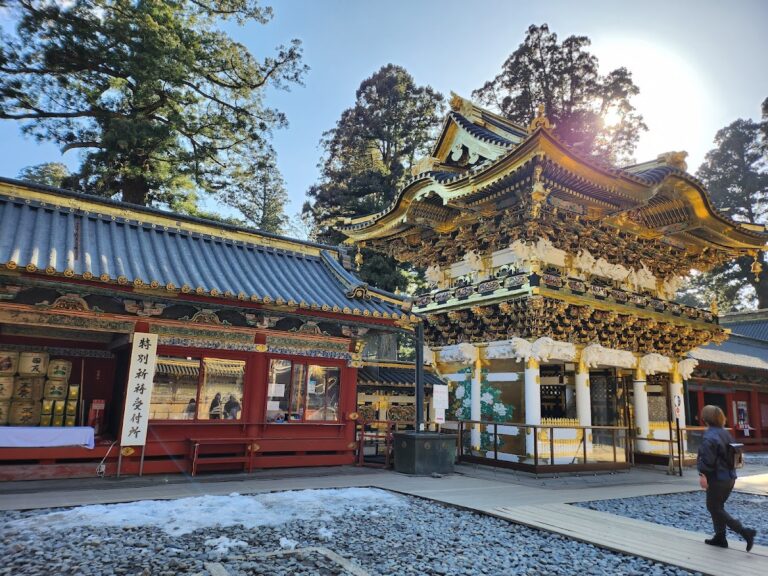
About Nikko Toshogu Shrine
Nikko Toshogu Shrine is a shrine dedicated to Tokugawa Ieyasu, the first shogun of the Edo shogunate, who was deified as Toshodai Gongen. Founded in 1617 (Genna 3), it was rebuilt in its current magnificent form in 1636 (Kanei 13) during the “Kanei Great Reconstruction” by the third shogun, Tokugawa Iemitsu.
Registered as a World Cultural Heritage site in 1999 as “Shrines and Temples of Nikko,” it boasts 55 existing buildings, including 8 National Treasures and 34 Important Cultural Properties. As a representative example of early Edo period architectural technology and artistry, it is one of Japan’s leading tourist destinations, attracting approximately 2 million visitors annually.
Main Highlights
Yomeimon Gate (National Treasure)
The Yomeimon Gate, a symbol of Nikko Toshogu Shrine, is a two-story gate tower measuring 11.1m in height, 7m in width, and 4.4m in depth. Adorned with 508 sculptures, its beauty has earned it the nickname “Gate of Day-Long Life,” meaning one could gaze at it all day without getting bored.
The sculptures cover a wide range of themes, including Chinese legends, sages, and mythical creatures, and their dazzling gold leaf and vibrant colors create a breathtaking spectacle. In 2017, it underwent its first major restoration in 44 years, restoring its original splendor.
Three Monkeys (Sacred Stable)
The sculptures of the three monkeys, known for “see no evil, speak no evil, hear no evil,” are carved above the lintel of the stable where the sacred horses are kept, known as the Sacred Stable (Shinkyusha). In fact, the eight sculptures, including the three monkeys, tell a story about the human way of life through the life of a monkey.
It’s a didactic work containing life lessons: avoiding evil in childhood, becoming independent in youth, overcoming life’s challenges, and eventually starting a family.
Sleeping Cat (National Treasure, East Corridor)
The “Sleeping Cat,” attributed to Hidari Jingoro, is a small sculpture carved above the entrance to the inner shrine’s approach in the East Corridor. Though only about 20cm long, it is known as a symbol of peace.
There are two interpretations: that it represents a time of peace so peaceful that even a cat can sleep, and that the cat is actually slightly awake, protecting Tokugawa Ieyasu. A sparrow sculpture adorns the reverse side, and the coexistence of the cat and sparrow is also said to symbolize peace.
Karamon Gate (National Treasure)
The Karamon Gate, located beyond the Yomeimon Gate, is the main gate to the main shrine (main hall, stone chamber, and worship hall). It is made of white wood coated with gofun (white pigment) and features delicate carvings.
Particularly noteworthy are the “Ascending Dragon” and “Descending Dragon” carvings. Legend says that these dragons would go to Shinobazu Pond every night to drink water, and that nails were driven into their eyes to immobilize them.
Five-Storied Pagoda (Important Cultural Property)
The 36-meter-tall five-storied pagoda, located immediately to the left after passing through the stone torii gate of the main approach, was rebuilt in 1818 (Bunsei 1). Each of the four stories features carvings of the twelve zodiac animals, guarding the cardinal directions.
The interior employs a “suspended” earthquake-resistant structure with a central pillar suspended from the ground, demonstrating the high level of architectural skill that allowed it to withstand the Great Kanto Earthquake without collapsing.
Points to Note During Your Visit
Recommended Visiting Route
- Main Gate (Nio Gate) – The starting point of your visit; observe the Nio statues on either side.
- Five-Storied Pagoda – Only the exterior can be viewed.
- From the Main Gate to the Sacred Stable – Admire the Three Wise Monkeys carvings.
- Water Pavilion – Purify yourself with the water.
- Yomeimon Gate – Carefully observe the carvings (30 minutes recommended).
- Karamon Gate – The gate before visiting the main shrine.
- Main Shrine (Worship Hall/Main Sanctuary) – Pay your respects to the enshrined deities.
- Sleeping Cat/Inner Shrine – Climb the 207 stone steps (separate admission fee required).
- Yakushido Hall (Honjido Hall) – Experience the Crying Dragon demonstration.
The estimated time required is approximately 90 minutes for the standard route, and 2 hours if you include the Inner Shrine.
Points to Note When Visiting
- Visiting Hours: 8:00-17:00 from April to October, 8:00-16:00 from November to March (Last entry 30 minutes before closing)
- Admission Fee: Adults 1,300 yen, Elementary and Junior High School Students 450 yen (Inner Shrine: 570 yen/230 yen extra)
- Photography: Photography is permitted for the exterior of the buildings, but generally prohibited for the interior.
- Estimated Time Required: Waiting times may occur around the Yomeimon Gate during peak hours.
- Attire: Comfortable shoes are recommended due to the many stone steps.
Best Season
- Spring (Late April to May): Season of fresh greenery and cherry blossoms, Thousand Warrior Procession (May 17th and 18th)
- Autumn (Late October to Early November): Peak of autumn foliage, Autumn Grand Festival (October 17th)
- Winter (January-February): The snow-covered shrine is magical, and fewer tourists allow for peaceful worship.
Benefits and Goshuin (Shrine Seals)
Main Benefits
Nikko Toshogu Shrine, dedicated to Tokugawa Ieyasu, is said to offer the following benefits:
- Good Fortune & Career Advancement: Seeking blessings from Tokugawa Ieyasu, who achieved the unification of Japan.
- Protection from Evil & Disaster: Believed in as a powerful guardian deity.
- Luck in Competition & Victory: The protection of a warlord who survived the Sengoku period.
- Academic Success: The teachings of Tokugawa Ieyasu, who valued learning.
- Business Prosperity: Seeking blessings from the 260 years of prosperity of the Edo Shogunate.
Goshuin (Shrine Seal) Information
- Issuance Location: Prayer reception area in front of the Yomeimon Gate
- Offering Fee: 500 yen
- Types: In addition to regular goshuin, seasonal special goshuin are also available.
- Reception Hours: 8:00 AM – 4:30 PM (Varies by season)
Original goshuin notebooks (from 1,500 yen) are also popular, featuring designs of the Yomeimon Gate and the sleeping cat.
Access Information
Access by Train
From Tobu Nikko Station/JR Nikko Station
- Tobu Bus: Approximately 10 minutes by “World Heritage Sightseeing” bus, get off at “Omotesando” bus stop, 5-minute walk (310 yen one way)
- Walking: Approximately 2.3 km from the station, about 30-35 minutes on foot (gentle uphill slope)
From Tokyo
- Tobu Railway: Approximately 1 hour 50 minutes from Asakusa Station to Tobu Nikko Station by the “Spacia” limited express train (2,860 yen~)
- JR: Approximately 2 hours from Shinjuku Station to JR Nikko Station by limited express train (around 4,000 yen)
Access by Car
- Nikko Utsunomiya Expressway: Approximately 2 km from Nikko IC, about 5 minutes
- Parking: Numerous paid parking lots in the surrounding area (600 yen~1,000 yen/day)
- Nikko Toshogu Shrine Main Parking Lot (200 cars)
- West Approach First and Second Parking Lots
- Numerous private parking lots are also available.
Caution: It gets very crowded during the autumn foliage season (late October to early November) and long holidays. Early morning arrival or use of public transportation is recommended.
Combining with Nearby Sightseeing
The following sights are located around Nikko Toshogu Shrine and are recommended to visit together:
- Nikko Futarasan Shrine: 5-minute walk, a power spot for matchmaking
- Nikkozan Rinnoji Temple: 5-minute walk, Sanbutsudo Hall and Taiyuin Temple
- Shinkyo Bridge: 10-minute walk, one of Japan’s three most unusual bridges
- Kegon Falls: Approximately 30 minutes by bus, one of Japan’s three most famous waterfalls
Summary
Nikko Toshogu Shrine is one of Japan’s leading historical buildings, conveying the power and prestige of the Edo Shogunate. Each of the 508 carvings on the Yomeimon Gate, the moral lesson of the Three Wise Monkeys, and the sleeping cat symbolizing peace, are imbued with deep meaning.
Beyond its value as a World Heritage Site, it is also a popular power spot for good fortune and career advancement, attracting many visitors at important turning points in their lives. Since it’s within day-trip distance from Tokyo, be sure to take your time and enjoy a thorough visit.