
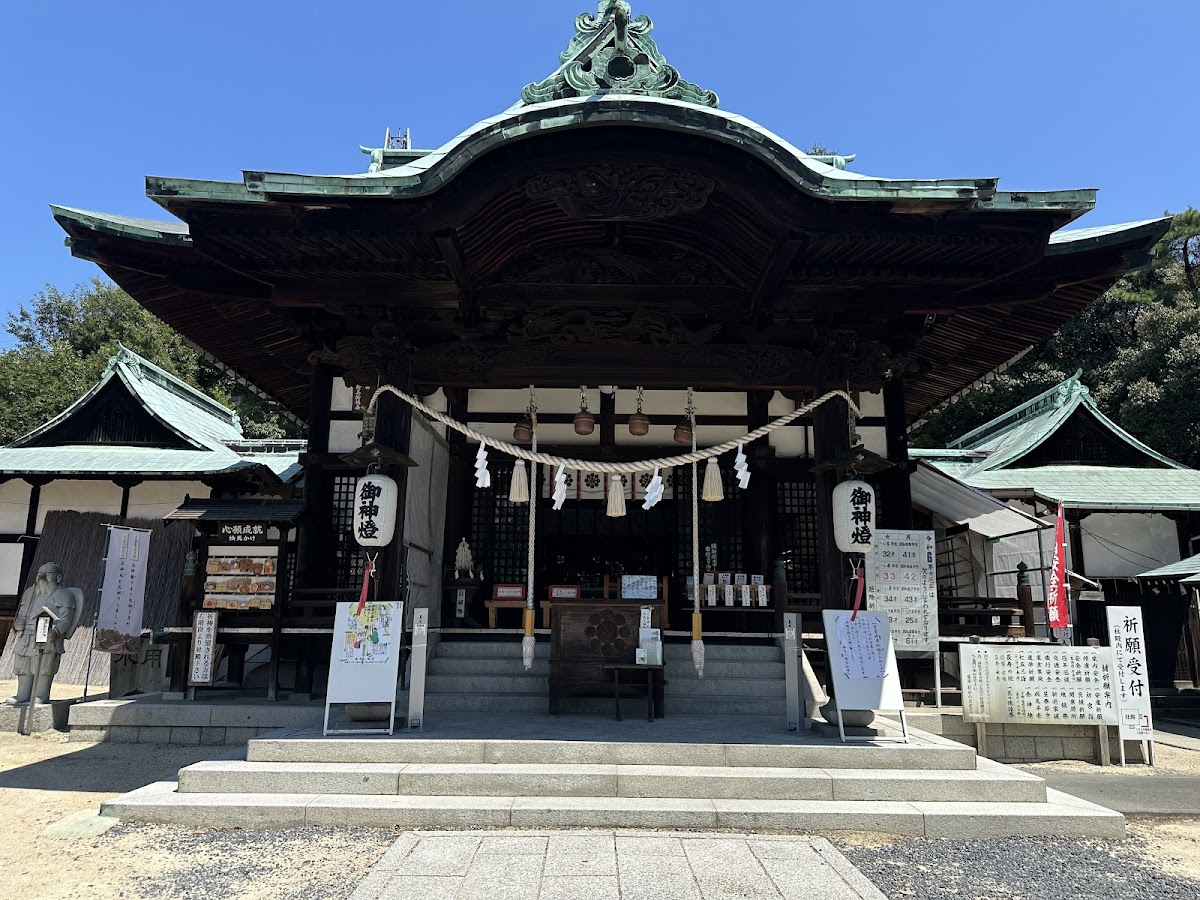
Shiio Hachimangu Shrine (Iwakuni City, Yamaguchi Prefecture) Complete Guide: History, Goshuin (Shrine Seal), Access, and Parking Information
Shiio Hachimangu Shrine, located near Kintaikyo Bridge in Iwakuni City, Yamaguchi Prefecture, is a historic shrine that has protected the region since the early Edo period. Situated on a hill overlooking Iwakuni Castle, it is also known for its Shinko-sai festival, which is held only once every 33 years. This article provides a detailed explanation of everything you need to know before visiting Shiio Hachimangu Shrine, including its history, highlights, goshuin (shrine seal), access methods, and parking information.
History and Origins of Shiio Hachimangu Shrine
Founding and Connection to the Kikkawa Family, Lords of Iwakuni Domain
Shiio Hachimangu Shrine is said to have been built in 1626 (Kanei 3) by Kikkawa Hiromasa, the second lord of the Iwakuni Domain. Yoshikawa Hiromasa, the head of the Yoshikawa family, who sided with the Western Army in the Battle of Sekigahara and thus became the head of the Iwakuni domain as a branch of the Choshu domain, constructed a shrine and enshrined Hachiman-jin (the god of war) to pray for the peace and prosperity of his territory.
Shiio Hachiman-gu Shrine, which received the patronage of the Iwakuni domain lord, is an important shrine that has watched over the history of Iwakuni along with Kintaikyo Bridge and Iwakuni Castle. Currently, it is the tutelary shrine of the West Iwakuni area and is revered by local residents.
Reasons for the existence of two Shiio Hachiman-gu Shrines
There are two shrines with the same name, “Shiio Hachiman-gu,” in Iwakuni City. One is the Shiio Hachiman-gu near Kintaikyo Bridge (Iwakuni 4-chome, Iwakuni City) introduced in this article, and the other is the Shiio Hachiman-gu located in Oaza Kaku, Iwakuni City. Since these are two different shrines, it is recommended to check the location before visiting.
Shiio Hachimangu Shrine, located near Kintaikyo Bridge, is easily accessible from the center of the tourist area, making it ideal for combining a visit with sightseeing in Iwakuni.
The Divine Procession Held Once Every 33 Years
A Grand Festival Held on a Special Cycle
The most distinctive feature of Shiio Hachimangu Shrine is its Divine Procession, held only once every 33 years. This festival is a special event for the community, a rare occasion that many people only experience a few times in their lifetime, attracting not only local residents but also numerous worshippers.
Most recently, the 11th Grand Festival was held with great fanfare in 2013. The next Divine Procession is scheduled for around 2046, and many local residents eagerly await its return.
The Significance of the Divine Procession
The 33-year cycle is said to originate from the 33 manifestations of Kannon Bodhisattva in Buddhism, reflecting the history of syncretism between Shinto and Buddhism. The Shinko-sai festival, prepared over many years and celebrated by the entire community, is an important festival that demonstrates the depth of faith at Shiio Hachimangu Shrine and the unity of the local community.
Highlights of Shiio Hachimangu Shrine
Atmosphere and Scenery of the Shrine Grounds
Shiio Hachimangu Shrine is located at the foot of Mt. Iwakuni, approximately 600 meters west of Kintaikyo Bridge. Climbing the stone steps from the entrance to the shrine grounds reveals a tranquil atmosphere. Due to its elevated location, the grounds offer panoramic views of Iwakuni Castle and Kintaikyo Bridge, allowing visitors to enjoy the beautiful scenery of Iwakuni.
Especially during the cherry blossom season in spring and the autumn foliage season, visitors can enjoy a magnificent landscape where the beauty of nature and historical buildings harmonize.
Shrine Buildings and Architecture
Since its construction in the early Edo period, the shrine buildings of Shiio Hachimangu Shrine have been carefully preserved as the center of local faith. Both the main hall and the worship hall maintain the traditional style of shrine architecture, conveying the appearance of the time when they were built by the lord of the Iwakuni domain. ### Shrine Precincts and Karasu-Tengu Statue
Within the grounds of Shiio Hachimangu Shrine, there are also subsidiary shrines, such as an Inari Shrine. Furthermore, there is a statue of a Karasu-Tengu (crow-billed goblin), allowing visitors to experience elements of traditional Japanese beliefs and folk religion. Karasu-Tengu are deeply associated with mountain worship and Shugendo (Japanese mountain asceticism), and are revered as guardians of the shrine’s spiritual power.
Stone Steps and Approach
The stone steps leading from the entrance to the approach play an important role in guiding worshippers into the sacred realm. The experience of calming one’s mind as one climbs each step and entering a sacred space away from everyday life is one of the great pleasures of visiting a shrine.
Goshuin (Shrine Seal) Information
Shiio Hachimangu Shrine is a shrine that offers Goshuin. You can receive a Goshuin as a memento of your visit. Goshuin are popular among many worshippers as a way to preserve their connection with the shrine.
When requesting a Goshuin (temple/shrine stamp), please complete your prayers first before inquiring at the shrine office. If you do not have a Goshuincho (stamp book), pre-printed Goshuin may be available; please check with the shrine office.
It is recommended to check the Goshuin reception hours and offering fees before your visit. Especially during special events such as the Shinkosai (procession festival), limited edition Goshuin may be offered.
Access to Shiio Hachimangu Shrine
Basic Information
Location: Iwakuni 4-chome, Iwakuni City, Yamaguchi Prefecture
Nearest Station: JR Sanyo Main Line, Iwakuni Station, or Nishikigawa Railway, Nishikimachi Station
Access by Public Transportation
From JR Iwakuni Station
From JR Iwakuni Station, take the Iwakuni Bus bound for “Shin-Iwakuni Station” or “Kintaikyo Bridge” and get off at the “Kintaikyo Bridge” bus stop. Shiio Hachimangu Shrine is approximately an 8-minute walk (about 600 meters) from the bus stop.
A common route is to visit Shiio Hachimangu Shrine on foot after sightseeing at Kintaikyo Bridge. Head west from Kintaikyo Bridge and follow the signs to the entrance of the shrine grounds, climbing the stone steps.
From Shin-Iwakuni Station
If using the Shinkansen (bullet train), the nearest station is JR Sanyo Shinkansen Shin-Iwakuni Station. From Shin-Iwakuni Station, it’s about a 20-minute bus ride to Kintaikyo Bridge, followed by an 8-minute walk to Shiio Hachimangu Shrine.
Access by Car
From the Expressway
- From Sanyo Expressway, Iwakuni IC: Approximately 15 minutes
- From Sanyo Expressway, Otake IC: Approximately 20 minutes
After exiting the Iwakuni IC, take National Route 2 towards Kintaikyo Bridge. Enter “Shiio Hachimangu Shrine” or “Iwakuni 4-chome, Iwakuni City, Yamaguchi Prefecture” into your car navigation system.
Walking Route from Kintaikyo Bridge
From Kintaikyo Bridge, the heart of the tourist area, to Shiio Hachimangu Shrine is approximately a 5-8 minute walk. After crossing Kintaikyo Bridge, head west to reach the entrance to the shrine’s approach. Signposts are installed along the way, so you won’t get lost.
Visiting Shiio Hachimangu Shrine in conjunction with other tourist spots such as Kintaikyo Bridge, Kikko Park, and the Iwakuni Castle Ropeway will allow you to fully enjoy the history and culture of Iwakuni.
Parking Information for Shiio Hachimangu Shrine (Detailed Guide)
About Shiio Hachimangu Shrine’s Dedicated Parking Lot
Shiio Hachimangu Shrine has its own dedicated parking lot, but the access road is difficult to find, and the road is steep and narrow. Therefore, it is not recommended for those who are not confident drivers or those using large vehicles.
Access Route to the Parking Lot
The access road to Shiio Hachimangu Shrine’s parking lot is located slightly off the main road, and may be difficult to find for first-time visitors. Even when following a car navigation system, the actual access road can be difficult to find, so we recommend checking a map beforehand.
The access road is a steep slope and narrow, making it difficult to pass oncoming vehicles in some places. Especially during events such as the Shinko-sai festival and peak tourist seasons, congestion is expected, so caution is advised.
Recommendation: Use the Kintaikyo Shimogawara Parking Lot
Generally, it is safer and more reliable to use the Kintaikyo Shimogawara Parking Lot and walk to Shiio Hachimangu Shrine from there.
Details of Shimogawara Parking Lot
- Location: Kintaikyo riverbank
- Capacity: Approximately 400 cars
- Fee: 300 yen for regular cars (may vary depending on the season)
- Distance to Shiio Hachimangu Shrine: Approximately 600 meters (about 8 minutes on foot)
The Shimogawara Parking Lot has a large parking area and is used by many tourists as a base for sightseeing around Kintaikyo Bridge. The most efficient and safest sightseeing route is to park your car here and explore Kintaikyo Bridge, Kikko Park, Iwakuni Castle Ropeway, and Shiio Hachimangu Shrine on foot.
Other Parking Options
Besides the Shimogawara Parking Lot, there are several other paid parking lots around Kintaikyo Bridge. Since the Shimogawara Parking Lot can fill up during peak tourist season and on weekends, it’s a good idea to check information about other nearby parking lots in advance.
Tourist Attractions Around Shiio Hachimangu Shrine
Kintaikyo Bridge
Located about an 8-minute walk from Shiio Hachimangu Shrine, Kintaikyo Bridge is one of Japan’s three most famous bridges and a symbol of Iwakuni. Built in 1673 by Kikkawa Hirokazu, the lord of the Iwakuni domain, this five-arch bridge was constructed using traditional woodworking techniques without a single nail, and its beauty is highly regarded both domestically and internationally.
Enjoy the scenery of each season: cherry blossoms in spring, cormorant fishing in summer, autumn leaves in fall, and snowscapes in winter.
Iwakuni Castle
Iwakuni Castle, located on the summit of Shiroyama Mountain across from Kintaikyo Bridge, was built in 1608 by Kikkawa Hiroie. The current castle tower was restored in 1962, and the interior now houses a historical museum.
Iwakuni Castle is accessible by ropeway, and from the tower, you can enjoy a spectacular panoramic view of the Seto Inland Sea and the city of Iwakuni. Iwakuni Castle can also be seen from the grounds of Shiio Hachimangu Shrine.
Kikkō Park
Kikkō Park, located beyond Kintaikyo Bridge, is a park developed on the site of the former residence of the Iwakuni feudal lord. Within its vast grounds, cultural facilities such as Kikkō Shrine, Iwakuni Art Museum, and Kashiwabara Art Museum are scattered, making it ideal for historical walks.
Especially in spring, during cherry blossom season, approximately 300 cherry trees bloom, attracting many visitors.
Iwakuni White Snake Museum
Iwakuni City is known as the habitat of the “Iwakuni White Snake,” a national natural monument. At the “Iwakuni White Snake Museum,” you can observe this rare white snake up close and learn about its ecology and conservation efforts.
White snakes are considered symbols of good fortune and business prosperity, and are cherished as auspicious creatures.
Best Season for Visiting Shiio Hachimangu Shrine
Spring (March-May)
Spring is cherry blossom season. The cherry blossoms around Kintaikyo Bridge and Kikko Park are in full bloom, making Iwakuni the most vibrant place of the year. You can feel the arrival of spring along the approach to Shiio Hachimangu Shrine and within the shrine grounds, and the scenery of cherry blossoms and the shrine presents a beautiful harmony.
The blooming season is usually from late March to early April, and this time is bustling with many tourists.
Summer (June-August)
Summer is a season of beautiful fresh greenery. Furthermore, cormorant fishing, a summer tradition, takes place at Kintaikyo Bridge, and visitors can enjoy the magical sight of bonfires illuminating the Nishiki River at night.
Due to the intense heat during the day, early morning or evening visits are recommended.
Autumn (September-November)
Autumn is the season of autumn leaves. The trees around Kintaikyo Bridge change color, creating a beautiful landscape of autumn splendor. The grounds and approach to Shiio Hachimangu Shrine are also adorned with autumn leaves, offering a charming and atmospheric experience.
The best time to see the autumn leaves is usually from mid- to late November, making it the second most popular tourist season after spring.
Winter (December-February)
Winter is a quiet season for visiting the shrine, with fewer tourists. When it snows, Kintaikyo Bridge, Iwakuni Castle, and Shiio Hachimangu Shrine are covered in a blanket of snow, creating a beautiful, ink-painting-like scene.
The shrine is bustling with local worshippers during the New Year’s visit period.
Manners and Precautions When Visiting a Shrine
Basic Manners for Visiting a Shrine
When visiting a shrine, please observe the following basic manners:
- Bow before passing through the torii gate – This is a sign of respect when entering the sacred area.
- Walk along the edge of the path – The center is considered the path of the gods.
- Purify yourself at the water basin – Purify your left hand, then your right hand, then your mouth.
- Two bows, two claps, one bow – This is the basic etiquette at the main hall.
Ascending and Descending Stone Steps
The path to Shiio Hachimangu Shrine has stone steps. They can be particularly slippery on rainy days and in winter, so please be careful when ascending and descending. Wearing comfortable shoes is recommended.
Photography
Photography is generally permitted within the shrine grounds, but it may be prohibited inside the main hall or during Shinto rituals. When taking photographs, please be considerate of other worshippers and always abide by any prohibited actions.
The History and Culture of Shiio Hachimangu Shrine and Iwakuni
The Kikkawa Family and the Development of Iwakuni
The history of Shiio Hachimangu Shrine is deeply intertwined with the history of the Kikkawa family, who ruled Iwakuni. The Kikkawa family was a branch of the Mori family and came to rule the Iwakuni territory after the Battle of Sekigahara. Although not officially recognized as a daimyo (feudal lord), they effectively functioned as an independent domain and contributed significantly to the development of Iwakuni.
Many of Iwakuni’s current tourist attractions, such as the construction of Shiio Hachimangu Shrine, the construction of Kintaikyo Bridge, and the building of Iwakuni Castle, originated during the Kikkawa family’s era.
As the Guardian Deity of the West Iwakuni Area
Currently, Shiio Hachimangu Shrine is the guardian deity of the West Iwakuni area, attracting the faith of local residents. Many people visit the shrine for important life events such as New Year’s visits, Shichi-Go-San (a traditional rite of passage for children), and exorcisms.
The festivals, including the Shinko-sai (procession of the deity) held once every 33 years, play a vital role in strengthening the bonds of the local community. Shiio Hachimangu Shrine is not merely a tourist spot, but a living place of faith deeply rooted in the region.
Summary: Key Points for Visiting Shiio Hachimangu Shrine
Shiio Hachimangu Shrine is an important shrine where you can experience the history and culture of Iwakuni. It’s close to famous tourist attractions such as Kintaikyo Bridge and Iwakuni Castle, making it a must-visit spot when sightseeing in Iwakuni.
Points to Note When Visiting:
- A historic shrine founded in 1626
- Features a Shinko-sai festival held once every 33 years
- Conveniently located about an 8-minute walk from Kintaikyo Bridge
- Offers panoramic views of Iwakuni Castle and Kintaikyo Bridge from the shrine grounds
- Offers Goshuin (shrine stamps)
- Convenient parking is available at the Shimogawara parking lot
- Beautiful cherry blossoms in spring and autumn foliage
When visiting Iwakuni, why not spend some time at Shiio Hachimangu Shrine, reflecting on its history and finding peace in its tranquil grounds? Along with Kintaikyo Bridge and Iwakuni Castle, it will be a valuable experience that will allow you to deeply understand the history and culture of Iwakuni.


