
Tamon-in Temple Complete Guide: Exploring the History of Bishamonten Associated with Takeda Shingen and the Sanpo Shinden Area
Located in Nakatomi, Tokorozawa City, Saitama Prefecture, Tamon-in Temple is a Shingon sect temple of the Buzan school with a history deeply intertwined with the Sanpo Shinden development during the Genroku era. Its principal image is a golden Bishamonten said to have been kept in Takeda Shingen’s helmet, and it has been a beloved center of local faith from the Edo period to the present day. This article will introduce the charm of this temple in its entirety, from its history and cultural assets to its grounds, highlights, and events.
History and Founding Background of Tamon-in Temple
Sanpo Shinden Development and Yanagisawa Yoshiyasu
Tamon-in Temple’s founding dates back to Genroku 9 (1696). When Yanagisawa Yoshiyasu, the lord of the Kawagoe Domain at the time, reclaimed undeveloped land on the Musashino Plateau to establish the Sanpo Shinden (Kamitomi, Nakatomi, and Shimotomi villages), Tamon-in Temple was built as a spiritual center for the pioneering farmers.
Yoshiyasu recognized the need for a spiritual pillar in the development of the new rice fields and, based on the “one temple, one shrine” system, placed temples and shrines in each village. Tamon-in Temple was founded in Nakatomi village and became a place of worship for the pioneering farmers, serving as a prayer temple and as the guardian shrine of Bishamonten.
The development of Sanpo Shinden is known for its planned land use. The land, divided into rectangular plots, was divided into three areas: residential land, cultivated land, and flatland forest (mixed forest), enabling sustainable agricultural management. Located at the heart of this naturally harmonious settlement, Tamon-in Temple functioned not merely as a religious facility but as the core of the local community.
Founding and Establishment of the Temple
Tamon-in Temple was founded by Eijin, the fourth abbot of Aizen-in Temple in Yotsuya, Edo. It was established as a temple inheriting the lineage of the Buzan branch of Shingon Buddhism, with the mountain name being Hōtōzan and the temple name Kichijōji. While the principal image is Dainichi Nyorai, the actual center of worship is the statue of Bishamonten.
At the time of its construction, the Bishamonten shrine boasted a magnificent complex consisting of a shrine, worship hall, abbot’s quarters, and a torii gate. This indicates that it was built under the patronage of Yanagisawa Yoshiyasu, with ample funds and personnel invested.
The Golden Bishamonten Associated with Takeda Shingen
Origin and Legend of the Guardian Deity
The most distinctive feature of Tamon-in Temple is the enshrinement of a golden statue of Bishamonten, which is said to have been the guardian deity of Takeda Shingen. According to temple tradition, Shingen always carried this statue of Bishamonten inside his helmet when going into battle.
Bishamonten is another name for Tamonten, one of the Four Heavenly Kings, and has long been revered by samurai as the god of military fortune and wealth. Takeda Shingen, in particular, was a devout follower of Bishamonten and is known to have displayed the character “毘” (Bi) on his battle standard.
There are several theories as to how this Bishamonten statue came to be enshrined at Tamon-in Temple. The most likely theory is that after the fall of the Takeda family, it passed into the hands of the Tokugawa family, and was then bestowed upon Yanagisawa Yoshiyasu, a close retainer of Shingen. When Yoshiyasu developed the Mitomi Shinden area, he enshrined this historically significant Buddha statue as the principal image of the newly established temple, thus giving Tamon-in Temple its special status as a sacred site.
Characteristics of the Bishamonten Statue
The golden Bishamonten statue is, as its name suggests, a small statue that shines with a golden luster. Its size, small enough to fit inside a helmet, suggests it was created as a portable protective Buddha. It is believed to be the statue that warriors kept closest to them when risking their lives on the battlefield, praying for its protection, and its miraculous power is immeasurable.
Currently, this Bishamonten statue is strictly enshrined within the Bishamondo Hall and is not usually open to the public. However, its presence attracts many worshippers, particularly those praying for success in competitions and business prosperity.
The Charm of the Bishamondo Hall and its Architecture
Architecture of the Bishamondo Hall
The Bishamondo Hall, the central building of Tamon-in Temple, was completed in 1766 (Meiwa 3), as confirmed by the building plaque. Built approximately 70 years after the temple’s founding in 1696 (Genroku 9), it is presumed to have been rebuilt after the original building deteriorated or was destroyed by fire.
A major repair was carried out in 1982 (Showa 57), and the building is in good condition. As a valuable cultural asset that preserves the architectural style of the mid-Edo period, it is designated as a cultural property of Tokorozawa City.
The architectural style of the Bishamondo Hall exhibits the characteristics of esoteric Buddhist architecture typical of Shingon Buddhist temples. Inside, a shrine is installed, housing a golden statue of Bishamonten. The decorations and carvings inside the hall also showcase the excellent craftsmanship of the mid-Edo period.
Substitute Tiger and Guardian Tiger
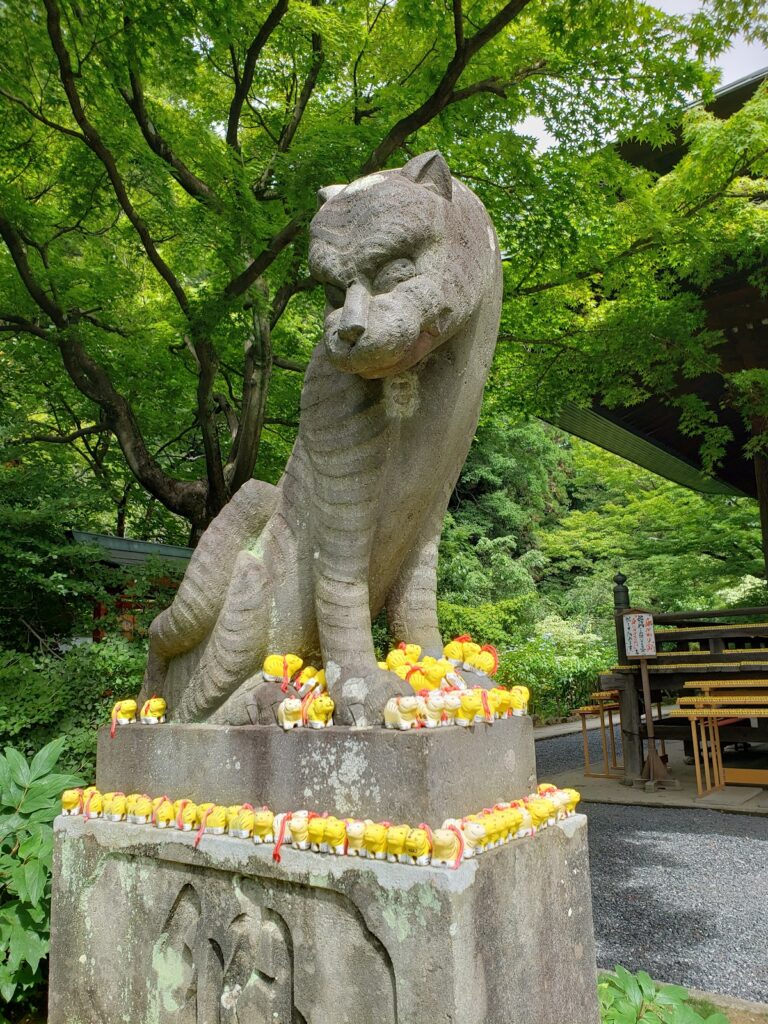
A unique feature of Tamon-in Temple is the “Komatora” (guardian tiger) placed in front of the Bishamondo Hall. While shrines and temples usually place guardian dogs (komainu), Tamon-in Temple has dedicated a pair of stone tiger statues. This originates from the fact that the messenger of Bishamonten is a tiger. Legend says that Bishamonten appeared on the day and hour of the tiger, and the tiger is considered a sacred animal deeply associated with Bishamonten. The guardian tigers at Tamon-in Temple are also called “substitute tigers,” and there is a belief that they will take on the misfortunes of worshippers.
It is customary for worshippers to stroke the same part of the stone statue as the part of their own body that is ailing, praying for recovery from illness or injury. The smooth surface of the guardian tigers, worn down by years of faith, is a testament to the many wishes they have received.
Temple Grounds and Natural Environment
The grounds of Tamon-in Temple are arranged in harmony with the natural environment of Mitomi Shinden. The space from the approach to the Bishamondo Hall is appropriately landscaped with trees, creating a tranquil atmosphere.
The temple grounds include the main hall, Bishamondo hall, bell tower, and priest’s quarters. It retains the basic layout of Edo period temple architecture, making it a valuable place to experience the temple space of that era.
The surrounding area still retains flatland forests left over from the development of the Mitomi Shinden area, allowing visitors to experience the original landscape of Musashino. This temple landscape, integrated with the natural environment, is one of Tamon-in’s greatest attractions.
Cultural Property Value
Tokorozawa City Designated Cultural Property
Tamon-in Bishamondo hall is protected as a designated cultural property (building) of Tokorozawa City. It is a valuable building that conveys the architectural techniques of the mid-Edo period and is an important heritage that tells the story of the region’s history.
The building plaque bears the year 1766 (Meiwa 3), and the clear construction date further enhances its value as a cultural property. Furthermore, detailed investigations were conducted during repairs in 1982 (Showa 57), accumulating research findings in architectural history.
A Historical Witness to the Reclamation of Mitomi Shinden
Tamon-in Temple is an important heritage site that conveys the history of planned land reclamation during the Genroku era. The reclamation of Mitomi Shinden by Yanagisawa Yoshiyasu is highly regarded as a model example of land reclamation during the Edo period, and Tamon-in Temple, founded in conjunction with this reclamation project, needs to be understood within its historical context.
Currently, some of the rectangular land divisions of Mitomi Shinden remain, and there are movements to have it designated as a nationally important cultural landscape. As a central part of this historical landscape, Tamon-in Temple plays a crucial role in protecting the region’s cultural heritage.
Annual Events and Beliefs
Major Events
As a Shingon Buddhist temple, Tamon-in Temple holds various Buddhist services and events throughout the year. In particular, many worshippers visit on the Day of the Tiger, which is the auspicious day of Bishamonten.
Seasonal events such as Hatsumode (first shrine visit of the year), Setsubun (bean-throwing festival), and the spring and autumn equinoxes are also popular among local people. These events provide an opportunity to carry on the traditions of the local community, which have continued since the Edo period.
Religion in the Modern Age
Even today, Tamon-in Temple functions as a center of local faith. Because it enshrines Bishamonten, who is associated with Takeda Shingen, many worshippers visit to pray for good fortune in competitions and business prosperity. Especially during exam season, students and their parents can be seen visiting to pray for success.
The belief in the substitute tiger remains strong, and people continue to visit to pray for recovery from illness and good health. As a sacred site visited not only by locals but also by worshippers from afar, the faith at Tamon-in Temple continues to thrive.
Surrounding Temples, Shrines, and Cultural Properties
Relationship with Tofuku-ji Temple
In addition to Tamon-in Temple, there are other important temples and shrines in the Mitomi Shinden area. Tofuku-ji Temple is located in Kamitomi Village, and Jizo-in Temple is located in Shimotomi Village, known as the Three Temples of Mitomi.
Tafuku-ji Temple was also founded by Yanagisawa Yoshiyasu and, like Tamon-in Temple, is an important cultural property that tells the history of the development of the Mitomi Shinden rice fields. Visiting these temples allows you to understand the overall picture of the rice field development during the Genroku era.
Cultural Landscape of Mitomi Shinden
In the Nakatomi district where Tamon-in Temple is located, parts of the Edo period’s rectangular land division system remain. The three-tiered land use structure of residential areas, cultivated land, and flatland forests is attracting attention as a pioneering example of a sustainable agricultural system.
In the flatland forests, a circular agriculture system is practiced using fallen leaves as compost, and this traditional farming method is also valued from a modern environmental conservation perspective. When visiting Tamon-in Temple, exploring the surrounding cultural landscape will provide a deeper understanding.
Access and Visiting Information
Location and Transportation Access
Tamon-in Temple is located in Nakatomi, Tokorozawa City, Saitama Prefecture. If using public transportation, it can be accessed by bus from Tokorozawa Station on the Seibu Ikebukuro Line or Shin-Tokorozawa Station on the Seibu Shinjuku Line. From Tokorozawa Station West Exit, take the Seibu Bus bound for “Mikashima/Waseda” and get off at the “Nakatomi” bus stop. It’s about a 5-minute walk from there.
If traveling by car, it’s about a 15-minute drive from the Tokorozawa Interchange on the Kan-Etsu Expressway. There is parking available on the temple grounds for visitors, but during busy periods such as New Year’s Day, you may need to use nearby parking lots.
Notes for Visitors
Tamon-in Temple is still an active religious temple. When visiting, please maintain silence and be considerate of other visitors and nearby residents.
The interior of the Bishamondo Hall is usually closed to the public, but the exterior and the guardian tigers can be freely viewed. Photography is permitted, but please be considerate of the privacy of other visitors and take pictures with moderation.
If you wish to receive a Goshuin (temple stamp), it is recommended to check the reception hours in advance. They may not be able to accommodate requests during temple events or ceremonies, so if you definitely want a Goshuin, it’s best to contact them beforehand.
To Fully Enjoy the Charms of Tamon-in Temple
Understanding the Historical Background
To fully appreciate the charms of Tamon-in Temple, it is important to understand the historical background of the development of the Mitomi Shinden area. Knowing the social and economic context under which the land reclamation project took place during the Genroku era, and understanding Yanagisawa Yoshiyasu’s vision, will allow for a deeper understanding of the temple’s significance.
The Tokorozawa City Local History Museum and Library have a wealth of materials related to the Mitomi Shinden area. Studying these materials beforehand will lead to a more fulfilling pilgrimage experience.
Seasonal Expressions
Tamon-in Temple displays different expressions throughout the four seasons. In spring, the cherry blossoms in the temple grounds are beautiful, and in the season of fresh greenery, the green of the lowland forest is vivid. The autumn foliage is also magnificent, and in winter, the temple grounds, enveloped in silence, exude a unique atmosphere.
By visiting in each season, you will discover the diverse charms of Tamon-in Temple. The quiet hours of early morning, in particular, offer a precious opportunity to experience the atmosphere of the Edo period, when pioneering farmers offered their prayers.
Exploring Local History
Exploring the entire Mitomi Shinden area, starting from Tamon-in Temple, is highly recommended. There are plenty of sights to see, including other temples such as Tofuku-ji and Jizo-in, farmland with its distinctive rectangular plot divisions, and walking trails through the flat forests.
Cycling or walking through the area allows you to discover traces of the planned development of the Edo period everywhere. While experiencing the region’s history, you’ll gain a deeper understanding of the role Tamon-in Temple has played.
Summary: History and Faith Conveyed by Tamon-in Temple
Tamon-in Temple possesses multifaceted value as a temple enshrining a golden Bishamonten associated with Takeda Shingen, and as a cultural asset that tells the history of the Mitomi Shinden development during the Genroku era. Founded under the vision of Yanagisawa Yoshiyasu, this temple has functioned as a spiritual pillar of the region for over 300 years.
The Bishamondo hall, built in the mid-Edo period, the guardian tiger statues affectionately known as “substitute tigers,” and the cultural landscape of the surrounding Mitomi Shinden area teach us about the continuity of history and the importance of regional culture.
Visiting Tamon-in Temple is not merely sightseeing; it is a precious opportunity to experience Japanese history and culture. In this place, watched over by the guardian deity of Takeda Shingen, one can reflect on the lives of our ancestors and contemplate the significance of faith and cultural heritage preservation in the modern age.
Nestled in the tranquil environment of Nakatomi, Tokorozawa City, Tamon-in Temple offers visitors a sense of historical romance and peace of mind—a temple truly worthy of the name “a place to listen to much.”
