
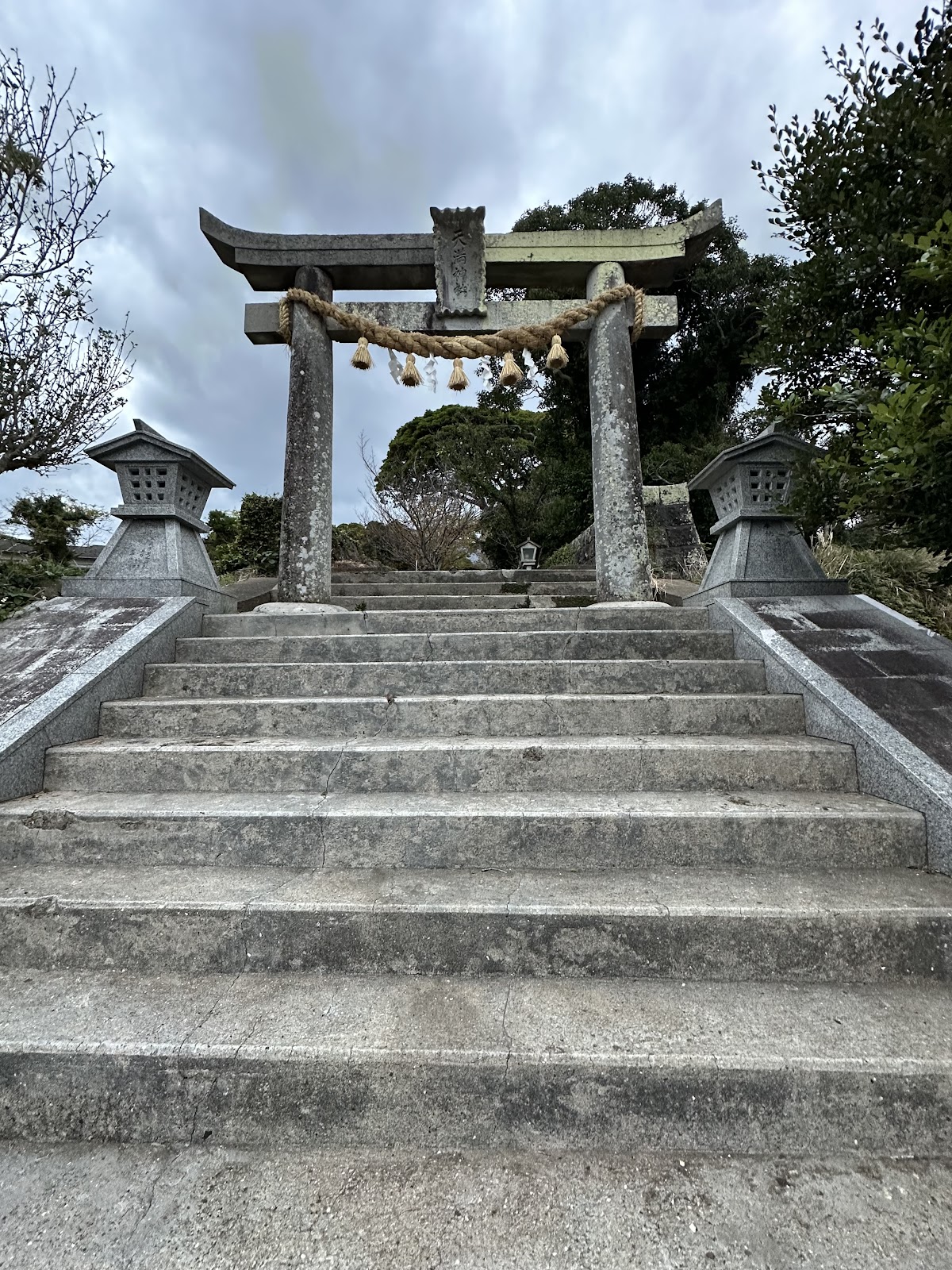
Tenman Shrine (Mitsuraku-cho, Minami-Matsuura-gun, Nagasaki Prefecture) | The Guardian Deity of Iwaseura with its Impressive Red Torii Gate
Mitsuraku-cho is located in the northwestern part of Fukue Island in the Goto Islands of Nagasaki Prefecture. In this historic area, known as the final port of call for Japanese envoys to Tang China, stands the quietly situated Tenman Shrine. Built on a hill at the entrance to the Iwaseura settlement, the shrine is characterized by its vibrant red torii gate and main hall, and has long been cherished by the local people.
Overview and History of Tenman Shrine
Tenman Shrine is located in the Iwaseura district of Mitsuraku-cho, Goto City, Nagasaki Prefecture. Situated near Ashiyama Falls (Rozan Falls), it is built on a hill overlooking the townscape of Iwaseura from the entrance to the settlement.
Deity and History
The deity enshrined at Tenman Shrine is Sugawara no Michizane, known nationwide as the god of learning. Sugawara no Michizane, enshrined in various locations as Tenmangu and Tenjin shrines, was a scholar and politician active during the Heian period and later deified. Several Tenman shrines exist in Mitsuraku Town, each revered as the tutelary deity of its respective settlement.
The Tenman Shrine in Iwaseura has been closely intertwined with the lives of the villagers as a guardian deity of the region. In the islands of the Goto archipelago, prayers for safe maritime travel, abundant fishing, and bountiful harvests have been deeply rooted since ancient times, and Tenman shrines are thought to have functioned as centers of such local faith.
Historical Background of Mitsuraku Town
Mitsuraku Town was formerly part of Minami-Matsuura District. On August 1, 2004, it merged with Fukue City, Tomie Town, Tamanoura Town, Kishuku Town, and Naru Town to form Goto City. It is recorded as “Mineraku-no-saki” in the “Hizen Province Fudoki” (ancient provincial gazetteer), indicating that it was a well-known area since ancient times.
Especially during the era of the Japanese envoys to Tang China, it played a crucial role as Japan’s final port of call. The envoy ships completed their final preparations at Mitsuraku before crossing the East China Sea to the Chinese mainland. This place, also known as the “island where one can meet deceased loved ones,” was a place of farewell to their homeland and a place where they prayed for a safe return.
Features and Highlights of Tenman Shrine
Impressive Red Torii Gate
The most striking feature of Tenman Shrine is its brightly painted vermilion torii gate. Standing on a hill, this red torii gate is a landmark of the Iwaseura settlement and catches the eye even from afar. Vermilion is considered a symbol of protection against evil and vitality in shrine architecture, impressing upon visitors that this is the entrance to a sacred space.
View from the Hilltop
The location of Tenman Shrine on a hilltop at the entrance to the Iwaseura settlement gives it a special atmosphere. From the shrine grounds, you can overlook the Iwaseura settlement and the surrounding nature, enjoying the beautiful scenery of the Goto Islands.
The Appearance of the Shrine
Along with the striking red torii gate is the shrine building itself, simple yet dignified in appearance. Its architecture evokes a sense of history, having withstood the island’s harsh climate and environment while preserving local faith.
Nearby Attractions and Tourist Spots
When visiting Tenman Shrine, exploring the surrounding tourist spots will allow you to experience the charm of Mitsuraku Town more deeply.
Rozan Falls (Ashiyama Falls)
Located very close to Tenman Shrine, Rozan Falls is a renowned spot representing the natural beauty of Mitsuraku Town. The sight of pure water cascading down the rock face provides visitors with a sense of coolness and tranquility. It’s an ideal spot to visit in conjunction with a visit to Tenman Shrine.
Shijiki Haguro Shrine [Iwaseura]
Within the Iwaseura settlement, separate from Tenman Shrine, there is a large Shijiki Haguro Shrine near the port. This too is an important place of worship in the region and is cherished by the people of Iwaseura. Visiting both shrines will allow you to gain a deeper understanding of the village’s religious culture.
Rozanji Temple
A Buddhist temple located in the Iwaseura district, it has supported the local faith alongside the shrine. It’s a place where you can experience the Japanese religious culture with its history of syncretism of Shinto and Buddhism.
Statue of Our Lady of Hope
Mitsuraku Town has a history of hidden Christians, and the legacy of their faith remains today. The Statue of Our Lady of Hope is one of the important monuments that tell the story of Christianity in the Goto Islands.
Shirauo Senninzuka (White Fish Thousand People Mound)
One of the historical sites that tells the history of Mitsuraku Town, it’s a recommended spot for those interested in the local history and culture.
Takaitabi Beach
A beach with beautiful sandy shores and crystal-clear waters. Many tourists visit during the summer to enjoy the beauty of the Goto Islands’ sea.
Takaitabi Log Houses & Cottages
Convenient accommodations in Mitsuraku Town, where you can relax in a natural environment.
Shukunoura Shrine
This shrine is located in a different settlement within Mimiraku Town, allowing visitors to experience the diversity of beliefs rooted in each settlement.
Yamagami Shrine [Kirikori]
Yamagami Shrine, located in the Kirikori district, is another spot worth adding to your Mimiraku Town shrine tour.
Tourism and Culture of Mimiraku Town
Sites Associated with the Japanese Envoys to Tang China
Mimiraku Town played a significant role in Japanese history as the final port of call for the Japanese envoys to Tang China. The well known as “Fuzen River” is said to have supplied drinking water to the envoy ships and remains today as a historical site associated with the envoys.
The coastal area and sea area from Takasaki-bana to Kashiwazaki and Nagasaki-bana are designated as the national scenic spot “Mimiraku no Shima,” and are highly valued for their scenic beauty and academic significance. In 2015, it was also designated a Japan Heritage site, widely recognized for its historical and cultural value. ### History of Hidden Christians
According to records, in 1797, hidden Christians who migrated from the Omura Domain settled in Mitsuraku. It is said to be the place where the faith of the Goto Christians was most deeply rooted, and the current Mitsuraku Church (locally known as “Take Church”) preserves this history of faith.
Historical sites related to Christianity, such as the Himejima faith monument, are scattered throughout the area, allowing visitors to experience the unique religious culture of the Goto Islands, where Shinto, Buddhism, and Christianity have coexisted.
Island Nature and Scenery
Mitsuraku Town is blessed with the rich natural beauty of the Goto Islands. Beautiful coastlines, crystal-clear waters, and lush green mountains create a captivating natural landscape for visitors. The sunsets, in particular, are exceptional, and the view of the sun setting over the East China Sea leaves a lasting impression on many travelers.
Access and Tourist Information
Access to Tenman Shrine
Tenman Shrine is located on a hill at the entrance to the Iwaseura settlement. It is approximately a 40-minute drive from Fukue Port, the center of Goto City.
Access from Fukue Port:
- By Car: Head north on National Route 384 towards Mitsuraku. Follow the signs for the Iwaseura area.
- By Rental Car: There are rental car companies around Fukue Port, and a car is convenient for sightseeing on the island.
Access from Nagasaki City:
- By Plane: Approximately 30 minutes from Nagasaki Airport to Fukue Airport. Approximately 35 minutes by car from Fukue Airport.
- By High-Speed Ferry: Approximately 1 hour and 25 minutes by high-speed ferry from Nagasaki Port to Fukue Port.
- By Ferry: Approximately 3 hours and 10 minutes by ferry from Nagasaki Port to Fukue Port.
Points to Note When Visiting
Tenman Shrine is a place of worship for the local community, so it is important to visit quietly and respectfully. Photography is permitted on the shrine grounds, but please be considerate of the local residents.
Public transportation in Mitsuraku Town is limited, so renting a car or taking a taxi is recommended. Also, there are few gas stations on the island, so be sure to check your fuel level.
Nearby Accommodations
There are accommodations such as guesthouses and cottages in Mitsuraku Town. There are also facilities like Takai Tabi Log House & Cottages where you can stay in a natural environment. The Fukue area, the center of Goto City, has plenty of hotels and inns, making it a good base for your visit.
Recommended Time to Visit
Tenman Shrine is open year-round, but each season has its own unique charm.
- Spring (March-May): The warm climate is ideal for sightseeing. It’s a beautiful season with fresh greenery.
- Summer (June-August): The swimming season. This is a beautiful time of year when the contrast between the blue sea and sky is stunning.
- Autumn (September-November): The weather is pleasant, and events such as the autumn festival are sometimes held.
- Winter (December-February): There are fewer tourists, allowing for a quiet visit. The roughness of the winter sea is also a highlight.
Other Tenman Shrines in Mitsuraku Town
Besides the Tenman Shrine in Iwaseura, there are other Tenman Shrines in Mitsuraku Town. The Tenman Shrine in the Hamanoura area, in particular, is large in scale and historically important.
Tenman Shrine [Hamanoura]
The Tenman Shrine in Hamanoura enshrines Sugawara no Michizane and has been revered as the tutelary deity of Hamanoura, Tsuzuki, Iinoseto, and Dodoi, which were formerly under the jurisdiction of the Hirado Domain. Records show that the local magistrate attended the annual festival as a service, indicating its importance to the region.
Designated a village shrine in 1874 (Meiji 7), it was designated a shrine receiving offerings of sacred food and cloth in 1929 (Showa 4). During the autumn festival, the Kamigoto Kagura dance is performed, making it a venue for the preservation of traditional performing arts.
Island Travel in the Goto Islands and Tenman Shrine
The Goto Islands have recently gained attention as a destination for “island travel.” It’s a fascinating tourist destination where beautiful nature, abundant seafood, and a unique history and culture come together.
How to Enjoy Island Travel
Cycling: The Goto Islands have an environment well-suited for cycling, and touring the islands by bicycle is popular. Beautiful scenery can be enjoyed from the roads along the coastline.
Cuisine: Fresh seafood is a major attraction of the Goto Islands. You can enjoy local food culture such as Goto udon noodles, local fish dishes, and kankoro mochi (sweet potato rice cakes).
Experience Programs: Programs are available that allow you to experience island life, such as fishing and camellia oil making.
Church Tours: Many churches are scattered throughout the Goto Islands, and they are registered as a World Cultural Heritage site as part of the “Hidden Christian Sites in the Nagasaki Region.”
Sample Course
Mitsuraku Town 1-Day Sightseeing Course:
- Morning: Depart from Fukue Port and learn about the history of the Japanese envoys to Tang China at the Kentoshi Furusato-kan Roadside Station.
- Visit Tenman Shrine (Iwaseura) and see the Rozan Waterfall.
- Lunch: Enjoy fresh seafood at a local restaurant.
- Afternoon: Visit Shijiki Haguro Shrine and tour Mitsuraku Church.
- Relax and enjoy the ocean view at Takaitabi Beach.
- Evening: Watch the sunset on the coastline of Mitsuraku, a nationally designated scenic spot.
Tenman Shrine and the Local Community
Tenman Shrine is not just a tourist spot, but a central hub for the local community. Through festivals and events, it has functioned as a place to deepen the bonds among the people of the village.
Even as the region faces aging and depopulation, the efforts of local people to protect and pass on the shrine continue. It is important for visiting tourists to respect the history and culture of the region and to be mindful of sustainable tourism practices.
Summary
Tenman Shrine (Mitsuraku-cho, Minami-Matsuura-gun, Nagasaki Prefecture) is an impressive shrine with a red torii gate and shrine building, standing on a hill at the entrance to the Iwaseura settlement. Located near Ashiyama Falls, it has long been cherished as a center of faith for the local people.
Mitsuraku-cho is full of diverse attractions, including the last port of call for the Japanese envoys to Tang China, the history of hidden Christians, and the beautiful scenery of a nationally designated scenic spot. By visiting Tenman Shrine, you can experience the rich nature and historical culture of the Goto Islands.
When planning a trip to Goto City, be sure to visit Tenman Shrine in Mitsuraku-cho. Find peace in its tranquil space for prayer, and fully enjoy the charm of island travel along with the surrounding tourist attractions. A special experience unique to the islands of Nagasaki awaits you.


