Complete Guide to Tsurugaoka Hachimangu Shrine | History, Highlights, Access, and Seasonal Charms
Tsurugaoka Hachimangu Shrine, located in Kamakura City, Kanagawa Prefecture, is a shrine that symbolizes the ancient capital of Kamakura. Known as a place associated with Minamoto no Yoritomo, it was deeply revered by samurai as the guardian deity of the Kamakura Shogunate. Even today, it remains a central hub of Kamakura, attracting many worshippers and tourists, and continues to generate the vibrant energy of Kamakura, just as it did in the past.
This article provides a thorough explanation of everything you need to know before visiting Tsurugaoka Hachimangu Shrine, from its history and highlights within the grounds to access methods and seasonal charms.
What is Tsurugaoka Hachimangu Shrine? | Symbol of Ancient Kamakura
Tsurugaoka Hachimangu Shrine has a history of over 900 years, beginning in 1063 (Kohei 6) when Minamoto no Yoriyoshi invited the deity from Iwashimizu Hachimangu Shrine in Kyoto. Also known as Kamakura Hachimangu Shrine, it is one of the approximately 44,000 Hachimangu shrines nationwide, and is particularly well-known in the Kanto region due to its connection to the Minamoto clan.
The shrine grounds are designated as a national historical site, and the beautiful shrine buildings, built against the backdrop of the Kamakura mountains, represent the quintessential scenery of the ancient capital of Kamakura. Revered as a god of military fortune and victory, it remains a central tourist spot in Kamakura, attracting many visitors even today.
Deities and Divine Virtues
The deities enshrined at Tsurugaoka Hachimangu Shrine are Emperor Ojin, Himegami, and Empress Jingu.
Emperor Ojin was the 15th Emperor and has long been worshipped by samurai as a god of military fortune. Himegami is considered one of the three Munakata goddesses and is known as a god of maritime safety and traffic safety. Empress Jingu was the mother of Emperor Ojin and is revered as a goddess of safe childbirth and child-rearing.
Due to these enshrined deities, Tsurugaoka Hachimangu Shrine is believed to offer a wide range of blessings, including good fortune in competitions, career success, safe childbirth, and family safety.
History of Tsurugaoka Hachimangu Shrine | Guardian Deity of the Minamoto Clan and the Kamakura Shogunate
From its Founding to the Era of Minamoto no Yoriyoshi
The history of Tsurugaoka Hachimangu Shrine dates back to 1063 (Kohei 6). Minamoto no Yoriyoshi, five generations before Minamoto no Yoritomo, prayed for victory in the Former Nine Years’ War and invited the Hachiman deity from Iwashimizu Hachimangu Shrine in Yamashiro Province (present-day Kyoto Prefecture) to Tsurugaoka, Yuigō (present-day Zaimokuza, Kamakura City).
At this time, the Hachimangu Shrine, established as the guardian deity of the Minamoto clan, became an important shrine that attracted the faith of the Minamoto family.
Relocation to the Current Location by Minamoto no Yoritomo
In 1180 (Jisho 4), when Minamoto no Yoritomo entered Kamakura, he moved the Hachiman Shrine, which was located in Yuigahama, to the area of present-day Wakamiya, and it came to be known as “Tsurugaoka Wakamiya.” When Yoritomo established Kamakura as his base, he placed the Hachiman Shrine at the center of Kamakura, making it the spiritual pillar of the samurai government.
In 1191 (Kenkyu 2), he constructed the Upper Shrine at the site of the current Main Shrine, completing the current appearance of Tsurugaoka Hachiman Shrine. Yoritomo also improved Wakamiya-oji Avenue, creating a roughly 2km-long approach road that stretches straight from the shrine buildings to Yuigahama Beach.
The Kamakura Shogunate and Tsurugaoka Hachiman Shrine
During the Kamakura Shogunate (1185-1336), Tsurugaoka Hachiman Shrine was deeply revered as the guardian deity of the shogunate. Successive shoguns held important ceremonies and festivals at Tsurugaoka Hachimangu Shrine, making it a spiritual pillar for samurai.
In particular, martial arts dedications such as Yabusame (mounted archery) became established as important events demonstrating the strength of the samurai, and are still passed down as traditional events today.
From the Edo Period to the Present
During the Edo period, under the patronage of the Tokugawa shogunate, the current main shrine (upper shrine) was rebuilt in 1828 (Bunsei 11). This shrine building is designated as a National Important Cultural Property.
With the Meiji-era separation of Shinto and Buddhism, Tsurugaoka Hachimangu Shrine, which had previously been a syncretic blend of Shinto and Buddhism, became an independent shrine. Today, as a central presence in the ancient capital of Kamakura, it is a representative shrine of Kamakura, attracting many worshippers and tourists throughout the year.
Highlights of the Shrine Grounds | Pilgrimage Route and Spot Introduction
The grounds of Tsurugaoka Hachimangu Shrine contain many historically valuable buildings and beautiful natural scenery. Here, we introduce the main spots you should visit during your pilgrimage. ### Wakamiya-oji Street and Dankazura
Wakamiya-oji Street, the approach to Tsurugaoka Hachimangu Shrine, is Kamakura’s main street, stretching approximately 2 km from Yuigahama Beach to the shrine. It is said to have been built by Minamoto no Yoritomo to pray for the safe delivery of his wife, Hojo Masako.
From the second torii gate to the third torii gate, a raised path called “Dankazura” stretches for about 500 meters. Cherry trees are planted on both sides, creating a tunnel of cherry blossoms in spring, attracting many visitors. Dankazura is designed to appear longer than it actually is using perspective, demonstrating the high level of architectural technology of the Kamakura period.
Third Torii Gate and Taiko Bridge
Approximately a 10-minute walk from JR Kamakura Station, after passing through Dankazura, the third torii gate appears. Passing through this gate, a vermilion-lacquered Taiko Bridge comes into view.
The Taikobashi Bridge is a steep bridge spanning the Genpei Pond, and in the past, only a select few, such as the shogun, were allowed to cross it. Although it is no longer accessible to the public, its beautiful curves have become one of the iconic landscapes of Tsurugaoka Hachimangu Shrine.
Genpei Pond
The Genpei Pond stretches out to the left and right of the Taikobashi Bridge. The eastern side is called the Genji Pond, and the western side is called the Heike Pond. It is said that Minamoto no Yoritomo had them built to pray for the prosperity of the Minamoto clan and the downfall of the Taira clan.
The Genji Pond has three islands, which are said to symbolize the prosperity of the Minamoto clan (associated with “birth”), while the Heike Pond has four islands, which are said to symbolize the downfall of the Taira clan (associated with “death”).
Along the shores of the Genpei Pond, cherry blossoms bloom in spring, and lotus flowers in early summer. The lotus flowers, especially in the early morning, are exceptionally beautiful. The lotus flowers of the Genpei Pond are known as a summer tradition in Kamakura, and many photography enthusiasts visit from early morning.
Maiden (Lower Worship Hall)
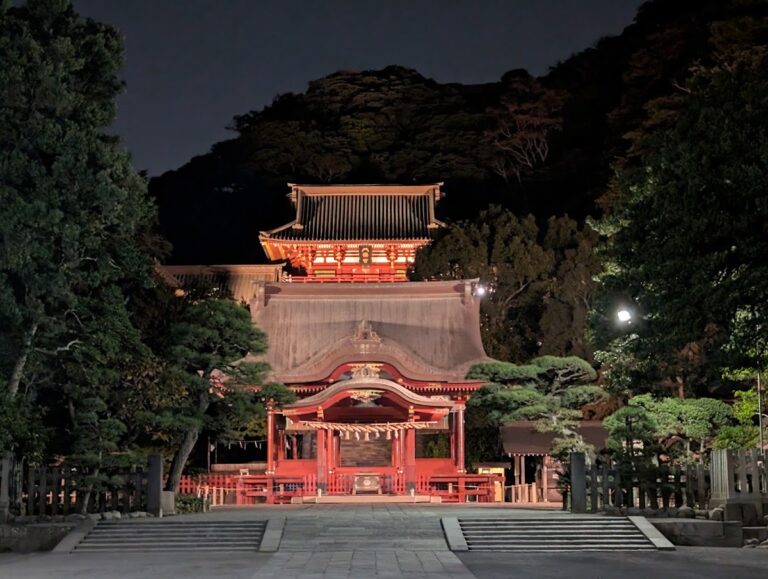
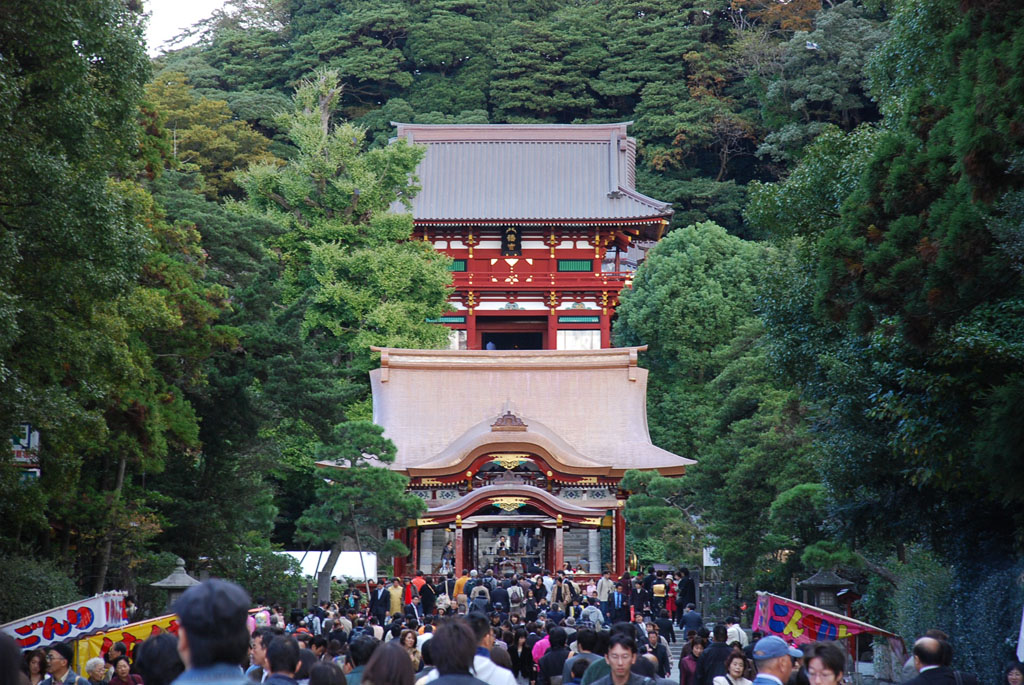
After passing the Genpei Pond, a beautiful vermilion-lacquered Maiden appears. This Maiden is a historical site where Shizuka Gozen, the beloved concubine of Minamoto no Yoshitsune, performed a dance before Minamoto no Yoritomo.
The current Maiden is a reconstruction of the one built in 1193, and is used for wedding ceremonies and Shinto rituals such as Kagura. During cherry blossom season, the Maiden and cherry blossoms create a magnificent scene, making it a place where you can truly feel the return of vitality to Kamakura.
Grand Stone Staircase and Main Shrine (Upper Shrine)
Behind the Maiden is a grand stone staircase leading to the main shrine. After climbing the 61 steps, you will reach the main shrine, situated at an altitude of approximately 40 meters.
The main shrine is a building reconstructed in 1828 (Bunsei 11) and is designated as a National Important Cultural Property. It is a valuable structure that preserves the architectural style of the late Edo period. From the main shrine, you can enjoy a panoramic view of Kamakura city and Sagami Bay, a truly spectacular sight on a clear day.
Yabusame Ground
On the east side of the shrine grounds is the ground where Yabusame (mounted archery) is performed. Every year on September 16th, during the annual festival, the Yabusame ritual, which has continued since the Kamakura period, is dedicated, allowing visitors to witness the magnificent sight of archers shooting at targets from horseback at galloping speed.
The Yabusame ground is approximately 250 meters long and is normally accessible to visitors. It is a valuable place where you can experience the traditions of Kamakura samurai firsthand.
Hatage Benzaiten Shrine
The Hatage Benzaiten Shrine stands on an island in the middle of Genji Pond. It is said to have been named after Minamoto no Yoritomo, who prayed for victory here when raising his banner.
Benzaiten is worshipped as the goddess of performing arts, learning, and wealth. In particular, a stone called “Masako Stone” is associated with the legend that Hojo Masako prayed there for a safe delivery, and many visitors come to pray for safe childbirth and good fortune in relationships.
Shirahata Shrine
Located east of the main shrine, Shirahata Shrine is dedicated to Minamoto no Yoritomo and Sanetomo. Yoritomo’s tomb is also nearby, allowing visitors to reflect on the history of the Kamakura Shogunate.
Access | Conveniently located about a 10-minute walk from Kamakura Station
Tsurugaoka Hachimangu Shrine is located in the heart of Kamakura, making it very easily accessible.
Access by Train
Approximately 10 minutes on foot from the East Exit of Kamakura Station on the JR Yokosuka Line and Shonan Shinjuku Line
- Exit the East Exit of Kamakura Station and walk straight north along Wakamiya-oji Street
- Walk along Dankazura for approximately 10 minutes to the third torii gate
Approximately 10 minutes on foot from Kamakura Station on the Enoshima Electric Railway
- Follow the same route as JR Kamakura Station
Access by Car
Approximately 20 minutes from the Asahina Interchange on the Yokohama-Yokosuka Expressway
There are several parking lots around Tsurugaoka Hachimangu Shrine, but they can get crowded on weekends and during peak tourist seasons, so we recommend using public transportation.
Visiting Hours
- Shrine Grounds Visiting Hours: 6:00 AM – 8:00 PM (6:00 AM – 9:00 PM from October to March)
- Prayer Reception Hours: 8:30 AM – 4:30 PM
- Treasure Hall: 8:30 AM – 4:00 PM (Last entry at 3:45 PM)
Seasonal Charms | Seasonal Highlights
Tsurugaoka Hachimangu Shrine displays different expressions throughout the four seasons, offering enjoyment in each season.
Spring (March – May) | A Competition of Cherry Blossoms and White Wisteria
Tsurugaoka Hachimangu Shrine in spring is known as a famous cherry blossom viewing spot. From late March to early April, the cherry blossoms along the Dankazura path and the banks of the Genpei Pond are in full bloom, bringing a cheerful and lively atmosphere back to the shrine grounds.
From late April to early May, the white wisteria within the shrine grounds is at its best. The fragrant white wisteria in full bloom captivates visitors to Kamakura during the long weekend. The scent of wisteria wafts from all directions, a quintessential sign of the end of spring.
Summer (June-August) | Lotus Flowers and Summer Festival
In early summer, lotus flowers bloom profusely at Genpei Pond. Especially in the early morning, the lotus flowers at Genpei Pond attract many photography enthusiasts. The lotus flowers open in the early morning and are at their most beautiful during the morning hours.
In August, the “Bonbori Festival” is held, a popular event for enjoying the summer evenings in Kamakura. Lanterns adorned with calligraphy and paintings by famous people decorate the temple grounds, creating a magical atmosphere at dusk.
Autumn (September-November) | Yabusame (Horseback Archery) and Autumn Leaves
At the annual festival on September 16th, the Yabusame ritual, which has continued since the Kamakura period, is performed. The sight of archers, clad in samurai attire, shooting at targets from galloping horseback is breathtaking.
From late November to early December, the autumn foliage on the shrine grounds is at its peak. You can enjoy the beautiful autumn colors around the stone steps leading to the main shrine and by the Genpei Pond.
Winter (December-February) | New Year’s Visit and Winter Peonies
Tsurugaoka Hachimangu Shrine is known as one of the top New Year’s visit spots in the Kanto region. Many worshippers visit Tsurugaoka Hachimangu Shrine for their first shrine visit of the year and hope to seize good fortune with the pigeon fortune-telling slips. Approximately 2.5 million people visit during the first three days of the New Year, creating a lively atmosphere.
In January, winter peonies are in full bloom, their blossoms adorning the winter grounds amidst snow protection.
Annual Events at Tsurugaoka Hachimangu Shrine
Tsurugaoka Hachimangu Shrine holds various Shinto rituals and festivals throughout the year.
- January 1st-3rd: First Shrine Visit of the Year
- January 5th: Exorcism Ritual (Axe-Wielding Ceremony)
- February 3rd: Setsubun Festival
- April: Kamakura Festival
- July 7th-9th: Tanabata Festival
- August: Bonbori Festival
- September 14th-16th: Grand Festival (Yabusame Ritual on the 16th)
- December 16th: Enshrinement Anniversary Festival
- December 31st: Great Purification Ceremony
These events are valuable opportunities to pass on Kamakura’s traditional culture to the present day.
Manners and Enjoyment of Visiting a Shrine
Basic Manners for Visiting a Shrine
- Bow before passing through the torii gate: This is a courtesy when entering the sacred area.
- Avoid walking in the center of the approach to the shrine: The center is considered the path of the gods.
- Purify yourself at the water basin: Left hand → Right hand → Mouth → Handle of the left hand → Hold the handle upright and rinse with the remaining water.
- Two bows, two claps, one bow: This is the proper way to worship at the main shrine.
Recommended Visiting Course
Estimated time: Approximately 60-90 minutes
- From Kamakura Station East Exit, walk along the Dankazura to the third torii gate (approximately 10 minutes).
- Stroll around Genpei Pond (approximately 15 minutes).
- Visit the Maiden (dance hall) (approximately 5 minutes).
- Visit the main shrine (approximately 20 minutes, including going up and down the stone steps).
- Visit Hatagami Benzaiten Shrine and Shirahata Shrine (approx. 15 minutes)
- Visit the Treasure Hall (approx. 20 minutes)
Pigeon Fortune Slips and Souvenirs
Tsurugaoka Hachimangu Shrine’s “Pigeon Fortune Slips” are cute fortune slips shaped like pigeons, popular with visitors. They are modeled after pigeons, the divine messengers of Hachimangu Shrine, and can be taken home as amulets.
Other souvenirs, such as victory charms and amulets for warding off evil, are also available.
Nearby Tourist Spots
When visiting Tsurugaoka Hachimangu Shrine, we recommend also visiting nearby tourist spots.
Komachi Street
A shopping street located on the way from Kamakura Station to Tsurugaoka Hachimangu Shrine. It’s lined with food stalls and souvenir shops, making it one of the joys of Kamakura sightseeing.
Kamakura National Treasure Museum
Approximately a 5-minute walk from Tsurugaoka Hachimangu Shrine. It exhibits cultural artifacts such as Buddhist statues and paintings passed down through temples and shrines in Kamakura.
Tomb of Minamoto no Yoritomo
Approximately a 10-minute walk from Tsurugaoka Hachimangu Shrine. This is the tomb of Minamoto no Yoritomo, the founder of the Kamakura Shogunate, and is recommended for historical walks.
Kamakura-gu Shrine
Approximately a 15-minute walk from Tsurugaoka Hachimangu Shrine. This shrine enshrines Prince Moriyoshi, son of Emperor Go-Daigo, and is known for its blessings of protection against misfortune.
Summary | Experience the History and Culture of Ancient Kamakura at Tsurugaoka Hachimangu Shrine
Tsurugaoka Hachimangu Shrine boasts a history of over 900 years and is located in the heart of Kamakura, a place associated with Minamoto no Yoritomo. Revered as a god of military fortune and victory, it remains a symbol of ancient Kamakura, attracting many visitors even today.
The shrine grounds offer many sights to see, including the Genpei Pond, the dance hall, and the main shrine, and you can also enjoy the beauty of nature throughout the seasons. Its convenient location, approximately a 10-minute walk from Kamakura Station, is also a major draw.
Tsurugaoka Hachimangu Shrine displays a different face with each season: cherry blossoms and white wisteria in spring, lotus flowers in summer, horseback archery and autumn leaves in autumn, and New Year’s visits in winter. This shrine, which has remained the heart of Kamakura and continues to generate vibrancy, offers a chance to fully experience the history and culture of the ancient capital.
A visit to Tsurugaoka Hachimangu Shrine will undoubtedly be a highlight of your Kamakura sightseeing. Take your time to stroll through the grounds, reflect on the history of the Minamoto clan and the Kamakura Shogunate, and enjoy a special time enveloped in a sacred atmosphere.