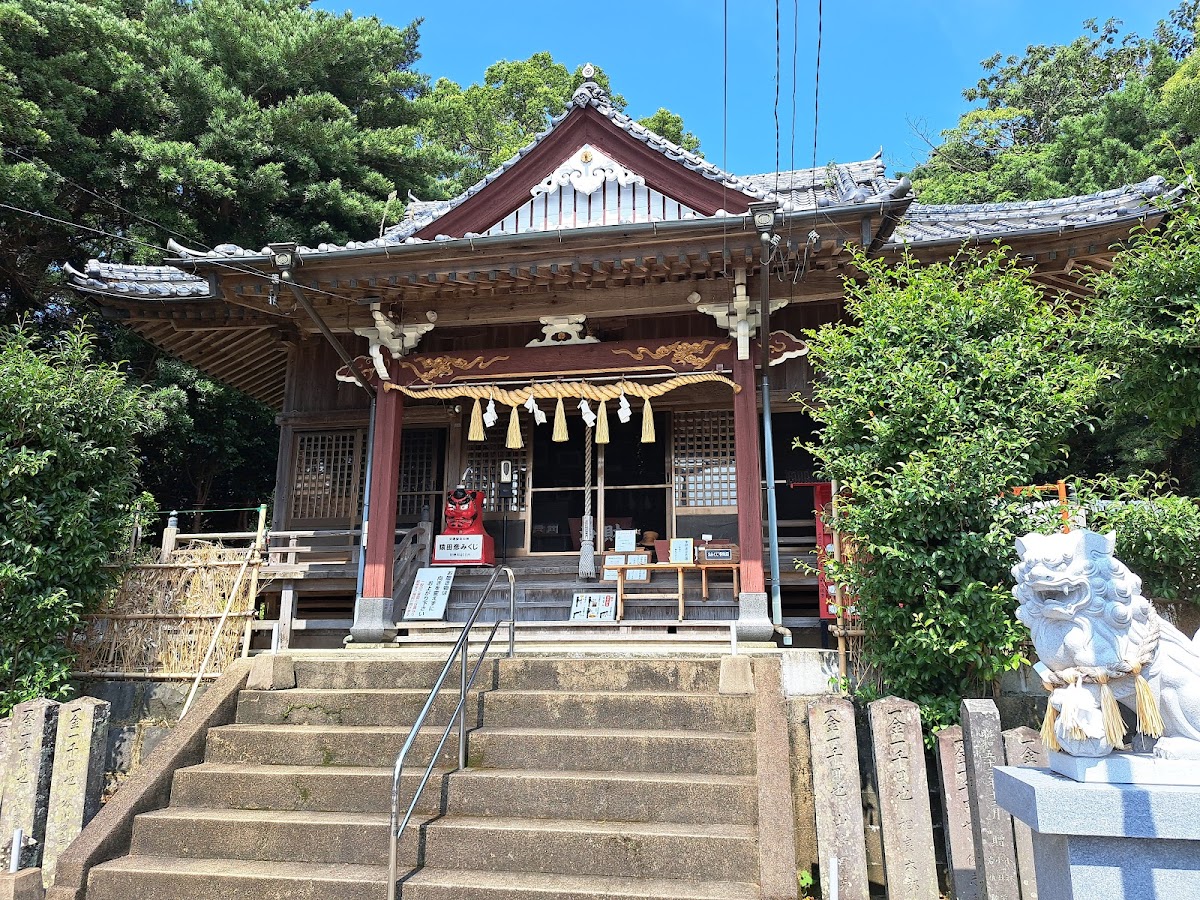
Yodohime Shrine (Matsuura City, Nagasaki Prefecture) Complete Guide: History, Deities, Yabusame Ritual, and the Charm of Shisa Kunchi
Located at 632 Uramen, Shisa-cho, Matsuura City, Nagasaki Prefecture, Yodohime Shrine is a venerable shrine that preserves its history and unique rituals dating back to ancient times. It is known as the only shrine in Nagasaki Prefecture where Yabusame (mounted archery) is performed, and every October, a grand annual festival called “Shisa Kunchi” is held. This article provides a detailed introduction to the history of Yodohime Shrine, the mystery of its enshrined deity, Yodohime-no-Mikoto, access information, and the valuable traditional rituals.
History and Origins of Yodohime Shrine
Founding and Ancient History
Yodohime Shrine is said to have been founded in the 24th year of Emperor Kinmei’s reign (around 563 AD), making it an ancient shrine with a history of over 1460 years. This region has long been the domain of the Matsuura clan, a group of naval warriors, and the shrine has played a crucial role as their spiritual pillar.
The Matsuura clan traced its ancestry to the Watanabe clan of the Saga Minamoto clan, with Watanabe Hisashi, a descendant of Emperor Saga, considered its founder. During the Middle Ages, they distinguished themselves in the Genpei War and the Mongol invasions, gaining renown on the sea. Yodohime Shrine developed as a shrine that attracted the faith of these seafaring people.
History of Shrine Rank and Relationship with Saga Prefecture
Interestingly, it is said that there was once a dispute over shrine rank between the Yodohime Shrine in Matsuura City, Nagasaki Prefecture, and the Yodohime Shrine in Kawakami, Yamato-cho, Saga Prefecture. This indicates that both shrines were historically significant shrines dedicated to Yodohime-no-Mikoto, illustrating the widespread and important nature of Yodohime worship in this region.
In 1874 (Meiji 7), it was ranked as a local shrine, establishing its position as a central shrine in the region. Since then, Shinto rituals such as Yabusame (mounted archery) and the offering of cycad dumplings, which have continued since ancient times, have been carefully preserved and passed down to this day.
Deity: Yodohime-no-Mikoto and Her Mystery
About the Main Deity, Yodohime-no-Mikoto
The main deity of Yodohime Shrine is Yodohime-no-Mikoto. Yodohime-no-Mikoto is known as a mysterious deity whose name does not appear at all in the “Kojiki and Nihon Shoki” (ancient Japanese chronicles).
According to various legends and local records, Yodohime-no-Mikoto is said to be the younger sister of Empress Jingu (Okinagatarashihime), the empress of Emperor Chuai, the 14th emperor who conquered the Three Kingdoms of Korea. However, since there is no record of her in orthodox historical texts, she is thought to be a deity that has developed as a unique, locally rooted belief.
Her Nature as a Water Goddess
Yodohime-no-Mikoto is worshipped as a goddess who controls water. According to legend, she received the “Two Tide-Controlling Jewels” from the Dragon King, and with the power of these jewels, she was able to control the sea at will. While possessing immense power, even capable of parting the sea for battle, she also had a gentle side, living among the people after battles, bringing compassionate rain, and healing the sick.
This duality of “fearless yet gentle” is thought to reflect the beliefs of a seafaring people who understood both the blessings and threats of the sea. She can be seen as a deified being who brings abundant catches while also personifying the sometimes raging power of the sea.
Other Deities Enshrined
Besides Yodohime-no-Mikoto, the following deities are enshrined at Yodohime Shrine:
Emperor Keikō
The 12th Emperor, known as the father of Yamato Takeru-no-Mikoto. He is deeply connected to the legend of the pacification of Kyushu, demonstrating a historical connection to this region.
Toyotama-hime no Mikoto
She is the daughter of the sea god and the consort of Yamasachihiko (Hikohodemi no Mikoto). As a sea goddess who also appears in the Ryugu legend, she, like Yodohime no Mikoto, is deeply connected to water and the sea.
Awashima Daimyojin
This deity is worshipped as a guardian deity of women, and is believed to grant blessings for healing women’s diseases, safe childbirth, and fertility.
From this combination of enshrined deities, it is clear that Yodohime Shrine has been worshipped as a shrine that governs sea safety, the blessings of water, and the protection of women.
Shisa Kunchi: Yodohime Shrine Annual Festival
Overview of the Annual Festival
The Yodohime Shrine’s autumn annual festival is held every year on October 26th and 27th, and is affectionately known to the local people as “Shisa Kunchi” or “Shisa Miyabi.” This festival is an important annual event in Matsuura City, attracting many worshippers and tourists.
Schedule of the Grand Festival
Eve of the Festival (Evening Festival): October 5th
The eve of the festival is held at the Yodohime Shrine from 7:00 PM. This is a solemn ceremony in which prayers are offered to the gods in preparation for the main festival.
Grand Festival (Main Festival): October 26th
The main festival begins at 10:30 AM. Traditional Shinto rituals, such as the recitation of prayers by Shinto priests and the offering of sacred branches, are performed with solemnity.
Procession of the Portable Shrine (Mikoshi): October 26th
The portable shrine departs from Yodohime Shrine at 1:00 PM and parades through the town. This is an important Shinto ritual in which the gods visit the parish area and bless the entire community.
Yabusame Ritual: October 26th
Around 3:30 PM, the Yabusame ritual will be performed at the horse track in front of Yodohime Shrine. This will be explained in detail in the next chapter.
Offering of Cycad Dumplings
At Shisa Kunchi, a rare ritual of offering cycad dumplings is also performed alongside the Yabusame. Cycads (Sotetsu) are plants that grow abundantly in the Kyushu region and have been used as famine food. Offering cycad dumplings to the gods is thought to express gratitude for food and a prayer for a bountiful harvest.
Yabusame Ritual: The Only Traditional Ritual in Nagasaki Prefecture
What is Yabusame?
Yabusame is a traditional Japanese mounted archery ceremony in which archers shoot at targets from horseback while galloping. This event, which combines martial arts training with Shinto rituals, is held at shrines throughout Japan, but in Nagasaki Prefecture, it is only held at Yodohime Shrine, making it a very valuable traditional event.
Characteristics of Yabusame at Yodohime Shrine
Yadohime Shrine’s Yabusame takes place on October 26th, the day of the annual festival, at the horse track in front of the shrine. This Shinto ritual, which has continued since ancient times, is a valuable cultural heritage that conveys the traditions of the Matsuura clan, a group of naval warriors.
The sight of archers hitting targets one after another from horseback as they gallop around the track is truly magnificent, drawing loud cheers from the spectators. It is said that hitting the target will bring a bountiful harvest that year, and the event also carries the meaning of praying for the prosperity of agriculture and fishing.
The Tradition of the Matsuura Clan, a Group of Naval Warriors
The existence of the Matsuura clan is the background to the continuation of Yabusame at Yodohime Shrine. The Matsuura clan was a samurai group that was active from the late Heian period to the Sengoku period, and was also known for its naval power. They fought on the side of the Minamoto clan in the Genpei War, and in particular, during the Mongol invasions, they fought bravely in both the Bun’ei War (1274) and the Kōan War (1281), achieving great success in repelling the Mongol forces.
The Matsuura clan’s warriors excelled not only in naval combat but also in horsemanship and archery. Yabusame (mounted archery) serves to pass on these martial arts traditions to future generations as a Shinto ritual.
Highlights of the Shrine Grounds
Shrine Buildings and Atmosphere
The shrine buildings of Yodohime Shrine exude a solemn presence that reflects its long history. Despite being located in the heart of town along National Route 204, stepping onto the shrine grounds envelops you in a tranquil atmosphere, creating a sacred feeling.
Horse Riding Ground
In front of the shrine is a horse riding ground where Yabusame (mounted archery) is performed. During the annual festival, a magnificent ritual unfolds here. While usually a quiet space, on festival days it becomes bustling with people, reviving the rich historical tradition.
Historical Sites Related to the Matsuura Clan
Within the shrine grounds and surrounding area, there are historical sites and information boards that tell the history of the Matsuura clan. You can also see materials related to the Matsuura family lineage, such as the “Three Stars and One Line Crest,” the representative crest of the Saga Minamoto clan, making it an irresistible spot for history buffs.
Access Information
Basic Information
Location: 632 Uramen, Shisa-cho, Matsuura City, Nagasaki Prefecture
Phone Number: 0956-72-0653
Parking: Free parking available
Access by Train
Nearest Station: Matsuura Station, Matsuura Railway Nishikyushu Line
The shrine is approximately a 7-minute walk (approx. 556m) from Matsuura Station, making it easily accessible on foot. The Matsuura Railway is a local line connecting Imari Station in Saga Prefecture to Sasa Station in Nagasaki Prefecture, offering beautiful ocean views from the train windows.
Other nearby stations include Chōkawa Station and Matsuura Power Plant Station, both within walking distance.
Access by Car
The shrine is located along National Route 204, making it easily accessible by car.
From Fukuoka:
Approximately 100km from Fukuoka Airport, about 2 hours by car.
From Nagasaki:
Approximately 100km from Nagasaki Airport, about 2 hours by car.
From Saga:
Approximately 15km west from Imari city center on National Route 204.
Free parking is available, so visiting by car is convenient. However, congestion is expected during the annual festival, so please consider using public transportation.
Attractions of Matsuura City and Surrounding Sightseeing
About Matsuura City
Matsuura City is located in the northern part of Nagasaki Prefecture, on the Kitamatsuura Peninsula. It was formed in 2006 through the merger of the former Matsuura City and the towns of Fukushima and Takashima, which are located in Imari Bay. It borders Imari City in Saga Prefecture to the east and Hirado City to the west.
Blessed with abundant nature, Matsuura City is known as one of the nation’s leading fishing towns, boasting the largest catch of horse mackerel in Japan. Furthermore, it is an agricultural town where a wide variety of vegetables and fruits are grown, and you can enjoy fresh seafood and mountain produce.
Historical Sites of the Mongol Invasions
Matsuura City is a region famous for the Mongol invasions. In the 13th century, the Yuan Dynasty (Mongol Empire) invaded Japan twice: the “Bun’ei War” in 1274 and the “Kōan War” in 1281.
In particular, Mongol ships and weapons have been discovered on the seabed around Takashima Island, and the site has been designated a national historical site as the “Takashima Kanzaki Ruins.” At the Matsuura City Takashima Historical and Folk Museum, you can see artifacts from the Mongol invasions recovered from the seabed, and feel the romance of history.
Nearby Tourist Spots
Tsuchiya Rice Terraces
These beautiful rice terraces have been selected as one of Japan’s Top 100 Rice Terraces, and the view is especially spectacular at sunset.
Aoshima Island
Although uninhabited, it’s a nature-rich island where you can enjoy swimming and camping.
Matsuura City Fisheries Museum
This museum allows you to learn about the history and culture of Matsuura’s fishing industry, and displays fishing gear and models of fishing boats.
Benefits and Faith of Worship
Blessings of Water and Maritime Safety
Yodohime-no-Mikoto is the goddess who controls water, and this shrine is deeply revered by those involved in the fishing industry who pray for safety at sea and abundant catches. Because Matsuura City is one of the nation’s leading fishing towns, many fishermen still visit the shrine to pray for safe voyages and bountiful catches.
Healing from Illness and Protection of Women
According to legend, Yodohime-no-Mikoto is believed to have the power to heal illnesses, and the shrine is said to offer blessings for healing from illness. Furthermore, Awashima Daimyojin, one of the enshrined deities, is known as a guardian deity of women, and many female worshippers visit to pray for healing from gynecological diseases, safe childbirth, and fertility.
Abundant Harvest and Regional Prosperity
The Yabusame (mounted archery) ritual and the offering of cycad dumplings are Shinto rituals praying for a bountiful harvest. In Matsuura City, where agriculture is thriving, these rituals attract the faith of people praying for a good harvest.
Yodohime Shrine and the Yodohime Shrine Group in Saga Prefecture
Yodohime Faith Spreading Throughout Northern Kyushu
Yodohime shrines exist not only in Matsuura City, Nagasaki Prefecture, but also in various locations throughout Saga and Nagasaki Prefectures. The main Yodohime shrines are listed below.
- Yodohime Shrine (Asahi-cho, Takeo City, Saga Prefecture)
- Yodohime Shrine (Okawa-cho, Imari City, Saga Prefecture)
- Yodohime Shrine (Matsuura-cho, Imari City, Saga Prefecture)
- Yodohime Shrine (Iwatani-cho, Hirado City, Nagasaki Prefecture)
- Yodohime Shrine (Tabira-cho, Hirado City, Nagasaki Prefecture)
- Yodohime Shrine (Matsuura City, Nagasaki Prefecture)
These shrines are concentrated in the coastal region of the Genkai Sea in northern Kyushu, demonstrating the widespread worship of Yodohime in this area. It is believed that the region’s deep connection to the sea fostered the worship of Yodohime-no-Mikoto, the goddess of water.
Characteristics of Yodohime Shrines in Various Locations
As mentioned above, there is said to have been a dispute over shrine rank with the Yodohime Shrine in Kawakami, Yamato-cho, Saga Prefecture. Both shrines have historically significant positions in their respective regions. Each Yodohime Shrine in the region has its own unique festivals and traditions, strongly reflecting the local culture.
By visiting Yodohime Shrines, you can experience the depth of the maritime culture and reverence for water in northern Kyushu.
Annual Events and Festivals
Main Annual Events
Besides the Shisa Kunchi festival, various other annual events are held at Yodohime Shrine.
New Year’s Day Festival (January 1st)
A festival to celebrate the new year and pray for peace throughout the year. It is bustling with many first-time visitors.
Setsubun Festival (February)
A festival involving bean-throwing and other rituals to ward off evil and invite good fortune.
Spring Festival (Spring)
A festival to celebrate the arrival of spring and pray for a bountiful harvest.
Summer Purification Ceremony (June 30th)
A Shinto ritual to purify and cleanse away the sins and impurities accumulated over the past six months. Shisa Kunchi Festival (October 26th & 27th)
As mentioned above, this is the most important autumn festival.
Niiname-sai Festival (November)
A festival to give thanks for the harvest, where new grains are offered to the gods.
Year-End Purification Ceremony (December 31st)
A ceremony to purify oneself of the sins and impurities of the past year and prepare for the New Year.
National Flag Raising Days
At Yodohime Shrine, the national flag is raised on national holidays and important festival days. Raising the national flag at a shrine symbolizes a prayer for the prosperity and peace of the nation.
Etiquette and Manners for Worship
Basic Worship Etiquette
Bow Before Passing Through the Torii Gate
Bow before entering the sacred area, in front of the torii gate.
Purify at the Water Basin
Purify your left hand, then your right hand, and rinse your mouth with water in your left hand. Finally, purify the handle of the ladle.
Walking the Path to the Shrine
The center of the path is considered the path of the gods, so it is polite to walk along the sides.
Mannerisms at the Main Hall
The basic ritual is “two bows, two claps, one bow.” Bow deeply twice, clap twice, and finally bow deeply once.
About Goshuin (Shrine Seals)
You can receive a Goshuin at Yodohime Shrine. Goshuin are cherished as proof of worship and as a way to forge a connection with the shrine. Bring your Goshuincho (seal book) and make your request respectfully.
Summary: The Charm of Yodohime Shrine
Located in Matsuura City, Nagasaki Prefecture, Yodohime Shrine is a venerable shrine with a history of approximately 1460 years. It enshrines Yodohime-no-Mikoto, the goddess of water, and is believed to offer blessings for safety at sea, healing from illness, and abundant harvests.
The most distinctive feature is the Yabusame (mounted archery) ritual, the only one of its kind in Nagasaki Prefecture, where magnificent mounted archery skills are showcased every October during the Shisa Kunchi festival. This tradition is a valuable intangible cultural asset that preserves the culture of the Matsuura clan, a group of naval warriors who played an active role in the Mongol invasions.
Despite its convenient location along National Route 204, the shrine grounds are enveloped in a tranquil and sacred atmosphere. It’s easily accessible, just a 7-minute walk from Matsuura Station on the Matsuura Railway, and free parking is available.
When visiting Matsuura City, why not savor the fresh seafood unique to this leading fishing town, explore the historical sites related to the Mongol invasions, and experience history and tradition at Yodohime Shrine? Especially during the Shisa Kunchi festival in October, you can witness the precious traditional Yabusame ritual, creating an unforgettable experience.
The duality of Yodohime-no-Mikoto, the goddess of water, who is both fearsome and gentle, represents the reverence and gratitude of people who live in harmony with the sea. Through a visit to Yodohime Shrine, you will surely feel the depth of Japan’s maritime culture and the preciousness of locally rooted faith.