Complete Guide to Takarada Shrine (Chuo Ward, Tokyo) | Bettara Market and Ebisu of the Nihonbashi Seven Lucky Gods
Near the high-rise buildings of Nihonbashi Honcho in Chuo Ward, Tokyo, lies a small, unassuming shrine: Takarada Shrine (Takarada Ebisu Shrine). While usually quiet and unmanned, every year on October 19th and 20th, the “Bettara Market” brings a lively, Edo-period atmosphere, attracting numerous visitors.
This shrine, which enshrines an Ebisu statue said to have been bestowed by Tokugawa Ieyasu, is known for its blessings of business prosperity and family safety, and is also a popular stop on the Nihonbashi Seven Lucky Gods pilgrimage. This article comprehensively covers everything you need to know before visiting, from the history of Takarada Shrine and its highlights to information on its goshuin (shrine stamps), details of the Bettara Market, and access methods.
Basic Information about Takarada Shrine
Official Name: Takarada Shrine
Common Name: Takarada Ebisu Shrine
Location: 3-10-11 Nihonbashi Honcho, Chuo-ku, Tokyo
Former Shrine Rank: Unranked Shrine
Current Management: Concurrently managed by Kanda Shrine (Kanda Myojin)
Deities Enshrined: Ebisu, Sukunahikona-no-Mikoto, Kotoshironushi-no-Mikoto
Benefits: Business prosperity, family safety, family prosperity, fire prevention
Although Takarada Shrine’s official name is “Takarada Shrine,” it is widely known by its common name, “Takarada Ebisu Shrine.” This is due to the historical circumstances of the original “Takarada Inari Shrine,” which later had a shrine dedicated to Ebisu merged with it.
History and Origins of Takarada Shrine
Before the Expansion of Edo Castle: As the Guardian Shrine of Takarada Village
The exact founding date of Takarada Shrine is unclear, but it was worshipped as the guardian shrine of Takarada Village, located in what is now the outer garden of the Imperial Palace (Chiyoda Ward), even before Tokugawa Ieyasu entered Edo. At that time, Takarada Village was located in what is now the area within the Gofukubashi Gate of Edo Castle and was the center of faith for the local residents.
1606 (Keicho 11): Relocation to Odenmacho
In conjunction with Tokugawa Ieyasu’s plan to expand Edo Castle, in 1606 (Keicho 11), an order was issued to relocate the three villages of Takarada, Iwaida, and Chiyoda. At this time, a man named Magome Kageyu, the headman of Takarada Village, enshrined the village’s guardian deity and led the residents to the present-day Nihonbashi Honcho (then Odenmacho). The shrine was located in the back of the land owned by Magome Kageyu on the north side of Shindo (Kitayokomachi) in Odenmacho 2-chome, and was named “Takada Inari” after the former village name. This relocation made Takada Shrine a spiritual center for the residents of the new area.
Origin of the Ebisu Statue: A Gift from Tokugawa Ieyasu
The Ebisu statue enshrined at Takada Shrine has a special history. According to tradition, this statue is said to be the work of Unkei, a master craftsman of the Kamakura period, and was bestowed upon Magome Kageyu, who accompanied Tokugawa Ieyasu as a retainer when he moved to Edo from Mikawa, as a guardian deity to pray for the prosperity of the Tokugawa family.
This Ebisu statue has been widely revered by merchants throughout the Kanto region since the Edo period as a guardian deity of business prosperity, family prosperity, and fire prevention. The Nihonbashi area, in particular, was a thriving commercial center during the Edo period, known for its gold and silver exchange, ekiden (long-distance relay races), and land and water transportation. For those engaged in business, the worship of Ebisu (the god of commerce) was indispensable.
Modern Era: As a Shrine under the Administration of Kanda Myojin
Although Takarada Shrine was classified as an unranked shrine under the Meiji era’s shrine ranking system, it is now managed as a shrine under the administration of Kanda Shrine (Kanda Myojin). While usually a small, unmanned shrine, it is carefully preserved by local residents and worshippers praying for business prosperity, passing down traditions from the Edo period.
Highlights of the Shrine Grounds
Torii Gate and Shrine Building
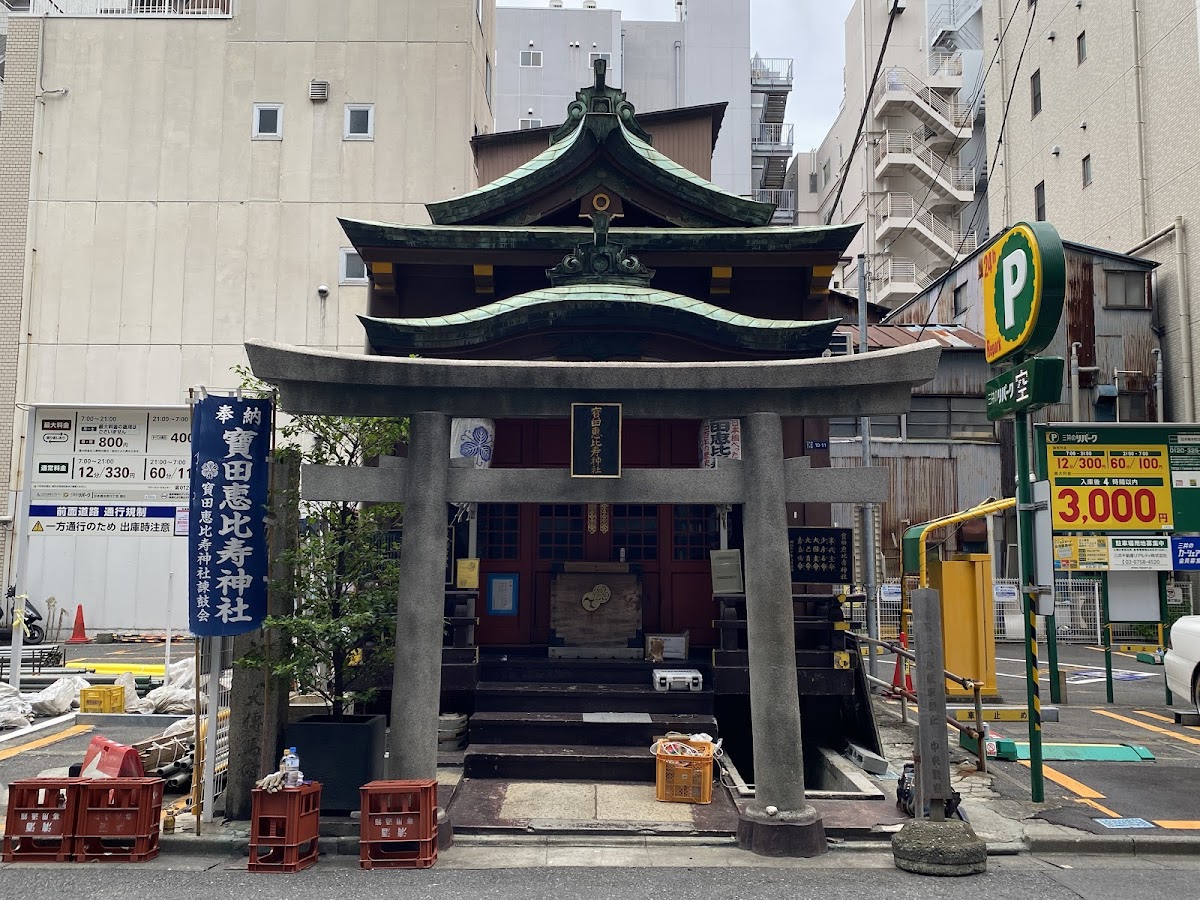
The grounds of Takarada Shrine are very compact, with a simple configuration consisting only of a torii gate and a shrine building. In a corner of Nihonbashi Honcho, surrounded by skyscrapers, a space unfolds that feels like a step back in time.
Passing through the vermilion torii gate, the shrine building comes into view immediately. The small but meticulously maintained shrine houses a statue of Ebisu, the god of fortune, said to have been bestowed by Tokugawa Ieyasu. Despite its location amidst the hustle and bustle of the city, the tranquil grounds create a calming and healing space.
Ebisu Street
The street where Takarada Shrine is located is named “Ebisu Street,” demonstrating the shrine’s integral role in the area’s identity. The street is lined with commercial facilities and office buildings, creating a Nihonbashi-esque landscape where modernity and tradition coexist.
Reason for No Shrine Office
Takarada Shrine does not have a resident priest or a shrine office. This is due to its dual role as a subsidiary shrine of Kanda Myojin and its location as a small shrine in the heart of the city. Therefore, under normal circumstances, amulets, fortune slips, and Goshuin (shrine stamps) are not available.
However, during special periods a few times a year, members of the preservation society may be available to assist (please refer to the Goshuin information below for details). ## Nihonbashi Seven Lucky Gods Pilgrimage and Takarada Ebisu Shrine
What are the Nihonbashi Seven Lucky Gods?
The Nihonbashi Seven Lucky Gods Pilgrimage is a traditional event involving visiting seven temples and shrines scattered throughout the Nihonbashi area of Chuo Ward, Tokyo. Visiting the temples and shrines dedicated to each of the seven lucky gods is believed to bring good fortune and prosperity.
Takarada Shrine is responsible for “Ebisu” in this Nihonbashi Seven Lucky Gods Pilgrimage. Ebisu is the only god of Japanese origin among the seven lucky gods and is known for bringing blessings such as business prosperity, abundant harvests, and bountiful catches.
Period of the Seven Lucky Gods Pilgrimage and Goshuin (Shrine Seals)
The Nihonbashi Seven Lucky Gods Pilgrimage is mainly held during the New Year period (from New Year’s Day to around January 7th). During this period, members of the Takarada Shrine Preservation Society are available to provide special Goshuin (shrine seals).
Visitors to the Seven Lucky Gods pilgrimage bring special paper or stamp books and collect stamps at each temple and shrine. It is believed that completing the pilgrimage to all seven temples and shrines grants the blessings of all seven gods, making it a popular way to pray for good fortune in the new year.
Other Six Temples and Shrines
The Nihonbashi Seven Lucky Gods pilgrimage consists of the following temples and shrines, in addition to Ebisu at Takarada Shrine:
- Koami Shrine: Fukurokuju and Benzaiten
- Chanoki Shrine: Hotei
- Suitengu Shrine: Benzaiten
- Matsushima Shrine: Daikokuten
- Suehiro Shrine: Bishamonten
- Kasama Inari Shrine: Jurojin
Each is within walking distance, and the pilgrimage can be completed in half a day to a full day.
Bettara Market: A Tradition of Edo
What is the Bettara Market?
When discussing Takarada Shrine, the Bettara Market, held annually on October 19th and 20th, is an essential element. This traditional market, dating back to the Edo period, is widely known as a symbol of autumn in Tokyo.
The name “Bettara Market” originates from the fact that bettara-zuke (lightly pickled radish) is a specialty sold there. Bettara-zuke is a sweet, lightly pickled radish made with koji (fermented rice), and its sticky surface is what gives it the name “bettara.”
Historical Background of the Bettara Market
The Bettara Market originally began as a market selling offerings on the 19th (the day before the Ebisu Festival on October 20th). During the Edo period, merchants had a custom of holding Ebisu-ko (Ebisu worship services) around this time of year, as the end of the year approached, to pray for business prosperity.
As the phrase “A new year begins” suggests, this time of year was a crucial turning point for merchants, marking the end of the year and the beginning of preparations for the new one. The market was bustling with people buying bettara pickles, Shinto altars, amulets, and rakes as offerings for the Ebisu festival.
The Modern Bettara Market
The modern Bettara Market is held on October 19th and 20th. Along the Odenma Honmachi Street near Takarada Shrine, stalls line the street for approximately 500 meters, selling a variety of goods including bettara pickles, rakes, Otafuku masks, Shinto altars, ornaments, and food.
Especially on the evening of the 19th, the market is lively with many visitors, offering a vibrant atmosphere reminiscent of the Edo period. The shouts of “Bettara, bettara!” from vendors selling bettara pickles fill the air, creating an experience that feels like stepping back in time to the Edo period.
Issuance of Goshuin (Shrine Seals) at the Bettara Market
During the Bettara Market, members of the preservation society will be on hand to provide special Goshuin at the normally unmanned Takarada Shrine. This is a rare opportunity for those collecting Goshuin, as it may be difficult to obtain them otherwise.
Due to the large number of visitors, there may be a waiting time to receive a Goshuin, but enjoying the atmosphere of the Bettara Market while waiting can be a pleasant experience.
Goshuin Information
Issuance of Goshuin During Normal Times
As mentioned above, Takarada Shrine does not have a resident priest or a shrine office, therefore, Goshuin are not issued during normal times. Amulets and fortune slips are also not available.
Period for Obtaining Goshuin (Shrine Seals)
Goshuin at Takarada Shrine are only available during the following limited periods throughout the year:
- Bettara Market Period: October 19th and 20th every year
- New Year’s Period (Seven Lucky Gods Pilgrimage): Around January 1st to January 7th every year
During these periods, members of the Takarada Ebisu Shrine Preservation Society will be available to assist you.
Goshuin Design
The Takarada Shrine goshuin features the calligraphy “Takarada Ebisu Shrine” and a seal symbolizing Ebisu, the god of fortune. During the Nihonbashi Seven Lucky Gods Pilgrimage, a special goshuin for the pilgrimage is also available.
Notes on Obtaining Goshuin
- Bring Your Goshuincho (Shrine Seal Book): Goshuin are generally written directly into your goshuincho. While pre-written goshuin may be available, it is recommended to bring your goshuincho.
- Be prepared for crowds: The shrine gets very crowded during the Bettara Market and the New Year period. Please allow ample time for your visit.
- Prepare your offering: Having the offering for the Goshuin (usually around 300-500 yen) ready in small change will make things smoother.
- Don’t forget to pray: The Goshuin is proof of your visit. Be sure to pray before receiving your Goshuin.
Benefits of Takarada Shrine
Business Prosperity
The most famous benefit of Takarada Shrine is “business prosperity.” Ebisu, the god of business, is widely worshipped and has been deeply revered, especially by merchants in the Nihonbashi area since the Edo period.
Even today, new business owners and entrepreneurs praying for business prosperity visit the shrine. The kumade (rakes) sold at the Bettara Market are said to gather good fortune and are popular as amulets for business prosperity.
Family Safety and Prosperity
Ebisu, the god of fortune, is known for his blessings of family prosperity and safety. His smiling face is benevolent, and he has been worshipped as a god who brings happiness to homes.
Fire Prevention
Fire prevention is also among the blessings of Takarada Shrine. During the Edo period, fire was a major threat in the Nihonbashi area, where wooden buildings were densely concentrated. For merchants, fire was a disaster that could instantly destroy their property and livelihoods, making faith in the god of fire prevention a crucial matter.
Good Fortune and Prosperity
Takarada Shrine, which enshrines Ebisu, one of the Seven Gods of Fortune, is believed to offer blessings for general good fortune and prosperity. Especially during the New Year’s pilgrimage to the Seven Gods of Fortune, many worshippers visit hoping for improved luck in the new year.
Access and Transportation Information
Nearest Station
Takada Shrine is within walking distance from several stations:
Closest Station:
- Tokyo Metro Hibiya Line “Kodemmacho Station”: Approximately 3 minutes on foot (Exit 4)
- JR Sobu Rapid Line/Tokyo Metro Ginza Line “Shin-Nihonbashi Station”: Approximately 5 minutes on foot (Exit 5)
Other Stations Available:
- Tokyo Metro Hanzomon Line “Mitsukoshimae Station”: Approximately 7 minutes on foot
- JR “Kanda Station”: Approximately 10 minutes on foot
- Tokyo Metro Ginza Line “Mitsukoshimae Station”: Approximately 8 minutes on foot
- Toei Shinjuku Line “Bakuroyokoyama Station”: Approximately 8 minutes on foot
Address and Map
Address: 103-0023 3-10-11 Nihonbashi Honcho, Chuo-ku, Tokyo
Takada Shrine faces “Ebisu Street,” and the surrounding area is lined with office buildings and commercial facilities in Nihonbashi Honcho. It’s a small shrine and easy to miss, but the vermilion torii gate is a landmark.
Access by Car and Parking
Takada Shrine does not have its own parking lot. If you are visiting by car, you will need to use nearby coin-operated parking lots. However, parking fees in the Nihonbashi area are relatively high, and parking lots tend to fill up quickly during busy periods such as the Bettara Market, so we recommend using public transportation.
Access Precautions During the Bettara Market
During the Bettara Market on October 19th and 20th, surrounding roads will become pedestrian zones, and heavy congestion is expected. If you are visiting during this period, please note the following:
- Use public transportation
- Allow ample time for your visit
- The peak of the crowds will be from the evening of the 19th onwards, so daytime visits are recommended
- Wear comfortable shoes
Etiquette and Manners for Visiting a Shrine
Basic Etiquette for Visiting a Shrine
Visiting Takarada Shrine follows the general etiquette for visiting a shrine:
- Bow before the Torii Gate: Before entering the shrine grounds, bow before the Torii gate.
- Purify yourself at the water basin: However, since Takarada Shrine does not have a water basin, this step is omitted.
- Proceed to the front of the shrine: Quietly approach the front of the shrine.
- Offer your donation: Place your donation in the offering box.
- Two bows, two claps, one bow: Bow deeply twice, clap your hands twice, and finally bow once.
- Bow before leaving the torii gate: When leaving the shrine grounds, turn around and bow to the shrine building.
Photography Etiquette
Takada Shrine is a small shrine surrounded by houses and office buildings. Photography is permitted, but please observe the following etiquette:
- Be considerate of other worshippers
- Do not speak loudly
- Refrain from taking photos inside the shrine building
- Be especially careful of your surroundings during the Bettara Market period, as it can get very crowded.
Nearby Attractions and Tourist Spots
Other Temples and Shrines on the Nihonbashi Seven Lucky Gods Pilgrimage
When visiting Takada Shrine, why not also visit the other temples and shrines on the Nihonbashi Seven Lucky Gods Pilgrimage? They are all within walking distance, allowing you to experience the history and culture of Nihonbashi.
Nihonbashi
Nihonbashi, which has flourished as a transportation hub since the Edo period, is about a 10-minute walk from Takada Shrine. The current Nihonbashi Bridge is a stone double-arch bridge built in 1911 (Meiji 44) and is designated as a National Important Cultural Property.
Mitsukoshi Main Store & Takashimaya
The Nihonbashi area is lined with long-established department stores. Mitsukoshi Main Store and Takashimaya are of high architectural value, and can be enjoyed not only for shopping but also for sightseeing.
Bank of Japan Headquarters
The headquarters of the Bank of Japan, Japan’s central bank, is also located in the Nihonbashi area. It is a Western-style building from the Meiji era, and guided tours are available by prior reservation.
COREDO Nihonbashi
For modern shopping and dining spots, there are commercial facilities such as COREDO Nihonbashi. You can experience the charm of Nihonbashi, where tradition and modernity blend together.
Annual Events of Takarada Shrine
Ebisu Festival (October 20th)
The most important festival of Takarada Shrine is the Ebisu Festival, held annually on October 20th. This day is also known as Ebisu-ko and was an important annual event for merchants praying for business prosperity.
Even today, the custom of celebrating Ebisu-ko remains in long-established merchant families, and festivals are held at the shrine.
Bettara Market (October 19th & 20th)
As mentioned above, the Bettara Market, held in conjunction with the Ebisu Festival, is the largest event at Takarada Shrine. As a traditional event that has continued since the Edo period, it attracts many people.
Nihonbashi Seven Lucky Gods Pilgrimage (New Year’s Period)
During the New Year’s period (around January 1st to 7th), many worshippers visit as it is one of the shrines on the Nihonbashi Seven Lucky Gods Pilgrimage. It is bustling with people praying for good fortune and prosperity in the new year.
Frequently Asked Questions (FAQ)
Q1: When can I get a Goshuin (shrine stamp) at Takarada Shrine?
A1: Goshuin are not usually given out at Takarada Shrine. Goshuin (temple/shrine stamps) are only available during two limited periods each year. Specifically, they are available only during the “Bettara Market” on October 19th and 20th each year, and during the New Year period (around January 1st to 7th) for the “Nihonbashi Seven Lucky Gods Pilgrimage,” when members of the preservation society handle the process.
Q2: Is there parking at Takarada Shrine?
A2: Takarada Shrine does not have its own parking lot. If you are visiting by car, you will need to use a nearby coin-operated parking lot. However, parking fees in the Nihonbashi area are relatively high, and parking lots tend to fill up quickly, especially during events such as the Bettara Market, so we recommend using public transportation. It is easily accessible, about a 3-minute walk from the nearest station, Kodemmacho Station.
Q3: What is the Bettara Market? When is it held?
A3: The Bettara Market is a traditional market that has been held since the Edo period, taking place around Takarada Shrine on October 19th and 20th each year. The name comes from the fact that bettara-zuke (sweet pickled daikon radish pickled with koji) is a specialty sold there. The market, which began the day before the Ebisu Festival, now features stalls lining a 500-meter street for both days, selling bettara-zuke, kumade (decorative rakes), Otafuku masks, Shinto altars, food, and more, creating an atmosphere full of Edo-period charm.
Q4: What are the blessings of Takarada Shrine?
A4: The main blessings of Takarada Shrine are business prosperity, household safety, family prosperity, and fire prevention. It is particularly famous for its blessings of business prosperity, as it enshrines Ebisu, and has been deeply revered by merchants in the Nihonbashi area since the Edo period. It is also considered one of the Seven Lucky Gods of Nihonbashi, offering blessings for general good fortune and happiness.
Q5: Can I visit Takarada Shrine at any time?
A5: Yes, Takarada Shrine is open for worship 24 hours a day. However, since there is no resident priest and no shrine office, amulets, fortune slips, and Goshuin (temple/shrine stamps) are not available. Although the grounds are small, it offers a quiet space for worship amidst the hustle and bustle of the city. If you need Goshuin or amulets, we recommend visiting during the Bettara Market period (October 19th and 20th) or the New Year period (around January 1st to 7th).
Q6: What is the Nihonbashi Seven Lucky Gods Pilgrimage?
A6: The Nihonbashi Seven Lucky Gods Pilgrimage is a traditional event involving visiting seven temples and shrines scattered throughout the Nihonbashi area of Chuo Ward, Tokyo. It is believed that visiting the temples and shrines dedicated to each of the Seven Lucky Gods brings good fortune and prosperity. Takarada Shrine is dedicated to Ebisu, the god of fortune. Other shrines in the area include Koami Shrine (Fukurokuju and Benzaiten), Chanoki Shrine (Hotei), Suiten-gu Shrine (Benzaiten), Matsushima Shrine (Daikokujin), Suehiro Shrine (Bishamonten), and Kasama Inari Shrine (Jurojin). Many worshippers visit these shrines, mainly during the New Year period (around January 1st to 7th).
Q7: Please tell me about the history of Takarada Shrine.
A7: Takarada Shrine was worshipped as the guardian shrine of Takarada Village, located near the present-day Imperial Palace Outer Garden, even before Tokugawa Ieyasu’s entry into Edo. In 1606, with the expansion of Edo Castle, Magome Kageyu, the headman of Takarada Village, enshrined the village’s guardian deity and led the residents to the present-day Nihonbashi Honcho (then Odenmacho). The enshrined statue of Ebisu, the god of fortune, is said to be the work of Unkei, a renowned craftsman of the Kamakura period, and was bestowed upon Magome Kageyu by Tokugawa Ieyasu. Since the Edo period, it has been deeply revered by merchants in Nihonbashi as the god of business prosperity.
Q8: How do I access Takarada Shrine?
A8: The nearest stations to Takarada Shrine are Kodemmacho Station on the Tokyo Metro Hibiya Line (approximately a 3-minute walk from Exit 4) or Shin-Nihonbashi Station on the JR Sobu Rapid Line and Tokyo Metro Ginza Line (approximately a 5-minute walk from Exit 5). Other accessible stations include Mitsukoshimae Station on the Tokyo Metro Hanzomon Line (approximately a 7-minute walk) and Kanda Station on the JR Line (approximately a 10-minute walk). The address is 3-10-11 Nihonbashi Honcho, Chuo-ku, Tokyo, and it faces Ebisu-dori Street. It’s a small shrine, but its vermilion torii gate is a landmark.
Summary: The Charm of Takarada Shrine
Takarada Shrine (Takarada Ebisu Shrine), located in Nihonbashi Honcho, Chuo-ku, Tokyo, is a precious shrine that preserves the history and traditions that have continued since the Edo period. It enshrines a statue of Ebisu, said to have been bestowed by Tokugawa Ieyasu, and is known for its blessings of business prosperity and family safety. It is also a popular stop on the Nihonbashi Seven Lucky Gods pilgrimage.
Normally a small, unmanned shrine nestled quietly amidst high-rise buildings, it comes alive with the lively atmosphere of the Edo period during the “Bettara Market” on October 19th and 20th each year, attracting many worshippers. It also draws visitors during the New Year’s period as part of the Nihonbashi Seven Lucky Gods pilgrimage, who pray for good fortune and prosperity.
While opportunities to receive a Goshuin (shrine stamp) are limited to a few times a year, this only enhances its specialness and makes it more worthwhile to visit. Takarada Shrine, located in Nihonbashi, a town where Edo and modern times intersect, allows visitors to feel the weight of history and the faith of merchants. Why not pay a visit sometime?
Whether you’re a business owner praying for business prosperity, interested in visiting the Seven Lucky Gods, want to enjoy the atmosphere of the Bettara Market, or want to experience the history of Nihonbashi—Takada Shrine is a hidden gem in Chuo Ward, Tokyo, worth visiting for a variety of reasons.