Kaeda Shrine (Miyazaki Prefecture) Complete Guide | History and Highlights of the Ancient Shrine Said to be the Birthplace of Amaterasu Omikami
Kaeda Shrine, located in Gakuen Konohanadai, Miyazaki City, Miyazaki Prefecture, is a venerable ancient shrine known for its connection to Japanese mythology. Said to be the birthplace of Amaterasu Omikami, it was formerly known as “Kaeda Ise Shinmei-gu” and was one of the old shrines of Hyuga Province, deeply revered by the local people.
This article comprehensively introduces information you should know before visiting Kaeda Shrine, from its historical background to its highlights and access information.
History and Origins of Kaeda Shrine
Origins from the Age of Mythology
Kaeda Shrine has a long history, with its origins dating back to the age of Japanese mythology. According to the Kojiki and Nihon Shoki, Izanagi-no-Okami, after returning from the underworld, performed a purification ritual at Awakihara, and it is said that he was enshrined in Nakahara, former Kaeda Village, at this location.
It is believed that Amaterasu-Omikami was born during this purification ritual, and Kaeda Shrine has been revered since ancient times as the birthplace of Amaterasu-Omikami. As the sacred site of the birth of Amaterasu-Omikami, the great ancestor of the Imperial family, it is a shrine of special significance.
History as Kaeda Ise Shinmei-gu
Kaeda Shrine has been known as “Kaeda Ise Shinmei-gu” since ancient times and held an important position as one of the old shrines of Hyuga Province. Like Ise Grand Shrine, it enshrines Amaterasu Omikami as its principal deity, hence its name, and it has flourished as a center of local faith.
The shrine’s grounds were vast, and including its subsidiary shrine, Kumiya Shrine, it was a large shrine with many parishioners. It is believed to have been located on the south side of the Kaeda River, near the present-day Kaeda Bridge, in a place called “Kaeda Motoise.”
The Great Earthquake of Kanbun 2 and Relocation
The most significant event in the history of Kaeda Shrine was the Great Earthquake of Sotosho, which occurred in Kanbun 2 (1662), during the reign of Emperor Gosaiin, the 111th emperor. This great earthquake caused immense damage, mainly in southern Miyazaki Prefecture.
The great earthquake and the subsequent tsunami caused catastrophic damage, with a coastal village submerged in the sea and 8,500 koku of farmland lost. The shrine grounds of Shinpachi Shrine, a subsidiary shrine of Kaeda Shrine, were submerged by the sea, and the former shrine grounds were also damaged by the disaster. Therefore, the shrine was forced to relocate to its current location, Gakuen Konohanadai Sakura.
This relocation moved Kaeda Shrine to a hilltop approximately 1 km southeast of its former site, where it remains today. The former site is still known as “Kaeda Motoise,” a place name that preserves the shrine’s history.
Meiji Restoration and Shrine Name Change
During the Meiji Restoration, the shrine system was reformed, and Kaeda Ise Shinmei-gu was renamed “Kaeda Shrine.” It was then designated a local shrine, officially recognized as an important regional shrine. This name change maintained the shrine’s status while clearly defining its character as a place of worship rooted in the community.
Deities and Divine Virtues
Main Deities
Kaeda Shrine enshrines three deities.
Amaterasu Omikami
The supreme deity in Japanese mythology, the personification of the sun. She is revered as the ancestral deity of the Imperial Family and the tutelary deity of all Japanese people. Kaeda Shrine is said to be the birthplace of Amaterasu Omikami, making her a particularly significant enshrined deity.
Izanagi-no-Mikoto
The creator god who gave birth to the land of Japan and many gods. After returning from the underworld, he performed a purification ritual at Aokihara, giving birth to Amaterasu Omikami and the other three noble children.
Izanami-no-Mikoto
The goddess who, together with Izanagi-no-Mikoto, created the land and the gods. As a divine couple, they are believed to bestow blessings of matchmaking and marital harmony.
Divine Virtues
Kaeda Shrine’s divine virtues are diverse.
- Good Fortune and Prosperity: Opening up all kinds of luck through the divine power of Amaterasu Omikami
- Family Safety: Protecting the health and peace of the family
- Business Prosperity: Praying for the development and prosperity of your business
- Exorcism: Purifying and warding off misfortune
- Matchmaking and Marital Harmony: The divine virtues of Izanagi-no-Mikoto and Izanami-no-Mikoto
- Childbirth and Safe Delivery: Protection from the gods involved in the creation of life
Especially due to its history as the birthplace of Amaterasu Omikami, it is believed to be particularly effective for prayers related to new beginnings and births.
Highlights of the Shrine Grounds
Main Hall and Worship Hall
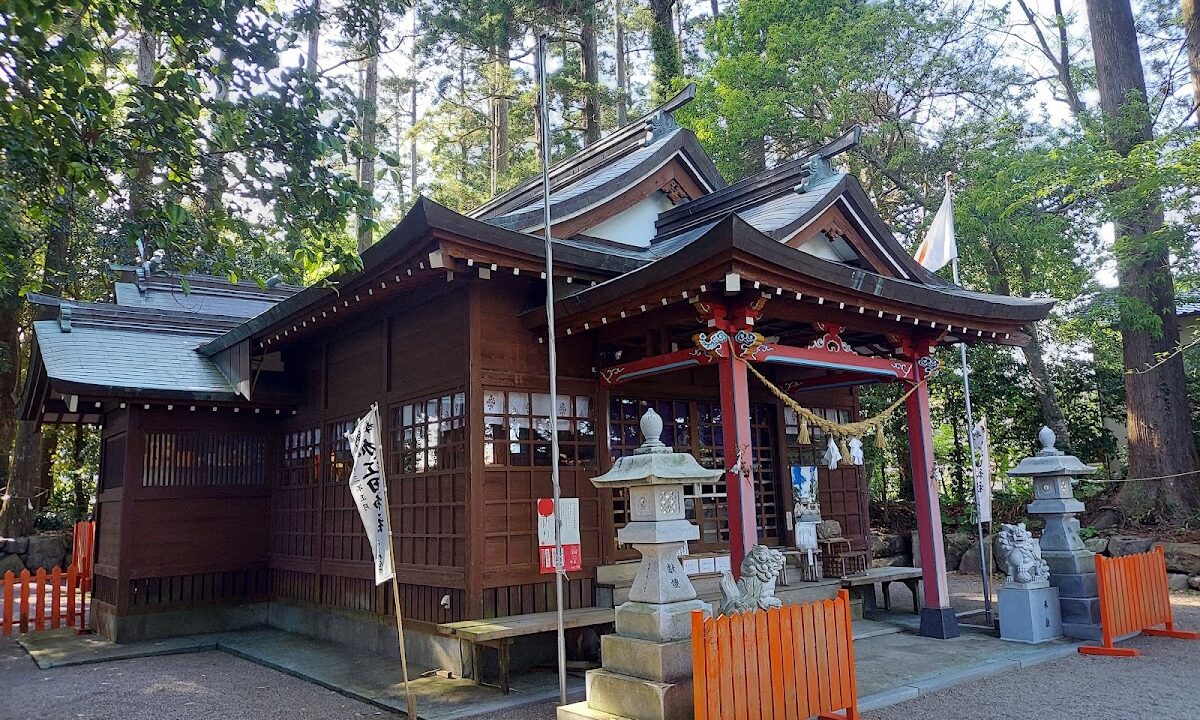
The main hall of Kaeda Shrine originated from a reconstruction made after the great earthquake of 1662 (Kanbun 2), and has undergone repeated repairs to reach its current state. The worship hall is a sacred space welcoming worshippers, exuding a tranquil atmosphere.
Stepping onto the shrine grounds, you’re greeted by a lush natural environment surrounded by blue skies and green trees, allowing you to forget the hustle and bustle of the city. The grounds, where you can feel the power of nature, are the perfect place to purify your mind and body.
Subsidiary Shrines
Several subsidiary shrines are located within the grounds of Kaeda Shrine.
Mitoshi Shrine
This subsidiary shrine enshrines the deity who presides over abundant harvests. In Miyazaki Prefecture, where agriculture is thriving, it has been worshipped as an object of prayer for a bountiful harvest.
Fukuchi Shrine
This shrine enshrines the deity who bestows wisdom and good fortune. It is believed to bring blessings for academic success and business prosperity, attracting many worshippers.
These subsidiary shrines, like the main shrine, are revered by the local people.
One of the Oldest Komainu in Japan
One of the highlights of Kaeda Shrine is the komainu (guardian lion-dogs) enshrined on the grounds. Experts in shrine exploration have pointed out that these are among the oldest guardian lion-dogs in Japan, making them a must-see spot for guardian lion-dog enthusiasts.
Few guardian lion-dogs from this ancient period still exist, and their form and style are valuable cultural assets that tell the history of the shrine. When visiting, be sure to pay attention to the guardian lion-dogs.
Rain-Praying Monument
Within the shrine grounds stands the “Rain-Praying Monument.” This commemorates the history of farmers praying for rain during droughts.
In 2011, a “Rain-Praying Prayer Ritual” was held for the first time in over 60 years. This ritual revived the ancient tradition of rain-praying and attracted attention as an event demonstrating the depth of local history and faith.
The Rain-Praying Monument is a valuable historical site that conveys the form of prayer of the Japanese people who have lived in harmony with nature.
A Shrine Surrounded by Abundant Nature
Kaeda Shrine’s grounds are surrounded by rich nature nurtured by Miyazaki’s mild climate. The trees and flowers, changing their appearance with each season, soothe the hearts of visitors.
Especially during the fresh greenery of spring and the vibrant autumn foliage, the shrine grounds are enveloped in beautiful natural colors, further enhancing its appeal as a power spot. You can feel the energy of nature in the tranquil grounds and offer your prayers with a calm mind.
Goshuin (Shrine Seal) Information
Goshuin are available at Kaeda Shrine. Many visitors seek them as proof of their visit and as a way to forge a connection with the shrine.
Features of the Goshuin
Kaeda Shrine’s goshuin features the shrine’s name and date of visit written in ink, along with the shrine’s seal. Simple yet dignified, this goshuin is also valuable as a collection item for your goshuincho (shrine seal book).
How to Obtain
Goshuin can be obtained at the shrine office. However, since they don’t always have staff available, it’s recommended to contact the shrine in advance to confirm if you definitely want to receive a goshuin (shrine stamp).
When receiving a goshuin, it’s customary to complete your prayers first before visiting the shrine office. Remember that a goshuin is proof of your visit, not a stamp rally.
Differences between Kaeda Shrine and Eda Shrine
In Miyazaki City, there are two shrines with similar names, “Kaeda Shrine” and “Eda Shrine,” which are sometimes confused. However, these are two different shrines.
About Eda Shrine
Eda Shrine (Eda Jinja) is a shrine located in Awagihara-cho, Miyazaki City, and is known as the “birthplace of misogi (purification ritual).” It is an ancient shrine mentioned in the early 10th-century Engishiki (a compilation of laws and regulations), and is located in Aokihara, the place where Izanagi-no-Mikoto performed the purification ritual.
Near Eda Shrine is “Misogi Pond,” which is revered as the actual place where the purification ritual took place. ### Relationship Between the Two Shrines
Both Kaeda Shrine and Eda Shrine are closely related as sites associated with the myths of Izanagi-no-Mikoto’s purification ritual and the birth of Amaterasu-Omikami. Both shrines preserve the same mythological setting, and visiting both will provide a deeper understanding when touring the myths of Miyazaki.
Geographically, Eda Shrine is located in the center of Aokihara (Awagihara), while Kaeda Shrine is situated in the Kaeda River basin, each playing a part in the mythological setting.
Information for Visitors
Basic Information
Location
1-29-4 Sakura, Gakuen Konohanadai, Miyazaki City, Miyazaki Prefecture 889-2155
Deities Enshrined
- Amaterasu Omikami
- Izanagi no Mikoto
- Izanami no Mikoto
Shrine Rank
Former Village Shrine
Access
Access by Car
- Approximately 15km from Miyazaki Station, about 25 minutes by car
- Approximately 10km from Miyazaki Airport, about 20 minutes by car
- Approximately 15 minutes from Miyazaki IC on the Miyazaki Expressway
Parking
A parking lot for visitors is available on the shrine grounds. It is free to use, but space is limited, so caution is advised during busy periods such as New Year’s visits and festivals.
Access by Public Transportation
Take a Miyazaki Kotsu bus bound for “Konohanadai” and get off at the nearest bus stop. The shrine is accessible on foot from there. However, bus service is limited, so checking the timetable is necessary.
Visiting Hours
While visiting the shrine grounds is generally free, the shrine office has limited operating hours. If you wish to receive a Goshuin (shrine stamp) or prayers, it is recommended to check in advance.
Visiting Etiquette
When visiting Kaeda Shrine, please observe the following etiquette.
- Bow before passing through the torii gate: This is a courtesy when entering a sacred area.
- Avoid walking in the center of the approach: The center is considered the path of the gods.
- Purify yourself at the water basin: Cleanse your mind and body before praying.
- Two bows, two claps, one bow: This is the general etiquette for visiting a shrine.
- Be quiet on the shrine grounds: Be mindful that this is a sacred place.
Nearby Tourist Attractions
When visiting Kaeda Shrine, why not also explore the nearby tourist attractions?
Eda Shrine and Misogi Pond
As mentioned above, Eda Shrine is known as the place where Izanagi-no-Mikoto performed his purification ritual. The “Misogi Pond” near the shrine grounds is said to be the actual place where the purification took place, and it exudes a mystical atmosphere. Visiting both Kaeda Shrine and Misogi Pond will allow you to experience the mythological world of Miyazaki more deeply.
Miyazaki University
Kaeda Shrine is located near Miyazaki University’s Kinohana Campus. There are many restaurants and cafes catering to students around the university, making it convenient for a rest after visiting the shrine.
Aoshima and Udo Shrines
In the southern part of Miyazaki City, there are numerous shrines associated with Hyuga mythology, including Aoshima Shrine, famous for matchmaking, and Udo Shrine, built on a cliff. If you have time, visiting several shrines as part of a Miyazaki mythology tour is highly recommended.
Kaeda River
The Kaeda River, which gave Kaeda Shrine its name, is known for its clear waters. The former shrine site, “Kaeda Motoise,” is also near the Kaeda River, making it an interesting area for a walking course tracing the shrine’s history.
Kaeda Shrine as a Power Spot
Kaeda Shrine is known as one of the leading power spots in Miyazaki Prefecture. This is due to its long history dating back to mythological times, its special significance as the birthplace of Amaterasu Omikami, and its rich natural environment. ### Energy of New Beginnings
Based on the legend that this is the birthplace of Amaterasu Omikami, Kaeda Shrine is considered a place filled with the energy of “new beginnings.” It is a shrine that empowers those facing a turning point in their lives or those embarking on new challenges.
Power of Purification
As a shrine originating from Izanagi-no-Mikoto’s purification ritual, it is believed to possess strong power to cleanse and purify the mind and body. Many people visit this shrine to wash away the stress and negative energy accumulated in daily life and to make a fresh start with a refreshed mind.
Energy of Nature
The abundant nature surrounding the shrine grounds is itself a powerful spiritual spot. By visiting while experiencing nature with all five senses—the green of the trees, the chirping of birds, the sound of the wind—you will feel your heart healed and your life force surging.
Annual Events and Festivals
Kaeda Shrine holds various Shinto rituals and festivals throughout the year.
Main Annual Events
New Year’s Day Festival (January 1st)
A Shinto ritual to celebrate the New Year and pray for peace throughout the year. Many worshippers visit for their first shrine visit of the year.
Spring Festival
A festival to celebrate the arrival of spring and pray for a bountiful harvest.
Autumn Festival
A festival to give thanks for the harvest and repay divine blessings.
Monthly Festival
A Shinto ritual held regularly every month to pray for the safety and prosperity of parishioners and worshippers.
The dates of the festivals may vary from year to year, so it is recommended that those wishing to participate inquire with the shrine in advance.
About Prayers and Supplications
Kaeda Shrine accepts various prayers and supplications.
Main Prayers Offered
- Family Safety
- Business Prosperity
- Protection from Evil
- Traffic Safety
- Safe Childbirth
- First Shrine Visit for a Newborn
- Shichi-Go-San (7-5-3 Festival)
- Success in Exams
- Matchmaking
If you wish to have a prayer performed, it is recommended to contact the shrine in advance to arrange a date and time. You can also confirm the offering fee (prayer fee) at that time.
Visiting with Children
Kaeda Shrine is a suitable shrine for visiting with children. The grounds are relatively spacious, and the rich natural environment will be a good experience for children.
Many families visit for events celebrating children’s growth, such as their first shrine visit for a newborn and Shichi-Go-San. Given its history as the birthplace of Amaterasu Omikami, it is a suitable shrine for praying for the healthy growth of children.
However, the shrine grounds are a sacred place, so parents should ensure their children do not make noise or run around.
Summary
Kaeda Shrine is a historic shrine said to be the birthplace of Amaterasu Omikami, and a precious place that preserves the stage of Japanese mythology. Having overcome the ordeal of the great earthquake of 1662, and even after being relocated to its current site, it has continued to attract the faith of the local people.
With its lush natural grounds, some of the oldest guardian lion-dogs in Japan, and a monument dedicated to rainmaking, there are many sights to see, and it is highly regarded as a power spot. When you visit Miyazaki, why not visit Kaeda Shrine and quietly pray while reflecting on the world of mythology?
For those embarking on a new beginning, those seeking purification of mind and body, and those interested in Japanese mythology and history, Kaeda Shrine is definitely worth a visit. A special space where Miyazaki’s rich nature and ancient faith merge awaits you.