Complete Guide to Kannonkyo-ji Temple (Shibayama Nio-son) | The Charm of Chiba Prefecture’s Proud 1200-Year History and Cultural Assets
What is Kannonkyo-ji Temple (Shibayama Nio-son)?
Kannonkyo-ji Temple is an ancient Tendai sect temple located at 298 Shibayama, Shibayama-machi, Sanbu-gun, Chiba Prefecture. Its official name is “Tennozan Kannonkyo-ji Fukuju-in,” and it is widely known locally as “Shibayama Nio-son.”
Since its founding in 781 (Tenno 1), it boasts a history of over 1200 years and attracts many visitors as one of Chiba Prefecture’s leading ancient temples. The principal image is the Eleven-Faced Kannon Bodhisattva. It is known as the 28th (final) temple of the Kazusa Province Yakushi Nyorai Pilgrimage, the 33rd (final) temple of the New Kazusa Province Thirty-Three Kannon Pilgrimage, and the 6th temple of the Eastern Japan Hundred Flower Temples in Chiba Prefecture, serving as the final temple for multiple pilgrimage routes.
The Nio statues enshrined in the Niomon Gate have been revered since the Edo period as “Nio statues that protect against fire and thieves,” and remain a central point of worship, attracting many visitors today.
History and Origins of Kannonkyo-ji Temple
From Founding to the Heian Period
Kannonkyo-ji Temple was founded in 781 (Ten’ō 1), at the end of the Nara period. It is believed to have begun with the enshrinement of the Eleven-Faced Kannon Bodhisattva by Fujiwara no Tsugunawa, who was appointed as the Commander-in-Chief of the Eastern Expedition to pacify the eastern provinces.
Fujiwara no Tsugunawa was a court official who was active during the reign of Emperor Kanmu and dedicated himself to the pacification and development of eastern Japan. The enshrinement of Kannon Bodhisattva in this location is thought to have been more than just the construction of a religious facility; it also served to establish a spiritual pillar for governing eastern Japan.
Restoration by Jikaku Daishi Ennin
In 825 (Tenchō 2) of the Heian period, the temple was restored by Jikaku Daishi Ennin, who later became the third head priest of the Tendai sect. Jikaku Daishi was a high-ranking monk who studied at Enryaku-ji Temple on Mount Hiei and deepened his Tendai teachings in Tang China.
After Ennin’s restoration, Kannon-kyō-ji Temple rapidly developed. It gradually increased the number of temple buildings, and at its peak, it is said to have grown into a large temple complex with over eighty sub-temples in the vicinity. As a Tendai sect temple with Enryaku-ji Temple on Mount Hiei as its head temple, it became one of the important centers of the Tendai sect in eastern Japan. ### Medieval Period: The Protection of the Chiba Clan
In the medieval period, Kannonkyo-ji Temple developed deep ties with the Chiba clan, a prominent family of the Boso Peninsula. During the Jisho era (1177-1181), it received the patronage of Chiba no Suke Taira no Tsunetane, who donated a large amount of Buddhist land (temple territory).
Chiba Tsunetane was a warrior who participated in Minamoto no Yoritomo’s uprising and contributed to the establishment of the Kamakura Shogunate. Under Tsunetane’s patronage, Kannonkyo-ji Temple flourished for a long time as the Chiba clan’s prayer temple. During this period, temples played an important role not only in religious functions but also as centers of regional culture and education.
Trials and Reconstruction in the Sengoku Period
At the end of the Sengoku period, during Toyotomi Hideyoshi’s siege of Odawara in 1590, Kannonkyo-ji Temple was caught in the flames of war. It is said that the entire mountain was reduced to ashes during this war, and the group of sub-temples that boasted over eighty buildings was also lost.
However, reconstruction gradually progressed during the Edo period. In particular, the faith in the Nio statues, believed to have miraculous powers against fire and theft, spread among the common people, and many pilgrims came from Edo (present-day Tokyo).
From Modern to Contemporary Times
Despite the impact of the anti-Buddhist movement of the Meiji era, Kannonkyo-ji Temple survived as a center of local faith. From the Showa to the Heisei period, improvements were made to the temple grounds and the protection of cultural properties, and today it welcomes many worshippers and tourists as one of Chiba Prefecture’s leading tourist temples.
Temple Grounds and Highlights
Nio Gate and Nio Statues
The Nio Gate, standing at the entrance to Kannonkyo-ji Temple, is an important structure that can be considered the face of the temple. The Nio statues enshrined in this gate are the origin of the name “Shibayama Nio-son.”
The Nio statues, a pair of Agyo and Ungyo figures, are characterized by their powerful forms. Since the Edo period, they have been revered by ordinary people as “Nio statues that protect against fire and theft,” and were especially popular among the townspeople of Edo.
During the Edo period, when fires were frequent, people sought a Buddha who would protect their homes from fire. Furthermore, in an era when public safety was not always guaranteed, the miraculous power to ward off theft was also considered important. The Nio statues of Kannonkyo-ji Temple gained widespread devotion as figures that answered these earnest wishes of ordinary people.
Main Hall and Eleven-Faced Kannon Bodhisattva
The main hall enshrines the Eleven-Faced Kannon Bodhisattva, the principal image of Kannonkyo-ji Temple. This Kannon is worshipped as a “Kannon that wards off evil,” and is believed to protect people from all kinds of calamities.
The Eleven-Faced Kannon is a Bodhisattva of Kannon with eleven faces on its head, believed to watch over all directions and save all sentient beings. The Eleven-Faced Kannon at Kannonkyo-ji Temple has been an object of worship for over 1200 years since it was enshrined by Fujiwara no Tsugunawa.
The main hall exhibits many characteristics of Tendai sect temples, with Enryaku-ji Temple on Mount Hiei as its head temple. The architectural style and interior splendor reflect the unique aesthetic sensibilities of the Tendai sect.
Three-Storied Pagoda (Chiba Prefecture Designated Tangible Cultural Property)
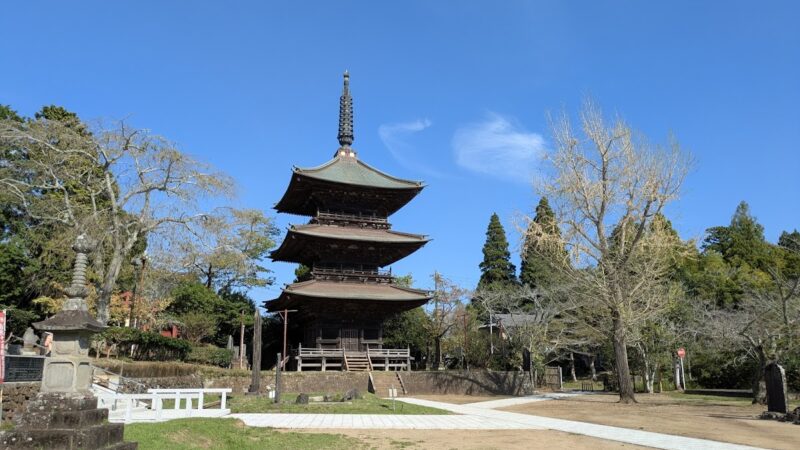
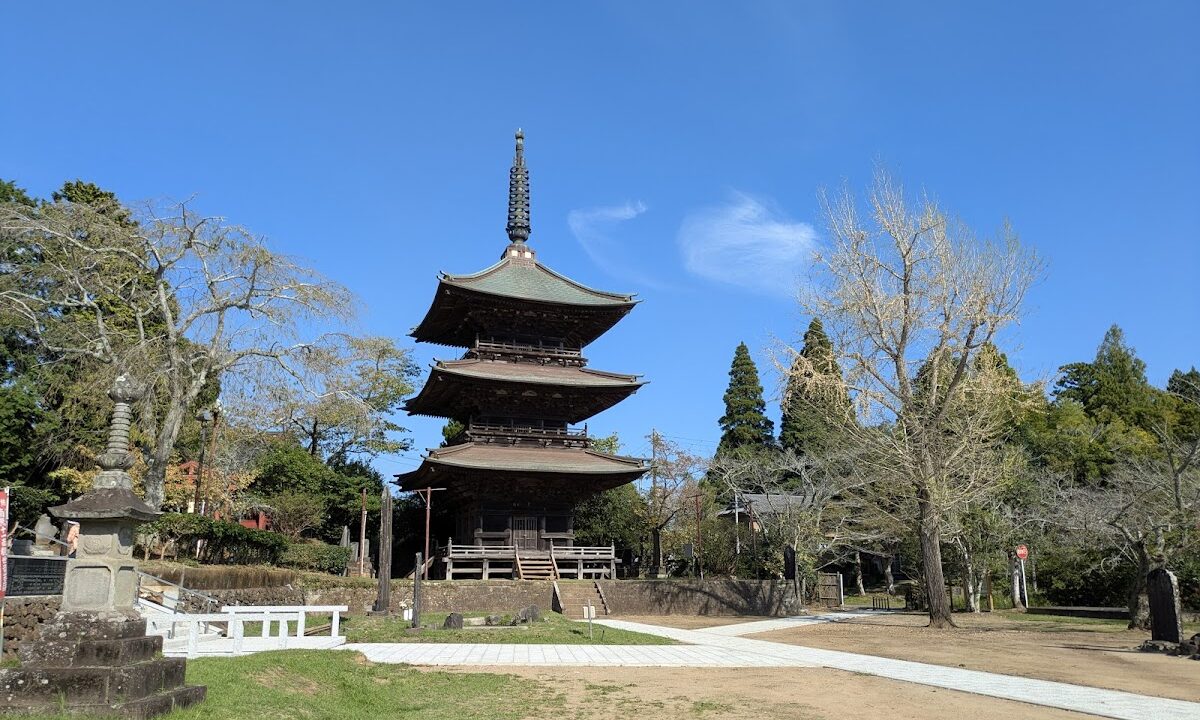
The most striking feature of the temple grounds is the elegant three-storied pagoda. This pagoda is designated as a tangible cultural property of Chiba Prefecture and is a symbolic presence at Kannonkyo-ji Temple.
Built during the Edo period, this pagoda features an eclectic style, based on a purely Japanese architectural style while incorporating elements of Zen Buddhism in its details. The curves of the roofs on each level and the intricate craftsmanship of the structural elements showcase the excellent architectural techniques of the Edo period.
Especially during the summer “Jushichiya-ko” festival, the pagoda is illuminated, and its fantastical appearance against the night sky captivates many visitors. This sight is a beloved summer tradition in Shibayama.
Other Temple Buildings
Within the temple grounds, various other structures supporting the functions of a Tendai Buddhist temple are located, including a bell tower, a goma hall, and a guest hall. The harmonious arrangement of these buildings creates a tranquil atmosphere, offering peace of mind to visitors.
Regular goma prayer ceremonies are held in the goma hall, where prayers are offered with the hopes and wishes of worshippers, symbolized by the “purifying fire of goma that cuts off worldly desires.”
Annual Events and Festivals
Jushichiya-ko (Seventeenth Night Festival)
The most important annual event at Kannonkyo-ji Temple is the “Jushichiya-ko,” held every year on August 17th. This is a summer festival coinciding with the auspicious day of the principal image, the Eleven-Faced Kannon Bodhisattva, and has long been a lively event attracting many worshippers.
In the past, the temple grounds were filled with stalls and sideshows, and it was a grand festival that attracted worshippers from all over the Boso Peninsula. In recent years, a full-fledged outdoor stage has been set up with the illuminated three-story pagoda as a backdrop, and various events such as music and dance have been held.
This festival, which blends traditional religious ceremonies with modern events, is regaining its former vibrancy and has become an important cultural event in the region.
Other Annual Events
In addition to the Jushichiya-ko, Kannonkyo-ji Temple holds various other annual events. Traditional Buddhist ceremonies as a Tendai sect temple are held throughout the year, including New Year’s visits, Setsubun festivals, spring and autumn equinox services, and Obon memorial services.
These events are not merely religious rituals, but also important opportunities to deepen the bonds of the local community, and are attended by many parishioners and local residents.
Cultural Properties and Treasures
Chiba Prefecture Designated Cultural Properties
Kannonkyo-ji Temple preserves valuable cultural properties, including the aforementioned three-story pagoda. These are important materials that tell the story of Chiba Prefecture’s history and culture, and are appropriately protected and managed.
In addition to buildings, cultural properties in various fields, such as Buddhist statues, Buddhist paintings, and ancient documents, are preserved, conveying the long history of Kannonkyo-ji Temple to the present day.
Collaboration with Shibayama Town Shibayama Kofun and Haniwa Museum
The Shibayama Town Shibayama Kofun and Haniwa Museum is located on the grounds of Kannonkyo-ji Temple. This museum is a specialized museum exhibiting Haniwa (clay figures) and artifacts from the Kofun period (Tumulus period) unearthed in Shibayama Town and the surrounding area.
Shibayama Town is an area with many important Kofun period sites, and is particularly rich in examples of Haniwa. At the museum, you can learn about the history and culture of ancient Boso through these valuable archaeological materials.
The integration of the historical buildings of Kannonkyo-ji Temple and the museum’s archaeological exhibits allows for a multifaceted experience of Shibayama’s history from ancient times to the present day, which is a unique charm of this location.
Kannonkyo-ji Temple as a Pilgrimage Site
Kannonkyo-ji Temple is a pilgrimage site for several sacred sites, and holds special significance for pilgrims.
Kazusa Province Yakushi Nyorai Pilgrimage Site No. 28 (Completion)
As the final pilgrimage site of the Kazusa Province Yakushi Nyorai Pilgrimage, it plays an important role in concluding the pilgrimage. As a completion temple, it is a place to receive the sense of accomplishment and gratitude of those who have completed the pilgrimage.
33rd Temple of the New Kazusa Province Thirty-Three Kannon Pilgrimage (Completion)
This temple also serves as the final stop on the Kannon pilgrimage. Its position as a temple of Kannon worship is truly fitting.
6th Temple in Chiba Prefecture of the Eastern Japan Hundred Flower Temples
Designated as the 6th temple in Chiba Prefecture of the Eastern Japan Hundred Flower Temples, this temple is known for its seasonal flowers. In particular, the temple grounds, which display different expressions in each season—cherry blossoms in spring, fresh greenery in early summer, and autumn leaves—attract many visitors.
Visiting Information and Access
Basic Information
Official Name: Tennozan Kannonkyo-ji Fukujuin
Common Name: Shibayama Nio-son
Sect: Tendai Sect
Principal Image: Eleven-faced Kannon Bodhisattva
Address: 298 Shibayama, Shibayama-machi, Sanbu-gun, Chiba 289-1619
Phone: 0479-77-0004
Access Methods
Access by Train:
- Approximately 20 minutes on foot from Shibayama Railway “Shibayama Chiyoda Station”
- Take a bus or taxi from JR Sobu Main Line/Keisei Main Line “Narita Station”
Access by Car:
- Approximately 15 minutes from Higashi-Kanto Expressway “Narita IC”
- Approximately 20 minutes from Higashi-Kanto Expressway “Tomisato IC”
- Visitor parking available on the temple grounds
Access from Narita Airport: Located approximately 20 minutes by car from Narita Airport, it’s easily accessible for airport users. As a historical temple near an international airport, it’s seeing an increase in visits from foreign tourists.
Visiting Hours and Admission Fees
While the temple grounds are generally open to visitors, please contact the temple office in advance if you wish to view the interior of the main hall or request special prayers.
The adjacent Shibayama Kofun and Haniwa Museum has set opening hours and admission fees; it’s recommended to check these in advance if you wish to visit the museum.
Nearby Tourist Attractions
Shibayama Kofun Cluster
Important archaeological sites from the Kofun period are scattered around Kannonkyo-ji Temple. The Shibayama Kofun Cluster consists of burial mounds constructed between the 5th and 7th centuries, indicating the existence of a powerful force in this region at that time.
Aviation Science Museum
This aviation-focused museum takes advantage of its proximity to Narita Airport. It features displays of actual aircraft and interactive exhibits where visitors can learn about the mechanics of airplanes, making it a popular spot for families.
Naritasan Shinshoji Temple
Located about 30 minutes away by car, Naritasan Shinshoji Temple is the head temple of the Chizan branch of Shingon Buddhism and one of the leading temples in the Kanto region, attracting over 10 million visitors annually. A popular sightseeing route also includes a visit to Kannonkyo-ji Temple.
The Charm and Characteristics of Kannonkyo-ji Temple
“The Compassionate Kannon, the Powerful Nio Guardians”
The phrase “The Compassionate Kannon, the Powerful Nio Guardians, and the Purifying Fire of the Goma Ritual that Severs Worldly Desires” describes the characteristics of Kannonkyo-ji Temple.
The principal image, the Eleven-Faced Kannon, symbolizes compassion, gently embracing all people. Meanwhile, the Nio guardians, with their powerful presence, repel calamities and protect people. The Goma flames burn away human desires, leading to a pure heart.
The harmony of these three elements makes Kannonkyo-ji Temple a temple that offers comprehensive salvation to its visitors.
Harmony of History and Modernity
Kannonkyo-ji Temple, with a history of over 1200 years, is also actively involved in modern events and information dissemination. Its commitment to preserving tradition while continuously evolving with the times serves as a model for many temples.
From music events at the Jushichiya-ko (Seventeenth Night Festival) to information dissemination via social media and efforts to make the temple barrier-free, various initiatives are evident throughout the grounds to welcome visitors of all ages.
As a Center of Local Culture
Kannonkyo-ji Temple is more than just a religious facility; it is the core of Shibayama Town’s cultural identity. Annual events serve as a place to deepen community bonds, and the temple grounds function as a place of relaxation for residents.
In collaboration with the adjacent museum, it also plays a role as a cultural complex that comprehensively conveys the history of the region from ancient times to the present day.
Points and Manners for Visiting
Etiquette for Visiting
At Kannonkyo-ji Temple, a Tendai sect temple, the general etiquette for visiting Buddhist temples is followed. When passing through the Niomon Gate, bow once, and in the main hall, quietly clasp your hands together and offer your prayers.
When making an offering, it is considered polite to quietly place it in the offering box rather than throwing it. If ringing the bell, it is customary to ring it only once before praying.
Regarding Photography
Photography of the temple grounds and the exterior of the buildings is generally permitted, but there may be restrictions on photographing the interior of the main hall or the Buddha statues. Please check before taking pictures or follow the signs.
In particular, please refrain from taking pictures that may disturb religious ceremonies or the prayers of other visitors. When photographing cultural properties such as the three-story pagoda, it is necessary to maintain an appropriate distance for protection purposes.
Clothing and Belongings
There are no specific dress code requirements, but modest attire appropriate for a religious site is desirable. During the summer, the sun is strong, so it is recommended to bring a hat, parasol, and drinks.
If you wish to receive a Goshuin (temple stamp), please bring your Goshuincho (stamp book). Kannonkyo-ji Temple is a pilgrimage site for multiple sacred sites. Therefore, if you have a stamp book for each pilgrimage site, please present the appropriate one.
Summary: The Value and Significance of Kannonkyo-ji Temple
Kannonkyo-ji Temple (Shibayama Nio-son) is a representative historical temple of Chiba Prefecture and a cultural heritage site with multifaceted value.
With a history of over 1200 years since its founding in 781 AD, it has undergone historical changes, including its founding by Fujiwara no Tsugunawa, restoration by Jikaku Daishi Ennin, patronage by the Chiba clan, and reconstruction after war, leading to its present form.
It boasts a concentration of elements of high religious and cultural value, such as the Nio statues that have attracted the faith of common people since the Edo period as “guardians against fire and thieves,” the Eleven-faced Kannon Bodhisattva worshipped as a Kannon for warding off evil, and the three-story pagoda, a prefectural designated cultural property.
As the final temple on a pilgrimage to multiple sacred sites, and as a renowned flower temple in eastern Japan, Kannonkyo-ji Temple continues to welcome many worshippers and tourists even today. Its collaboration with the adjacent museum allows visitors to comprehensively experience the region’s history from ancient times to the present day, a feature particularly noteworthy.
Taking advantage of its convenient location near Narita Airport, the temple will undoubtedly continue to showcase its value to visitors from both Japan and abroad. When visiting Shibayama-machi, Sanbu-gun, Chiba Prefecture, be sure to stop by Kannonkyo-ji Temple and spend some peaceful time in its grounds, steeped in 1200 years of history.