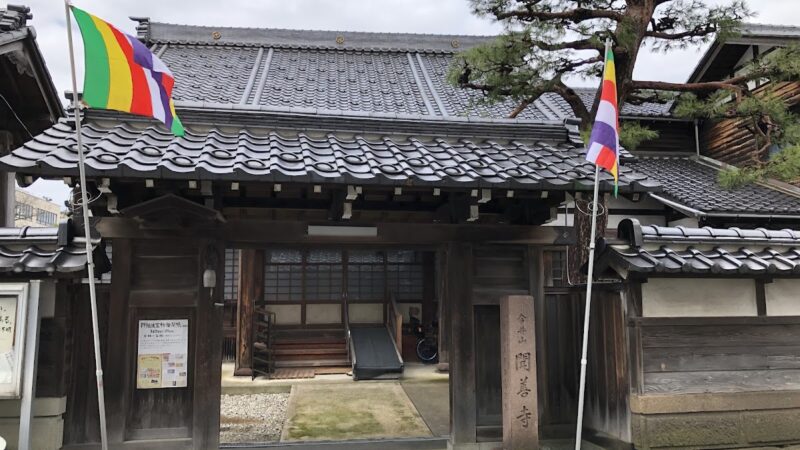
Complete Guide to Monzenji Temple (Kanazawa City, Ishikawa Prefecture) | History, Goshuin (Temple Seal), Perpetual Memorial Service, and Access Information
Monzenji Temple, located in Hyotan-cho, Kanazawa City, Ishikawa Prefecture, is a historic temple of the Jodo Shinshu Otani sect that has existed since the Muromachi period. As a branch temple of Yoshizaki Gobo, associated with Rennyo Shonin, it has attracted the faith of people in Kanazawa for over 500 years. This article provides detailed information useful for visiting or considering a burial site at Monzenji Temple, from its history to its goshuin (temple seal), perpetual memorial graves, and access methods.
History and Origins of Monzenji Temple
Origins as a Branch Temple of Yoshizaki Gobo
Monzenji Temple is a historic temple founded in Bunmei 13 (1481) during the Muromachi period. Kenzenji Temple originated as a branch temple of Yoshizaki Gobo, which was established in Yoshizaki, Echizen Province (present-day Awara City, Fukui Prefecture) by Rennyo Shonin, known as the restorer of Jodo Shinshu Buddhism, as a base for missionary work in the Hokuriku region.
Rennyo Shonin stayed in Yoshizaki from 1471 to 1476, spreading the teachings of Jodo Shinshu Buddhism throughout the Hokuriku region. His influence was immense, leading to the establishment of many temples in Kaga, Echizen, and Noto. Kenzenji Temple was founded in Kanazawa as a result of his missionary activities during this period.
Founding and Development on the West Side of Kanazawa Castle
Kenzenji Temple was first established on the west side of Kanazawa Castle. At that time, Kanazawa was a stronghold of the Kaga Ikko-ikki rebellion, and the influence of Jodo Shinshu Buddhism was very strong there. Until 1580, when Sakuma Morimasa attacked and captured Kanazawa Mido, Kenzenji Temple played an important role in Kaga Province, known as “the land owned by the common people,” for approximately 100 years.
In the Edo period, under the rule of the Maeda family of the Kaga Domain, the town layout of Kanazawa was reorganized, and Kenzenji Temple relocated to its current location in Hyotan-cho. Since then, it has continued to serve as the family temple and center of faith for the local people.
Doctrines and Principal Image of the Jodo Shinshu Otani School
Kenzenji Temple belongs to the Jodo Shinshu Otani School (Shinshu Otani School). Jodo Shinshu, founded by Shinran Shonin, preaches the doctrine of salvation through the power of Amida Buddha’s original vow, stating that everyone is equally saved.
The principal image is Amida Buddha, and it is taught that by chanting “Namu Amida Butsu,” one can attain rebirth in the Pure Land through Amida Buddha’s compassion. Jodo Shinshu Buddhism does not require rigorous training or strict precepts; instead, it emphasizes chanting the Nembutsu in daily life.
Highlights and Grounds Guide of Kenzenji Temple
Main Hall and Amida Buddha Statue
Kenzenji Temple’s main hall is a magnificent building in the traditional style of Shinshu temples. The principal image, Amida Buddha, is enshrined in the inner sanctuary, and the golden, gleaming Buddha statue warmly welcomes visitors. The interior of the main hall is covered with tatami mats, and many followers gather here for religious services and sermons.
A characteristic of Shinshu temples is that the main hall is divided into an outer sanctuary and an inner sanctuary, with a palace-like structure (kuden) in the center of the inner sanctuary where the principal image is enshrined. On either side of the gate are portraits of Shinran Shonin and Rennyo Shonin, preserving the tradition of Jodo Shinshu Buddhism.
Atmosphere of the Temple Gate and Grounds
Kenzenji Temple’s temple gate faces Hyotan-cho Street, quietly welcoming visitors. Passing through the gate, one enters a tranquil temple grounds, despite its urban location. The well-maintained grounds are clean, and the seasonal flowers and trees soothe the hearts of visitors.
The temple grounds also include a cemetery, where generations of temple followers rest. In recent years, perpetual memorial graves and tree burials have been established to meet diverse memorial needs.
Bulletin Boards and Buddhist Teachings
Kenzenji Temple has bulletin boards next to the temple gate and within the grounds, displaying Buddhist teachings and teachings by the head priest. These boards offer Buddhist wisdom and guiding principles for life, often forgotten in daily life, providing profound insights not only to visitors but also to passersby. These kinds of online forum posts are gaining attention as a social role for temples in modern times, and Kenzenji Temple is actively participating in them.
Kenzenji Temple’s Goshuin (Temple Seal) Information
About the Issuance of Goshuin
Kenzenji Temple issues Goshuin. While many Jodo Shinshu temples traditionally do not issue Goshuin, Kenzenji Temple accommodates those who wish to receive one as proof of their visit.
The Goshuin features the temple name “Kenzenji” written in ink and stamped with the temple’s seal. In keeping with Jodo Shinshu tradition, the characters “Namu Amida Butsu” (Homage to Amida Buddha) may also be inscribed, characterized by a simple yet powerful calligraphy style.
How to Receive a Goshuin and Etiquette
When receiving a Goshuin, first complete your prayers at the main hall, then request one at the temple office or living quarters. It is important to bring your Goshuin book and make your request politely.
The offering fee (for the temple’s seal) is generally around 300 to 500 yen, but please follow the temple’s instructions. The temple seal is not a stamp rally; it is proof of your visit and an important act of forging a connection with Buddhism. Please receive it with gratitude.
Points to Note When Visiting
When visiting Kenzenji Temple, it is recommended to contact them in advance. The head priest may be absent due to memorial services or other outings, so if you want to be sure to receive a temple seal, it is best to call and confirm before visiting.
Kenzenji Temple’s Perpetual Memorial Graves, Tree Burials, and Columbarium
Features and Costs of Perpetual Memorial Graves
Kenzenji Temple offers perpetual memorial graves to meet modern needs. A perpetual memorial grave is a burial site where the temple takes responsibility for perpetual memorial services and management. It is chosen by those without successors or those who do not want to burden their descendants with grave maintenance.
At Kenzenji Temple, the perpetual memorial graves typically involve a period of individual interment before communal burial. The cost is generally between 300,000 and 800,000 yen, which is a reasonable price range compared to other temples in Kanazawa City. There are also plans that do not require annual maintenance fees, making them attractive as there are no additional costs after the initial payment.
Regarding the use of perpetual memorial graves, there are often no restrictions on religious affiliation or sect; even those who are not followers of Jodo Shinshu Buddhism can inquire. However, it is recommended to contact the temple directly for detailed conditions and costs.
Tree Burial Plans and Details
Kenzenji Temple also offers tree burials, which have become increasingly popular in recent years. Tree burial is a nature-oriented burial method where a tree serves as a grave marker instead of a tombstone, and is chosen by those who wish to “return to nature.”
Kenzenji Temple’s tree burials are located in designated sections within the temple grounds, allowing for a beautiful resting environment planted with seasonal flowering trees. The cost is similar to the perpetual memorial graves, ranging from 300,000 to 600,000 yen.
Since tree burial also includes perpetual memorial services, there are fewer worries about future maintenance, making it a reassuring choice.
About the Use of the Columbarium
Kenzenji Temple also has a columbarium where cremated remains can be kept indoors. The columbarium has the advantage of allowing visits regardless of the weather, and is popular with the elderly and those visiting from afar.
There are various types of columbariums, such as individual locker-style and altar-style, but it is necessary to check directly with Kenzenji Temple regarding their specific format. Costs vary depending on the storage period and format, but generally range from 200,000 to 1,000,000 yen.
Consultation Regarding Graves and Grave Closure
Kenzenji Temple handles not only the construction of new graves but also the management of existing graves and consultations regarding grave closure. In recent years, more people are considering grave closure due to reasons such as living far away and difficulty visiting graves, or lack of successors.
Grave closure refers to the removal of an existing grave and the transfer of cremated remains to a perpetual memorial grave or columbarium. Kenzenji Temple accepts reburials from other cemeteries and provides thorough support for procedures and memorial services.
The cost of closing a grave generally ranges from 500,000 to 1,500,000 yen, including the cost of removing the existing grave, retrieving the remains, and finding a new burial site.
Flow of Interment at Kenzenji Temple
The general flow for using the perpetual memorial grave or tree burial at Kenzenji Temple is as follows:
- Visit Reservation: First, make a reservation for a visit by phone or email. You will actually visit the temple grounds and check the atmosphere and facilities of the burial site.
- Consultation and Explanation: You will receive an explanation from the head priest or temple office staff regarding the details, costs, and methods of memorial services for the perpetual memorial grave or tree burial. Feel free to ask any questions you may have.
- Contract: Once you are satisfied with the contents, you will sign a contract. The contract will clearly state the costs, the content of the memorial service, and the duration.
- Interment: After the contract is signed, the date for interment will be arranged. A Buddhist sutra will be chanted during the interment ceremony to respectfully send off the deceased.
- Memorial Service: Even after interment, joint memorial services are held during the spring and autumn equinoxes and Obon festival, ensuring perpetual memorial services.
How to Make a Visit Reservation
If you wish to visit the perpetual memorial graves or tree burial sites at Kenzenji Temple, we recommend making a reservation by phone in advance. The head priest and staff will provide a thorough tour, allowing you to consider your options carefully.
When visiting, you should confirm the following points:
- Location and environment of the grave site
- Details of costs (initial costs, whether or not there are annual maintenance fees)
- Method and frequency of memorial services
- Restrictions on religious affiliation/sect
- Changes or cancellations after contract signing
Kenzenji Temple Facilities Information
Barrier-Free Accessibility
As a temple located in an urban area, Kenzenji Temple has facilities designed with the convenience of visitors in mind. The temple grounds are relatively flat, making it easily accessible for the elderly and those in wheelchairs. However, as it is a historical temple, complete barrier-free access is difficult in some areas.
If you have any concerns about visiting, we recommend contacting the temple in advance.
Parking
Kenzenji Temple has a parking lot for visitors. However, spaces are limited, and it may be full during religious services and events. Consider using public transportation.
Toilets and Rest Areas
Toilets are available on the temple grounds for visitors. They are kept clean and well-maintained, so you can use them with peace of mind.
How to Access Kenzenji Temple
Basic Information
Location: 5-33 Hyotan-cho, Kanazawa City, Ishikawa Prefecture
Sect: Jodo Shinshu Otani-ha (Shinshu Otani-ha)
Principal Image: Amida Buddha
Phone Number: 076-261-7374
Access by Train
The following routes are convenient for visiting Kenzenji Temple by train.
Using the Hokuriku Railway Asanogawa Line:
- Approximately 11 minutes on foot from Nanatsuya Station (approx. 900m)
From JR Kanazawa Station:
- Approximately 5 minutes on the Hokuriku Railway Asanogawa Line from Hokutetsu Kanazawa Station (adjacent to JR Kanazawa Station) to Nanatsuya Station
- Approximately 11 minutes on foot from Nanatsuya Station
Alternatively, walking directly from JR Kanazawa Station takes approximately 15 minutes (approx. 1.2km). From the east exit of Kanazawa Station, head northeast, cross the Asano River, and proceed towards Hyotan-machi.
Access by Bus
If using local buses within Kanazawa City, it’s a few minutes’ walk from the nearest bus stop. Since Hokuriku Railway Bus and Kanazawa Flat Bus routes pass nearby, it’s a good idea to check the bus stop locations and timetables in advance.
Access by Car
If visiting by car, the following route is convenient.
- From Kanazawa Station: Head north on National Route 159 from the east exit of the station, cross the Asanogawa Bridge, and head towards Hyotan-cho.
- From Kanazawa East IC: Approximately 15 minutes from the Hokuriku Expressway Kanazawa East IC.
- From Kanazawa West IC: Approximately 20 minutes from the Hokuriku Expressway Kanazawa West IC.
When using a car navigation system, please search using the address “5-33 Hyotan-cho, Kanazawa City, Ishikawa Prefecture” or the phone number “076-261-7374”.
Parking Information
Kenzenji Temple has a parking lot for visitors, but the number of spaces is limited. There are also several coin-operated parking lots in the surrounding area, so you can use those if the main parking lot is full.
Events and Activities at Kenzenji Temple
Annual Events
Kenzenji Temple holds annual events based on the traditions of Jodo Shinshu Buddhism.
Spring Equinox Service (March): A memorial service for ancestors is held during the spring equinox.
Birth Day (Flower Festival) (April): A memorial service celebrating the birth of Shinran Shonin.
Obon Festival (August): A memorial service to welcome the spirits of ancestors is held during the Obon period.
Autumn Equinox Service (September): A memorial service is also held during the autumn equinox.
Memorial Service (November): The most important memorial service in Jodo Shinshu Buddhism, commemorating the anniversary of Shinran Shonin’s death.
These events may be open to general visitors as well as temple members. Please inquire with the temple for details.
Dharma Talks and Buddhist Lectures
Kenzenji Temple regularly holds Dharma talks and Buddhist lectures. In the Dharma talks by the head priest, Buddhist teachings are explained in an easy-to-understand manner, allowing participants to learn about the significance of Buddhism in modern society and its practical application in daily life.
The content is easy for beginners to participate in, and anyone interested in Buddhism or struggling with life’s problems is welcome.
Open Temple Activities
Kenzenji Temple is committed to creating an “Open Temple” that is open to the community. In addition to posting Buddhist teachings on a bulletin board, the temple’s activities and the head priest’s thoughts are shared through blogs and social media.
This initiative, aimed at making the temple more accessible and applying Buddhist teachings to modern life, has resonated with many people.
Tourist Spots Around Kenzenji Temple
Temple and Shrine Pilgrimage in Kanazawa
Kanazawa City, where Kenzenji Temple is located, is a historic city that flourished as a castle town of the Kaga domain. Numerous temples and shrines are scattered throughout the city, making it a great place to enjoy temple and shrine pilgrimages.
Higashiyama Higashi Chaya District: A teahouse district that retains the atmosphere of the Edo period, located within walking distance of Kenzenji Temple.
Utatsuyama Temple Group: Over 50 temples are clustered at the foot of Utatsuyama Mountain, offering a peaceful and enjoyable stroll.
Oyama Shrine: A shrine dedicated to Maeda Toshiie, famous for its stained-glass gate.
A Base for Kanazawa Sightseeing
Kenzenji Temple is conveniently located near Kanazawa Station, making it an ideal base for sightseeing in Kanazawa. It offers easy access to major tourist attractions such as Kenrokuen Garden, Kanazawa Castle Park, Omicho Market, and the 21st Century Museum of Contemporary Art.
When visiting Kanazawa, we recommend taking some time to visit Kenzenji Temple and enjoy a peaceful moment amidst your sightseeing.
Recommended Points of Kenzenji Temple
A Temple Where You Can Feel History and Tradition
Kenzenji Temple boasts a history of over 500 years and has a distinguished history as a branch temple of Yoshizaki Gobo, associated with Rennyo Shonin. It is a temple that has walked hand in hand with the history of Kanazawa, and visiting it allows you to experience the Buddhist culture of Kaga.
Courteous Service and a Warm Atmosphere
Kenzenji Temple is renowned for the courteous and warm service provided by its head priest and other temple staff. They offer personalized suggestions tailored to each individual’s circumstances, even when discussing perpetual memorial graves or tree burials.
Clean and Well-Maintained Grounds
The temple grounds and cemetery are always kept clean and well-maintained. It provides a safe and secure environment for entrusting your loved ones.
Modern Initiatives and an Open Approach
Kenzenji Temple actively engages in modern initiatives such as open temple activities and social media outreach. While preserving tradition, they manage the temple in a way that suits the times, earning support from a wide range of generations.
Other Temples and Cemeteries in Kanazawa City
Besides Kenzenji Temple, there are many other temples and cemeteries in Kanazawa City. When considering perpetual memorial graves or tree burials, it is recommended to visit and compare several temples.
Major Temples and Cemeteries
- Nodayama Cemetery: The largest public cemetery in Kanazawa City, also containing the Maeda family’s tomb.
- Tentokuin Temple: A temple dedicated to Matsu, the wife of Maeda Toshiie.
- Daijoji Temple: A renowned Soto Zen temple famous for its beautiful garden.
- Myoryu-ji Temple (Ninja Temple): A popular tourist attraction with its architecture featuring hidden mechanisms.
Each temple has its own unique characteristics, so it’s important to choose a place that suits your and your family’s wishes.
Summary
Kenzenji Temple is a historic Jodo Shinshu Otani sect temple located in Kanazawa City, Ishikawa Prefecture. Since its founding in the Muromachi period, it has attracted the faith of local people for over 500 years. It is characterized by its history as a branch temple of Yoshizaki Gobo, associated with Rennyo Shonin, its courteous service, and its clean and well-maintained grounds.
While preserving tradition, Kenzenji Temple also caters to modern needs through initiatives such as issuing Goshuin (temple stamps), offering perpetual memorial graves, tree burials, and columbariums, and participating in open temple activities. Its convenient location within walking distance of Kanazawa Station is another attractive feature.
When visiting Kenzenji Temple for worship or to consider perpetual memorial graves, it is recommended to contact them in advance. The head priest and temple staff will provide courteous assistance, ensuring a smooth and reassuring consultation.
Why not spend some time at Kenzenji Temple, immersing yourself in Kanazawa’s history and Buddhist culture, and offering a moment of quiet prayer?