Miotsukushi Sumiyoshi Shrine (Osaka Prefecture) Complete Guide | History Related to the Japanese Envoys to Tang China, Goshuin (Shrine Seal), and Access Information
Miotsukushi Sumiyoshi Shrine, located in Denpo, Konohana-ku, Osaka City, is a venerable shrine boasting a history of over a thousand years. Founded to pray for the safe voyages of the Japanese envoys to Tang China, it is the origin of the Osaka City emblem, “Miotsukushi,” and is deeply revered by the local people.
This article provides a detailed explanation of everything you need to know before visiting Miotsukushi Sumiyoshi Shrine, including its history, enshrined deities, highlights within the grounds, goshuin information, and access methods.
History of Miotsukushi Sumiyoshi Shrine | A Thousand-Year Story Beginning with the Prayers of the Japanese Envoys to Tang China and Kukai
Founded in Enryaku 23 (804 AD)
The founding of Miotsukushi Sumiyoshi Shrine dates back to Enryaku 23 (804 AD). In that year, a delegation of Japanese envoys to Tang China visited this area and was deeply impressed by the island’s scenic beauty. The voyage to Tang China was a perilous undertaking at the time, with no guarantee of a safe return.
To pray for a safe voyage, the envoys built an altar on a corner of the island and enshrined the four Sumiyoshi deities. It is said that the shrine originated from the “Mio-tsukushi” (channel markers) erected to guide them on their return journey.
Deep Connection to Kukai
Kukai (Kobo Daishi), who would later become the founder of Shingon Buddhism, was also a member of the Japanese envoy to Tang China in 700 AD. It is said that Kukai prayed for a safe voyage at this location, and Mio-tsukushi Sumiyoshi Shrine is known as a place associated with Kukai.
After returning from Tang China, Kukai left a significant mark on the history of Japanese Buddhism. Considering that the first step in his great achievements began with prayers at this Mio-tsukushi Sumiyoshi Shrine, the historical importance of this shrine becomes clear.
A Land that Flourished as the Gateway to Denpo
Denpo, where the Mio-tsukushi Sumiyoshi Shrine is located, has flourished since ancient times as the “Denpo-guchi,” the gateway from the Seto Inland Sea to Osaka. Located at the mouth of the Yodo River, this area was a vital hub for maritime traffic, with many ships passing through and developing into a commercial center.
During the Edo period, it became the birthplace of “taru-kaisen” (barrel-carrying ships) that transported sake from Itami and Nada to Edo, and its importance as a maritime transport base increased even further, with the largest shipping magistrate’s office of the Edo shogunate located there.
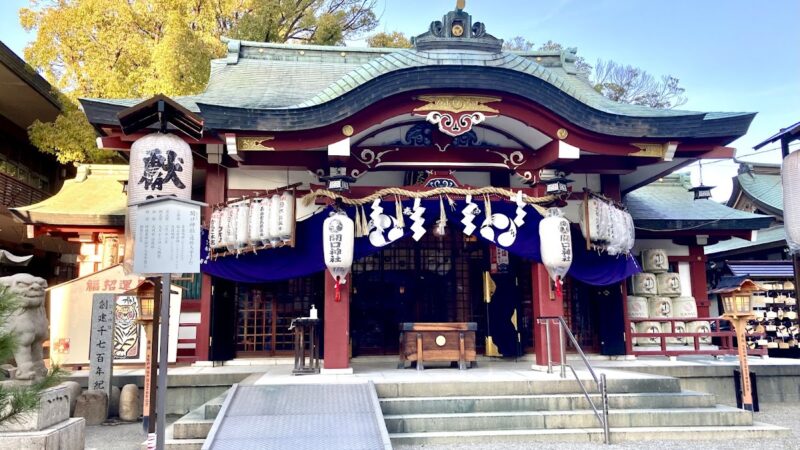
The Mio-tsukushi Sumiyoshi Shrine has continued to attract the faith of local people as a deity protecting the safety of maritime traffic and as a guardian deity of the land. While the shrine buildings and grounds have been renovated over time, they still retain the appearance of the time of its founding.
Deities Enshrined | Guardian Deities of the Sea and Major Japanese Gods
The following deities are enshrined at the Mio-tsukushi Sumiyoshi Shrine:
Sumiyoshi Okami
The principal deities, Sumiyoshi Okami, are a collective term for three deities: Sokotsutsu-no-Mikoto, Nakatsutsu-no-Mikoto, and Uwatsutsu-no-Mikoto, also known as the Sumiyoshi Three Gods. They have been revered since ancient times as guardians of maritime traffic and gods of safe voyages.
For Miotsukushi Sumiyoshi Shrine, founded to pray for the safe voyages of Japanese envoys to Tang China, Sumiyoshi Okami are the most fitting deities to enshrine.
Amaterasu Omikami
This shrine enshrines Amaterasu Omikami, the supreme deity in Japanese mythology and the ancestral god of the Imperial family. As the sun goddess, she is a god who brings blessings to all life.
Hachiman Okami
Hachiman Okami, with Emperor Ojin as its principal deity, is worshipped as a god of military fortune and victory. It is believed that the deities were invited from Usa Shrine, the head shrine of all Hachiman shrines nationwide.
With these three deities enshrined, Mio-tsukushi Sumiyoshi Shrine is revered as a shrine that brings a wide range of blessings, including not only maritime safety but also national peace, military success, and good fortune.
Highlights of the Shrine Grounds | Mio-tsukushi, Chikaraishi (Power Stone), and Subsidiary Shrines
The Grand Torii Gate and Approach
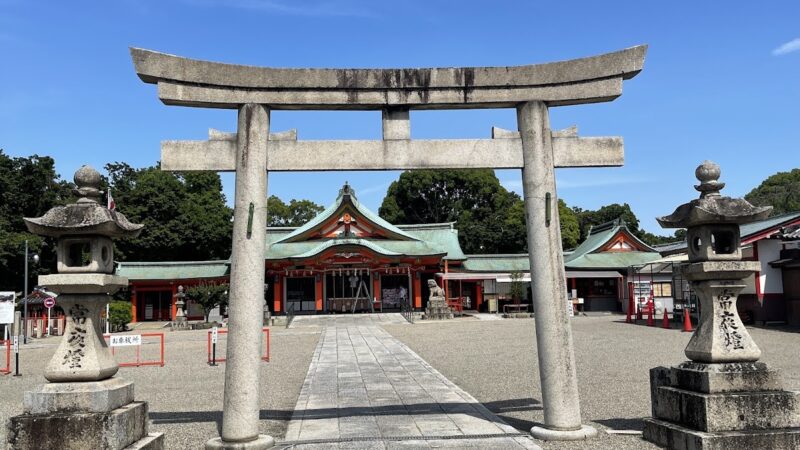
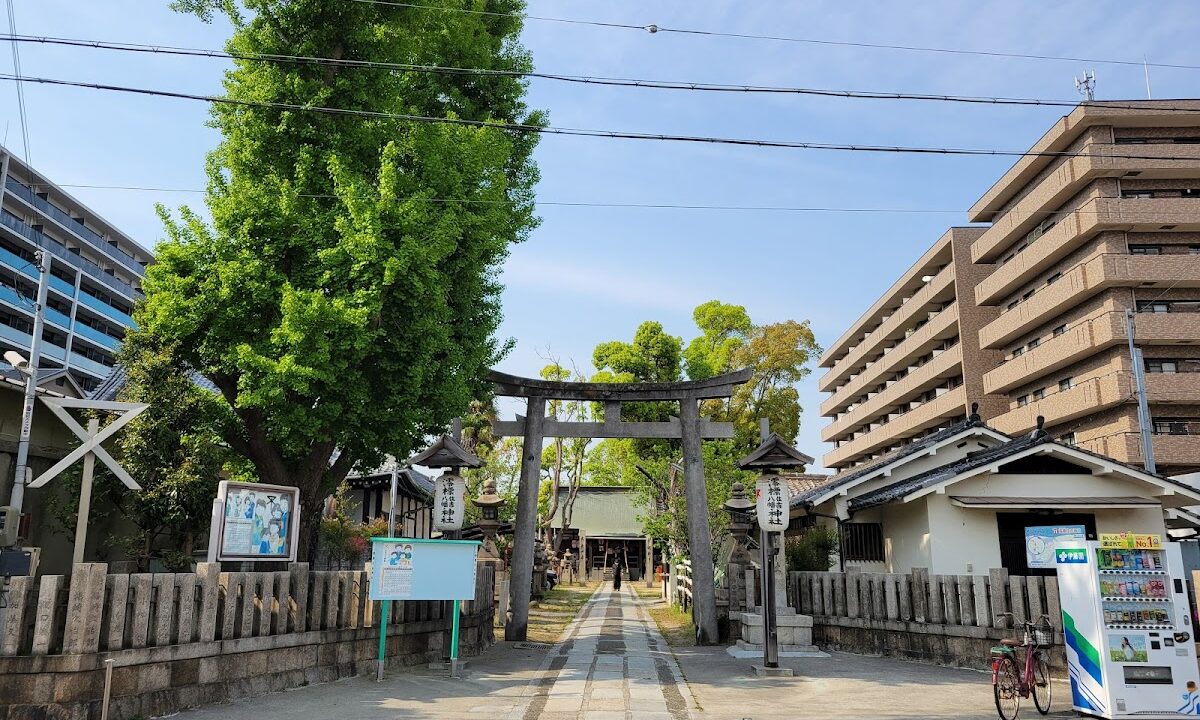
Approximately a 2-minute walk from Denpo Station on the Hanshin Namba Line, a large torii gate stands at the entrance to Mio-tsukushi Sumiyoshi Shrine. The lanterns displayed in front of the torii gate depict the shrine’s crest (three tomoe) and the Osaka City emblem, signifying the shrine’s special significance to Osaka City.
Passing through the torii gate, a quiet and serene approach continues. Away from the hustle and bustle of the city, the shrine grounds, enveloped in a sacred atmosphere, are the perfect space for peaceful worship.
Miotsukushi (Channel Marker)
Within the shrine grounds, a “Mio-tsukushi,” the origin of the shrine’s name, is preserved. A Mio-tsukushi is a stake erected to indicate the depth of a waterway, serving as an important marker for safe navigation.
In ancient Osaka Bay, many Mio-tsukushi were erected, protecting the lives of sailors. These Mio-tsukushi later became a symbol of Osaka and formed the basis for the current Osaka City emblem. The Osaka City emblem is a stylized representation of the Mio-tsukushi, and is said to be modeled after the “mi” character from “Mio-tsukushi.”
By visiting Mio-tsukushi Sumiyoshi Shrine, you can truly appreciate the origin of the Osaka City emblem.
Chikaraishi (Strength Stone)
Within the shrine grounds, there is a huge stone called “Chikaraishi” (Strength Stone). Chikaraishi were stones used by young men boasting of their strength during the Edo and Meiji periods for strength contests.
In Denpo, a thriving port town, there was a lot of heavy lifting involved in loading and unloading cargo, attracting strong people. This strength stone is a valuable cultural artifact that conveys the vibrancy of Denpo and the energy of its people at that time.
Shrines within the Precincts | Dedicating Diverse Gods
Within the grounds of Mio-tsukushi Sumiyoshi Shrine, several subsidiary shrines are located.
Osaka Ebisu Shrine/Hikariishi Shrine
This shrine enshrines Ebisu, the god of business prosperity. Osaka, known as the “kitchen of the nation,” is a commercial center, and Ebisu worship is prevalent in this area.
Enoki Inari Shrine
This shrine enshrines Inari, the god of abundant harvests and business prosperity. Its name is derived from the Enoki tree, and it is a popular local shrine.
Kotohira Shrine
This shrine is believed to enshrine Kotohira, the guardian deity of maritime traffic. It is likely that the deity was invited from Kotohira-gu Shrine in Sanuki Province.
Thirteen Shrines
This shrine enshrines multiple deities and is presumed to be a collection of small shrines worshipped in the region.
Visiting these subsidiary shrines will provide a more fulfilling pilgrimage experience.
Goshuin Information | Receive a Money Luck Ticket (100 Million Yen Bill)
Mioshi Sumiyoshi Shrine offers goshuin (shrine stamps) to visitors. Goshuin are popular among many visitors as proof of their visit and as a memento of their trip.
Special Gift: “Money Luck Ticket”
Mioshi Sumiyoshi Shrine is known for offering a large 100 million yen bill called a “Money Luck Ticket” to those who receive a goshuin. This ticket is popular as a lucky charm for attracting wealth, and many visitors come specifically to obtain it.
It is believed that keeping it in your wallet or displaying it at home will bring good fortune.
Goshuin (Shrine Stamp) Reception Hours
The reception hours for Goshuin are the same as the shrine office’s opening hours. It is recommended to call and confirm before visiting.
Phone Number: 06-6461-0775
Since staff may be absent, it is advisable to contact the shrine in advance if you wish to be sure to receive a Goshuin.
Annual Festivals | Summer and Autumn Festivals
Mioshi Sumiyoshi Shrine holds various festivals throughout the year.
Summer Festival (August 1st)
The Summer Festival is held every year on August 1st. As a summer tradition, local people gather, and the festival is lively with portable shrines and stalls. It has been a long-standing festival to pray for maritime safety and a bountiful catch.
Autumn Festival (November 3rd)
The Autumn Festival is held on Culture Day, November 3rd. It is a festival to give thanks for a bountiful harvest and to pray for the prosperity of the community. Local parishioners play a central role in making the festival a success.
During these festivals, you can enjoy a lively atmosphere unlike the usual.
Access Information | Conveniently located just a 2-minute walk from Dempo Station
Access by Train
Nearest Station: Hanshin Namba Line “Denpo Station”
It’s extremely accessible, just a 2-minute walk (approximately 250m) from Dempo Station.
From Osaka Station/Umeda Station
- Take the JR Osaka Loop Line to Nishikujo Station (approx. 10 minutes)
- Transfer to the Hanshin Namba Line and go to Dempo Station (approx. 3 minutes)
- Approximately 2 minutes on foot from Dempo Station
Total travel time: approx. 20 minutes
From Namba Station
- Take the Hanshin Namba Line to Dempo Station (approx. 10 minutes)
- Approximately 2 minutes on foot from Dempo Station
Total travel time: approx. 15 minutes
Other Nearest Stations
- Approximately 10 minutes on foot (approx. 839m) from Chidoribashi Station on the JR Tozai Line and Hanshin Main Line
Access by Car
Approximately 5 minutes from the Wangan Maishima Interchange on the Hanshin Expressway Route 5 Wangan Line. However, it is recommended to check with the shrine in advance regarding the availability of a dedicated parking lot.
Address and Contact Information
Address: 3-1-6 Denpo, Konohana-ku, Osaka City, Osaka Prefecture 554-0002
Phone: 06-6461-0775
Nearby Tourist Attractions | Combine with Universal Studios Japan
Mio-tsukushi Sumiyoshi Shrine is located approximately 3.5 km northeast of Universal Studios Japan (USJ). It’s recommended to extend your visit slightly when you’re visiting USJ to pay your respects.
Historical Walk in the Denpo Area
The Denpo area is dotted with townscapes and historical sites that retain the atmosphere of the Edo period. You can enjoy a historical walk in conjunction with a visit to Mio-tsukushi Sumiyoshi Shrine.
Nature at the Mouth of the Yodo River
The Yodo River flows near the shrine, allowing you to experience the nature of the river mouth. It’s also charming to stroll along the waterfront, imagining the scenery from which Japanese envoys to Tang China once set sail.
Points and Manners for Visiting a Shrine
Etiquette for Visiting a Shrine
- Bow Before Passing Through the Torii Gate
Bow respectfully before entering the sacred area.
- Purify Yourself at the Water Basin
Purify your left hand, right hand, and mouth in that order.
- Worship at the Main Hall
Worship using the two bows, two claps, and one bow ritual.
- Worship at the Subsidiary Shrines
If time permits, visit the subsidiary shrines as well.
Regarding Photography
Photography is generally permitted on the shrine grounds, but please be considerate of other visitors. Photography inside the shrine buildings may be prohibited.
Maintain a Solemn Atmosphere
The shrine grounds are a quiet and sacred place. Please worship in a calm manner, without speaking loudly or making noise.
The Charm of Miotsukushi Sumiyoshi Shrine | A Place of Prayer Where a Thousand Years of History Breathe Life
Miotsukushi Sumiyoshi Shrine is a shrine that has watched over the sea and people of Osaka for over a thousand years. Beginning with the prayers of the Japanese envoys to Tang China, and later as a place associated with Kukai, and as the guardian deity of Denpo-guchi, it has attracted faith across generations.
The legend of the Miotsukushi, which is the origin of the Osaka City emblem, the vibrancy of the port town as told by the Chikaraishi (power stone), and the tranquil atmosphere of the shrine grounds—all of these tell the story of the rich history and culture of this shrine.
While conveniently located near Universal Studios Japan and just a 2-minute walk from Denpo Station on the Hanshin Namba Line, Miotsukushi Sumiyoshi Shrine offers a quiet space for prayer away from the hustle and bustle of the city.
When sightseeing in Osaka, be sure to visit. The experience of offering your own wishes in the same place where the Japanese envoys to Tang China prayed will surely be a memorable one.
Summary
Mio-tsukushi Sumiyoshi Shrine is a historic shrine founded in 804 AD (Enryaku 23) to pray for the safe voyage of the Japanese envoys to Tang China. As a place associated with Kukai and home to the legend of the Mio-tsukushi (a channel marker that inspired the Osaka city emblem), this shrine has been revered as a guardian deity of maritime traffic for over a thousand years.
Conveniently located about a 2-minute walk from Denpo Station on the Hanshin Namba Line, it’s also popular for offering a lucky charm (a 100 million yen bill) along with its Goshuin (shrine stamp). The shrine grounds contain historical artifacts such as the Mio-tsukushi and Chikaraishi (power stones), and several smaller shrines are also located within the grounds.
As a valuable shrine where you can experience Osaka’s history and culture, we highly recommend visiting.