Kuronuki-dera Temple (Saito City, Miyazaki Prefecture) Complete Guide: The History of an Ancient Temple Associated with Emperor Keiko and the Site of Takaya Palace
Kuronuki-dera Temple, located in Iwazume, Saito City, Miyazaki Prefecture, is a historical temple deeply connected to Japanese mythology. Built on the site of “Takaya Palace,” where Emperor Keiko is said to have stayed for six years during his campaign against the Kumaso people, it remains a Shingon sect Chizan-ha temple and continues to attract local devotion. This article comprehensively introduces information useful for your visit, from the history and highlights of Kuronuki-dera Temple to access methods.
History and Origin of Kuronuki-dera Temple
Legend of Emperor Keiko and Takaya Palace
The land where Kuronuki-dera Temple stands was an important stage in Emperor Keiko’s campaign against the Kumaso people, as recorded in the *Nihon Shoki* (Chronicles of Japan). Emperor Keiko traveled to Hyuga Province (present-day Miyazaki Prefecture) to pacify the Kumaso people of southern Kyushu and established a temporary palace called “Takaya Palace” in this location.
According to tradition, Emperor Keikō stayed in this area for six years, from 71 to 77 AD. The Emperor, along with Yamato Takeru no Mikoto, used this palace as a base for his campaign against the Kumaso people, laying the foundation for his rule over Kyushu. This Takaya Palace was built using the Kuroki-zukuri style (an architectural style using logs without stripping the bark), and it is said that this “Kuroki” (black wood) evolved into the place name “Kurokan.”
Founding and Development as a Temple
Kurokanji Temple, as a Buddhist temple, is said to have been founded in 946 AD by Abbot Ryūgen. It belonged to the Chizan branch of the Shingon sect and developed as a training ground for esoteric Buddhism.
Of particular note is the prosperity of Kurokanji Temple during the medieval period. During the time of the Itō clan, who ruled Hyūga Province from the Kamakura period to the Sengoku period, Kurokanji Temple flourished as “the foremost temple in Hyūga.” The Ito family protected this temple for generations, and it grew into a large temple complex with many buildings. Ikkai, a member of the Ito family, dedicated himself to developing the temple grounds and is known for constructing the “Shinji Pond” (described later).
Changes After the Sengoku Period
In 1577, when the Ito family was defeated in battle against the Shimazu family and driven out of Hyuga Province, Kurokanji Temple also lost its patronage and its former prosperity. However, the temple’s traditions have continued uninterrupted to the present day.
During the Edo period, it came under the control of the Satsuma Domain and survived as a local family temple. Although affected by the anti-Buddhist movement after the Meiji Restoration, it survived thanks to the faith of the local residents and continues to operate as a Shingon Buddhist temple today.
Highlights and Grounds Guide of Kurokanji Temple
Main Hall and Buddhist Statues
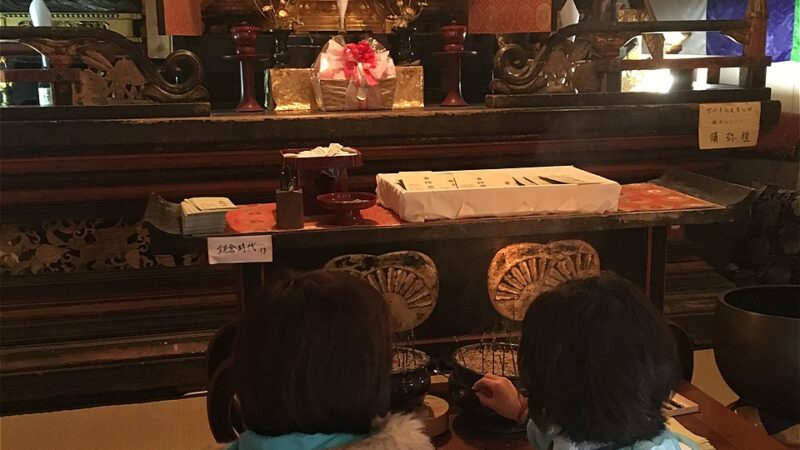
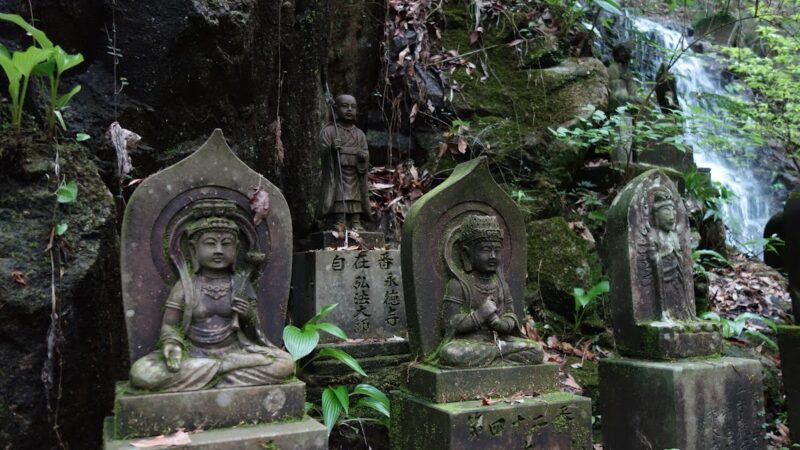
The main hall of Kurokanji Temple is a magnificent building with a solemn atmosphere befitting a Shingon Buddhist temple. The principal image is Fudo Myoo, a revered deity in Esoteric Buddhism. Several other Buddhist statues are also enshrined within the hall, making them valuable cultural artifacts that tell the story of its long history.
While the main hall’s architectural style dates from a modern reconstruction, the overall layout of the temple grounds retains strong traces of ancient tradition. Visitors can quietly offer their prayers in the main hall, feeling the spiritual energy of this place with over a thousand years of history.
Shinji-no-ike Pond
A particularly noteworthy feature within the grounds of Kurokanji Temple is the “Shinji-no-ike Pond.” As its name suggests, this garden pond is shaped like the Chinese character for “heart” (心), representing a traditional style of Japanese gardens.
It is said that the Shinji-no-ike Pond was constructed by Ikkai, a member of the Ito clan. Because the pond’s shape resembles the character for “heart,” it is believed to represent the importance of “heart” in Buddhism, specifically the state of Zen meditation and contemplation.
Stone arrangements surround the pond, allowing visitors to enjoy the changing seasons. Especially during the fresh greenery of spring and the vibrant autumn foliage, the reflections of the trees on the water’s surface are beautiful, soothing the hearts of visitors. This pond can be considered a valuable historical site that conveys the high level of cultural sophistication during the heyday of the Ito clan.
Relationship with Takaya Shrine
Across from Kurokanji Temple lies Takaya Shrine. This shrine is dedicated to Emperor Keiko and, together with Kurokanji Temple, is an important historical site that constitutes the Takaya Palace ruins.
Before the Meiji-era separation of Shinto and Buddhism, Kurokanji Temple and Takaya Shrine functioned as a single religious complex. During the era of syncretism of Shinto and Buddhism, it was not uncommon for temples and shrines to coexist within the same grounds, and it is believed that Kurokanji Temple also played a role as a betto-ji (a temple that managed the shrine).
Even today, the two are adjacent, and visitors can experience the layered history of this area by visiting both the temple and the shrine. From the grounds of Takaya Shrine, you can enjoy a panoramic view of Saito City, a view that makes you understand why Emperor Keiko chose this location.
Natural Environment of the Temple Grounds
The grounds of Kurokanji Temple are surrounded by abundant nature. Ancient trees flourish, creating a tranquil atmosphere where you can find peace of mind. Each season has its own charm, especially in spring when the cherry blossoms bloom, in summer when it is enveloped in deep green, in autumn when the leaves change color beautifully, and in winter when a crisp air permeates the air.
A stroll through the grounds will help you understand why this place has been cherished as a sacred site since ancient times. The quiet environment is suitable for meditation and introspection, making it an ideal place to escape the hustle and bustle of modern life and find inner peace.
Historical Background of the Area Around Kurokanji Temple
Saito City and Ancient Hyuga Province
Saito City, where Kurokanji Temple is located, was one of the centers of the ancient Hyuga Province. Within the city is the Saitobaru Kofun Cluster, one of the largest groups of ancient burial mounds in Japan, indicating that this region was an important political and cultural center from ancient times.
Emperor Keikō likely chose the Saito region as his base for conquering the Kumaso people because it was a strategically important location for governing southern Kyushu. The site of Kurokanji Temple was located at a key point on ancient transportation routes and was militarily important.
The Ito Clan and the Medieval History of Hyūga Province
The prosperity of Kurokanji Temple is deeply intertwined with the Ito clan, who ruled Hyūga Province during the medieval period. The Ito clan entered Hyūga Province as jitō (land stewards) during the Kamakura period and grew into a powerful daimyo (feudal lord) controlling almost the entire province during the Sengoku period.
The Ito clan were devout Buddhists and protected temples within their territory. Kurokanji Temple, in particular, received special treatment, boasting a scale and prestige that earned it the title of “the foremost temple in Hyūga.” It was also close to Tonokori Castle, the Ito clan’s base, and is thought to have served as a family temple for the clan.
When the Ito clan was defeated by the Shimazu clan in the Battle of Kizakihara in 1577, the Ito clan fled to Bungo Province (present-day Oita Prefecture), and Kurokanji Temple also lost its protection. This historical turning point drastically altered the fate of Kurokanji Temple.
Kurokanji Site and Prehistory
Around Kurokanji Temple, there is also a Paleolithic site called the “Kuronaka Site.” Paleolithic stone tools have been unearthed from this site, revealing that humans have inhabited this area for tens of thousands of years.
The traces of human activity, continuing uninterrupted from ancient times to the present, speak to the deep history of the place name Kurokanji. This land has been a place of human life since a time far older than the reign of Emperor Keiko.
Access and Visiting Information for Kurokanji Temple
Basic Information
Location: 2050 Iwazume, Saito City, Miyazaki Prefecture
Sect: Shingon-shu Chizan-ha
Principal Image: Fudo Myoo
Founded: Tenkei 9 (946)
Founder: Reverend Ryugen
Access Methods
Access by Car:
- Approximately 40 minutes from central Miyazaki City via National Route 219
- Approximately 15 minutes from the Saito IC on the Higashi-Kyushu Expressway
- Parking: Free parking available for visitors on the temple grounds
Access by Public Transportation:
- Approximately 1 hour by Miyazaki Kotsu bus from JR Miyazaki Station to Saito Bus Center
- Approximately 10 minutes by taxi from Saito Bus Center
- *Public transportation is limited, so it is recommended to check the timetable in advance.
Notes for Visitors
- While you are free to visit the temple grounds, please inquire with the temple in advance regarding viewing the interior of the main hall.
- Photography is generally permitted, but permission may be required for photographing the interior of the main hall or the Buddha statues.
- Please refrain from loud conversations to maintain a peaceful environment.
- Please be careful of your footing when walking around the Shinji Pond.
Best Time to Visit
Kurokanji Temple is open for visits throughout the year, but the following times are especially recommended:
Spring (March-May): The temple grounds are vibrant during the cherry blossom season. The fresh greenery is also beautiful, and the area around Shinji Pond is enveloped in vivid green.
Autumn (October-November): During the autumn foliage season, the trees on the temple grounds change color, and the reflection of the autumn leaves in Shinji Pond creates a particularly beautiful landscape.
Winter (December-February): This is a time when there are fewer visitors, allowing for a quiet visit. You can feel a deeper spirituality in the crisp, serene atmosphere.
Tourist Attractions Around Kurokanji Temple
Saitobaru Burial Mounds
Located about 20 minutes by car from Kurokanji Temple, the Saitobaru Burial Mounds are one of Japan’s largest groups of ancient burial mounds, designated as a National Special Historic Site. With over 300 burial mounds concentrated in one area, it is an important historical site that tells the story of the prosperity of ancient Hyuga Province. In spring, cherry blossoms and rapeseed flowers bloom, making it known as a “famous spot for cherry blossoms and rapeseed flowers.”
Tono-gun Castle Ruins
The ruins of Tono-gun Castle, the base of the Ito clan, are also worth visiting. It is an important historical site for understanding the history of the Ito clan, who protected Kurokanji Temple, and offers a panoramic view of the Saito Plain.
Saito City Historical and Folk Museum
For learning about the history of Saito City, the Saito City Historical and Folk Museum is recommended. It exhibits artifacts unearthed from the Saitobaru Burial Mounds and materials related to the Ito clan. Visiting before or after your visit to Kurokanji Temple will provide a deeper understanding.
The Path of the Kojiki and Nihon Shoki
Within Saito City, there is a walking course called the “Path of the Kojiki and Nihon Shoki.” This course visits sites associated with myths appearing in the *Kojiki* and *Nihon Shoki*, and Kurokanji Temple is included as part of this course. You can experience the world of mythology while learning about the history of ancient Hyuga Province.
The Cultural Value and Modern Significance of Kurokanji Temple
Value as a Historical Heritage Site
Kurokanji Temple is a valuable historical heritage site where ancient, medieval, and religious history of Japan are layered upon each other. It is a site associated with the *Nihon Shoki*’s account of Emperor Keiko’s conquest of the Kumaso, and is important as a place that shows the intersection of mythology and history.
Furthermore, its history as the “foremost temple in Hyuga” during the Ito clan era tells of its role as a center of Buddhist culture in medieval Hyuga Province. Remains such as the Shinji Pond are valuable evidence that convey the high level of culture at that time.
Core of Regional Identity
Kurokanji Temple is an important element of Saito City’s historical identity. As a symbol of the long and continuous history of this land, dating back to ancient times, it is a source of pride for the local residents.
Kurokanji Temple plays an important role in local festivals and events, serving as a spiritual anchor that supports the unity of the local community.
A Healing Space in the Modern Age
In modern society, historical temples like Kurokanji Temple are invaluable spaces for people seeking spiritual healing. The tranquil grounds, the calm surface of the heart-shaped pond, and the lush greenery of ancient trees provide a place to escape the hustle and bustle of everyday life and find peace of mind, offering solace to many visitors.
As a Shingon Buddhist temple, Kurokanji Temple, which provides a space for meditation and introspection, can be said to play a role in supporting the mental well-being of modern people.
A Recommendation to Visit Kurokanji Temple
Kurokanji Temple is a hidden gem that you should definitely visit when you come to Miyazaki Prefecture. While it lacks the flashiness of famous tourist spots, the temple grounds, where over a thousand years of history quietly breathe, possess a profound spirituality that cannot be experienced anywhere else.
Spending time quietly by the heart-shaped pond, while feeling the layered history etched into this land from the time of Emperor Keiko to the present day, is sure to leave a deep impression on the hearts of visitors.
Visiting Kurokanji Temple in conjunction with surrounding tourist attractions such as the Saitobaru Burial Mounds allows for a comprehensive understanding of the history of Hyuga Province, from ancient times to the Middle Ages and into the present day. Whether you’re a history buff, someone seeking quiet time, or someone wanting to experience Japanese spiritual culture, Kurokanji Temple is an ideal destination.
Experience the profound history and culture of Miyazaki Prefecture at Kurokanji Temple. Why not touch the heart of Japan that has transcended a thousand years in its tranquil grounds?