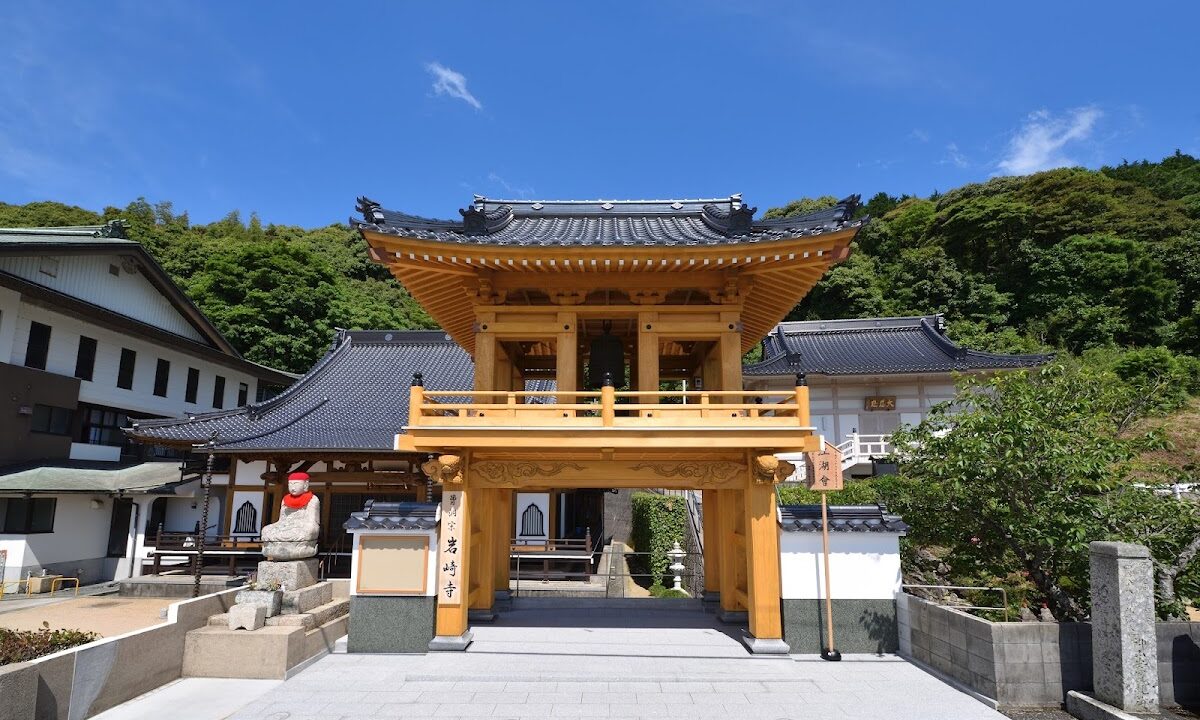
Iwasaki-ji Temple (Sanyo-Onoda City, Yamaguchi Prefecture) Complete Guide | History, Cultural Properties, and Visiting Information
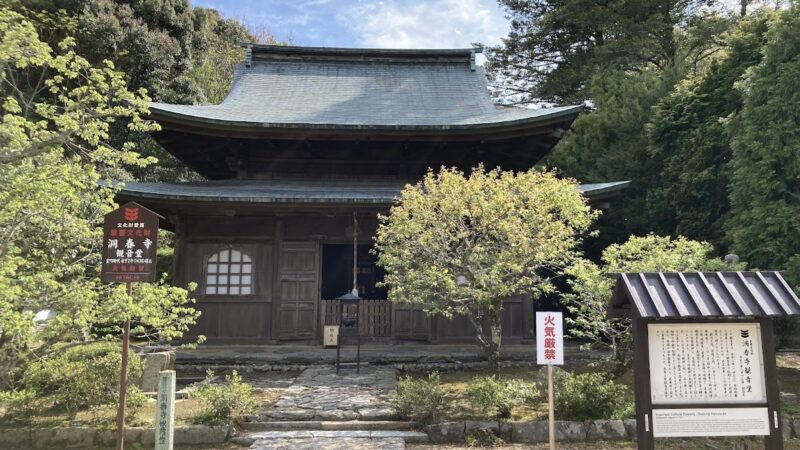
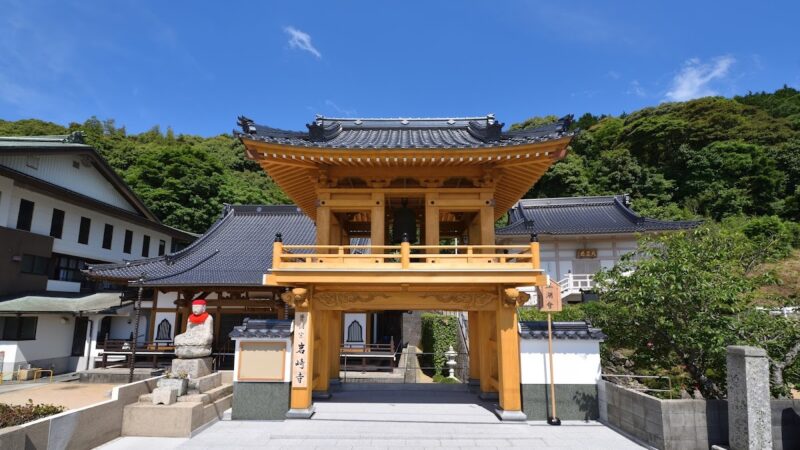
Located in Ariho, Sanyo-Onoda City, Yamaguchi Prefecture, Iwasaki-ji Temple is a historic Soto Zen Buddhist temple founded in 806 during the early Heian period. It houses a valuable collection of Buddhist statues designated as prefectural cultural properties and has served as a center of local faith and a spiritual haven for over 1200 years. This article comprehensively introduces information you should know before visiting Iwasaki-ji Temple, including its history, cultural properties, visiting information, and transportation access.
Basic Information about Iwasaki-ji Temple
Location and Access
Location: 2289 Ariho, Sanyo-Onoda City, Yamaguchi Prefecture (Ariho-Kakuseki area)
Iwasaki-ji Temple is located slightly northeast of the center of Sanyo-Onoda City, in an area of quiet residential streets and rural landscapes. While there are several nearby train stations, none are within walking distance, so access by car is recommended.
Nearest Stations:
- JR Sanyo Main Line “Onoda” Station (approx. 1.5km)
- JR Sanyo Main Line “Ube” Station
- JR Ube Line “Ube” Station
It takes about 5 minutes by taxi from Onoda Station. If using public transportation, we recommend taking a bus or taxi from the station.
Sect and Temple Status
Sect: Soto Zen
The Soto Zen sect is a branch of Zen Buddhism and the largest Zen religious organization in Japan, founded by Zen Master Dogen. It emphasizes the practice of “Shikantaza” (just sitting), and its teachings are characterized by viewing daily life itself as a form of spiritual practice. Iwasaki-ji Temple also functions as a spiritual pillar for local residents, based on the teachings of the Soto Zen sect.
While there are several Soto Zen temples in Sanyo-Onoda City, Iwasaki-ji Temple has a particularly long history and holds an important position in terms of cultural heritage.
History of Iwasaki-ji Temple
Founding History
Iwasaki-ji Temple is said to have been founded in 806 (Daido 1) during the early Heian period. This period was a crucial turning point in the history of Japanese Buddhism, coinciding with the time when eminent monks such as Saicho and Kukai brought new forms of Buddhism back from Tang China and established the Tendai and Shingon sects.
While detailed records from the time of its founding are not available, it can be inferred that the temple served as a center of Buddhist faith in the region, attracting the devotion of local residents from an early stage. The existence of Buddhist statues created from the Heian to Kamakura periods suggests that the temple possessed a considerable scale and a strong foundation of faith even at that time.
Changes in Era and the Present
Iwasaki-ji Temple has experienced numerous changes throughout its long history of over 1200 years. It has overcome various difficulties faced by Japanese temples, including the turmoil of the Sengoku period, the control of temples during the Edo period, and the anti-Buddhist movement after the Meiji Restoration, to reach its present state.
Iwasaki-ji Temple, currently a Soto Zen temple, is maintained primarily by local parishioners. Through regular memorial services and annual events, it continues to play a vital role as a spiritual center of the local community.
Group of Buddhist Statues Designated as Prefectural Cultural Properties
The most distinctive feature of Iwasaki-ji Temple is its collection of precious Buddhist statues, designated as Yamaguchi Prefecture Cultural Properties on April 5, 1983 (Showa 58). These statues were created from the mid-Heian period to the early Kamakura period, demonstrating the high level of Buddhist art at that time.
Wooden Standing Statue of the Thousand-Armed Kannon Bodhisattva
The wooden standing statue of the Thousand-Armed Kannon Bodhisattva, the principal image of Iwasaki-ji Temple, is an important Buddhist statue estimated to be from the mid-Heian period. The Thousand-Armed Kannon is a symbol of compassion, said to “save all sentient beings with a thousand hands and a thousand eyes,” and is a particularly popular deity in Kannon worship.
This statue exhibits the gentle and elegant style characteristic of the Heian period, demonstrating the high level of skill of the Buddhist sculptors of that time. The statue is in excellent condition and is a valuable cultural asset that conveys its original appearance.
Wooden Seated Shakyamuni Buddha Statue
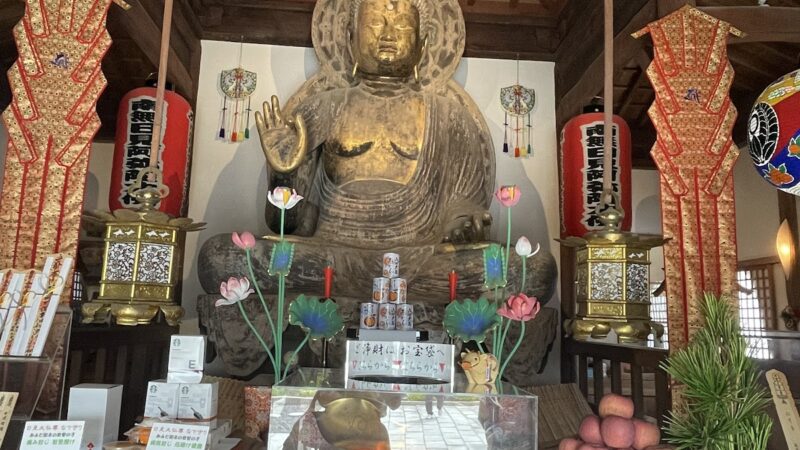
Shakyamuni Buddha is a Buddhist statue representing Gautama Siddhartha (Shakyamuni Buddha), the founder of Buddhism. The wooden seated Shakyamuni Buddha statue owned by Iwasaki-ji Temple is believed to have been created between the Heian and early Kamakura periods, and is depicted in a seated form with the meditation mudra.
Shakyamuni Buddha statues hold an important position as the fundamental Buddha in Buddhist temples, and this statue has been an object of worship for many years. The meticulous finishing of the carving details demonstrates the faith and high level of skill of the Buddhist sculptor of the time.
Wooden Seated Amida Buddha Statue
Amida Buddha, as the principal deity of the Western Pure Land, is the most widely worshipped Buddha in Japanese Buddhism from the Heian period onward. The wooden seated statue of Amida Buddha at Iwasaki-ji Temple is depicted in a seated form with the mudra of meditation, characterized by its serene expression and well-proportioned physique.
From the late Heian period to the early Kamakura period, Pure Land Buddhism spread widely from the aristocracy to the common people. It is believed that this Amida Buddha statue was created and worshipped within this historical context.
Regarding the Public Display of Hidden Buddha Images
Important: The three wooden statues—the standing statue of the Thousand-Armed Kannon Bodhisattva, the seated statue of the Shakyamuni Buddha, and the seated statue of the Amida Buddha—are hidden Buddha images and are only displayed to the public on February 18th each year.
A hidden Buddha image is a Buddhist statue that is usually kept in a shrine and not seen by the general public, and traditionally is only displayed on specific days. At Iwasaki-ji Temple, a special display is held every year on February 18th, allowing visitors to view these precious, prefecturally designated cultural properties up close.
On days when the hidden Buddha statues are publicly displayed, many worshippers and Buddhist art enthusiasts visit from far and wide. This is a rare opportunity to directly view excellent Buddhist statues from the Heian to Kamakura periods, so those interested in Buddhist art are highly encouraged to visit on these dates.
Manners and Etiquette for Worship
Soto Zen Worship Etiquette
Iwasaki-ji Temple is a Soto Zen temple, so it is advisable to worship according to Soto Zen etiquette. The basic flow of worship is as follows:
- Bow at the Temple Gate: When entering the temple, bow before the temple gate before entering the grounds.
- Purification at the Water Basin: If there is a water basin, purify your hands and mouth.
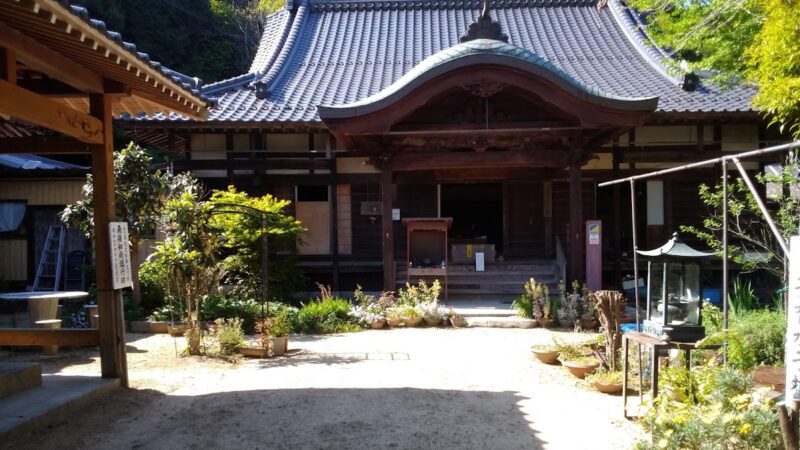
- Worship at the Main Hall: Join your hands in prayer in front of the main hall and pray quietly. Use your prayer beads if you have them.
- Offerings: When making an offering, please quietly place it in the offering box.
- Bow upon Departure: When leaving the temple grounds, please turn back at the main gate and bow.
Precautions on the Day the Hidden Buddha is Publicly Displayed
If you are visiting on February 18th, the day the hidden Buddha is publicly displayed, please note the following:
- No Photography: For cultural property protection reasons, photography of the Buddha statue may be prohibited. Please check in advance or follow the instructions.
- Respectful Respect: Many visitors will be present, so please observe quietly.
- Allow Ample Time: Viewing hours may be limited, so please allow ample time for your visit.
- Donation: When viewing the hidden Buddha, it is customary to offer a donation as a token of gratitude.
Local Information Around Iwasaki-ji Temple
About Sanyo-Onoda City
Sanyo-Onoda City is a city with a population of approximately 60,000 located in the southwestern part of Yamaguchi Prefecture. It was formed in 2005 through the merger of Onoda City and Sanyo Town. Facing the Seto Inland Sea, it is blessed with a mild climate and a rich natural environment.
Industry: Once a thriving industrial city centered on the cement industry, it remains a thriving manufacturing center, primarily in the chemical industry.
Tourism: The city boasts numerous natural spots such as Ryuo-zan Park, Kirara Beach Yakeno, and Eishio Park, as well as historical temples and shrines.
Temples Around Iwasaki-ji Temple
Besides Iwasaki-ji Temple, Sanyo-Onoda City has several other Soto Zen temples and temples of other denominations. Those interested in temple hopping may want to visit the following temples:
- Dogen-ji Temple: A Soto Zen temple that attracts the faith of the local community.
- Other Soto Zen Temples: There are several Soto Zen temples in the city, each with its own unique characteristics.
Nearby Tourist Attractions
Here are some nearby tourist attractions you might want to visit when you come to Iwasaki-ji Temple.
Ryuo-zan Park: A park located on Mt. Ryuo (136 meters above sea level), it has an observation deck offering panoramic views of the Seto Inland Sea. It is also known as a famous cherry blossom viewing spot.
Kirara Beach Yakeno: A beach with beautiful sandy shores, bustling with beachgoers in the summer.
Eshio Park: A nature park where you can enjoy flowers throughout the seasons, especially during the plum and cherry blossom seasons.
Sanyo-Onoda City Historical and Folk Museum: A facility where you can learn about the history and culture of the region, and it may also have exhibits related to the Buddhist statues at Iwasaki-ji Temple.
Iwasaki-ji Temple and Cemetery/Burial Park Information
About Temple Cemeteries
Iwasaki-ji Temple may have an attached temple cemetery. If you wish to use a cemetery as a member of the Soto Zen sect, or if you are interested in perpetual memorial services, please contact the temple directly.
Generally, the characteristics of temple cemeteries are as follows:
Advantages:
- Peace of mind knowing that the temple will manage and perform memorial services indefinitely
- Convenience of being able to hold memorial services and ceremonies at the temple
- An environment where you can remember the deceased in a religious atmosphere
Points to Note:
- Often requires becoming a temple member
- Restrictions on religious denominations
- May have restrictions on the style of gravestones
Cemeteries and Burial Grounds in and around Sanyo-Onoda City
Besides Iwasaki-ji Temple, there are several cemeteries and burial grounds in Sanyo-Onoda City and the surrounding areas. There are also public and private cemeteries that accept all denominations, so if you are looking for a burial ground, we recommend comparing multiple options.
Public Cemeteries: Municipal and town-run cemeteries tend to be open to all denominations and have relatively low usage fees.
Private Cemeteries: These are cemeteries operated by religious or public interest corporations, often offering comprehensive facilities and services.
Temple Cemeteries: These are cemeteries managed by temples like Iwasaki-ji Temple, providing attentive memorial services.
Consultations Regarding Graves
If you wish to consult about purchasing a grave, closing a grave, or perpetual memorial services, you can use the following methods:
- Direct Consultation with a Temple: Contact Iwasaki-ji Temple directly for consultation.
- Stone Masons: Consult a local stone mason and ask them to introduce you to several cemeteries.
- Cemetery Introduction Services: Use online cemetery search websites.
- Local Government Inquiries: Inquire at the city hall regarding public cemeteries.
Buddhist Culture in Yamaguchi Prefecture and Iwasaki-ji Temple
Temple Culture in Yamaguchi Prefecture
Yamaguchi Prefecture is a region where Buddhist culture has flourished since ancient times, and many historical temples exist. Yamaguchi City, in particular, is known as the “Kyoto of the West,” and many temples were built under the patronage of the Ouchi clan during the Muromachi period.
Major Buddhist Sects:
- Soto Zen: Numerous temples within the prefecture, including Iwasaki-ji Temple.
- Rinzai Zen: Another major sect of Zen Buddhism.
- Shingon Buddhism: A branch of Esoteric Buddhism founded by Kobo Daishi Kukai.
- Jodo/Jodo Shinshu: Sects centered on Amida Buddhism.
- Obaku Zen: A branch of Zen Buddhism introduced from China during the Edo period.
Cultural Property Buddhist Statues of Yamaguchi Prefecture
Many valuable Buddhist statues are preserved in Yamaguchi Prefecture, such as the group of prefecturally designated cultural property Buddhist statues at Iwasaki-ji Temple.
National Treasures and Important Cultural Properties:
- Rurikoji Temple Five-Storied Pagoda (National Treasure Building)
- Kozanji Temple Buddha Hall (National Treasure Building)
- Buddhist statues from the Heian and Kamakura periods preserved in various temples (Important Cultural Properties)
Prefectural Designated Cultural Properties:
- Buddhist statues at Iwasakiji Temple
- Buddhist statues and paintings preserved in other temples throughout the prefecture
These cultural properties are valuable legacies that tell the story of Yamaguchi Prefecture’s rich Buddhist culture.
Annual Events and Ceremonies
Unveiling of the Hidden Buddha Statues (February 18th)
As mentioned above, the most important annual event at Iwasakiji Temple is the unveiling of the hidden Buddha statues on February 18th. On this day, three Buddhist statues designated as prefectural cultural properties are publicly displayed, attracting many visitors.
Other Events
As a Soto Zen temple, Iwasakiji Temple may hold the following annual events (please contact the temple directly for details).
- Shushōe: A Buddhist service celebrating the New Year (January)
- Higane: Ancestor memorial service centered around the spring and autumn equinoxes (March and September)
- Hanamatsuri (Kanbutsu-e): A Buddhist service celebrating the birth of Shakyamuni Buddha (April 8th)
- Urabon-e: A Buddhist service to commemorate the spirits of ancestors (August)
- Segakie: A Buddhist service to offer alms to beings in the realm of hungry ghosts
- Kaisanki: A Buddhist service to commemorate the founder of the temple
Practical Guide to Visiting Iwasaki-ji Temple
Detailed Access Information
Access by Car:
- Approximately 15 minutes from Sanyo Expressway “Hanyu IC”
- Approximately 20 minutes from Sanyo Expressway “Ube Minami IC”
- We recommend checking the availability of parking in advance.
Access by Public Transportation:
- Get off at Onoda Station on the JR Sanyo Main Line, then take a taxi for approximately 5 minutes.
- If using the bus, please check the nearest bus stop and schedule in advance.
Estimated Time Required for Visiting
For a normal visit, 30 minutes is usually sufficient. However, if you visit on a day when the hidden Buddha statue is on display, it may take longer depending on the crowd. If you want to view the Buddha statue at your leisure, it’s a good idea to allow about an hour.
Attire and Belongings
Attire:
- No special attire is required, but clean and subdued clothing appropriate for a temple is preferred.
- On special days, such as when the hidden Buddha statue is on display, slightly more formal attire is appropriate.
- Take adequate sun protection in summer and warm clothing in winter.
Belongings:
- Prayer beads (if you have them)
- Offering/donation
- Camera (only in areas where photography is permitted)
- Goshuincho (stamp book) (if you wish to receive a Goshuin stamp)
About Goshuin Stamps
It is recommended to check in advance whether Goshuin stamps are available at Iwasaki-ji Temple. Goshuin stamps are given as proof of worship, so be sure to receive them after worshipping.
When receiving a Goshuin stamp, bring your Goshuincho and offer a donation (usually around 300-500 yen).
Contacting Iwasaki-ji Temple
If you are planning a visit to Iwasaki-ji Temple, or would like to inquire about cemeteries or memorial services, please contact the temple directly. Examples of Inquiries:
- Detailed times for the public viewing of the hidden Buddha statue
- Availability and location of parking
- Consultation regarding cemeteries and perpetual memorial services
- Application for memorial services
- Information on the issuance of Goshuin (temple stamps)
- Whether there is an admission fee
While telephone inquiries are the most reliable, please be mindful of the time of your visit. It is polite to avoid early mornings, evenings, and meal times (around noon), and to contact the temple during quiet hours in the morning or afternoon.
Summary: The Charm of Iwasaki-ji Temple
Iwasaki-ji Temple in Sanyo-Onoda City, Yamaguchi Prefecture, is an ancient Soto Zen temple with a long history, founded in 806. It houses precious Buddhist statues from the Heian to early Kamakura periods, including a wooden standing statue of the Thousand-Armed Kannon Bodhisattva, a wooden seated statue of Shakyamuni Buddha, and a wooden seated statue of Amida Buddha, all designated as prefectural cultural properties. For over 1200 years, it has supported the hearts of people as a center of local faith.
The annual unveiling of the temple’s hidden Buddha statue on February 18th offers a rare opportunity to directly view these precious cultural treasures. For those interested in Buddhist art, those wishing to visit a historical temple, or those seeking a quiet and peaceful place of worship, Iwasaki-ji Temple is well worth a visit.
When visiting Sanyo-Onoda City, be sure to stop by Iwasaki-ji Temple and experience its long history and valuable cultural assets. The time spent praying in its tranquil grounds will be a precious escape from the hustle and bustle of everyday life.