Iigaoka Hachimangu Shrine (Ichihara City, Chiba Prefecture) Complete Guide | The History, Goshuin (Shrine Seals), and Charm of a National Important Cultural Property – A Sole Shrine in the Province
Iigaoka Hachimangu Shrine, located in Yawata, Ichihara City, Chiba Prefecture, is a historic shrine that gave its name to the area “Yawata.” It boasts a main hall designated as a National Important Cultural Property and has held a special position in Kazusa Province as the “Sole Shrine of the Province.” This article comprehensively explains all the information you need to know before visiting Iigaoka Hachimangu Shrine, including its history, cultural properties, goshuin (shrine seals), and access information.
Basic Information on Iigaoka Hachimangu Shrine
Iigaoka Hachimangu Shrine is located in Yawata, Ichihara City, Chiba Prefecture, and is conveniently located about a 2-minute walk from Yawatajuku Station on the JR Uchibo Line. It has been selected as one of the 500 Charms of Boso and one of the 100 Chiba Heritage Sites, and is one of Chiba Prefecture’s representative ancient shrines.
Location: 1057-1 Yawata, Ichihara City, Chiba Prefecture
Phone Number: 0436-41-0023
Main Deities: Hondawake-no-Mikoto, Okinagatarashihime-no-Mikoto, Tamayorihime-no-Mikoto
Shrine Rank: Former Prefectural Shrine
Visiting Hours: Grounds are freely accessible (Shrine office is open from 9:00 to 16:00)
Parking: Available (Free)
Currently also known as “Child-Rearing Hachiman,” it attracts many worshippers as a god of matchmaking and child-rearing.
History and Origins of Iikagaoka Hachimangu Shrine
Origin of Founding and Legend of Yamato Takeru
According to shrine tradition, the origins of Iikagaoka Hachimangu Shrine date back to the 40th year of Emperor Keiko’s reign (110 AD). During his eastern expedition, Yamato Takeru no Mikoto stopped and rested in this area. It is said that he enjoyed the aroma of the sake and rice offered by the local people, and thus the place came to be called “Iigaoka” (meaning “rice-fragrance hill”).
Initially, it was called Rokushō Mikage Shrine, but in 675 AD (Hakuhō 4), it was established as the sole Hachiman shrine of the province, which is considered the origin of the current Iigaoka Hachiman Shrine.
Status as the sole Hachiman shrine of the province
In 759 AD (Tenpyō Hōji 3), Iigaoka Hachiman Shrine was designated as the sole Hachiman shrine of the province, located in the area of nationwide release of animals. “Single shrine of the province” means a special shrine where only one shrine is located in a single province (a province under the Ritsuryō system), and it was revered as the central Hachiman shrine in Kazusa Province.
As an ancient shrine in Kazusa Province that still preserves the Hojo-e (release of captive animals) ceremony of the provincial priest, it holds a historically significant position. It is also said to have served as the principal shrine of Kazusa Province, although records suggest that a separate principal shrine existed at least until the late 14th century.
Deep Faith from Samurai Clan
Iikagaoka Hachimangu Shrine received deep devotion from prominent historical figures such as Minamoto no Yoritomo, Ashikaga Takauji, and Tokugawa Ieyasu. Minamoto no Yoritomo continued to cherish the shrine even after establishing the Kamakura Shogunate, and Ashikaga Takauji is said to have prayed for the peace and stability of the Muromachi Shogunate.
Tokugawa Ieyasu also devoted himself to the restoration of the shrine buildings after the establishment of the Edo Shogunate. Thanks to the support of these samurai clans, Iikagaoka Hachimangu Shrine was able to maintain its buildings and continue its religious ceremonies, developing into a prestigious shrine that continues to this day.
National Important Cultural Property: Main Hall and Shrine Architecture
Only Two National Important Cultural Properties in Chiba Prefecture
The main hall of Iikagaoka Hachimangu Shrine is designated as a National Important Cultural Property. It is rare, as only two shrine buildings in Chiba Prefecture, the main hall of Katori Jingu Shrine and the main hall of Iikagaoka Hachimangu Shrine, hold this designation.
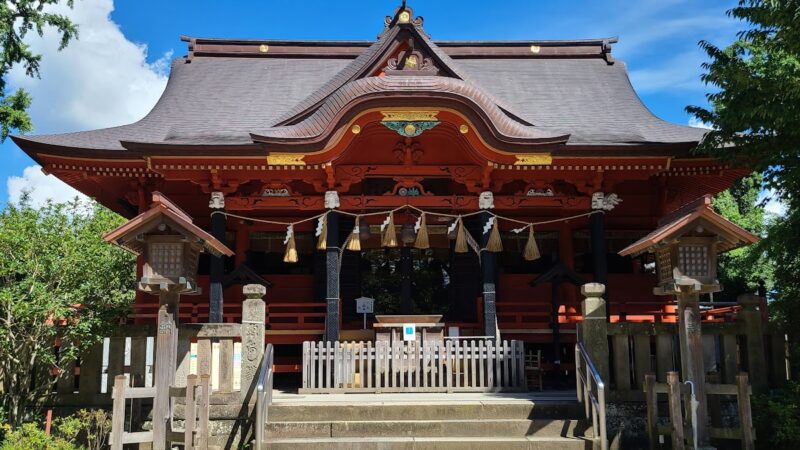
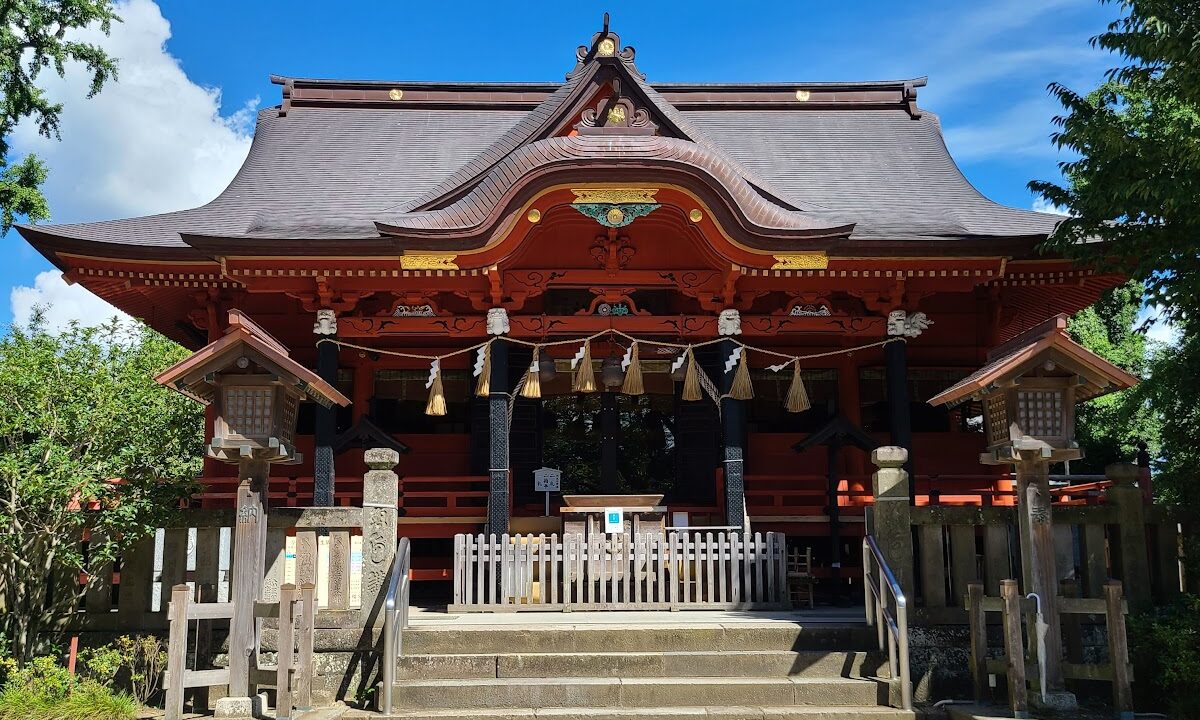
The main hall is characterized by its large, simple, and dignified Japanese-style architecture, displaying a beautiful appearance with its entire structure painted in vermilion. From an architectural style perspective, it is a cultural property that occupies an extremely important position in the history of shrine architecture in Chiba Prefecture.
Gongen-zukuri Shrine Structure
The shrine buildings of Iikagaoka Hachimangu Shrine employ the “Gongen-zukuri” architectural style, where the main hall and the worship hall are connected and integrated by a Heiden (offering hall). Gongen-zukuri is a shrine architectural style that developed during the Edo period and is a highly dignified style that can also be seen at Nikko Toshogu Shrine.
The worship hall measures five bays wide and three bays deep, with a hipped roof covered in copper plates. Like the main shrine, it is entirely painted in vermilion, its vibrant red color standing out beautifully within the shrine grounds.
Worship Hall: A Prefecturally Designated Tangible Cultural Property
While the main shrine is a nationally designated important cultural property, the worship hall is designated as a Chiba Prefecture designated tangible cultural property. Despite having different cultural property designations, the structure, connected by a connecting hall, is historically interesting.
The current worship hall is a valuable structure that preserves Edo period architectural techniques, allowing visitors to simultaneously worship both the important cultural property main shrine and the prefecturally designated cultural property worship hall.
Shrine Grounds Highlights and Cultural Properties
Meoto Icho (Married Couple Ginkgo Trees)
Within the shrine grounds are two large ginkgo trees known as “Meoto Icho” (Married Couple Ginkgo Trees). These trees are said to be several hundred years old and are cherished by visitors as symbols of matchmaking and marital harmony. In autumn, the beautiful golden foliage paints the temple grounds in a dazzling display that captivates many photography enthusiasts and worshippers.
Many worshippers pray for good relationships and marital harmony in front of the “Married Couple Ginkgo Trees,” which is one of the reasons why Iikagaoka Hachimangu Shrine is revered as a “Hachiman Shrine for Child-Rearing.”
Fountain Pond and Carp
Within the temple grounds is a pond with a fountain, where visitors can admire the graceful swimming of carp. This pond serves as a place of tranquility, a space where one can escape the hustle and bustle of the city and enjoy a peaceful time.
The area around the pond is surrounded by well-maintained trees, allowing visitors to stroll through the grounds while experiencing the changing seasons. The scenery is particularly beautiful in the spring with its fresh green leaves and in the autumn with its vibrant foliage.
Traces of the Former Coastline
The location where Iikagaoka Hachimangu Shrine stands is believed to have once been a coastline. Although land reclamation has receded the coastline, making it difficult to discern its former appearance, this site testifies to its historical importance as a transportation hub since ancient times.
The fact that it was located in Ichihara, the site of the provincial capital of Kazusa Province, and situated in a strategically important location facing the sea, is considered one of the factors that supported its status as the only shrine of its kind in the province.
Goshuin (Shrine Seal) and Gifts
Goshuin Information
At Iikagaoka Hachimangu Shrine, goshuin are given as a memento of your visit. Goshuin are available at the shrine office, and in addition to the regular goshuin, seasonal limited-edition goshuin are sometimes offered.
The goshuin features the calligraphy and red seal of “Iikagaoka Hachimangu,” a design that reflects the prestige befitting a historically significant shrine. Goshuin notebooks are also available, and the original designs of Iikagaoka Hachimangu Shrine are popular as souvenirs of your visit.
Goshuin (temple/shrine stamp) reception hours: 9:00 AM to around 4:00 PM (subject to change due to events, etc.)
Offering fee: 300-500 yen (Goshuin notebook sold separately)
Items and Amulets
Iikagaoka Hachimangu Shrine offers various amulets and items, primarily focused on child-rearing, safe childbirth, and matchmaking. As befits a shrine worshipped as “Child-rearing Hachiman,” amulets for safe childbirth, child-rearing, and academic success are popular.
In addition, amulets for matchmaking related to the “Married Couple Ginkgo” tree, as well as amulets for traffic safety and protection from evil, are available to meet various wishes. Ema (votive tablets) are also available, and you can dedicate an ema with your wish written on it at the ema rack on the shrine grounds.
Main Festivals and Annual Events
Annual Grand Festival (around September 15th)
The most important festival at Iikagaoka Hachimangu Shrine is the Annual Grand Festival. Held annually around September 15th, the festival features a grand procession of portable shrines and various dedication ceremonies. The entire community participates, and the shrine grounds are bustling with many worshippers.
The annual festival includes solemn traditional Shinto rituals, making it an important event that conveys the status of a shrine unique to the province.
Hojo-e (Release of Living Things)
Since the establishment of the Hojo-e ceremony by the provincial priest in 759 AD, the traditional Hojo-e ceremony has been passed down at Iikagaoka Hachimangu Shrine. While Hojo-e is a Buddhist ritual involving the release of living creatures to accumulate merit, it has also been practiced at shrines since the era of syncretism of Shinto and Buddhism.
The tradition of Hojo-e continues to be upheld today, making it an event that reflects the weight of history as an ancient shrine of Kazusa Province.
Other Annual Events
- Hatsumode (January 1st-3rd): The shrine is bustling with New Year’s visitors praying for a safe year and the safety of their families.
- Setsubun Festival (around February 3rd): Events such as bean-throwing are held.
- Shichi-Go-San Festival (November): Many families visit the shrine as a place for praying for children’s well-being.
- Monthly Festival: A regular Shinto ritual held on the 15th of each month.
Access and Parking Information
Access by Train
Iikagaoka Hachimangu Shrine is conveniently located about a 2-minute walk from Yawatajuku Station on the JR Uchibo Line.
Nearest Station: JR Uchibo Line, Yawatajuku Station
Travel Time from Station: Approximately 2 minutes on foot from the West Exit
Travel Time from Tokyo Station: Approximately 1 hour 30 minutes via JR Sobu Line Rapid and Uchibo Line
Due to its proximity to the station, access by train is very convenient, attracting many visitors from both within and outside Chiba Prefecture.
Access by Car and Parking
For those visiting by car, ample parking is available.
Tateyama Expressway: Approximately 15 minutes from Ichihara IC
Parking: Free parking available on the temple grounds (limited spaces)
Address: 1057-1 Yawata, Ichihara City, Chiba Prefecture (for car navigation settings)
During peak seasons such as New Year’s Day and the annual festival, the parking lot may be full, so we recommend considering using public transportation.
Manners and Points for Visiting a Shrine
Proper Etiquette for Visiting a Shrine
When visiting Iikagaoka Hachimangu Shrine, please observe the following basic etiquette:
- Bow before passing through the torii gate: This is a sign of respect before entering the sacred area.
- Purify yourself at the water basin: Purify your left hand, then your right hand, then your mouth, and finally wash the handle of the ladle.
- Avoid the center of the path: The center is considered the path of the gods.
- Worship in front of the main hall: Follow the ritual of two bows, two claps, and one bow.
- Bow upon leaving: Turn around and bow before leaving the torii gate.
Regarding Photography
Photography is generally permitted on the shrine grounds, but please note the following points.
- Please refrain from taking photos in restricted areas such as the interior of the main shrine.
- Please be considerate of other worshippers.
- Please refrain from taking photos during Shinto rituals, or obtain permission.
- When posting on social media, please be considerate of other worshippers.
The main shrine, a National Important Cultural Property, and the worship hall, a Prefectural Designated Cultural Property, are particularly popular spots for taking photos of their exteriors.
Nearby Tourist Attractions
Attractions in Ichihara City
When visiting Iikagaoka Hachimangu Shrine, it is recommended to also visit other tourist attractions in Ichihara City.
Kazusa Kokubunji Temple Ruins: A historical site commemorating the center of ancient Kazusa Province
Ichihara Historical Museum: A facility where you can learn about the history and culture of Kazusa Province
Yoro Valley: A valley rich in nature and a famous spot for autumn foliage (approximately 40 minutes by car)
Other Hachimangu Shrines in Chiba Prefecture
There are many other historically significant Hachimangu shrines scattered throughout Chiba Prefecture.
Chiba Shrine: An ancient shrine located in the heart of Chiba City.
Katori Shrine: The Ichinomiya (first-ranked shrine) of Shimosa Province, also possessing a main hall designated as a National Important Cultural Property.
Awa Shrine: An ancient shrine known as the Ichinomiya of Awa Province.
Benefits and Faith of Iikagaoka Hachimangu Shrine
As a God of Child-Rearing and Safe Childbirth
Currently, Iikagaoka Hachimangu Shrine is widely known as “Child-Rearing Hachiman,” and many families visit to pray for safe childbirth, first shrine visits for newborns, and Shichi-Go-San (7-5-3) celebrations, among other things related to the growth of children. The foundation of this faith lies in the fact that one of the main deities, Empress Jingu (Okinagatarashihime-no-Mikoto), is revered as a god of safe childbirth and child-rearing.
Matchmaking and Marital Harmony
As symbolized by the pair of ginkgo trees on the shrine grounds, it is also known for its benefits in matchmaking and marital harmony. Many people seeking good relationships and couples wishing to deepen their marital bond visit the shrine.
Long-lasting Military Fortune and Protection from Evil
With a history of being revered by warlords such as Minamoto no Yoritomo, Ashikaga Takauji, and Tokugawa Ieyasu, it is believed to offer blessings for long-lasting military fortune, victory, and protection from evil. Many people visit the shrine at important turning points in their lives or when embarking on new challenges.
Summary: The Charm of Iikagaoka Hachimangu Shrine
Iikagaoka Hachimangu Shrine is a representative ancient shrine of Chiba Prefecture with a history of over 1300 years. It is a shrine with multifaceted charm, possessing a main hall designated as a National Important Cultural Property, the prestige of being the only Hachimangu shrine in the province, the deep faith of samurai families, and the current approachable nature of a “child-rearing Hachiman.”
Its excellent accessibility, just a 2-minute walk from JR Yawatajuku Station, attracts many visitors from both within and outside Chiba Prefecture. It is also a rare opportunity to view the shrine’s architecture, a National Important Cultural Property, up close, making it a must-see spot for history buffs and architecture fans.
The shrine grounds offer a calming natural environment, including a pair of ginkgo trees and a pond with a fountain, allowing visitors to escape the hustle and bustle of the city and enjoy a peaceful time. For those collecting Goshuin (shrine stamps), the historically significant stamp from this one-of-a-kind shrine will hold special value.
When visiting Ichihara City in Chiba Prefecture, be sure to visit Iikagaoka Hachimangu Shrine and experience its long history, dignified shrine buildings, and warm, welcoming atmosphere of faith.