Hirakawa Tenmangu Shrine (Chiyoda Ward, Tokyo) Complete Guide | History, Goshuin (Shrine Seals), Access, and Benefits Explained in Detail
Hirakawa Tenmangu Shrine, located in Hirakawa-cho, Chiyoda Ward, Tokyo, is a historic shrine dedicated to Sugawara no Michizane, known as the god of learning. Despite its prime location in the heart of Tokyo, just a one-minute walk from Hanzomon Station west of the Imperial Palace, it maintains a tranquil atmosphere, making it popular with many visitors, including students and those preparing for exams.
This article provides a detailed explanation of everything you need to know before visiting Hirakawa Tenmangu Shrine, including its history, goshuin information, access methods, benefits, highlights within the grounds, and annual events.
History of Hirakawa Tenmangu Shrine
Founded by Ota Dokan
The founding of Hirakawa Tenmangu Shrine dates back to the Muromachi period, specifically Bunmei 10 (1478). The story begins when Ota Dokan, a samurai known for building Edo Castle, had a divine dream one night in which he saw Sugawara no Michizane. Following the dream’s message, Dokan erected a Tenmangu shrine on Umebayashi-zaka, north of Edo Castle, within the castle grounds.
Initially, it is believed that the deity was invited from Miyoshino Tenjin (Miyoshino Shrine) in Kawagoe, and it was enshrined within the castle as the guardian deity of Edo Castle and as the god of learning. This founding story is a particularly important part of the history of Hirakawa Tenmangu Shrine.
Changes in the Edo Period
With the arrival of the Edo period, the history of Hirakawa Tenmangu Shrine underwent a major turning point. When Tokugawa Ieyasu entered Edo Castle and expansion work was carried out in 1607 (Keicho 12), the Tenmangu shrine was relocated outside the castle.
At this time, it was moved to its current location in Hirakawa-cho, Chiyoda-ku, and has since been worshipped as “Hirakawa Tenmangu” in this area. The name Hirakawa-cho originates from the Hirakawa River (the upper reaches of the current Nihonbashi River) that once flowed through this area, and the shrine’s name was also derived from this place name.
Throughout the Edo period, Hirakawa Tenmangu Shrine served as a place of prayer for the Tokugawa shogunate and was also deeply revered by the common people of Edo who prayed for academic success and family safety. Especially during the late Edo period, when terakoya (private schools) became widespread, records indicate that it attracted many worshippers as a deity of learning.
Development after the Meiji Restoration
Even after the Meiji Restoration, Hirakawa Tenmangu Shrine continued to exist as an important Tenmangu shrine in Tokyo. Having survived the Great Kanto Earthquake and the ravages of World War II, it remains a beloved local shrine in Chiyoda Ward to this day.
After the post-war reconstruction period, the current shrine building was rebuilt in the Showa era. Even amidst the ongoing redevelopment of the city center, Hirakawa Tenmangu Shrine, as a historical shrine, maintains its green grounds and continues to provide tranquility to worshippers as an urban oasis.
Basic Information about Hirakawa Tenmangu Shrine
Deities and Benefits
Deities
- Sugawara no Michizane
Sugawara no Michizane was a scholar and politician of the Heian period, known for his outstanding learning and sincere character. After his death, he was deified as Tenjin-sama and is enshrined as the god of learning at Tenmangu shrines throughout Japan.
Main Benefits
- Academic success and passing exams
- Protection from evil and good fortune
- Family safety
- Business prosperity
- Traffic safety
Especially during exam season, students preparing for university entrance exams, high school entrance exams, and qualification exams visit to pray for success. Many also visit to pray at important life milestones such as starting school or a new job.
Location and Contact Information
Address
1-7-5 Hirakawa-cho, Chiyoda-ku, Tokyo 102-0093
Phone Number
03-3261-0481
Visiting Hours
The shrine grounds are generally open for free worship. The shrine office is usually open from 9:00 AM to around 5:00 PM.
Parking
Available (limited spaces). However, due to its central Tokyo location, the use of public transportation is recommended.
Access Methods
Access by Train
Hirakawa Tenmangu Shrine is conveniently located in central Tokyo and is accessible from multiple train lines.
Nearest Stations
- Tokyo Metro Hanzomon Line “Hanzomon Station”
- Approximately 1 minute walk from Exit 1 (closest)
- After exiting, turn left and you will immediately see the torii gate.
- Tokyo Metro Yurakucho Line “Kojimachi Station”
- Approximately 3 minute walk
- From Exit 1, head towards Shinjuku-dori.
- Tokyo Metro Namboku Line/Marunouchi Line “Nagatacho Station”
- Approximately 5 minute walk
- Exit 9a is convenient.
Access by Car
Route from Major Roads
- Approximately 5 minutes from the Shuto Expressway Inner Circular Route “Kasumigaseki IC”
- Convenient access from Shinjuku-dori and Uchibori-dori.
However, on weekdays, traffic in the surrounding office district is heavy and parking is limited, so using public transportation is recommended.
Landmarks in the Area
Hirakawa Tenmangu Shrine is located west of the Imperial Palace, and important facilities such as the National Diet Building, the Supreme Court, and the British Embassy are located nearby. Located in a quiet residential and office district of Hirakawa-cho, the shrine is easily recognizable by its lush green grounds.
Goshuin (Shrine Seals) and Goshuincho (Shrine Seal Books)
About Goshuin
At Hirakawa Tenmangu Shrine, you can receive a goshuin as proof of your visit. It is available at the shrine office, and the offering fee is usually around 300 to 500 yen.
Features of the Goshuin
- Ink calligraphy of “Hirakawa Tenmangu” in the center
- Shrine seal (red seal)
- Date of visit
Limited Edition Goshuin
Hirakawa Tenmangu Shrine sometimes offers limited edition goshuin to coincide with seasonal events and special occasions.
- Limited-edition Goshuin (temple/shrine stamp) available on the 25th of each month
- Limited-edition Goshuin for Hatsutenjin (January 25th)
- Limited-edition Goshuin for Baika Matsuri (February 25th)
- Limited-edition Goshuin for Reisai (September 25th)
- Limited-edition Goshuin for the first three days of the New Year
- Limited-edition Goshuin for Setsubun (Bean-Throwing Festival)
These limited-edition Goshuin may be pre-printed and feature special designs different from the regular ones. They are very popular and may sell out quickly, so early visits are recommended if you want to be sure to get one.
Goshuincho (Stamp Book)
Hirakawa Tenmangu Shrine also offers original Goshuincho. They feature designs related to plum blossoms and Tenjin-sama, and the offering fee is approximately 1,500 to 2,000 yen.
There are several designs of Goshuincho, and new designs may appear seasonally. Please check with the shrine office.
Highlights of the Shrine Grounds
Shrine Building
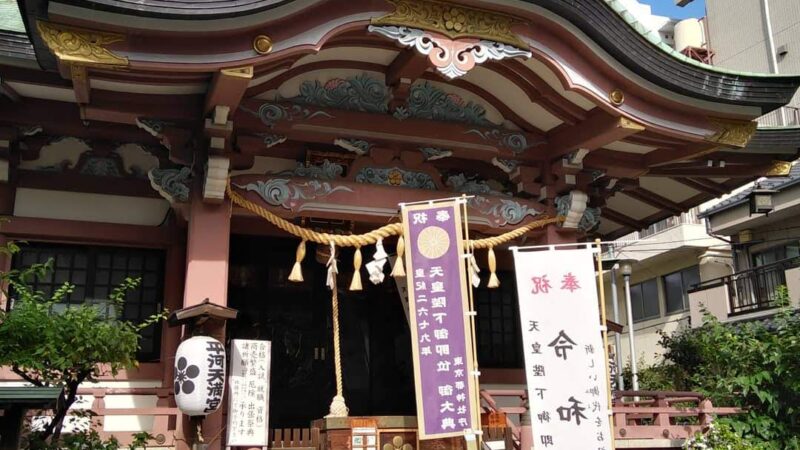
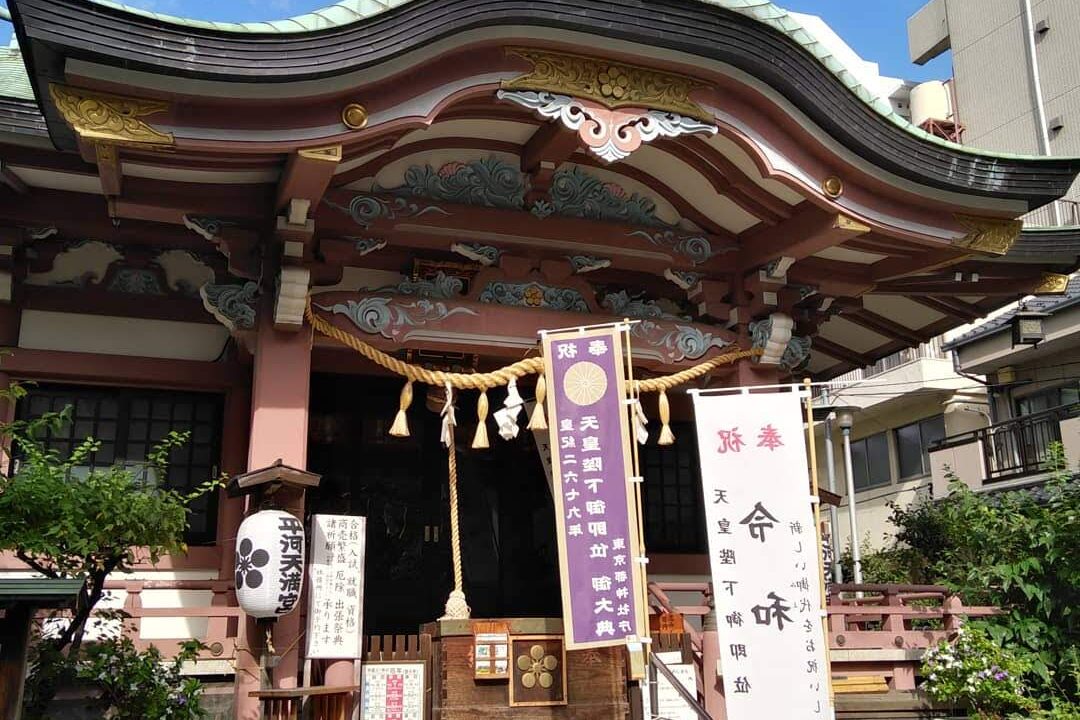
The shrine building of Hirakawa Tenmangu Shrine is a wooden structure rebuilt in the Showa era. It follows the traditional style of shrine architecture, creating a solemn atmosphere despite its central urban location.
In front of the main hall is a magnificent offering box, above which is the plum blossom emblem, a symbol of Tenmangu shrines. The area surrounding the shrine is adorned with seasonal flowers, and the grounds are particularly vibrant during the plum blossom season.
Nade-ushi (Reclining Ox Statue)
An essential feature of Tenmangu shrines is the “Nade-ushi” (reclining ox statue). Hirakawa Tenmangu Shrine also houses a Nade-ushi associated with Sugawara no Michizane.
There is a belief that stroking the same part of the statue as the part of one’s own body that is ailing will bring healing. Students, in particular, stroke the statue’s head to pray for academic success. Having been stroked by countless visitors over the years, its surface is polished smooth.
Komainu (Guardian Lion-Dogs)
A pair of komainu stand guard within the shrine grounds. The komainu at Hirakawa Tenmangu Shrine were donated between the Edo and Meiji periods, possessing a dignified style that reflects their history.
Pay attention to the expressions and postures of the komainu. One has its mouth open (A-form), while the other has its mouth closed (Un-form), representing the “A-Un” (open and closed mouth) harmony.
Plum Tree
Sugawara no Michizane was known to love plum blossoms, and it is a tradition to plant plum trees at Tenmangu shrines. Hirakawa Tenmangu Shrine also has plum trees on its grounds, which bloom beautifully from February to March.
This scene evokes Michizane’s famous poem: “When the east wind blows, send forth your fragrance, plum blossoms; do not forget spring, even though your master is gone.”
Water Basin
A water basin for purifying oneself before worship is also provided. Please purify your hands and mouth according to the correct etiquette before worshipping. Procedure for Washing Hands
- Hold the ladle in your right hand and wash your left hand.
- Switch the ladle to your left hand and wash your right hand.
- Switch the ladle back to your right hand, receive water in your left hand, and rinse your mouth.
- Wash your left hand once more.
- Stand the ladle upright, wash the handle, and return it to its original position.
Reception Area (Shrine Office)
There is a reception area where you can receive Goshuin (shrine stamps), amulets, ema (votive tablets), etc. Amulets for academic success are particularly popular, and many worshippers seek them during exam season.
Main Items Offered
- Academic Success Amulet
- Passing Exam Amulet
- Protection from Evil Spirits Amulet
- Traffic Safety Amulet
- Family Safety Amulet
- Ema (votive tablets, for passing exams, etc.)
- Talisman
- Fortune Slip
Annual Events and Festivals
Annual Festival (September 25th)
The most important festival at Hirakawa Tenmangu Shrine is the annual festival held on September 25th every year. A solemn Shinto ritual is performed to commemorate and express gratitude to Sugawara no Michizane.
Hatsutenjin (January 25th)
Hatsutenjin, the first festival of the new year, is bustling with many worshippers. Students and those taking exams visit to pray for success in their studies and academic achievements throughout the year.
Plum Blossom Festival (February 25th)
The Plum Blossom Festival is held on February 25th, the anniversary of the death of Sugawara no Michizane. Plum blossoms are offered to the gods, commemorating the virtues of Sugawara no Michizane. The plum blossoms in the temple grounds are often in full bloom around this time, making it an event that evokes the feeling of spring’s arrival.
Monthly Festival on the 25th
In honor of Sugawara no Michizane’s birthday (June 25th) and death anniversary (February 25th), the 25th of each month is considered a festival day for Tenjin-sama. At Hirakawa Tenmangu Shrine, the 25th of each month is a special day, and limited edition goshuin (temple/shrine stamps) are sometimes offered.
New Year’s Visit (January 1st-3rd)
Many worshippers visit the shrine for their first shrine visit of the new year. They pray for safety in the new year, academic success, and family safety. Special goshuin and offerings may be available during the first three days of the new year.
Setsubun Festival (around February 3rd)
During Setsubun, events such as bean-throwing are sometimes held. The shrine is bustling with worshippers praying for protection from evil and good fortune.
Manners and Points for Visiting a Shrine
Basic Worship Etiquette
By following the correct worship etiquette at a shrine, you can offer a more heartfelt prayer.
Worship Procedure
- Bow before passing through the torii gate
- Cleanse your hands and mouth at the water basin
- Walk away from the center of the path (the center is the path of the gods)
- Place your offering in front of the main hall
- Bow twice, clap twice, and bow once
- Silently recite your wish
- After praying, turn around and bow before leaving the torii gate
Photography
Photography is generally permitted on the shrine grounds, but please note the following:
- Be considerate of other worshippers
- Photography inside the shrine building or of the deity is prohibited
- Avoid using tripods during crowded times
- Use flash sparingly
Recommended Visiting Time
Hirakawa Tenmangu Shrine is located in the city center, so the atmosphere varies depending on the time of day.
- Early Morning: A quiet and peaceful place for worship.
- Weekday Mornings: Relatively uncrowded.
- Weekends and Holidays: Bustling with worshippers seeking Goshuin (temple/shrine stamps).
- Evening: Visitors come after work.
The shrine can get crowded during exam season (January-March) and on the 25th of each month (the temple’s festival day).
Nearby Tourist Attractions
Imperial Palace and East Garden
The Imperial Palace, within walking distance of Hirakawa Tenmangu Shrine, is one of Tokyo’s most representative tourist attractions. The East Garden is open to the public, allowing visitors to see the beautiful Japanese garden and remnants of Edo Castle.
National Diet Building
The National Diet Building, about a 10-minute walk away, is the center of Japanese politics. Guided tours are available (reservations required), allowing visitors to learn about Japanese democracy.
Supreme Court
The Supreme Court, also located near Hirakawa Tenmangu Shrine, is an impressive architectural structure. Many students aspiring to enter the legal profession visit it along with Hirakawa Tenmangu Shrine.
Chidorigafuchi
Chidorigafuchi, known as a famous cherry blossom viewing spot, is about a 15-minute walk away. In spring, you can enjoy the magnificent rows of cherry trees.
Hie Shrine
Hie Shrine, also about a 15-minute walk away, is an important shrine in Chiyoda Ward. Many people visit it along with Hirakawa Tenmangu Shrine.
Prayers and Rituals at Hirakawa Tenmangu Shrine
Prayer for Success in Exams and Academic Achievement
At Hirakawa Tenmangu Shrine, you can receive formal prayers and blessings individually or in groups. During exam season, many students visit to receive prayers for success in their exams.
How to Apply for Prayer
- Apply at the shrine office (reservations recommended)
- Offering Fee: 5,000 yen and up (varies depending on the prayer)
- Duration: Approximately 20-30 minutes
After the prayer, you will receive amulets and talismans.
Shichi-Go-San (7-5-3 Festival)
In November, many people visit the shrine for Shichi-Go-San. This traditional event, where people pray for the healthy growth of their children, attracts many families.
Exorcism/Protection from Misfortune
We also accept prayers for protection from misfortune for those entering their unlucky years. Many people receive this service during the New Year and Setsubun (bean-throwing festival).
Cultural Assets
Hirakawa Tenmangu Shrine possesses cultural assets and historically significant items that have been passed down through its long history.
Ancient Documents and Records
Records and documents from the Edo period are preserved, serving as valuable resources that convey the history of Hirakawa Tenmangu Shrine and the culture of Edo.
Votive Items
Votive ema (wooden plaques) and votive tablets donated by successive generations of worshippers are preserved. Some were donated by scholars and literary figures of the Edo period, offering insights into the religious practices of that time.
The Charms and Characteristics of Hirakawa Tenmangu Shrine
A Tranquil Space in the Heart of the City
Despite its prime location in the heart of Tokyo, close to the Imperial Palace, the shrine grounds maintain a quiet and peaceful atmosphere. A lush green space unfolds amidst the surrounding buildings, offering a tranquil oasis for visitors.
Excellent Access
Located just a one-minute walk from Hanzomon Station, it boasts one of the best accessibility features among shrines in Tokyo. Its ease of access, allowing visitors to easily stop by on their way home from work or while shopping, is a major draw.
A Holy Site for Students Taking Exams
As a Tenmangu shrine dedicated to the god of learning, it attracts many students during exam season. It’s a popular spot for students aiming for prestigious universities such as the University of Tokyo, Waseda University, and Keio University to pray for success.
A Popular Spot for Collecting Goshuin (Shrine Stamps)
The shrine offers a wide variety of goshuin, including seasonal limited editions and those available only on the 25th of each month (the temple’s festival day), making it a popular destination for collecting goshuin. This shrine is attracting attention among those who enjoy collecting Goshuin (temple/shrine stamps).
Historical Romance
With a history full of historical romance, including its founding by Ota Dokan, its connection to Edo Castle, and its history as a place of prayer for the Tokugawa shogunate, it is a fascinating spot for history buffs.
Visitor Voices and Reviews
The following are comments from visitors who have come to Hirakawa Tenmangu Shrine:
- “It’s right near Hanzomon Station, so you can easily visit on your way home from work.”
- “The quiet atmosphere is unlike anything you’d expect in the city center, and it’s very calming.”
- “I visited before my exams and passed them successfully.”
- “The limited-edition goshuin (temple stamp) is wonderful, and I visit every 25th of the month.”
- “The grounds are beautiful during plum blossom season, making it very photogenic.”
- “Petting the Nadeushi-ushi (stroking cow) somehow makes me feel energized.”
- “It’s a historical shrine, and visiting it gives me a sense of solemnity.”
Summary
Hirakawa Tenmangu Shrine is a venerable Tenmangu shrine with a history of over 500 years since its founding in the Muromachi period. Built within Edo Castle by Ota Dokan, it served as a place of prayer for the Tokugawa shogunate during the Edo period and was also revered by common people as the god of learning.
Even today, it is bustling with many students seeking blessings for academic success and passing exams, as well as worshippers praying for protection from evil and good fortune. Despite its prime location in the heart of Tokyo, the shrine grounds offer a tranquil and peaceful atmosphere, providing solace to visitors.
With seasonal limited-edition goshuin (shrine stamps) and a monthly festival on the 25th, this shrine offers new discoveries with every visit. When sightseeing in Tokyo, be sure to visit Hirakawa Tenmangu Shrine. It’s a precious place where you can feel the blessings of the god of learning and escape the hustle and bustle of the city for a peaceful prayer.
Hirakawa Tenmangu Shrine is open to everyone: those preparing for exams, those praying for academic success, those seeking inner peace, those interested in history, and those who enjoy collecting goshuin. Its location near the Imperial Palace makes it ideal for combining with visits to other nearby tourist attractions.
When praying, please observe proper etiquette and approach the deities with gratitude. We hope your visit to Hirakawa Tenmangu Shrine will help fulfill your wishes.