Complete Guide to Chiba-dera Temple: History, Highlights, and Access Information for Chiba City’s Oldest Temple
Chiba-dera Temple (Senyoji), located in Chuo Ward, Chiba City, Chiba Prefecture, is a Shingon sect temple of the Buzan school, affectionately known as “Chibadera.” Founded in 709 AD (Wado 2), it boasts a history of over 1300 years as the oldest temple in Chiba City and welcomes many visitors as the 29th temple on the Bando Thirty-Three Kannon Pilgrimage.
This article comprehensively explains everything you need to know before visiting Chiba-dera Temple, from its history and highlights to its cultural assets and access methods.
Basic Information about Chiba-dera Temple
Official Name: Kaijōzan Sen’yōji
Sect: Shingon-shu Buzan-ha
Principal Deity: Eleven-faced Kannon Bodhisattva, Yakushi Nyorai
Founder: Gyōki Bodhisattva
Founded: 709 AD (Wadō 2)
Pilgrimage Site: 29th temple of the Bandō Thirty-Three Kannon Pilgrimage
Location: 161 Chibadera-machi, Chuo-ku, Chiba City, Chiba Prefecture
Chiba-dera Temple is said to have been founded in 709 AD, the year before the relocation of the capital to Heijō-kyō, and is known as one of the oldest temples in Chiba Prefecture. The mountain name, “Kaijōzan,” originates from the fact that this area was once a plateau on the coast facing Tokyo Bay.
History of Chiba-dera Temple
Origin of its Founding and the Legend of Gyoki
According to the “Chiba-dera Engi” (compiled during the Tenna era), the founding of Chiba-dera Temple is based on the following legend: In 709 AD, during a pilgrimage throughout the country, the high priest Gyoki visited the Chiba area and witnessed the sight of a thousand lotus leaves (Chiba) blooming in a pond in Ikeda-go. Struck by this divine inspiration, Gyoki carved a Jōroku (approximately 4.85 meters) Eleven-faced Kannon statue.
Later, by imperial decree of Emperor Shōmu, the main hall and other temple buildings were constructed, and the temple was given the name “Chiba-dera.” This is an important legend related to the origin of the place name “Chiba.”
Development in the Medieval Period
From the Heian period to the Kamakura period, Chiba-dera Temple developed under the patronage of the Chiba clan. The Chiba clan was a powerful family descended from the Kanmu Taira clan, and they ruled this region. Chiba-dera Temple also served as the clan temple of the Chiba clan and flourished as a center of local faith.
It was also established as the 29th temple of the Bandō Thirty-Three Kannon Pilgrimage, attracting many pilgrims. The Bandō pilgrimage sites are central to Kannon worship in the Kanto region, and Chiba-dera Temple occupies an important place within this network.
From the Early Modern Period to the Present
During the Edo period, it belonged to the Buzan branch of the Shingon sect and was maintained with temple lands. However, it declined for a time due to the anti-Buddhist movement after the Meiji Restoration. Later, it was restored through the efforts of local people and continues to thrive today.
From the Showa to the Heisei period, improvements were made to the temple grounds and the protection of cultural properties, and it is carefully preserved as a historical symbol of Chiba City.
Highlights of Chiba-dera Temple
The Ginkgo Tree of Chiba-dera Temple
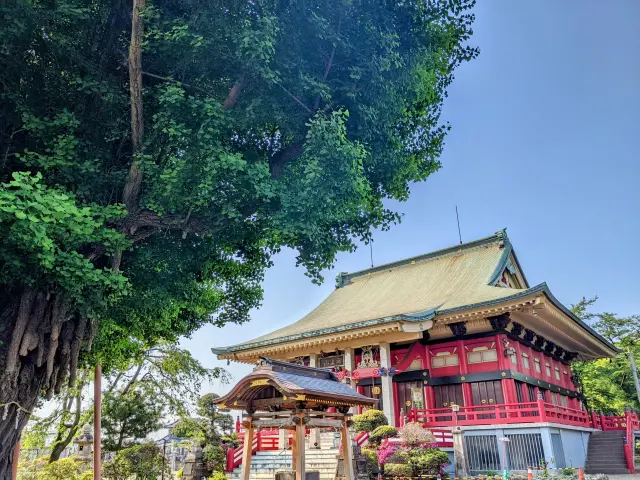
The most iconic highlight of Chiba-dera Temple is the gigantic ginkgo tree towering over the temple grounds. Designated as a natural monument of Chiba Prefecture, this tree, known as “The Ginkgo Tree of Chiba-dera Temple,” is said to have been planted in 710, the year after the temple’s founding.
Characteristics of the Ginkgo Tree:
- Height: Approximately 27-30 meters
- Trunk Circumference (at eye level): Approximately 8-10 meters
- Estimated Age: Over 1300 years
This ginkgo tree is even larger than the ginkgo tree at Tsurugaoka Hachimangu Shrine in Kamakura (which fell in 2010), and is known as one of the largest trees in the Kanto region. In autumn, it turns golden, beautifully coloring the temple grounds. When the leaves fall, the entire grounds become like a yellow carpet, attracting many worshippers and photography enthusiasts.
Main Hall and Principal Image
The main hall of Chiba-dera Temple houses the principal image, a statue of the Eleven-Faced Kannon Bodhisattva. This Kannon statue, said to have been created by Gyoki, is considered a hidden Buddha and is not usually on public display, but it is sometimes unveiled during special religious ceremonies.
The principal image, the Eleven-Faced Kannon, is a Kannon Bodhisattva with eleven faces on its head, believed to watch over all directions and save all sentient beings. As the principal image of one of the 33 Kannon pilgrimage sites of Bandō, it attracts many worshippers.
Yakushi Nyorai (Medicine Buddha) is also enshrined as a principal image, and is an object of worship for healing illnesses and prayers for good health.
29th Temple of the 33 Kannon Pilgrimage of Bandō
Chiba-dera Temple is the 29th temple of the 33 Kannon pilgrimage of Bandō, making it an important sacred site for pilgrims. The Bandō pilgrimage is counted as one of the three major Kannon pilgrimage sites in Japan, along with the 33 temples of Saigoku and the 34 temples of Chichibu.
Goeika:
“As I make my pilgrimage to Chiba-dera Temple, I feel reassured, like a ship being washed ashore by the waves crashing against the shore.”
This goeika indicates Chiba-dera Temple’s location near the sea and expresses faith in Kannon (Goddess of Mercy) by likening it to a ship.
Previous and Next Temples:
- Temple No. 28: Ryushoin (Ryugasaki City, Ibaraki Prefecture)
- Temple No. 30: Kozoji (Kisarazu City, Chiba Prefecture)
You can obtain a Goshuin (temple stamp) at the sutra hall next to the main hall. If you bring a Goshuincho (stamp book) for the Bando pilgrimage temples, you will be given a special Goshuin.
Cultural Properties and Historic Sites on the Temple Grounds
Besides the ginkgo tree, Chiba-dera Temple’s grounds contain many cultural properties and historical sites.
Chiba-dera Temple Grounds: The entire temple grounds are recognized for their historical value as a Chiba City designated cultural property. The temple grounds are a valuable space that preserves the layout of temples from ancient to medieval times.
Stone Sculptures: Numerous stone Buddha statues and pagodas from the Edo and Meiji periods remain on the grounds, telling the story of the region’s religious history.
Temple Bell: The current temple bell is modern, but it is believed that an older bell once existed.
Cultural Properties of Chiba-dera Temple
Prefectural Designated Natural Monument
Ginkgo Tree of Chiba-dera Temple: Chiba Prefecture Designated Natural Monument
- Date of Designation: December 24, 1935
- Owner: Chiba-dera Temple
- Location: 161 Chiba-dera-cho, Chuo-ku, Chiba City
This ginkgo tree is one of the largest in Chiba Prefecture in terms of age, height, and trunk circumference, and is protected as a valuable tree from a scientific perspective.
City-Designated Cultural Property
Chiba-dera Temple Grounds: Chiba City Designated Historic Site
- Designation Date: March 25, 1994
The temple grounds may contain the remains of an ancient temple, and archaeological excavations have unearthed artifacts from the Nara and Heian periods. It is an important historical site for understanding the history of Chiba City.
Historical Walks Around Chiba-dera Temple
Historic Sites Related to the Chiba Clan
There are several historical sites related to the Chiba clan scattered around Chiba-dera Temple.
Inohana Castle Ruins: The site of the Chiba clan’s castle, located approximately 2 km northwest of Chiba-dera Temple. It is now developed as Inohana Park and houses the Chiba City Local History Museum.
Chiba Shrine: A shrine associated with the Chiba clan, located near Chiba Station. It is known as a center of Myoken worship.
Nearby Temples and Shrines
Hongyo-ji Temple: A Nichiren Buddhist temple located south of Chiba-dera Temple. This temple has strong ties to the Chiba clan.
Daikakujiyama Tumulus Cluster: To the east of Chiba-dera Temple remain the remains of the Kofun period (Tumulus period), indicating that this area was an important location from ancient times.
Access and Transportation Information
Access by Train
From Keisei Chiba Line “Chibadera Station”:
- Approximately 10 minutes on foot
- Exit the station and head north. After passing through the residential area, you will arrive at Chibadera Temple.
From JR “Chiba Station”:
- Bus is convenient
- Take the Chiba Chuo Bus bound for “Shirahata,” “Omiya Danchi,” or “Kamatori Depot” via Chibadera and get off at the “Chibadera” bus stop. 1 minute on foot.
- Approximately 15-20 minutes
Access by Car
From Keiyo Expressway “Matsugaoka IC”:
- Approximately 10 minutes
From Higashi-Kanto Expressway “Chiba Kita IC”:
- Approximately 20 minutes
Parking: There is parking space for visitors on the temple grounds (spaces are limited, so using public transportation is recommended).
Area Map
Chiba-dera Temple is located in a residential area of Chuo Ward, Chiba City, but its large ginkgo tree serves as a landmark, making it easily identifiable from a distance.
Visiting Information
Visiting Hours: Grounds are freely accessible (Please check the rules regarding the interior of the main hall)
Admission Fee: Free
Goshuin (Temple Stamp) Reception Hours: 9:00 AM – 5:00 PM (Subject to change, prior confirmation recommended)
Inquiries: Chiba-dera Temple Office
*Due to the impact of the COVID-19 pandemic, visiting hours and Goshuin reception hours may be shortened. We recommend checking official information before visiting.
Annual Events
Chiba-dera Temple holds various Buddhist services and events throughout the year.
January 1st-3rd: First Shrine Visit of the Year
February 3rd: Setsubun Festival
Spring and Autumn Equinoxes: Equinox Memorial Service
August: Segaki Memorial Service
Mid-November to Early December: Ginkgo leaves are at their peak.
Many worshippers and tourists visit during the ginkgo leaf season. Especially on sunny days, the golden ginkgo leaves against the blue sky are breathtakingly beautiful.
Points to Note When Visiting Chiba-dera Temple
Recommended Time to Visit
Autumn (Mid-November to Early December): The time when the ginkgo leaves are at their most beautiful. It can get crowded on weekends.
Spring (April to May): The season of fresh greenery; the trees on the temple grounds are beautiful, and the weather is pleasant.
First Shrine Visit of the Year (January 1st-3rd): Bustling with New Year’s worshippers.
Photo Spots
- Ginkgo Tree from in front of the Main Hall: A panoramic view of the giant ginkgo tree with the main hall in the background.
- From the back of the temple grounds: An angle looking up at the ginkgo tree.
- During the autumn leaf fall: The contrast between the yellow carpet of leaves and the main hall.
Photography is permitted within the temple grounds, but please refrain from taking photos inside the main hall or during religious services. Also, please be considerate of other visitors.
Advice for Bando Pilgrims
Those undertaking the Bando Thirty-Three Kannon Pilgrimage should remember to bring their goshuincho (stamp book). Chiba-dera Temple is the 29th temple on the pilgrimage, and it is efficient to plan your pilgrimage route considering its location relative to the preceding and succeeding temples (Ryusei-in Temple, the 28th temple; and Takakura-ji Temple, the 30th temple).
You can obtain a goshuin (temple stamp) at the sutra office next to the main hall, but it may be closed during religious services or if staff are absent, so it is recommended to visit with ample time.
The Relationship Between Chiba-dera Temple and the Place Name Chiba
There are several theories about the origin of the place name “Chiba,” but one of the most plausible is the “Chiba” (meaning “a thousand lotus leaves”) that appears in the founding legend of Chiba-dera Temple. The legend says that the place name “Chiba” originated from a thousand lotus leaves that Gyoki saw in a pond in Ikeda-go, and this later became the temple’s name.
Thus, Chiba-dera Temple is not merely an ancient temple, but an important entity connected to the origin of the place name Chiba.
The History of Chiba City and Chiba-dera Temple
Chiba-dera Temple is an indispensable part of the history of Chiba City. For over 1300 years since its founding in 709, it has functioned as a center of faith and a cultural hub in this region.
Chiba City is currently a designated city with a population of approximately 1 million, but it is no exaggeration to say that its history began with Chiba-dera Temple. Visiting Chiba-dera Temple is also about touching the roots of Chiba City’s history.
Summary
Chiba-dera Temple (Sen’yōji), founded in 709, is the oldest temple in Chiba City and the 29th temple on the Bandō Thirty-Three Kannon Pilgrimage, belonging to the Buzan branch of the Shingon sect. It is symbolized by a giant ginkgo tree, a prefectural designated natural monument over 1300 years old, and is particularly bustling with visitors during the autumn foliage season.
With Kaijōzan as its mountain name, Chiba-dera Temple, which enshrines the Eleven-Faced Kannon Bodhisattva and Yakushi Nyorai as its principal deities, is a historically important temple with a legend of its founding by Gyōki, deep ties to the Chiba clan, and connections to the origin of the place name Chiba.
It is accessible by a 10-minute walk from Chiba-dera Station on the Keisei Chiba Line, or by bus from JR Chiba Station, and the temple grounds are freely accessible. It is a recommended place not only for Bandō pilgrims, but also for a wide range of people, including those interested in Chiba’s history, those who love giant trees, and photography enthusiasts.
When you visit Chiba, be sure to stop by Chiba-dera Temple and experience its 1300-year history and the majesty of its giant ginkgo tree.