Complete Guide to Ichinomiya Nukisaki Shrine | A Thorough Explanation of the Mystery of the Downward Approach and 1500 Years of History
Ichinomiya Nukisaki Shrine, located in Ichinomiya, Tomioka City, Gunma Prefecture, is a prestigious shrine with a history of approximately 1500 years. As the Ichinomiya (first-ranked shrine) of Kozuke Province, it has attracted deep devotion since ancient times and is known for its unique “downward approach,” a rare form of worship nationwide. The main hall, worship hall, and gate tower are designated as National Important Cultural Properties, and along with the Tomioka Silk Mill, it welcomes many visitors as a representative historical and cultural heritage site of Tomioka City.
What is Ichinomiya Nukisaki Shrine?
Status and History of the Ichinomiya of Kozuke Province
Ichinomiya Nukisaki Shrine is a historically significant shrine listed in the Engishiki Jinmyocho (a list of shrines compiled in the Heian period) as a Shikinaisha (a major shrine listed in the Engishiki). “Ichinomiya” is a title bestowed upon the highest-ranking shrine in each province during the Ritsuryo period, and it has held the highest position in Kōzuke Province (present-day Gunma Prefecture).
Its former rank was Kokuhei Chūsha (National Shrine of the Second Rank), and it is currently designated as a Beppyo Jinja (Special Shrine) by the Association of Shinto Shrines. It is said to have been founded in the first year of Emperor Ankan’s reign (531 AD), and its existence was already known to the imperial court during the reign of Emperor Tenmu, making it an ancient shrine boasting a history of nearly 1500 years.
Location of Ichinomiya, Tomioka City, Gunma Prefecture
The shrine is located at 1535 Ichinomiya, Tomioka City, Gunma Prefecture, on the southern slope of Yomogigaoka Hill, approximately 2 kilometers northwest of Tomioka city center. Surrounded by lush forests, the shrine grounds are enveloped in a sacred atmosphere.
It is approximately a 10-15 minute walk from Joshu-Ichinomiya Station on the Joshin Electric Railway and about a 10-minute drive from the Tomioka Silk Mill, making it an important tourist spot in Tomioka. The shrine has ample parking, making it easily accessible by car.
Deities and History of Worship
Futsunushi-no-kami
Ichinomiya Nukisaki Shrine enshrines two deities. One of the main deities, Futsunushi-no-kami, is a god known in Japanese mythology as a god of war and swords. In the myth of the transfer of the land, which appears in the Kojiki and Nihon Shoki, he is depicted as a god who descended to Izumo along with Takemikazuchi-no-kami and received the land from Okuninushi-no-mikoto.
Futsunushi-no-kami is a symbol of military power and victory, and was particularly revered by the samurai class. He is believed to bring blessings for traffic safety, good fortune in competitions, and protection from evil. From the medieval period onward, his worship as a god of war spread within samurai society, and it is said that many warlords visited the shrine to pray for victory in battle.
Hime-Ōkami
Hime-Ōkami, the other enshrined deity, is revered as the goddess of weaving, sericulture, and agriculture. In Kōzuke Province, where silk weaving flourished since ancient times, she has been closely intertwined with the lives of the local people as the guardian deity of sericulture and weaving.
There are various theories regarding the true identity of Hime-Ōkami, including the theory that she is an indigenous local deity, and the theory that she is a deification of weaving techniques brought by immigrants. The area around Tomioka City has been a center of the silk industry since the Edo period, with the establishment of the Tomioka Silk Mill in the Meiji era. The worship of Hime-Ōkami is deeply connected to the industrial development of this region.
The Coexistence of a War God and an Industrial God
A major characteristic of Ichinomiya Nukisaki Shrine is the coexistence of two deities with contrasting characteristics: Futsunushi-no-Kami, a war god, and Hime-Ōkami, the goddess of agriculture and weaving. This combination indicates that ancient Kōzuke Province was both a strategically important military location and a region where industries such as sericulture and weaving flourished.
The Mystery of the Downward Approach and Architectural Features
A Nationwide Rare “Downward Approach”
The most distinctive feature of Ichinomiya Nukisaki Shrine is its “downward approach,” which is rare nationwide. While it’s customary at most shrines to pass through the torii gate, climb stone steps, and worship at the shrine building located at a higher elevation, Nukisaki Shrine has a unique structure where worshippers first ascend the approach, pass through the main gate, and then descend stone steps to reach the main hall.
Specifically, after climbing approximately 70 stone steps from the large torii gate to reach the main gate (rōmon), the main hall and worship hall are located at a lower elevation after descending another 100 stone steps. In other words, it’s a rare form of “downward shrine,” where worshippers worship while looking down on the deity.
Why is the approach path descending?
Several theories exist regarding this unusual structure.
The topographical theory suggests that the shrine was positioned along the natural slope to maximize the use of the southern slope of Yomogigaoka Hill. Building the shrine facing south allowed for ample sunlight, creating a sacred space.
The feng shui theory suggests that, based on ancient feng shui principles, the shrine was placed on the mountainside to better receive the mountain’s energy. It may have been believed that establishing the sacred area on the mountainside rather than the summit would grant stronger spiritual power.
The defensive theory suggests that during times of war, the gatehouse was placed on a high, easily visible point to protect the shrine, while the main shrine building itself was positioned at a lower, more defensible location.
While the truth remains uncertain, this unique approach path is a major attraction of Ichinomiya Nukisaki Shrine and leaves a strong impression on visitors.
Nationally Designated Important Cultural Property Shrine Architecture
The main hall, worship hall, and gate tower of Ichinomiya Nukisaki Shrine were rebuilt in 1635 (Kanei 12) by order of Tokugawa Iemitsu, the third shogun of the Tokugawa shogunate, and are designated as National Important Cultural Properties.
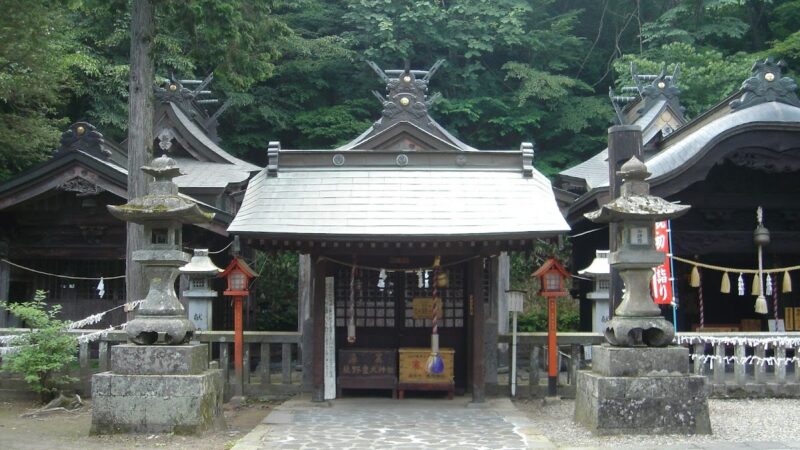
The main hall has a rare structure that appears to be a single-story building from the outside but is actually two stories inside, a unique architectural style called “Nukisaki-zukuri.” It is adorned with vividly colored carvings and is a magnificent structure that embodies the pinnacle of early Edo period architectural technology.
The worship hall is integrated with the main hall in the Gongen-zukuri style and is designed as a space for worshippers to offer prayers. The vermilion-painted pillars and vividly colored decorations are beautiful and convey the high level of craftsmanship of the time.
The gate tower is a magnificent two-story gate located at the beginning of the descending approach to the shrine. A bell tower is built on the upper level, making it a superb building where a solid structure and ornate decorations harmonize.
These buildings retain a strong architectural style from the Kan’ei period and are highly valued as precious cultural heritage, representing the culmination of the authority and faith of the Edo shogunate.
The Secret of the Vividly Colored Shrine
The vividly colored decorations adorning the main hall and worship hall are a major highlight of Ichinomiya Nukisaki Shrine. The sculptures and paintings, adorned with vibrant colors such as vermilion, green, and gold, retain their beauty even after many years.
These colors have meaning beyond mere decoration. Vermilion symbolizes protection against evil and vitality, gold represents sanctity and authority, and green signifies harmony with nature; each color holds religious and symbolic meaning.
These decorations, created by painters and sculptors competing with each other in the early Edo period, demonstrate the highest level of craftsmanship of the time and have been preserved to this day through regular restoration work.
Highlights and Power Spots within the Shrine Grounds
Recommended Spots by Shinto Priests
Besides the main hall and worship hall, there are many other points of interest within the shrine grounds. Here are some recommended points of worship from the Shinto priests.
Sacred Trees: The grounds are dotted with giant cedar and zelkova trees over several hundred years old, creating a sacred atmosphere. The sacred tree behind the main hall is particularly popular with visitors as a power spot.
Subsidiary Shrines: Several subsidiary shrines are enshrined within the grounds, each offering different blessings. Deities who grant various wishes, such as business prosperity, academic success, and matchmaking, reside here.
Stone Sculptures: Many stone sculptures, such as stone lanterns and guardian lion-dogs, donated from the Edo period to the Meiji period, remain within the grounds, allowing visitors to feel the layers of history.
A Frog God!?
Ichinomiya Nukisaki Shrine has an intriguing legend about a “frog god.” Within the shrine grounds, there’s a stone shaped like a frog. Because of the wordplay (“kaeru” sounds like “safe return” or “money return”), it’s revered by worshippers as a source of traffic safety and financial good fortune.
This frog-shaped stone became an object of worship simply because a natural rock happened to resemble a frog. It’s a popular spot for locals and tourists alike to take photos and offer donations.
The Shrine Grounds and a Healing Space
The majority of the shrine grounds are covered in a lush forest, allowing visitors to enjoy the beauty of nature throughout the seasons. Spring brings cherry blossoms, summer offers deep greenery, autumn brings vibrant foliage, and winter presents snowscapes—each season revealing a different face.
After visiting the shrine, a stroll through the grounds offers a tranquility that makes you forget the hustle and bustle of the city, and the healing effects of forest bathing. Listening to the birdsong and rustling of the trees, you can spend time calming your mind.
Annual Events and Festivals
Major Festivals
Ichinomiya Nukisaki Shrine holds various festivals throughout the year.
Grand Festival (Second Sunday of December): This is the most important festival of the year, featuring the dedication of Kagura (sacred dance) and the procession of the portable shrine. It is bustling with many worshippers and is a valuable opportunity for the preservation of local traditional culture.
New Year’s Visit: Many worshippers visit in the new year to pray for safety and prosperity throughout the year. It is especially crowded from New Year’s Day to the third day.
Setsubun Festival: Bean-throwing is held on Setsubun in February, and the shrine is bustling with worshippers praying for protection from evil and good fortune.
Shichi-Go-San (7-5-3 Festival): In autumn, many families visit to celebrate Shichi-Go-San.
Goshuin (Shrine Seals) and Amulets
At Ichinomiya Nukisaki Shrine, you can receive a Goshuin as a memento of your visit. The goshuin (temple/shrine stamp) bears the shrine’s seal and the date of visit, and is carefully handwritten in ink in your goshuincho (stamp book). The calligraphy and composition reflect the individuality of the Shinto priest, making them popular among collectors.
A wide variety of amulets are also available, offering blessings for various purposes such as traffic safety, academic success, business prosperity, matchmaking, and protection from evil. In particular, the “Work Amulet” and “Skill Improvement Amulet,” associated with Hime-Ōkami, the goddess of sericulture and weaving, are popular and unique to this shrine.
Visiting Information and Access
Basic Information
Location: 1535 Ichinomiya, Tomioka City, Gunma Prefecture
Phone: 0274-62-2009
Visiting Hours: Grounds are freely accessible (Shrine office is generally open from 9:00 to 17:00)
Admission Fee: Free
Parking: Available (Free, approximately 50 spaces for regular cars)
Access Methods
Access by Train
・Approximately 10-15 minutes on foot from Joshu-Ichinomiya Station on the Joshin Electric Railway
・Approximately 40 minutes by transferring to the Joshin Electric Railway from JR Takasaki Station
Access by Car
・Approximately 10 minutes from Tomioka IC on the Joshinetsu Expressway
・Approximately 20 minutes from Fujioka IC on the Kanetsu Expressway
・Approximately 10 minutes from Tomioka Silk Mill
Access by Bus * Get off at “Ichinomiya Nukisaki Shrine” bus stop on the Tomioka City Loop Bus.
Visiting Etiquette and Time Required
For a visit, including the downhill path, allow approximately 30 minutes to 1 hour round trip. If you wish to leisurely explore the shrine grounds, it is recommended to allow 1.5 to 2 hours.
Since there are stone steps to climb and descend, comfortable walking shoes are recommended. Particular caution is needed during rainy weather and winter, as the steps can become slippery.
The basic etiquette for visiting a shrine is to bow at the torii gate before entering the grounds, purify your hands and mouth at the water basin, and perform two bows, two claps, and one bow in front of the main hall. Photography is permitted, but please observe proper etiquette, such as refraining from taking photos inside the main hall or during religious ceremonies.
Nearby Tourist Attractions
Combined Sightseeing with Tomioka Silk Mill
Located about a 10-minute drive from Ichinomiya Nukisaki Shrine, Tomioka Silk Mill is a symbol of Japan’s modernization and a UNESCO World Heritage Site. Visiting both Nukisaki Shrine, dedicated to Hime-no-Okami, the goddess of sericulture and weaving, and Tomioka Silk Mill, a symbol of the modernization of Japan’s silk industry, allows you to experience the history of Gunma Prefecture’s sericulture culture from ancient times to the modern era.
Sightseeing in Tomioka City
Tomioka City boasts a variety of tourist attractions, including Mt. Myogi, Gunma Safari Park, and Konnyaku Park. Starting from Ichinomiya Nukisaki Shrine, you can create a one-day sightseeing plan to enjoy Tomioka City’s nature, history, and cuisine.
Historical Changes of Ichinomiya Nukisaki Shrine
Ancient Beliefs
While Ichinomiya Nukisaki Shrine is said to have been founded in the first year of Emperor Ankan’s reign (531 AD), it is possible that the Yomogigaoka area was actually revered as a sacred site even before that. It was already known to the imperial court during the reign of Emperor Tenmu (late 7th century), and the “Engishiki Jinmyocho” (compiled in 927 AD) lists it as “Nukisaki Shrine, Kanra District, Kōzuke Province, Myōjin-dai (Great Shrine).”
Ancient Kōzuke Province was a strategic point for controlling the eastern provinces, and at the same time, it was a region where advanced sericulture and weaving techniques brought by immigrants developed. Nukisaki Shrine, which enshrines both the god of war and the god of industry, was considered important as a supporter of regional development from both military and industrial perspectives.
Samurai Beliefs in the Medieval Period
From the late Heian period to the Kamakura period, with the rise of the samurai class, faith in the god of war, Futsunushi-no-kami, increased. It is said that powerful warlords of the Kanto region, such as the Minamoto and Hojo clans, visited the shrine to pray for victory in battle and for lasting military fortune.
During the Sengoku period (Warring States period), powerful daimyo such as the Takeda, Hojo, and Uesugi clans, who ruled Kozuke Province, also revered Nukisaki Shrine, donating land and repairing the shrine buildings. Even in times of war, the authority and faith of the shrine remained.
Prosperity in the Edo Period
During the Edo period, Nukisaki Shrine flourished greatly under the patronage of the Tokugawa shogunate. In 1635, by order of the third shogun, Tokugawa Iemitsu, the main hall, worship hall, and gate tower were extensively rebuilt. These are the buildings now designated as important national cultural properties.
Throughout the Edo period, Nukisaki Shrine served as the guardian shrine of Kozuke Province, a spiritual pillar of the region, and the worship of Hime-Okami spread along with the development of sericulture. Many worshippers visited the shrine throughout the year, and a temple town developed around it.
Modern Era
With the Meiji-era decree separating Shinto and Buddhism, Nukisaki Shrine, which had previously practiced a syncretic blend of Shinto and Buddhism, clearly established its character as a Shinto shrine. In 1871 (Meiji 4), it was ranked as a National Shrine of the second rank, becoming an important shrine receiving national protection.
From the Taisho era to the early Showa era, as sericulture in the Tomioka area reached its peak, devotion to Hime-Ōkami also reached its zenith. Many sericulture farmers and those involved in silk reeling factories were seen visiting the shrine to pray for a bountiful harvest and safety.
After the war, it became a special shrine of the Association of Shinto Shrines, a status it maintains to this day. In 1980 (Showa 55), the main hall, worship hall, and gate tower were designated as important national cultural properties, widely recognizing their value as historical buildings.
Summary
Ichinomiya Nukisaki Shrine, with its 1500-year history, is the Ichinomiya (first-ranked shrine) of Kōzuke Province and a representative shrine of Gunma Prefecture. Ichinomiya Nukisaki Shrine possesses many attractions, including its unique “downward-facing approach” to the shrine (rare in Japan), its magnificent shrine architecture designated as a National Important Cultural Property, and the worship of two deities: Futsunushi-no-kami, the god of war, and Hime-no-Okami, the goddess of sericulture.
With its long history of faith spanning from ancient times to the present, its grounds surrounded by abundant nature, and its seasonal festivals, Ichinomiya Nukisaki Shrine offers numerous elements that captivate visitors. Visiting it in conjunction with the Tomioka Silk Mill will allow you to gain a deeper understanding of Gunma Prefecture’s sericulture culture.
When visiting, take your time to descend the downward-facing approach and feel the unique atmosphere and historical weight of this shrine. The time spent calming your mind and offering prayers in silence, away from the hustle and bustle of everyday life, will surely be a precious experience.
If you have the opportunity to visit Tomioka City in Gunma Prefecture, be sure to visit Ichinomiya Nukisaki Shrine. You will be able to experience the depth of faith and culture woven over 1500 years of history.