Complete Guide to Ankoku-ronji Temple | History, Highlights, and Visiting Information for a Sacred Site in Kamakura Associated with Nichiren Shonin
Ankoku-ronji Temple, located in Omachi, Kamakura City, Kanagawa Prefecture, is a historic temple built on the site of Matsubagaya Hermitage, which served as the base for Nichiren Shonin’s missionary activities in Kamakura. Known as the sacred site where Nichiren Shonin’s representative work, “Rissho Ankoku Ron” (Treatise on Establishing Righteousness and Securing the Peace of the Nation), was written, it holds special significance as a sacred place for Nichiren sect followers.
This article will introduce the charm of this ancient temple in its entirety, from its history and highlights within the temple grounds to seasonal flowers and visiting information.
What is Ankoku-ronji Temple? | Origin and Overview of the Matsubagaya Sacred Site
Ankoku-ronji Temple, whose mountain name is Myohokkekyozan, is a temple belonging to the Nichiren sect. While there are several temples in Kamakura associated with Nichiren Shonin, Ankoku-ronji Temple, along with Chosho-ji and Myohoji Temples, is considered one of the candidate sites for “Matsubagaya Hermitage,” where Nichiren Shonin first established his hermitage.
The temple’s official name is also known as “Matsubagaya Reiseki Ankoku-ronji,” and it remains a sacred place visited by many worshippers today, as it is where Nichiren Shonin began his missionary work in Kamakura.
About Matsubagaya Hermitage
Matsubagaya is a place name in the valley stretching from Omachi to Nagoshi in Kamakura. It is believed to be the place where, in 1253 (Kencho 5), the 32-year-old Nichiren Shonin entered Kamakura from Awa Province (present-day Chiba Prefecture) and first established his hermitage.
At this hermitage, Nichiren Shonin analyzed the causes of social unrest and disasters of the time from a Buddhist perspective and wrote “Rissho Ankoku Ron” (Treatise on Establishing Righteousness and Securing the Nation) with the hope of national peace and the happiness of the people. This work, submitted to the then-regent Hojo Tokiyori in 1260, is an important document that reveals the core of Nichiren Shonin’s thought.
History of Ankoku-ronji Temple | From its founding to the present day
Nichiren Shonin’s arrival in Kamakura and the establishment of his hermitage
In 1253, Nichiren Shonin left his hometown of Awa Province and entered Kamakura, the political and cultural center of the time. Determined to preach in Kamakura, Nichiren Shonin built a hermitage at the site where Ankoku-ronji Temple now stands, and began preaching the teachings of the Lotus Sutra from this base.
This hermitage contained a cave where Nichiren Shonin devoted himself to ascetic practice and writing. This cave is now called “Goho-kutsu” (御法草) and is preserved as an important sacred site within the temple grounds.
Writing and Submission of the “Rissho Ankoku Ron”
In 1260 (Bun’ō 1), Nichiren Shonin wrote the “Rissho Ankoku Ron” in this hermitage. At that time, Kamakura was experiencing a series of disasters, including earthquakes, famine, and epidemics, leading to widespread social unrest. Nichiren Shonin believed that the cause of these calamities lay in the disregard for the true Buddhist teachings (the Lotus Sutra) and the adherence to false teachings (such as the Nembutsu).
The “Rissho Ankoku Ron” was a treatise arguing that national peace and security could be achieved through devotion to the true Dharma, and it was submitted to the regent, Hōjō Tokiyori. However, this argument provoked opposition from other Buddhist sects, leading to the later Matsubagaya Persecution.
The Matsubagaya Persecution and the Suffering of Nichiren Shonin
The year after the submission of the *Rissho Ankoku Ron*, on August 27, 1261 (Kōchō 1), a mob, mainly composed of Nembutsu believers, attacked the hermitage in Matsubagaya. This is known as the “Matsubagaya Persecution.”
According to tradition, a white monkey guided Nichiren Shonin to safety. This legend of the white monkey is an important anecdote passed down at Ankokuron-ji Temple and is still recounted today. After this persecution, Nichiren Shonin was exiled to Izu.
The Founding and Development of Ankokuronkutsu-ji Temple
Nichiro Shonin, a direct disciple of Nichiren Shonin and known as “the foremost in filial piety,” founded “Ankokuronkutsu-ji Temple” next to the sacred cave in 1260 (Bun’ō 1) to pass on the sacred site of his teacher, Nichiren Shonin, to future generations. This is considered the beginning of Ankoku-ronji Temple.
The temple’s name, “Ankoku-ron,” is derived from the *Rissho Ankoku-ron* (Treatise on Establishing Righteousness and Securing the Nation), which Nichiren Shonin wrote in this very place. Since then, the temple has been preserved by successive chief priests, and currently stands at the 52nd generation.
Changes Since the Edo Period
During the Edo period, the temple was developed as a Nichiren Buddhist temple, and many buildings were constructed. Despite the impact of the anti-Buddhist movement of the Meiji era, the temple was maintained through the efforts of its followers, and continues to exist through the Showa and Heisei eras to the present day.
In recent years, its value as a site related to Nichiren Shonin has been re-evaluated, and its importance as a cultural property has increased, including its recognition as a component of a Japan Heritage site.
Highlights of the Temple Grounds | From the Goho-kutsu Cave to Fujimi-dai
The grounds of Ankoku-ronji Temple offer a harmonious space where sacred sites associated with Nichiren Shonin, historical buildings, and natural landscapes are blended. Here are some of the main highlights.
Gohokutsu (Sacred Cave)
The most important sacred site within the temple grounds is the “Gohokutsu.” This cave is believed to be the place where Nichiren Shonin built his hermitage and wrote the “Rissho Ankoku Ron” (Treatise on Establishing Righteousness and Securing the Peace of the Nation). Even today, a statue of Nichiren Shonin is enshrined inside the cave, and it is constantly visited by worshippers.
A stone staircase leads to the cave, enveloped in a tranquil atmosphere. Standing here, one can imagine the scene of Nichiren Shonin taking up his brush, praying for the peace and security of the nation and the happiness of its people.
Nanmenkutsu (South-facing Cave)
Equally important as the Gohokutsu is the “Nanmenkutsu.” This cave is believed to be where Nichiren Shonin practiced his daily asceticism and meditation, and it is named as such because it faces south.
The area around Nanmenkutsu is surrounded by a bamboo grove, creating a serene space. It is easy to imagine that this was an ideal environment for concentrating one’s mind, away from the hustle and bustle of Kamakura.
Main Hall
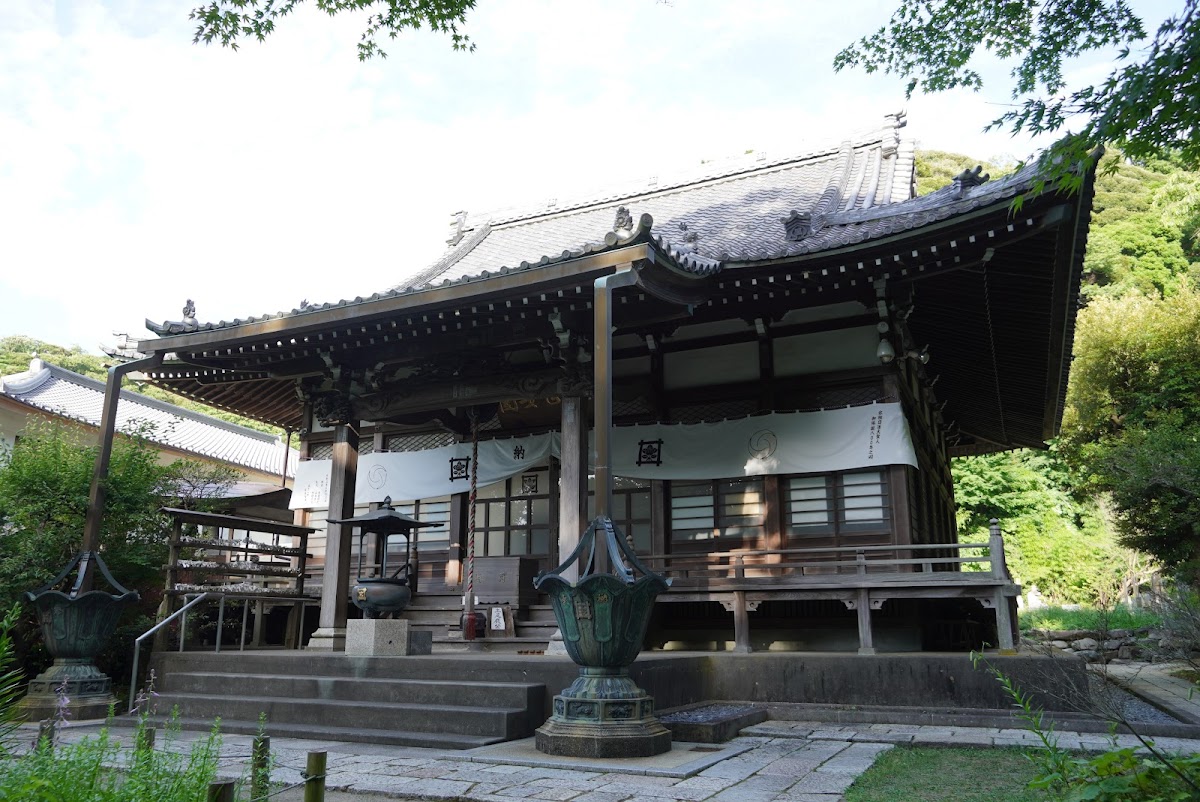
Located in the center of the temple grounds, the main hall houses a statue of Nichiren Shonin as the principal image. Daily services are performed inside the hall, and visitors can quietly offer their prayers.
The main hall’s architectural style retains characteristics of the Edo period, making it a building of high historical value. Items related to Nichiren Shonin and successive high priests are also stored inside.
Small Hermitage (Okoan)
Within the temple grounds is a building called “Okoan.” This is a replica of the hermitage where Nichiren Shonin actually lived, allowing visitors to imagine the simple life of that time.
The area surrounding Okoan is maintained as a garden, planted with seasonal flowers and plants. Imagining Nichiren Shonin teaching his disciples here further enhances the sacredness of this place.
Fujimidai (Mount Fuji Viewing Platform)
On a hill within the temple grounds is an observation spot called “Fujimidai.” From here, you can enjoy a panoramic view of Kamakura’s townscape and Yuigahama Beach, and if the weather is good, you can even see Mount Fuji in the distance.
Nichiren Shonin also gazed upon Mount Fuji from this spot, contemplating the land of Japan and the happiness of its people. Even today, by gazing upon the same scenery, we can feel a spiritual connection that transcends time and space.
Myoho Cherry Blossoms and Seasonal Flowers
Ankoku-ronji Temple is also known as a “famous temple of flowers.” Particularly famous is the cherry tree called “Myoho Cherry Blossom,” which beautifully colors the temple grounds in spring. This cherry tree is said to be several hundred years old, a living witness to a long history.
In spring, in addition to cherry blossoms, camellias and magnolias also bloom. In summer, hydrangeas bloom along the stone steps of the temple grounds, adding color to the rainy season. In autumn, the autumn leaves are beautiful, and the sasanqua flowers, in particular, make the temple grounds vibrant in late autumn. In winter, sasanquas and winter camellias bloom quietly, delighting visitors throughout the four seasons.
Traces of the White Monkey Legend
The legend of the white monkey that saved Nichiren Shonin during the Matsubagaya Persecution can be seen throughout the temple grounds. There is a path said to have guided Nichiren Shonin, and a small shrine dedicated to the white monkey, preserving this mysterious legend to this day.
The white monkey is worshipped as Nichiren Shonin’s guardian deity and is considered a symbol of courage and wisdom in the face of adversity.
Temple Treasures and Cultural Properties of Ankoku-ronji Temple
Important Cultural Properties and Designated Cultural Properties
Ankoku-ronji Temple houses numerous items related to Nichiren Shonin and cultural properties of high historical value. These include letters believed to be Nichiren Shonin’s own writings, scriptures copied by his disciples, and portraits of successive high priests.
These temple treasures are usually not open to the public, but some are displayed during special viewings. Some are designated cultural properties of Kamakura City and are valuable resources for historical research.
Relics Associated with Nichiren Shonin
The temple grounds contain items believed to have been actually used by Nichiren Shonin. Tools used during his training and daily life are preserved, illustrating the saint’s simple and strict lifestyle.
Furthermore, items believed to have survived the Matsubagaya Persecution are carefully preserved, making them valuable witnesses to this historical event.
Visiting Information | Access, Hours, and Fees
Opening Hours and Closing Days
Opening Hours: 9:00 AM – 4:30 PM
Closing Days: Mondays (except national holidays and the O-higan period)
The temple is open on national holidays and during the O-higan period. However, visiting hours may change during memorial services and special events, so it is recommended to check in advance.
Admission Fee
Visiting Ankoku-ronji Temple is generally based on a donation system. Please make a donation to help maintain the temple grounds. Additional fees may apply for special viewings or events.
Access
By Train:
- Approximately 12-15 minutes on foot from the East Exit of Kamakura Station on the JR Yokosuka Line and Enoshima Electric Railway
- From the East Exit of Kamakura Station, walk along Komachi Street towards Omachi.
By Bus:
- Take a bus from Kamakura Station and get off at the Nagoe bus stop, then walk for approximately 5 minutes.
By Car:
- Approximately 15 minutes from the Asahina Interchange on the Yokohama-Yokosuka Expressway
- Parking is limited, so we recommend using public transportation.
Address: 4-4-18 Omachi, Kamakura City, Kanagawa Prefecture 248-0007
Nearby Attractions
Nearby Ankoku-ronji Temple are Myohoji Temple and Choshoji Temple, both also associated with Nichiren Shonin. Furthermore, the Omachi-Nagoe area of Kamakura, where the old townscape remains, is ideal for strolling, allowing you to walk slowly while feeling the history.
Zaimokuza Beach and Yuigahama Beach are also nearby, and sightseeing plans combining temple visits with walks along the beach are popular.
Special Viewings and Events
Annual Events
Ankoku-ronji Temple holds various Buddhist services and events throughout the year.
Main Annual Events:
- Rissho Ankoku Ron Reading Ceremony (around February 16th): A memorial service commemorating the achievements of Nichiren Shonin in writing the *Rissho Ankoku Ron*.
- Spring Equinox Service (March)
- Hanamatsuri (Flower Festival) (April 8th): A celebration of the birth of Shakyamuni Buddha.
- Matsubagaya Persecution Memorial Service (August 27th): A memorial service commemorating the Matsubagaya Persecution.
- Autumn Equinox Service (September)
- Oeshiki Ceremony (October 13th): A memorial service commemorating the anniversary of Nichiren Shonin’s death.
Special memorial services are held during these events, attracting many believers and worshippers.
Special Viewings
Special viewings are sometimes held in spring and autumn, offering a rare opportunity to see temple treasures and the interior of buildings that are normally not open to the public. Please check the official website or inquire for details on the dates and contents of special viewings.
Training Experiences and Dharma Talks
Ankoku-ronji Temple offers training experiences such as sutra copying and chanting for those who wish to participate. Regular Dharma talks by the head priest are also held, allowing visitors to learn about the teachings of Nichiren Shonin and the wisdom of Buddhism.
Many of these programs require advance reservations, so it is recommended that those wishing to participate contact the temple beforehand.
Points to Note When Visiting Ankoku-ronji Temple
Recommended Time to Visit
Ankoku-ronji Temple is beautiful in every season, but the following times are particularly recommended:
Spring (Late March to April): Cherry blossoms, including the Myoho-zakura, are in full bloom, beautifully coloring the temple grounds. Camellias and magnolias are also in full bloom during this season.
Early Summer (June): Hydrangeas bloom along the stone steps, allowing visitors to enjoy the atmosphere of Kamakura during the rainy season.
Autumn (November): The autumn leaves are beautiful, and camellias begin to bloom. The view from Fujimidai is exceptional in the crisp autumn air.
Winter (December-February): This is a quiet time to visit, with fewer tourists. Winter camellias bloom, creating a serene atmosphere.
Visiting Etiquette
Ankoku-ronji Temple is a sacred site of Nichiren Shonin and continues to function as a place of worship. Please observe the following etiquette when visiting:
- Please be quiet on the temple grounds and refrain from loud conversations.
- Photography is permitted, but please refrain from taking pictures in areas where photography is prohibited, such as inside the main hall and the sacred cave.
- Please do not harm or take away any plants or animals.
- Please take all your trash with you.
- Please observe quietly during religious services and be considerate so as not to disturb them.
Estimated Time Required
If you take your time to stroll around the temple grounds and see the main sights, it will take approximately 30 minutes to 1 hour. If you participate in a sutra copying experience or a Dharma talk, please allow an additional 1-2 hours. If you plan to visit surrounding temples as well, it’s a good idea to allocate about half a day.
Nichiren Shonin and the *Rissho Ankoku Ron*
The Life of Nichiren Shonin
Nichiren Shonin (1222-1282) was a Buddhist monk in the mid-Kamakura period and the founder of the Nichiren sect (Hokke sect). Born in Awa Province (present-day Chiba Prefecture), he became a monk at the age of 12. After training at Mount Hiei and other places, he became convinced that the Lotus Sutra was the true teaching of Shakyamuni Buddha, and founded his sect in 1253.
During his missionary activities in Kamakura, he severely criticized other sects and suffered persecution many times. Despite experiencing numerous hardships, including the Matsubagaya Persecution, exile to Izu, the Komatsubara Persecution, the Tatsunokuchi Persecution, and exile to Sado, he remained steadfast in his beliefs.
In his later years, he built a hermitage on Mount Minobu and devoted himself to training disciples and writing. He passed away on October 13, 1282, at the age of 61.
The Significance of “Rissho Ankoku Ron”
“Rissho Ankoku Ron” is a treatise written by Nichiren Shonin in 1260 and submitted to the regent Hojo Tokiyori. At that time, Japan was suffering from disasters such as earthquakes, famines, and epidemics, leading to high levels of social unrest.
Nichiren Shonin analyzed the cause of these calamities as the disregard for the true Buddhist teachings (the Lotus Sutra) and the adherence to false teachings such as chanting the Buddha’s name. He argued that by devoting oneself to the true teachings, national peace and the happiness of the people could be achieved.
“Rissho Ankoku Ron” is written in a question-and-answer format, with the argument unfolding through a dialogue between a traveler and his host. This work is highly regarded not only for its Buddhist thought but also for its keen insights into the social conditions and politics of the time, making it a significant work of religious literature.
This work represents the core of Nichiren Shonin’s thought and forms the fundamental doctrine of the Nichiren sect. Furthermore, as an important document discussing the relationship between state and religion, it occupies a significant position in the history of Japanese thought.
Ankoku-ronji Temple and the History of Kamakura
Religious Situation in the Kamakura Period
The Kamakura period was a time of revolutionary change in Japanese Buddhism, known as “Kamakura New Buddhism.” Many of the major sects of present-day Japanese Buddhism, such as Honen’s Jodo sect, Shinran’s Jodo Shinshu sect, Eisai’s Rinzai sect, Dogen’s Soto sect, and Nichiren’s Nichiren sect, were established during this period.
These new sects, unlike the traditional aristocratic Buddhism, preached teachings easily understandable to samurai and commoners, and spread rapidly. However, because each sect developed its own unique doctrines, conflicts between sects intensified.
Nichiren Shonin’s criticism of other sects was carried out amidst this religious tension, and persecutions such as the Matsubagaya Persecution arose from this background.
Nichiren Shonin’s Footprints in Kamakura
Nichiren Shonin conducted missionary work in Kamakura for approximately 20 years. Many places associated with Nichiren Shonin remain in Kamakura, including the Matsubagaya hermitage where Ankoku-ronji Temple is located, places where he gave street sermons, and temples built by his disciples.
Currently, there are approximately 30 Nichiren Buddhist temples in Kamakura, and it is said that “Kamakura is a sacred place of Nichiren Buddhism.” The “Three Sacred Sites of Matsubagaya”—Ankoku-ronji, Myohoji, and Choshoji—as well as Honkakuji, Myohonji, and Joeiji, each have deep connections to Nichiren Shonin.
The Role of Ankoku-ronji Temple in Modern Times
Modern-day Ankoku-ronji Temple functions not merely as a historical site, but as a living place of faith. Daily religious services are performed here, believers visit to worship, and memorial services and ceremonies are held.
Furthermore, it plays an important role as an educational place that transmits the teachings of Nichiren Shonin to the present day. Through training experiences and Dharma talks, it provides opportunities to learn Buddhist wisdom and consider the problems of modern society.
From a tourism perspective, it is a popular cultural property of Kamakura and is recognized as a component of a Japan Heritage site. As a space where history and faith, culture and nature harmonize, it continues to deeply impress visitors.
Summary | The Charm and Significance of Visiting Ankoku-ronji Temple
Ankoku-ronji Temple is a special sacred site for Nichiren Buddhist followers, as it is the Matsubagaya sacred site where Nichiren Shonin wrote “Rissho Ankoku Ron” (Treatise on Establishing Righteousness and Securing the Peace of the Nation). It is also an important temple that conveys the history and culture of Kamakura.
It boasts many attractions, including sacred sites such as the Goho-kutsu and Nanmen-kutsu caves, beautiful grounds adorned with seasonal flowers, and the view from Fujimidai (Mt. Fuji Viewing Platform). This is a precious place where you can learn about the life and teachings of Nichiren Shonin and study the religious history of the Kamakura period.
As you walk through the tranquil temple grounds and reflect on the time when Nichiren Shonin took up his brush, praying for the peace of the nation and the happiness of the people, you will feel a spiritual connection that transcends time and space.
When you visit Kamakura, be sure to visit Ankoku-ronji Temple and experience the serene atmosphere and profound spirituality of this historic temple. Nichiren Shonin’s aspirations and the feelings of those who have preserved and passed them down will surely offer profound insights for us living in the modern age.