Complete Guide to Eikoji Temple (Kyoto Prefecture) | History, Goshuin (Temple Seal), and the Giant Ginkgo Tree: A Thorough Explanation
Eikoji Temple, located on Jofukuji Street in Kamigyo Ward, Kyoto City, is an ancient Nichiren Buddhist temple born from the tragedy of the Sengoku period. Situated in a quiet residential area slightly off the main street, it boasts a tranquil atmosphere that sets it apart from famous temples bustling with tourists. A giant ginkgo tree, said to be over 400 years old, adorns the temple grounds, displaying magnificent yellow foliage in autumn.
This article comprehensively introduces all the information you need to know before visiting Eikoji Temple, including its detailed history, highlights within the grounds, information on goshuin (temple seals), and access methods.
Basic Information about Eikoji Temple
Official Name: Chishozan Eikoji Temple
Sect: Nichiren Buddhism
Mountain Name: Chishozan
Former Head Temple: Honkokuji Temple (Rokujo School)
Dharma Connection: Shinshi Dharma Connection
Principal Image: Ten Realms Mandala
Founded: Tenbun Era (1532-1555)
Founder: Myoho-ni (Isa, wife of Nomoto Teruhisa)
Location: 1-562-5 Sasaya-cho, Kamigyo-ku, Kyoto City, Kyoto Prefecture (Jofukuji-dori, Ichijo-agaru)
Telephone Number: 075-441-3903
Eikoji Temple is a temple that has attracted the faith of the local community as a center for the propagation of Nichiren Buddhism. It belongs to the Rokujo school of Honkoku-ji Temple, the head temple of the Shingon sect, and inherits the lineage known as Shinshi Hōen.
History of Keikō-ji Temple | A Temple Born from a Tragic Story of the Sengoku Period
Background of Founding: The Bodhisattva Spirit of a Wife Who Lost Her Husband
The founding of Keikō-ji Temple holds a sad story from the Sengoku period. During the Tenbun era (1532-1555), there was a warrior named Nomoto Shikibu Shōyū Teruhisa who served Ashikaga Yoshiteru, the 13th shogun of the Muromachi shogunate. His Buddhist name was Keikō, which later became the origin of the temple’s name.
Nomoto Teruhisa was active as a retainer of Ashikaga Yoshiteru, but Kyoto at that time was in the midst of war. While Miyoshi Nagayoshi held real power, Nomoto Teruhisa was assassinated by a retainer of the Miyoshi side. It was Teruhisa’s wife, Isa, who faced this sudden tragedy. ### Founding of the Temple by Myōhōni
After losing her husband, Isa, in deep sorrow, converted to Buddhism and took the name Myōhōni. To pray for the repose of her husband Teruhisa’s soul, she decided to convert her residence into a temple. This was the beginning of Keikōji Temple.
As the founding abbot, Myōhōni named the temple after her late husband’s posthumous Buddhist name, “Eikō,” and continued to perform memorial services under the teachings of the Nichiren sect. The circumstances of its founding, reflecting the impermanence of the Sengoku period, remain the spiritual foundation of the temple today.
Changes After the Edo Period
It is said that Keikōji Temple moved to its current location after the Tenshō era (1573-1592). Its name and origin are mentioned in the “Miyako Meisho Zue” (Illustrated Guide to Famous Places in Kyoto), published in 1787 (Tenmei 7) during the Edo period, indicating that it was already recognized as a temple in Kyoto at that time.
Having survived the Meiji era as a place of worship for the local community and having escaped wartime destruction, the temple grounds retain their ancient atmosphere. Currently, Reverend Keisei Yamaga serves as the head priest, continuing the teachings of the Nichiren sect while operating as a temple open to the community.
Highlights of the Temple Grounds | The Giant Ginkgo Tree and a Tranquil Space
The Giant Ginkgo Tree Over 400 Years Old
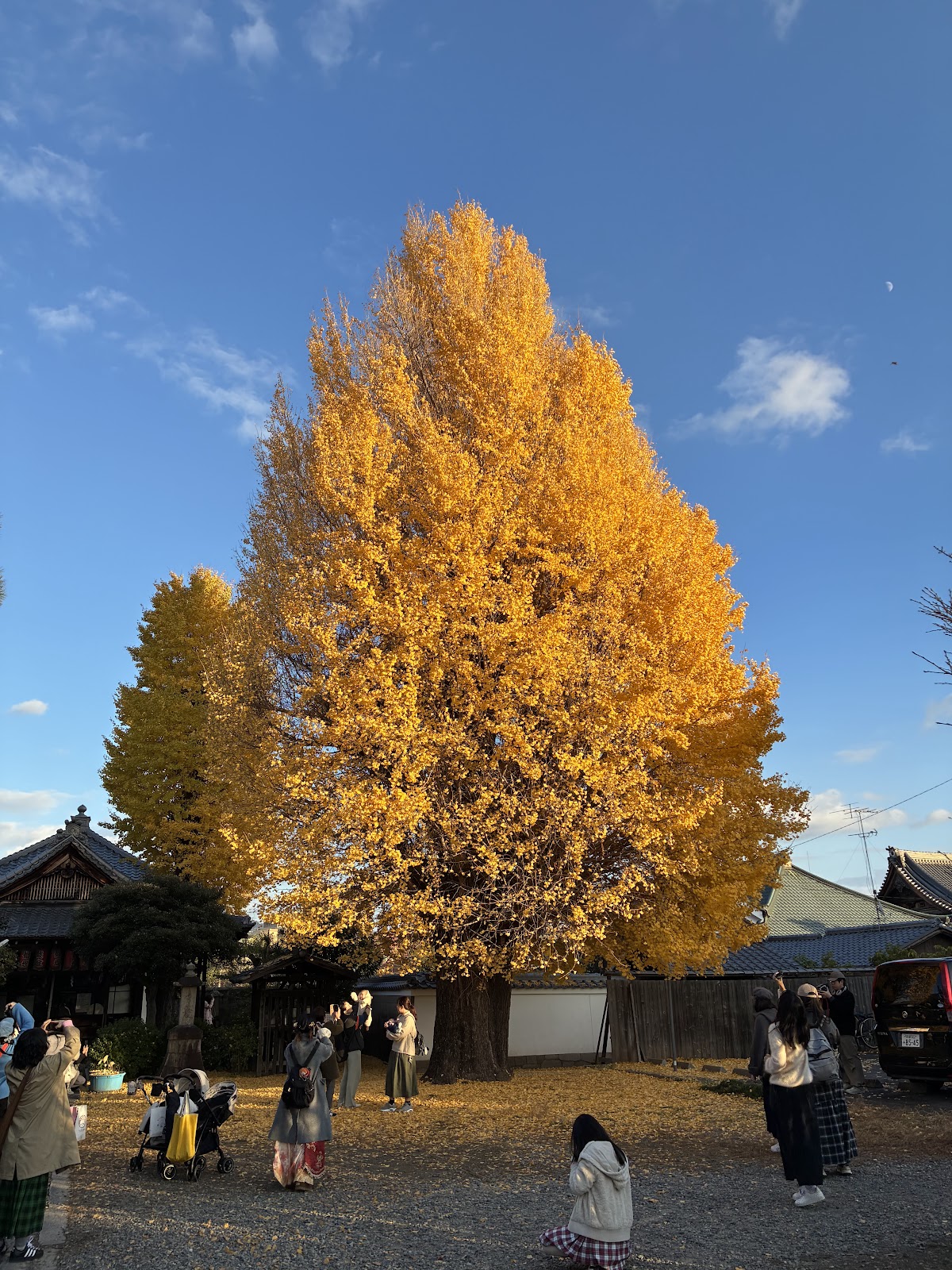
The greatest highlight of Keikoji Temple is the giant ginkgo tree that stands as if protecting the temple grounds. Estimated to be over 400 years old, this ancient tree may have watched over the temple grounds since its founding.
Spring to Summer: Lush green leaves create refreshing shade within the temple grounds.
Autumn (Mid-to-Late November): The grounds are bathed in a golden hue, enveloped in a carpet of yellow.
Winter: The powerful branches after leaf fall convey the weight of the temple’s history.
The autumn foliage season, in particular, is breathtaking and has become a hidden photography spot for local photography enthusiasts. Because it’s not as crowded as famous tourist temples, you can enjoy the autumn scenery at your leisure.
Main Hall and the Ten Realms Mandala
The principal image of Keikoji Temple is the Ten Realms Mandala. In the Nichiren sect, it is common to use a mandala, which is an iconographic representation of the teachings of the Lotus Sutra, as the principal image, expressing the teaching that Buddha-nature resides in all ten realms (Hell, Hungry Ghosts, Animals, Asuras, Humans, Devas, Shravakas, Pratyekabuddhas, Bodhisattvas, and Buddhas).
The main hall, though simple, is built with dignity, exuding the dignified atmosphere characteristic of a Nichiren Buddhist temple. While usually quiet, the temple grounds resonate with chanting during religious services, creating a solemn and reverent atmosphere befitting a place of faith.
Atmosphere of the Temple Grounds
Located slightly off Jofukuji Street, Keikoji Temple is situated in a quiet environment surrounded by residential areas. Its location west of Tachibana Park gives it the impression of a temple deeply integrated into the community.
The temple grounds are small but meticulously maintained, giving a sense of cleanliness. While lacking the flashy appearance of a tourist temple, this is precisely why it can be considered a valuable space where one can experience Kyoto’s “living place of faith.”
Information on Goshuin (Temple Seals) and Goshuincho (Seal Books)
About Goshuin
Goshuin (temple seals) are available at Keikoji Temple. The goshuin, featuring the powerful calligraphy of “Chishōzan Keikoji” (智照山 恵光寺), is a popular memento of a visit.
Features of the Goshuin (Temple Seal):
- The characters “Eikoji” or “Jikkai Mandala” are in the center.
- The temple’s mountain name, “Chishōzan,” is stamped.
- A stamp indicating the Nichiren sect is present.
- The date is written in ink.
When receiving a Goshuin, please be sure to complete your prayers before speaking to the priest at the main hall or the temple’s living quarters. It’s important to remember that the Goshuin is a symbol of faith, not a stamp rally.
About Goshuincho (Stamp Books):
We recommend asking directly about the availability of Eikoji’s original Goshuincho upon your visit. As it is a small temple, they may not always be available.
Precautions When Receiving a Goshuin:
- Prior Contact: As it is a small temple, the head priest may be absent. If you want to be sure to receive a Goshuin (temple stamp), we recommend checking in advance by phone (075-441-3903).
- Visiting Manners: First, bow and pray at the main hall, then request a Goshuin.
- Goshuin Fee: Generally, it is around 300 to 500 yen, but please offer whatever you feel is appropriate.
- Time of Day: Avoid early mornings and late evenings; 10:00 AM to 4:00 PM is generally safe.
Access and Transportation Information
Access by Train
From Imadegawa Station on the Kyoto Municipal Subway Karasuma Line
- Approximately 20 minutes on foot (approx. 1.5 km)
- From Exit 6, head west, go north on Karasuma Street, then west on Imadegawa Street, and then north on Jofukuji Street.
From Kitano-Hakubaicho Station on the Keifuku Electric Railway Kitano Line
- Approximately 19 minutes on foot (approx. 1.4 km)
- From the station, head southeast via Imadegawa Street to Jofukuji Street.
Access by Bus (Recommended)
Since it’s a bit of a distance from the train station, using Kyoto City Buses is convenient.
From the “Imadegawa Jofukuji” bus stop:
- Approximately 3 minutes on foot
- The nearest bus stop, the shortest distance to the temple
- Available routes: Routes 201, 203, etc.
From the “Senbon Imadegawa” bus stop:
- Approximately 5 minutes on foot
- A major bus stop where multiple routes stop
- Available routes: Routes 10, 50, 51, 201, 203, etc.
Access by Car and Parking
Parking: Please inquire with the temple in advance regarding the availability of a dedicated parking lot (075-441-3903). As it is a small temple, there may not be a dedicated parking lot.
Nearby Coin Parking: Since the surrounding area is residential, coin parking is limited. We recommend using public transportation whenever possible.
Car Navigation Settings:
Address: 1-562-5 Sasaya-cho, Kamigyo-ku, Kyoto City, Kyoto Prefecture
Phone Number: 075-441-3903
Access Points
- Jofukuji-dori is a relatively narrow street running north-south.
- It is located a short distance north from the intersection with Ichijo-dori.
- It is easy to find using Tachibana Park as a landmark (west side of the park).
- As it is located in a residential area, signs are inconspicuous. We recommend using a map app.
Visiting Information and Manners
Visiting Hours and Admission Fee
Visiting Hours: There are no specific hours, but it is preferable to visit during reasonable hours (around 9:00 AM to 5:00 PM).
Admission Fee: Free (grounds are freely accessible).
Closed Days: None (however, visits may be closed for religious services, etc.)
As it is a small temple, internal viewing may not be available on a regular basis. The main focus will be visiting the temple grounds and admiring the large ginkgo tree.
Manners for Visiting
- Please be quiet: As the temple is located in a residential area, please refrain from loud conversations.
- Photography: Photography of the temple grounds and the large ginkgo tree is generally permitted, but consideration should be given to avoid including the interior of the main hall or other visitors in the photos.
- Please take your trash with you: As it is a small temple, there may not be trash cans.
- No smoking: Smoking is prohibited on the temple grounds.
- Pets: Generally, pets should not be brought into temples.
Nearby Tourist Attractions
There are several historical sites within walking distance of Keikoji Temple.
Kitano Tenmangu Shrine
Located about 1km northwest of Keikoji Temple, a 15-minute walk, this is the head shrine of all Tenmangu shrines nationwide, dedicated to Sugawara no Michizane, the god of learning. It is also famous for its plum blossoms, and the temple is bustling with many visitors on the 25th of each month.
Senbon Shakado (Daihoonji Temple)
Approximately 800m east, about a 10-minute walk. This ancient temple boasts the oldest wooden building in Kyoto, the main hall (a National Treasure). It’s also known for the Okame legend, and its December “Daikon-daki” (radish stew) is a winter tradition.
Seimei Shrine
Approximately 1.3km southeast, about a 15-minute walk. This shrine enshrines Abe no Seimei, a Heian period Onmyoji (diviner), and has recently gained popularity as a power spot.
Kyoto Gyoen National Garden/Kyoto Imperial Palace
Approximately 1.5km east. A classic Kyoto sightseeing spot where you can enjoy a vast park and historical buildings for free.
Recommended Time to Visit Keikoji Temple
Autumn (mid- to late November)
This is the most recommended time. The large ginkgo tree turns golden, and the temple grounds are covered in a carpet of yellow fallen leaves. While Kyoto’s autumn foliage season sees crowded temples and tourist spots, Keikoji Temple is a relatively quiet hidden gem where you can enjoy the autumn scenery.
Best time to visit: Mid-November to late November (may vary depending on the weather)
Recommended time of day: Viewing in the soft morning light is recommended.
Spring (April-May)
The season of fresh green leaves is also beautiful, with the young ginkgo leaves creating a refreshing atmosphere. It’s a time when there are fewer tourists, allowing for a peaceful visit.
Winter (December-February)
The powerful branches of the ginkgo trees after leaf fall, and visiting in the crisp winter air, offer a unique charm. On snowy days, a beautiful landscape unfolds, reminiscent of an ink painting.
Cultural Properties and Treasures of Keikoji Temple
The Great Ginkgo Tree (Kyoto City’s Designated Protected Tree)
The Great Ginkgo Tree, estimated to be over 400 years old, is a symbolic presence at Keikoji Temple. It may be designated as a protected tree by Kyoto City (confirmation needed), and is carefully protected as a valuable natural heritage of the region.
Ten Realms Mandala (Main Image)
The Ten Realms Mandala, enshrined as the main image in Nichiren Buddhist temples, is a visual representation of the worldview of the Lotus Sutra. While usually not open to the public, it is an important object of worship embodying the doctrines of Nichiren Buddhism.
Anecdotes and Legends Related to Keikoji Temple
The Devotion of Myoho-ni
Myoho-ni (Isa), the temple’s founder, suffered the tragedy of her husband’s assassination, yet she did not succumb to hatred, instead devoting herself to Buddhism and continuing to pray for his soul. This attitude is still recounted today as an example of the strength of women and the power of Buddhist faith in the turbulent Sengoku period.
A Temple That Escaped War
Kyoto has been struck by war numerous times, including the Ōnin War, but Keikōji Temple, being a relatively small temple, fortunately escaped major damage. It also avoided the air raids of World War II, preserving the atmosphere of its ancient grounds to this day.
Frequently Asked Questions (FAQ)
Q1: How much is the entrance fee to Keikōji Temple?
A1: There is no entrance fee to Keikōji Temple. You can freely enter the temple grounds. However, if you wish to receive a temple stamp (Goshuin), there is usually a fee of around 300 to 500 yen.
Q2: When is the best time to see the large ginkgo tree at Keikōji Temple?
A2: The best time to see the large ginkgo tree is usually from mid-November to late November. However, this can vary depending on the weather each year, so we recommend checking the latest autumn foliage information before visiting. It is especially beautiful to view in the soft morning light.
Q3: Does Keikoji Temple have a parking lot?
A3: Please contact the temple (075-441-3903) in advance to inquire about the availability of a dedicated parking lot. As it is a small temple, there may not be a dedicated parking lot. Since the surrounding area is a residential area with limited coin-operated parking, we recommend using public transportation.
Q4: Is it guaranteed that I will receive a Goshuin (temple stamp)?
A4: As it is a small temple, the head priest may be absent. If you want to be sure to receive a Goshuin, we recommend calling in advance (075-441-3903). Also, it is considered good manners to request a Goshuin after completing your prayers.
Q5: Is photography allowed at Keikoji Temple?
A5: Photography of the temple grounds and the large ginkgo tree is generally permitted. However, consideration is needed when photographing inside the main hall or when other visitors are included in the photos. Also, as it is located in a residential area, please be considerate of the privacy of the surrounding residents.
Q6: What is the most convenient way to access Keikoji Temple?
A6: Using the Kyoto City Bus is the most convenient. It’s about a 3-minute walk from the “Imadegawa Jofukuji” bus stop, or about a 5-minute walk from the “Senbon Imadegawa” bus stop. It takes about 20 minutes to walk from Imadegawa Subway Station, so we recommend taking a bus from the station.
Q7: Is Keikoji Temple crowded with tourists?
A7: Keikoji Temple is not a famous tourist temple, so there are relatively few tourists, allowing for a peaceful visit. Even during the autumn ginkgo tree season, it is rarely crowded. It’s a hidden gem in Kyoto, a great place to spend time at a leisurely pace.
Q8: Who was Nomoto Teruhisa, who was involved in the founding of Keikoji Temple?
A8: Nomoto Shikibu-no-Shoyu Teruhisa was a samurai who served Ashikaga Yoshiteru, the 13th Shogun of the Muromachi Shogunate. His posthumous Buddhist name was Keikō, which is the origin of the temple’s name. He met a tragic end, assassinated by a retainer of Miyoshi Nagayoshi. His wife, Isa (Myōhōni), converted their residence into a temple to mourn her husband, marking the beginning of Keikōji Temple.
Summary: The Charm of Keikōji Temple, a Quiet Place of Prayer
While Keikōji Temple has a history born from the tragedy of the Sengoku period, it is now a temple deeply rooted in the community as a quiet place of prayer. The temple grounds, watched over by a ginkgo tree over 400 years old, offer a healing space that allows you to forget the hustle and bustle of Kyoto.
It lacks the flashiness of famous tourist temples, but that’s precisely why you can feel the “faith that breathes in everyday life” of Kyoto. It’s especially recommended during the autumn foliage season as a hidden gem to quietly enjoy Kyoto’s autumn.
Visiting it in conjunction with other nearby attractions such as Kitano Tenmangu Shrine and Senbon Shakadō Temple will allow you to experience Kyoto’s history and culture more deeply. Why not take some time to reflect on the thoughts and feelings of the people who lived through the turbulent Sengoku period while receiving a Goshuin (temple stamp)?
Points to note when visiting:
- The large ginkgo tree in autumn is a must-see (mid-to-late November)
- It is recommended to contact the temple in advance if you wish to receive a Goshuin
- As it is located in a quiet residential area, please observe proper etiquette when visiting
- It is recommended to combine your visit with other nearby tourist spots
- Using public transportation (especially buses) is convenient
Eikoji Temple is a hidden gem that quietly conveys the profound charm of Kyoto. Please do visit it at least once.