Myorenji Temple (Kyoto Prefecture) Complete Guide | History, Highlights, Seasonal Flowers, and Access Information
Located in the Nishijin area of Kamigyo Ward, Kyoto City, Myorenji Temple is the oldest Honmon Hokke sect temple in Kyoto, founded in 1294. Established by Nichizo Shonin, a senior disciple of Nichiren Daishonin, as a base for missionary work in Kyoto, this temple boasts a history of over 700 years and is known as the “Temple of Flowers,” captivating visitors with its beautiful seasonal blossoms. This article provides a detailed overview of Myorenji Temple, from its historical background to its cultural assets, highlights, and visiting information.
History and Origins of Myorenji Temple
The Beginning of Nichizo Shonin’s Missionary Work in Kyoto
Myorenji Temple is known as the temple where Nichizo Shonin, entrusted with the mission of missionary work in Kyoto by Nichiren Daishonin, first took off his sandals upon arriving in Kyoto. In 1294, when Nichizo Shonin began his missionary work in Kyoto, the Yanagiya Nakaoki couple donated their residence, marking the beginning of Myorenji Temple’s founding.
Nichizo Shonin, as a direct disciple of Nichiren Shonin, was tasked with spreading his master’s teachings in Kyoto. At that time, Kyoto was dominated by other Buddhist sects, making the propagation of the Lotus Sutra extremely difficult. However, through Nichizo Shonin’s fervent missionary work, he gradually gained followers. Myorenji Temple is an important temple that can be considered the origin of the Nichiren sect (Honmon Hokke sect) in Kyoto.
Numerous Relocations and Reconstruction in the Tensho Era
The history of Myorenji Temple is also a history of numerous relocations. Initially located in a different place than its current location, it was forced to move several times due to wars and urban planning.
In 1587, with the construction of Jurakudai Palace by Toyotomi Hideyoshi, it was relocated to its current location at Teranouchi-dori, Omiya-higashi-iri. This relocation resulted in Myorenji Temple settling into its current form. The main hall is said to have been constructed using leftover wood from the Hokoji Temple’s Great Buddha Hall, making it a valuable structure that conveys the history of the Toyotomi regime.
Status as a Head Temple of the Honmon Hokke Sect
Myorenji Temple is a head temple of the Honmon Hokke sect and is counted among the sixteen head temples of Kyoto. Its mountain name is Ubokusan, and its principal image is the Ten Realms Mandala. The temple grounds contain eight sub-temples, attesting to its former status as a large temple complex.
The Honmon Hokke sect, as a sect that orthodoxly inherits the teachings of Nichiren Shonin, has many followers. Myorenji Temple, as a central temple of this sect, continues to welcome many worshippers and tourists.
Cultural Assets and Highlights of Myorenji Temple
Screen Paintings by the Hasegawa Tohaku School
Myorenji Temple’s storage houses screen paintings by the Hasegawa Tohaku school, a leading painter of the Azuchi-Momoyama period. These 16 screen paintings are known as masterpieces that beautifully blend Tohaku’s powerful brushwork and delicate expression.
Hasegawa Tohaku was a master painter who stood in opposition to the Kano school, leaving behind national treasure-class works such as the “Pine Forest Screen.” The screen paintings at Myorenji Temple are highly valued in art history as important cultural assets demonstrating the high level of skill of Tohaku and his school.
Matsuo-sha Issaikyo and Valuable Cultural Assets
In addition to the screen paintings by Hasegawa Tohaku, Myorenji Temple houses many cultural assets, including the Matsuo-sha Issaikyo (complete collection of Buddhist scriptures). The Issaikyo is a comprehensive collection of Buddhist scriptures and is an extremely important resource for Buddhist studies.
These cultural artifacts demonstrate that Myorenji Temple has functioned not only as a place of worship but also as a center of culture and learning. The temple’s storage facilities also carefully preserve other historically valuable Buddhist statues and calligraphic works.
The Beauty of the Sixteen Arhats Stone Garden
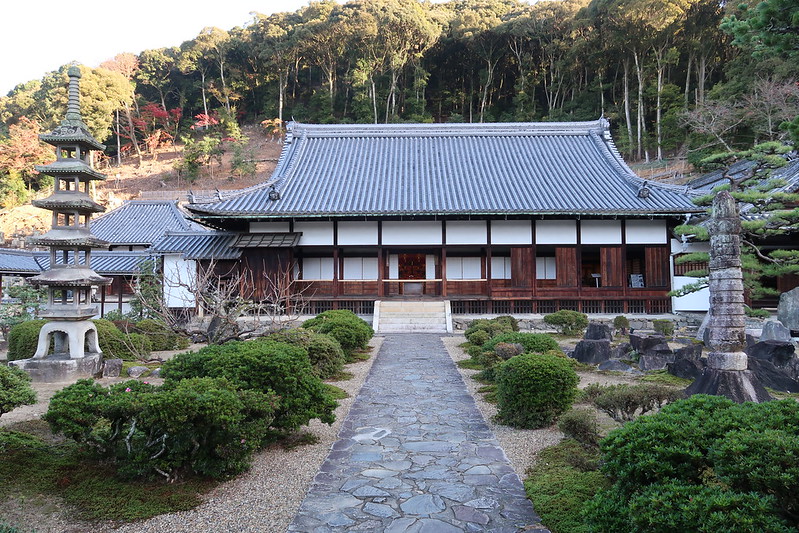
Within the grounds of Myorenji Temple is a viewing stone garden called the “Sixteen Arhats Stone Garden.” This unique garden, which depicts the sixteen Arhats with stones, has a different character from the dry landscape gardens of Zen temples.
The arrangement of the stones is said to visually represent Buddhist teachings, and it is believed that one can attain inner peace by quietly gazing upon it. The beauty of the stone garden, harmonizing with the plants of each season, leaves a deep impression on visitors.
Fusuma Paintings in the Inner Study
In the inner study, four fusuma paintings depicting the four seasons, painted by contemporary artist Kono Baikei, span four panels. In contrast to traditional wall paintings, these works, painted with a modern sensibility, demonstrate Myorenji Temple’s attitude of embracing new culture while preserving tradition. The delicately depicted scenes of each of the four seasons in the fusuma (sliding door) paintings are works of art that allow us to rediscover the beauty of Japan’s four seasons.
The Four Seasons of Myorenji Temple, the “Temple of Flowers”
The Miracle of the Oeshiki Cherry Blossom
Myorenji Temple is particularly famous as the “Temple of Flowers” for the presence of the Oeshiki cherry blossoms, which bloom continuously from October to April of the following year. While ordinary cherry blossoms bloom only for a short period in spring, the Oeshiki cherry blossom is a rare variety that blooms intermittently from autumn to spring.
The name Oeshiki cherry blossom originates from “Oeshiki,” the anniversary of the death of Nichiren Shonin on October 13th. These cherry blossoms begin to bloom in autumn, as if in remembrance of Nichiren Shonin, and continue to bloom through winter and into spring. Their pale pink petals are a precious presence that beautifies the temple grounds during the cold season, and are loved by many visitors.
The Winter Colors of Myorenji Temple Camellias
In winter, the beautiful camellias known as “Myorenji Camellias” adorn the temple grounds. Camellias have long been cherished as a representative flower of Japanese winter, but Myorenji Temple’s camellias are particularly rich in variety, allowing visitors to enjoy flowers of various colors and shapes.
The red, white, and pink camellia blossoms blooming in the snow-covered temple grounds stand out even more vividly in the winter silence, bringing warmth and hope to visitors. The best time to see the camellias is from December to March, and along with the Oeshiki cherry blossoms, they are an important flower that colors Myorenji Temple in winter.
Magnolias and Cherry Blossoms in Spring
In March, magnolia blossoms bloom profusely in the temple grounds. The large white, pink, and purple petals are a beloved symbol of the arrival of spring. The magnolia’s flower meanings include “love of nature” and “nobility,” perfectly fitting the atmosphere of the temple.
In spring, the Oeshiki cherry blossoms reach their peak, beautifully adorning the temple grounds alongside the regular cherry blossoms. The sight of cherry blossoms and magnolias blooming simultaneously is truly a breathtaking display of springtime beauty.
Lotus Flowers in Early Summer
From late June to July, the lotus flowers, which are the origin of the temple’s name, bloom. In Buddhism, the lotus is considered a symbol of enlightenment because it blooms purely from the mud.
At Myorenji Temple, the lotus flowers are planted in pots and ponds, and you can witness them blooming in the early morning. Lotus flowers are said to be most beautiful in the morning, making it well worth getting up early to visit. The pure pink and white flowers further enhance the atmosphere of the Buddhist temple.
Hibiscus and Drunken Hibiscus in Late Summer and Autumn
From August to September, the hibiscus and drunken hibiscus, representative flowers of Myorenji Temple, adorn the temple grounds. Myorenji Temple is widely known as a temple famous for its hibiscus flowers, and many tourists visit during this season.
Hibiscus flowers are beautiful with large petals, and pink and white blossoms bloom one after another. The “Drunken Hibiscus” in particular is a fascinating flower; its white blossoms change to pink by midday and then to a deep crimson by evening. It was named “Drunken Hibiscus” because its color changes as if it were intoxicated.
The hibiscus flowers planted throughout the temple grounds allow visitors to feel the changing seasons from the end of summer to the beginning of autumn.
Myorenji Temple Visiting Information
Basic Information
Location: Myorenji-mae-cho, Teranouchi-dori, Omiya-higashi-iru, Kamigyo-ku, Kyoto City, Kyoto Prefecture
Sect: Honmon Hokke-shu
Mountain Name: Utsukiyama
Principal Image: Jikkai Mandala
Founder: Nichizo Shonin
Established: Einin 2 (1294)
Visiting Hours and Admission Fee
While Myorenji Temple’s grounds are generally open to visitors, admission fees may apply for viewing cultural properties or during special exhibitions. Please check the official website or contact the temple directly for details.
General visiting hours are during the daytime, but these may vary depending on the season and events. It is recommended to check before visiting.
Access Methods
Access by Train:
- Approximately 10 minutes on foot from Kuramaguchi Station on the Kyoto Municipal Subway Karasuma Line
- Approximately 15 minutes on foot from Imadegawa Station on the Kyoto Municipal Subway Karasuma Line
Access by Bus:
- Approximately 5 minutes on foot from the Horikawa Teranouchi bus stop (Kyoto City Bus)
- Approximately 7 minutes on foot from the Tenjin Koen-mae bus stop (Kyoto City Bus)
Access by Car:
- Approximately 30 minutes from the Kyoto Minami Interchange (Meishin Expressway)
- Parking is limited, so we recommend using public transportation.
Nearby Tourist Attractions
Myorenji Temple is located in the Nishijin area, and there are many tourist attractions nearby.
Kitano Tenmangu Shrine: A shrine dedicated to Sugawara no Michizane, known as the god of learning. Also famous for its plum blossoms. Approximately 15 minutes on foot from Myorenji Temple.
Seimei Shrine: A shrine dedicated to Abe no Seimei, an Onmyoji (diviner) of the Heian period. Popular as a power spot. Approximately 10 minutes on foot from Myorenji Temple.
Daitokuji Temple: The head temple of the Daitokuji branch of the Rinzai school of Zen Buddhism. It has many sub-temples and is known for its dry landscape garden and tea ceremony culture. Approximately 15 minutes on foot from Myorenji Temple.
Nishijin Textile Center: A facility where you can learn about the history and production process of Nishijin weaving, a traditional Kyoto craft. Approximately 10 minutes on foot from Myorenji Temple.
Nearby Gourmet Information
The Nishijin area has many restaurants with a distinctly Kyoto atmosphere.
Kyoto Cuisine Restaurants: Many long-established restaurants offering Kyoto-style kaiseki and other Kyoto cuisine using seasonal ingredients are scattered throughout the area.
Machiya Cafes: Cafes renovated from traditional Kyoto townhouses where you can enjoy matcha sweets and Japanese confectionery.
Soba and Udon Restaurants: Enjoy elegant noodle dishes using Kyoto-style broth.
Bakeries: Kyoto is actually a city with a high bread consumption rate. There are also many popular local bakeries.
Points to Note When Visiting Myorenji Temple
Manners for Visiting Temples
When visiting a temple, please observe the following basic manners:
- Bow at the Temple Gate: Bow before entering the temple grounds to compose yourself.
- Be Quiet: Be quiet within the temple grounds and avoid disturbing other visitors.
- Photography: Be mindful of areas where photography is prohibited and cultural properties; only take photos where permitted.
- Attire: Avoid revealing clothing and dress appropriately.
Recommended Time to Visit
Myorenji Temple is worth visiting throughout the year as you can enjoy flowers in every season, but the following times are especially recommended:
October to April: This is the time to enjoy the Oeshiki cherry blossoms. The Oeshiki ceremony in October, in particular, is held, creating a special atmosphere.
December to March: The beautiful winter season when Myorenji Temple’s camellias bloom. It’s especially picturesque on snowy days.
March: The beginning of spring when magnolias are in full bloom. Enjoy the spectacle of them blooming alongside the cherry blossoms.
August to September: The peak season for hibiscus and Confederate Rose. This is the season for Myorenji Temple’s representative flowers.
Guided Tours by a Dedicated Guide
At Myorenji Temple, guided tours by a dedicated guide may be available with prior reservation. Visiting while listening to detailed explanations about the temple’s history and cultural assets will lead to a deeper understanding and appreciation.
For information on the availability and cost of guided tours, please check the official website or contact the temple directly.
Annual Events at Myorenji Temple
Oeshiki Ceremony
The Oeshiki Ceremony, held on October 13th, is an important memorial service commemorating the death anniversary of Nichiren Shonin. On this day, many believers gather for memorial services and sermons. It’s also the time when the Oeshiki cherry blossoms begin to bloom, creating a special atmosphere for worship.
Other Annual Events
Myorenji Temple holds various memorial services and events throughout the year. Traditional Buddhist temple events such as the New Year’s visit, the spring and autumn equinox services, and the Obon memorial service are all preserved.
Voices of Visitors to Myorenji Temple
Visitor Trends
Visitors to Myorenji Temple come from diverse backgrounds, including those interested in history and culture, flower lovers, and those seeking quiet time. Even during peak tourist seasons, the atmosphere is relatively calm, making it especially recommended for those who want to escape the hustle and bustle of Kyoto and relax.
The number of foreign tourists is also increasing, and it’s gaining popularity as a place to experience traditional Japanese temple culture.
Appeal as Seen Through Reviews
Visitors have shared the following comments:
- “The flowers of each season are beautiful, and there are new discoveries every time you visit.”
- “The Sixteen Arhat Stone Garden is wonderful and calming.”
- “I was moved by the long-lasting bloom of the Oeshiki cherry blossoms.”
- “I was thrilled to see Hasegawa Tohaku’s screen paintings up close.”
- “It’s nice that there are few tourists, allowing for a quiet visit.”
Accommodation near Myorenji Temple
There are various types of accommodations near Myorenji Temple.
Luxury Ryokan: Traditional inns where you can enjoy Kyoto-style hospitality and Kyoto cuisine.
Business Hotel: Affordable hotels offering comfortable stays.
Guest House: Reasonably priced accommodations where you can also enjoy international exchange.
Machiya Inn: Accommodations offering a special experience of staying in a traditional Kyoto townhouse.
Many hotels are located around Kyoto Station and the Kawaramachi area, and Myorenji Temple is accessible from there in about 30 minutes by public transport.
Planning Your Visit to Myorenji Temple
Model Itinerary
Half-Day Itinerary:
- 10:00 Arrive at Myorenji Temple, stroll around the grounds
- 10:30 Visit the main hall, view cultural artifacts
- 11:00 Relax in the Sixteen Arhat Stone Garden
- 11:30 Stroll around the surrounding Nishijin area
- 12:30 Lunch at a nearby cafe or restaurant
Full-Day Itinerary:
- 9:30 Arrive at Myorenji Temple, stroll through the quiet grounds in the morning
- 10:00 Visit the main hall, view cultural artifacts
- 11:00 Move to Kitano Tenmangu Shrine
- 12:00 Lunch in the surrounding area
- 13:30 Visit Seimei Shrine
- 14:30 Visit Nishijin Textile Center
- 16:00 Visit Daitokuji Temple
- 17:30 End of Itinerary
Travel Planning Tips
Consider the Season: Plan your visit to coincide with the blooming season of the flowers you want to see.
Allow plenty of time: Plan your visit with ample time to stroll through the temple grounds and enjoy a peaceful time.
Combine with surrounding attractions: Combine your visit with other sightseeing spots in the Nishijin or Kitano areas to efficiently enjoy Kyoto sightseeing.
Use public transportation: Due to frequent traffic congestion in Kyoto city, using public transportation such as the subway and buses is recommended.
Summary
Myorenji Temple, the head temple of the Honmon Hokke sect, is the oldest Honmon Hokke sect temple in Kyoto with a history of over 700 years, and continues to fascinate visitors with its rich cultural assets and beautiful flowers throughout the seasons. It is the starting point of missionary work in Kyoto founded by Nichizo Shonin, and is an important temple that houses valuable cultural assets such as screen paintings by Hasegawa Tohaku and the Matsuo Shrine Sutra.
As a “flower temple” where you can enjoy different flowers in each season, such as the Oeshiki cherry blossoms, Myorenji camellias, hibiscus, and drunken hibiscus, it is worth visiting throughout the year. The serene beauty of the Sixteen Arhats Stone Garden deeply moves those seeking peace of mind.
Easily accessible by Kyoto City Subway and bus, the temple is surrounded by numerous tourist attractions such as Kitano Tenmangu Shrine, Seimei Shrine, and Daitoku-ji Temple. Why not spend some relaxing time at Myoren-ji Temple while experiencing the history and culture of the Nishijin area?
When planning your Kyoto trip, be sure to include Myoren-ji Temple as one of your destinations to experience the beauty of traditional Japanese culture and nature.