Complete Guide to Kubizuka Daimyojin (Kyoto Prefecture) | The Legend of Shuten-doji and a Historical Spot at Oinosaka Pass
Located at Oinosaka Pass in Nishikyo Ward, Kyoto City, Kubizuka Daimyojin is a mystical historical site with a legend that the head of Shuten-doji, one of Japan’s three greatest evil yokai (supernatural beings), is buried there. This small shrine, standing on the border between Kyoto and Tanba, strongly reflects the story of demon slaying that has continued since the Heian period, and the spirituality of the Japanese people.
This article thoroughly explains the charm of this mystical spot, from the historical background of Kubizuka Daimyojin and the details of the Shuten-doji legend to access methods and highlights for visitors.
What is Kubizuka Daimyojin? | The Head of the Demon King Sleeping on Kyoto’s Border
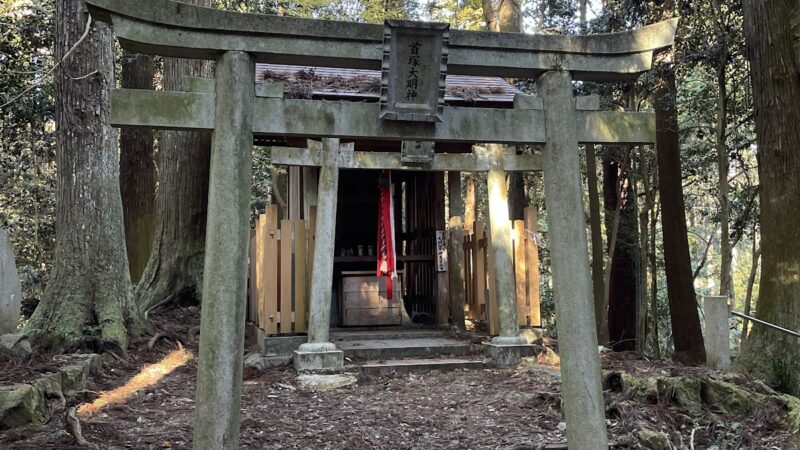
Kubizuka Daimyojin is a small shrine located at Oinosaka Pass in Oeda Kutsukake-cho, Nishikyo Ward, Kyoto City. Located along a mountain pass at an altitude of approximately 270 meters, it is situated slightly off National Route 9.
This area has historically been a crucial boundary point on a major road connecting Kyoto and Tanba (present-day Kameoka area). During the Sengoku period, it is also a historical site where Akechi Mitsuhide crossed the pass on his way to Kyoto during the Honnoji Incident.
The most distinctive feature of Kubizuka Daimyojin is the legend that the head of Shuten-doji, a legendary demon from the Heian period, is buried here. Because of this legend, the place possesses a sense of mystery and awe that transcends mere historical significance, and it continues to attract many worshippers and history enthusiasts.
Basic Information about Kubizuka Daimyojin Shrine
Location: Oeda Kutsukake-cho, Nishikyo-ku, Kyoto City, Kyoto Prefecture
Elevation: Approximately 270 meters
Deity: Enshrined as the burial mound of Shuten-doji
Annual Festival: Held every April
Visiting Hours: Open 24 hours (be careful of your footing at night)
Admission Fee: Free
Parking: None (park in a safe place on the roadside)
The Legend of Shuten-doji | A Demon-Slaying Tale from the Heian Period
Understanding Kubizuka Daimyojin Shrine requires understanding the legend of Shuten-doji. This story originated in the mid-Heian period and is one of the most famous demon legends in Japan.
Who Was Shuten-doji?
Shuten-doji was the leader of demons said to have lived on Mt. Oe (or Mt. Oeda) in Tanba Province during the early Heian period. He is said to have been over 6 meters tall, with a red face, five horns, and fifteen eyes.
His name, “Shuten-doji,” is believed to have originated from his extreme love of sake. He led his demon followers to Kyoto, where he committed all sorts of evil deeds, including kidnapping young women and daughters of court nobles and plundering treasures.
Minamoto no Yorimitsu’s Demon Slayer
As the damage in Kyoto escalated, Emperor Ichijo issued an imperial order to the warrior Minamoto no Yorimitsu to subdue Shuten-doji. Minamoto no Yorimitsu, accompanied by his elite warriors known as the “Four Heavenly Kings of Yorimitsu,” headed towards Mount Oe.
The members of the Four Heavenly Kings are as follows:
- Sakata Kintaro: A samurai known for his superhuman strength
- Watanabe Tsuna: Yorimitsu’s chief retainer
- Urabe Suetake: A master archer
- Usui Sadamitsu: A master swordsman
The group disguised themselves as mountain ascetics and infiltrated Mt. Oe, where they gave Shuten-doji a special sake called Jinbenkidokushu. This sake was harmless to humans but poisonous to demons.
While Shuten-doji was drunk and asleep, Minamoto no Yorimitsu and his men attacked him all at once. After a fierce battle, Yorimitsu successfully beheaded Shuten-doji.
The reason why the head stopped moving
Having successfully defeated Shuten-doji, Minamoto no Yorimitsu and his men attempted to bring Shuten-doji’s head back to the capital as proof. When Sakata Kintoki carried the chest containing the head of Shuten-doji to the Oinosaka Pass, a strange event occurred.
The Jizo statue enshrined at the pass suddenly emitted a light and declared, “You must not bring such an impure thing as a demon into the capital!” Suddenly, the chest, which Sakata Kintoki had been lifting, became incredibly heavy, and even with his immense strength, he could no longer lift it.
The group had no choice but to bury Shuten-doji’s head at the Oinosaka Pass and build a mound to enshrine it. This is considered the origin of the present-day Kubizuka Daimyojin (Head Mound Great Deity).
Meaning of the Legend
This legend is not simply a story of demon slaying; it contains several important meanings.
Concept of Boundaries: The Oinosaka Pass was the boundary between Kyoto and Tanba, a boundary separating the capital from the outside world. Burying the demon’s head at this boundary symbolizes preventing evil from entering the capital.
The Concept of Purity and Impurity: The Jizo Bodhisattva’s refusal to allow the demon’s head into the capital reflects the Heian period’s concept of purity and impurity. It reflects the idea that the capital was a pure space, and that impure things should be confined to its boundaries.
Appeasing and Worship: The careful burial of the demon’s head and the construction of a mound for worship demonstrate the Japanese spirit of “appeasing vengeful spirits.” This legend embodies a culture of commemorating even defeated enemies.
History and Transformation of Kubizuka Daimyojin
The history of Kubizuka Daimyojin dates back to the Heian period, when the Shuten-doji legend originated, but it underwent many years and transformations before reaching its current form.
From the Heian Period to the Edo Period
According to legend, the Kubizuka mound was first built in the early Heian period, but the exact date is uncertain. It is believed to have existed as a simple mound at that time.
From the medieval to the early modern period, the Oinosaka Pass developed as an important highway connecting Kyoto and Tanba, becoming a place where many travelers passed through. The Kubizuka (head mound) came to be recognized as a landmark on the pass and a place to pray for safe travels.
During the Edo period, the story of Shuten-doji became widely known as a subject for Joruri and Kabuki plays, and interest in the Kubizuka increased. It is believed that around this time, it was deified as “Kubizuka Daimyojin” and a small shrine was erected.
Changes after the Meiji Era
Due to the Meiji-era separation of Shinto and Buddhism, many places of folk worship were reorganized, but Kubizuka Daimyojin was maintained through the faith of the local people.
Since the Showa era, with the development of National Route 9, traffic on the Oinosaka Pass increased. Access to Kubizuka Daimyojin became easier, and it also developed as a tourist spot.
Currently, it is maintained by local volunteers, and an annual festival is held in April. In recent years, it has attracted attention as a power spot and a haunted spot, attracting visitors with various purposes.
Highlights and Visitor Guide
Kubizuka Daimyojin is a small historical site, but its highlights are concentrated within. We will explain in detail the points you should check when visiting.
The Main Shrine
After turning off National Route 9 onto a narrow road, you will immediately see a vermilion torii gate. Passing through the gate, a small shrine sits directly in front.
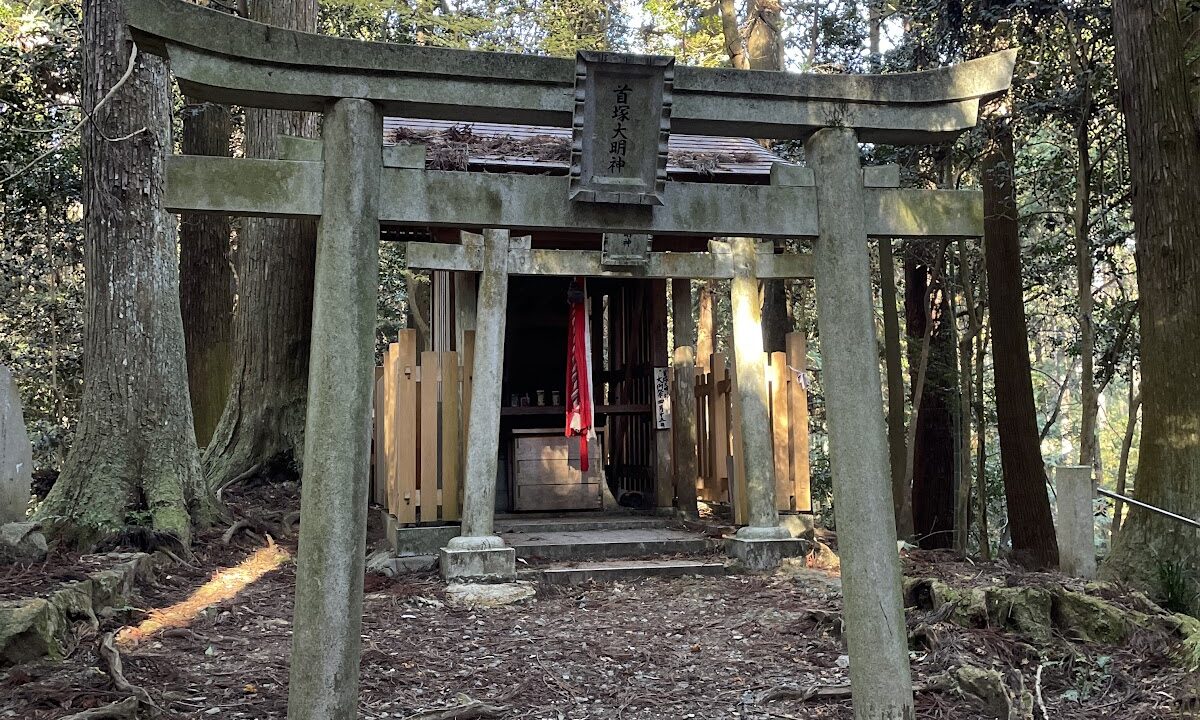
This shrine is a simple wooden structure, but it is carefully maintained, reflecting the deep faith of the local people. A donation box is placed in front of the shrine, where visitors can offer their prayers.
Around the shrine, you may see sake bottles and offerings left by visitors. Because Shuten-doji was fond of sake, the custom of offering sake continues.
The Main Burial Mound Behind the Shrine
Behind the shrine is a mound believed to contain the actual burial of Shuten-doji’s head. It’s a small, raised mound surrounded by stones.
This place is considered particularly sacred, and many worshippers offer prayers here. The mound is surrounded by trees, creating a dim, mystical atmosphere even during the day.
Photography is permitted, but it’s important to treat it with respect. There’s a local legend that says, “Do not carelessly disturb the mound.”
Atmosphere and Precautions within the Shrine Grounds
The grounds of Kubizuka Daimyojin are a tranquil space surrounded by trees. Due to its location on a mountain pass, a breeze constantly blows through, and the sound of rustling leaves can be heard.
Precautions for Visiting:
- Watch your step: Some parts of the grounds are not leveled and can become slippery in rainy weather. Please wear appropriate footwear.
- Nighttime Visits: While the shrine is open 24 hours, there are no lights. A flashlight is essential if visiting at night.
- Caution for Those Seeking Courage: While some visit for paranormal purposes, this is a sacred place. Please refrain from making noise or engaging in disrespectful behavior.
- Handling of Offerings: When offering items, choose those that will not spoil, and take home anything that can be taken away.
About the Annual Festival
Every April, the annual festival of Kubizuka Daimyojin is held. Local parishioners and related parties gather for the Shinto rituals.
The festival prays for the appeasement of Shuten-doji and the safety of the region. General visitors are welcome to participate and experience a solemn atmosphere different from the usual.
The date of the annual festival may vary from year to year, so those wishing to participate are advised to check with the local tourism association beforehand.
Access and Surrounding Information
The most convenient way to access Kubizuka Daimyojin is by car, but it can also be reached by public transport.
Access by Car
From Kyoto City:
- Head towards Kameoka on National Route 9
- The entrance to Kubizuka Daimyojin is located near the “Oinosaka Pass” bus stop, halfway up the Oinosaka Pass
- Travel time: Approximately 30 minutes from Kyoto Station
From Osaka:
- Use the Meishin Expressway or Kyoto Jukan Expressway
- Exit at Kameoka IC and head towards Kyoto on National Route 9
- Travel time: Approximately 1 hour
There is no dedicated parking lot, so you will need to park in a safe place on the shoulder of the road. Please be very careful when parking on National Route 9, as it has heavy traffic.
Access by Public Transportation
By Bus:
- Take a Keihan Kyoto Kotsu bus from Kyoto Station or Hankyu Katsura Station.
- Get off at the “Oinosaka Pass” bus stop.
- Approximately 10 minutes on foot from the bus stop.
By Train:
- The nearest station is JR Sanin Main Line “Hozukyo Station,” but it is about 4 kilometers from the station to Kubizuka Daimyojin, making it difficult to walk.
- We recommend taking a taxi from Hozukyo Station or combining it with a bus.
Nearby Attractions
When visiting Kubizuka Daimyojin, we recommend also visiting nearby historical sites and tourist spots.
Oinosaka Jizo: Located very close to Kubizuka Daimyojin, this Jizo statue is said to have refused to allow Shuten-doji’s head into the capital.
Towards Kameoka:
If you cross the pass and head towards Kameoka, you will find plenty of tourist spots such as the Hozugawa River boat ride and Yunohana Onsen.
Arashiyama/Sagano Area: Returning towards Kyoto city center, you’ll find iconic Kyoto tourist spots such as Togetsukyo Bridge and the Bamboo Grove.
Mt. Oe (Fukuchiyama area): If you have time, it would be interesting to extend your trip to Mt. Oe (Tango Peninsula side), which was Shuten-doji’s base. Historical sites related to Shuten-doji remain here as well.
Mysterious Stories Surrounding Kubizuka Daimyojin
Besides the legend of Shuten-doji, various other mysterious stories and experiences are associated with Kubizuka Daimyojin.
Modern Sightings
Visitors have reported the following experiences:
- Seeing strange lights around the shrine at night
- Feeling a human presence even though no one should be there
- Seeing strange orbs (balls of light) in photographs
- Suddenly experiencing a strong wind in the shrine grounds, causing trees to shake violently
These experiences are sometimes described as paranormal phenomena, but there are also religious interpretations suggesting that “the spirit of Shuten-doji still resides there.”
Aspect as a Ghost Hunting Spot
Kubizuka Daimyojin is also known as a haunted spot in Kyoto, and some people visit it on summer nights for the purpose of testing their courage.
However, locals warn that “this is not a place to visit for fun.” In fact, there are stories of people suffering misfortune after disrespectful behavior.
When visiting, it is important to treat it with respect as a historical site, not as a haunted spot.
The Mystery of the Offerings
At the Kubizuka Daimyojin shrine, large quantities of sake bottles and other unusual offerings are sometimes found.
While sake is understandable as it was favored by Shuten-doji, some modern beverages and sweets are also found. This may be an expression of the worshippers’ wish that “even demons can enjoy modern flavors.”
Furthermore, the number of foreign tourists visiting is increasing, and more people are experiencing Kubizuka Daimyojin from a different cultural perspective. One foreign traveler’s blog describes it as “a very unique spot where Japanese demon culture and the spirit of memorial services are fused.”
Kubizuka Daimyojin and Japanese Demon Culture
To deeply understand Kubizuka Daimyojin, it is important to know about Japanese demon culture.
The Concept of Demons in Japan
Japanese demons are unique beings, different from Western demons. Originally, the word is thought to originate from “onu,” referring to something invisible and terrifying.
The concept of demons has changed over time, and during the Heian period, the following image was established:
- A humanoid monster with horns and a tiger-striped loincloth
- A being with superhuman strength and magical powers
- An evil being that harms humans
The Position of Shuten-dōji
Shuten-dōji holds a special place among Japanese demons. He is counted as one of the “Three Great Evil Yokai of Japan,” the other two being:
- Tamamo-no-Mae: A nine-tailed fox
- Emperor Sutoku: An emperor who became a vengeful spirit
Shuten-dōji was particularly feared not only for his superhuman strength, but also for his intelligence and ability to lead an organization. His ability to command his subordinate demons and systematically attack the capital portrays him not as a simple, barbaric monster, but as a highly intelligent being.
The Culture of Worshipping Demons
The act of worshipping defeated demons, as exemplified by Kubizuka Daimyojin, represents a distinctive aspect of Japanese culture.
Vengeful Spirit Belief: During the Heian period, there was a belief that those who died tragically or defeated enemies became vengeful spirits that brought misfortune. To appease these spirits, the custom arose of respectfully performing memorial services and worshipping even enemies as deities.
Guardian Deity of Boundaries: There is also the idea that by worshipping powerful beings like demons at boundaries, their power can be used to prevent the intrusion of evil. Kubizuka Daimyojin functions as a guardian of the western boundary of Kyoto.
Awe: This reflects the Japanese spirit of acknowledging and respecting the strength and presence of even enemies.
Manners and Mindset for Visiting
When visiting Kubizuka Daimyojin, please observe the following manners and mindset.
Basic Etiquette for Visiting Shrines
- Bow at the Torii Gate: Before entering the shrine grounds, bow at the torii gate.
- Walk Quietly: Maintain silence within the shrine grounds and avoid disturbing other visitors.
- Worship at the Shrine: Place your offering in the offering box and worship using the two bows, two claps, and one bow ritual.
- Worship at the Mound Behind the Shrine: In addition to the shrine, offer your prayers at the main mound behind the shrine.
- Bow Upon Leaving: When leaving the shrine grounds, turn around and bow.
Regarding Photography
Photography is generally permitted, but please note the following:
- When photographing shrines and mounds, do so with respect.
- Be considerate and avoid including other worshippers in your photos.
- When posting on social media, include a comment that acknowledges the sacredness of the place.
- When taking photos at night, be careful not to disturb others with your flash.
Precautions When Visiting as a Haunted Spot
Some people visit Kubizuka Daimyojin as a haunted spot, but please observe the following:
- Do not make noise or engage in pranks.
- Do not vandalize the grounds or move offerings without permission.
- Avoid visiting in large groups late at night (be considerate of nearby residents).
- Visit with the intention of learning about history and culture, rather than expecting a frightening experience.
For local people, Kubizuka Daimyojin is an object of worship and an important historical site. Tourists and visitors must respect this sentiment.
Voices of Visitors to Kubizuka Daimyojin
Here are some impressions from people who have actually visited Kubizuka Daimyojin.
History Enthusiast (50s Male): “I’ve known the legend of Shuten-doji since I was a child, but actually visiting the burial mound made me realize that the legend isn’t just a story, but something that lives on as a belief among the people. It’s a small shrine, but it encapsulates the Japanese spirit.”
Foreign Tourist (30s Female, USA): “I visited because I was interested in Japan’s demon culture. Unlike Western monsters, I was surprised by the culture of enshrining defeated enemies. The atmosphere of the shrine grounds was mystical, and I could feel the deep spirituality of Japan.”
Local Resident (60s Female): “The burial mound has been a familiar presence since I was a child. I participate in the annual festival every year. I’m happy that the number of tourists is increasing, but I hope they don’t forget that this place is not just a tourist spot, but a place of worship.”
Photography Enthusiast (40s Male): “When I visited early in the morning when the mountain pass was shrouded in mist, I was able to take some fantastical photos. The silhouettes of the trees and shrines in the temple grounds are beautiful, and it’s a place that evokes a sense of Japan’s original landscape. However, I made sure not to get too engrossed in taking pictures and to remember to be respectful.”
Kubizuka Daimyojin and Other Shuten-doji Related Spots
The legend of Shuten-doji is preserved in several locations, not just Kubizuka Daimyojin.
Mt. Oe (Fukuchiyama City)
Mt. Oe in Fukuchiyama City, Kyoto Prefecture, is said to be the place where Shuten-doji had his base. Historical sites related to Shuten-doji, such as the “Onitake Inari Shrine,” remain here as well.
Mt. Oe also has the “Japanese Oni Exchange Museum,” where you can learn more about oni culture. Visiting it together with Kubizuka Daimyojin will allow you to understand the Shuten-doji legend more deeply.
Oedayama (Nishikyo Ward, Kyoto City)
Actually, there are two theories regarding the location of “Oeyama”: one is Oeyama in Fukuchiyama City, and the other is “Oedayama” around the Oinosaka Pass where Kubizuka Daimyojin Shrine is located.
Due to the similarity of the place names, both have been said to be the setting of the Shuten-doji legend. It is uncertain which is the true setting, but visiting and comparing both would be an interesting experience.
Ichijo Modoribashi (Kamigyo Ward, Kyoto City)
Ichijo Modoribashi in Kyoto City is the bridge that Minamoto no Yorimitsu is said to have crossed upon his return from defeating Shuten-doji. Although it has now been replaced with a modern bridge, an explanatory sign is installed at the foot of the bridge.
Kiyomizu-dera Temple (Higashiyama Ward, Kyoto City)
Within the grounds of Kiyomizu-dera Temple, there is a legend that Minamoto no Yorimitsu prayed before defeating Shuten-doji. Furthermore, among the treasures of Kiyomizu-dera Temple, there is an illustrated scroll depicting the Shuten-doji legend.
Planning your own “Shuten-doji Legend Tour” visiting these spots would be a new way to enjoy sightseeing in Kyoto.
Summary: The Charm and Significance of Visiting Kubizuka Daimyojin
Kubizuka Daimyojin is a small historical site nestled on the Oinosaka Pass in Nishikyo Ward, Kyoto City, but it encapsulates a rich history dating back to the Heian period and the essence of the Japanese spirit.
Historical Value: It is an important setting in the Shuten-doji legend, one of Japan’s most representative demon-slaying stories, and a valuable historical site that conveys the beliefs and culture of the Heian period to the present day.
Cultural Significance: It embodies fundamental Japanese cultural concepts such as the uniquely Japanese belief in vengeful spirits (enshrining defeated enemies), the concept of boundaries, and the ideas of purity and impurity.
Spiritual Place: It is not merely a tourist spot, but a sacred place still cherished as an object of faith by local people.
Ease of Access: Its location, about 30 minutes by car from central Kyoto, while maintaining its tranquility and mystique, is also a major attraction.
Visiting Kubizuka Daimyojin offers a profound opportunity to understand Japanese history and culture. Unlike famous tourist spots, it’s a quiet and introspective place, a place I hope many people will visit.
When you visit, reflect on the story of Shuten-doji, pay your respects to the spirit of the demon king resting in this land, and feel the depth of Japanese spiritual culture. Standing on this boundary, you’ll also have an opportunity to contemplate various boundaries: inside and outside, sacred and profane, life and death.
Kubizuka Daimyojin, though small, is a hidden gem in Kyoto that leaves a deep impression on its visitors.