Aoshima Shrine (Miyazaki Prefecture, Miyazaki City) Complete Guide | A Sacred Place for Matchmaking and the Mystery of the “Devil’s Washboard”
Aoshima Shrine, located on Aoshima Island in Miyazaki City, Miyazaki Prefecture, is a rare shrine in Japan where the entire island, with a circumference of 1.5 km, serves as the shrine grounds. The vermilion shrine building stands in the center of Aoshima Island, floating in the Pacific Ocean. The landscape, woven from the strangely shaped rocks known as the “Devil’s Washboard” and subtropical plants surrounding the island, is truly a mystical power spot that attracts many visitors.
History and Origins of Aoshima Shrine
History of Founding
While the exact founding date of Aoshima Shrine is unclear, it is confirmed to be a historically significant shrine, having been worshipped for at least approximately 820 years, as evidenced by its mention in the “Hyuga Miyage,” a Heian period provincial governor’s inspection record. Historical records date back to the Bunki era (around 1503), indicating its long history as a center of local faith.
Aoshima as a Setting in Mythology
Aoshima Shrine is known as the setting for the Japanese myth of “Umisachihiko and Yamasachihiko.” It is said that after the enshrined deity, Hikohodemi-no-Mikoto (Yamasachihiko), returned from the Sea God’s Palace (Umizumi Palace) with his consort, Toyotamahime-no-Mikoto, they established their residence in this area. Because of this myth, Aoshima Shrine has long been worshipped as a deity of matchmaking and marital harmony.
History as a Sacred Site
Until the Edo period, Aoshima was considered a sacred site, and entry was prohibited to the general public. Entry to the island was permitted only twice a year, on the 16th of the 3rd and 16th of the 10th month of the lunar calendar. At other times, only Shinto priests were allowed to visit. In the Meiji era, general public visits became possible, and today it is a representative tourist spot in Miyazaki, attracting many visitors throughout the year.
History as a Sacred Site
Until the Edo period, Aoshima was considered a sacred site, and entry was prohibited to the general public. Entry to the island was permitted only twice a year, on the 16th of the 3rd and 16th of the 10th month of the lunar calendar. At other times, only Shinto priests were allowed to worship. In the Meiji era, general public visits became possible, and today it is a representative tourist spot in Miyazaki, attracting many visitors throughout the year.
Deities and Blessings
Main Deities
Aoshima Shrine enshrines three deities.
Hikohodemi-no-Mikoto
Known as Yamasachihiko, this is the main deity who met and married Toyotama-hime-no-Mikoto at the sea god’s palace. He is believed to grant blessings for matchmaking, successful love, and marital harmony.
Toyotama-hime-no-Mikoto
The daughter of the sea god and the consort of Hikohodemi-no-Mikoto. A goddess possessing both beauty and gentleness, she grants blessings for safe childbirth, fertility, and matchmaking.
Shiozutsu-no-Okami
The god of the sea, who governs the ebb and flow of the tides, grants blessings for safe voyages and prosperous fishing.
A Popular Power Spot Known for its Blessings in Matchmaking
Aoshima Shrine has become nationally known as a “sacred place for matchmaking” due to the myth that it is the place where Yamasachihiko and Toyotamahime were united. Young women and couples from all over Japan visit the shrine to pray for success in love, and various matchmaking items and prayer spots are scattered throughout the grounds.
It is worshipped as a deity that brings “harmony” in all aspects of life, including not only romantic relationships but also work relationships and interpersonal relationships, making it a popular power spot for forging connections in various aspects of life.
Highlights of the Shrine Grounds
Yayoi Bridge and Approach
The Yayoi Bridge, connecting Aoshima Island to the mainland, is a 200-meter-long approach bridge. While crossing the bridge, you can enjoy the spectacular view of the “Oni no Sentakuita” (Devil’s Washboard) on both sides. Walking along the approach while feeling the sea breeze is a special experience, stepping from everyday life into a sacred realm.
Main Hall and Shrine Buildings
Located almost in the center of Aoshima Island, the main hall is characterized by its vibrant vermilion color. The shrine, surrounded by subtropical plants, exudes a unique atmosphere overflowing with tropical charm. Numerous paper strings, tied by worshippers with their prayers, are offered in front of the main hall, adding a colorful spectacle to the grounds.
Motomiya (Original Shrine)
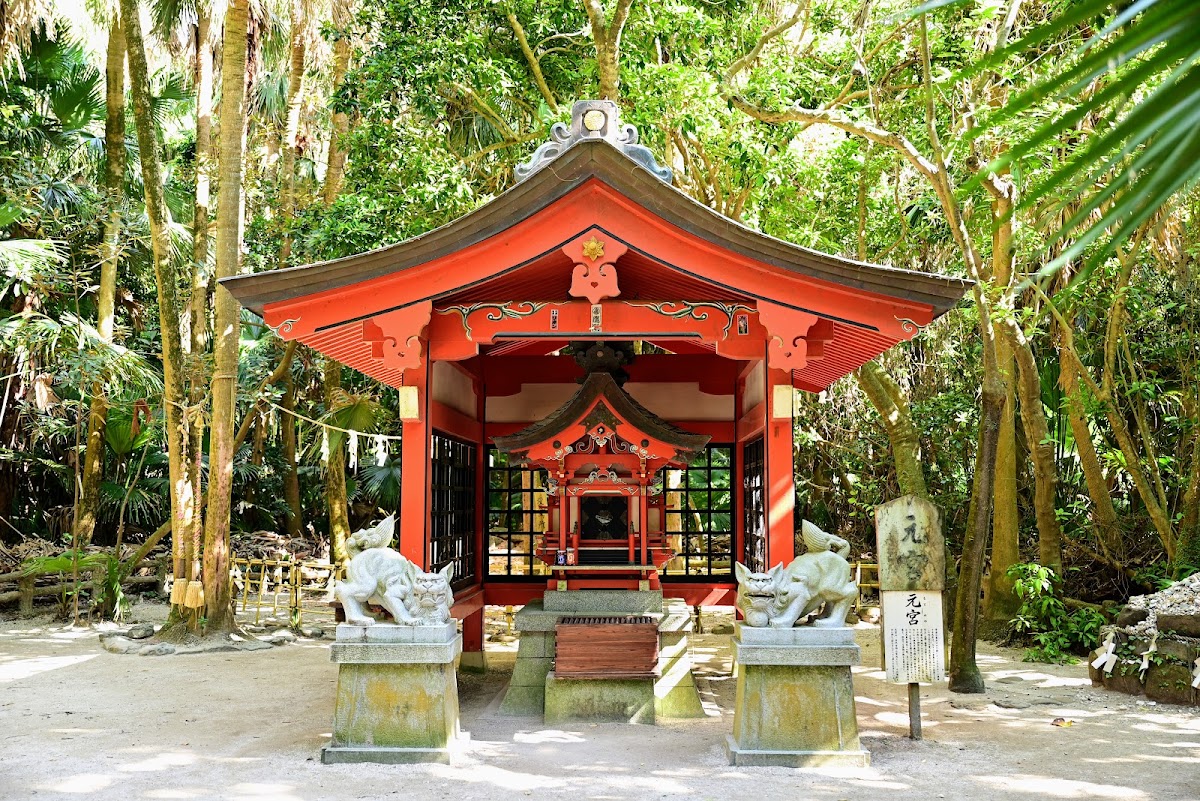
Located behind the main hall, at the innermost part of Aoshima Island, Motomiya is a sacred site considered to be the birthplace of Aoshima Shrine. Surrounded by a primeval forest of Livistona palm trees, this mystical space features a massive rock enshrined as the deity. The area around Motomiya is particularly sacred and popular as a power spot.
The Married Livistona Palms
The “Married Livistona Palms,” two Livistona palm trees standing close together within the shrine grounds, are a beloved symbol of matchmaking. Visitors can tie paper strings of different colors, each corresponding to a wish, and a constant stream of worshippers pray for success in love and marital harmony.
Ame no Hirakanage (Throwing the Heavenly Flat Plate)
Near the original shrine, “Ame no Hirakanage” is a unique prayer method at Aoshima Shrine where you throw unglazed earthenware plates (hiragana) to make a wish. It is believed that if you successfully hit the target, your wish will come true. This ritual is related to the sacred artifact that Yamasachihiko brought back from the sea god’s palace, and many worshippers try their hand at it.
Musubi Koyori (Musubi Paper Twists)
“Musubi Koyori” are placed throughout the shrine grounds. It is believed that if you choose one of five colored paper twists according to your wish and tie it at the designated spot, your wish will come true. Each color brings different blessings: red for love, yellow for financial luck, blue for career success, and so on. The sight of the colorful paper twists fluttering in the wind is one of the beautiful sights of the shrine grounds.
The Mystery of the Devil’s Washboard
A Miraculous Landscape Created by Nature
The “Devil’s Washboard,” surrounding Aoshima Island, is a geological phenomenon officially called “Aoshima’s Uplifted Seabed and Unusual Wave Erosion Marks,” and is designated as a national natural monument. It’s affectionately known by this name because the regularly arranged wave-shaped rocks resemble a washboard.
Formation Mechanism
The Devil’s Washboard was formed approximately 7 to 8 million years ago during the Neogene period. Alternating layers of sandstone and mudstone deposited on the seabed were uplifted by crustal movements, and subsequently eroded by waves. Because hard sandstone and soft mudstone layers are alternately stacked, wave erosion eroded the softer mudstone while leaving the harder sandstone, creating the distinctive wave-like topography.
Spectacular View at Low Tide
The beauty of the Devil’s Washboard can be best appreciated at low tide. When the tide recedes, the wave-shaped rock formations, stretching for approximately 8 km, are revealed, and their magnificent scale is overwhelming. When visiting Aoshima Shrine, it is recommended to check the low tide times in advance.
Aoshima’s Subtropical Plant Community
Special Natural Monument Forest
The entire island of Aoshima is covered with a subtropical plant community designated as a national special natural monument. Subtropical plants, rare in the Northern Hemisphere, grow here, with over 200 species identified, primarily the Livistona palm.
Virgin Forest of Livistona Palms
The Livistona palm, a symbol of Aoshima, is an evergreen tree belonging to the palm family and prefers warm climates. Approximately 5,000 Livistona palms grow naturally on Aoshima, and the unique landscape created by their leaves exudes a tropical atmosphere. Livistona palm leaves have been used in Shinto rituals since ancient times and are still used today in amulets at Aoshima Shrine.
Reflecting on the Eternal Past
Walking through the shrine grounds, surrounded by subtropical plants, gives you the feeling of having traveled back in time to ancient times. Aoshima, which retains its natural beauty unchanged since the age of myths, is a precious place where you can feel the timeless history and the mystery of nature.
Amulets and Souvenirs
Kami-Hina Amulet
The “Kami-Hina Amulet” is the representative amulet of Aoshima Shrine. This amulet, bestowed based on ancient customs, is a matchmaking amulet shaped like a pair of male and female dolls and is popular with many visitors.
Various Matchmaking Amulets
Various amulets for achieving romantic success and praying for good relationships are available. They feature unique designs characteristic of Aoshima Shrine, such as heart-shaped ema (votive tablets) and amulets made from Livistona palm leaves.
The Lucky Yellow Postbox
A “Lucky Yellow Postbox” is located on the shrine grounds. It is said that if you mail a letter with your wish from here, your wish will come true. It’s also a popular spot for sending letters to lovers and loved ones.
Nearby Tourist Attractions
AOSHIMA BEACH PARK
A complex located very close to Aoshima Shrine, featuring cafes, restaurants, and souvenir shops. Ideal for a break or lunch after visiting the shrine, and where you can purchase Miyazaki’s local specialties and souvenirs.
Miyako Botanic Garden Aoshima (Miyazaki Prefectural Aoshima Subtropical Botanical Garden)
Located across from Aoshima, this botanical garden allows for a more detailed observation of subtropical plants. The vast grounds cultivate tropical and subtropical plants from around the world, allowing visitors to enjoy flowers throughout the seasons.
Kodomo no Kuni (AOSHIMA PICNIC CLUB)
A leisure facility located about 5 minutes by car from Aoshima. With a large lawn and playground equipment, it’s a popular spot for families. Perfect for visiting in conjunction with a visit to Aoshima Shrine.
Horikiri Pass
A scenic spot located about 10 minutes by car south of Aoshima. From the observation deck overlooking the Pacific Ocean, you can enjoy the magnificent scenery of the Oni no Sentakuita (Devil’s Washboard) and the Hyuga Sea.
Michi-no-Eki Phoenix
This roadside station near Horikiri Pass offers Miyazaki’s local specialties and gourmet food. The view from the observation deck is also superb, making it perfect for a break during a drive.
Miyazaki Shrine
Located in the city of Miyazaki, this is one of Miyazaki Prefecture’s most representative shrines, dedicated to Emperor Jimmu. Many people visit it along with Aoshima Shrine, making it a popular part of a trip exploring Miyazaki’s mythological sites.
Access Information
Access by Train
Approximately 15 minutes on foot from JR Nichinan Line “Aoshima Station”. The walk from the station to Aoshima Shrine offers scenic coastal views. It’s approximately 25 minutes by train from Miyazaki Station.
Access by Car
Approximately 20 minutes from Miyazaki IC on the Miyazaki Expressway via National Route 220. There are several parking lots around Aoshima, and paid parking is available. However, congestion is expected during the New Year period and long holidays, so using public transportation is recommended.
Access by Bus
From Miyazaki Station, take the Miyazaki Kotsu bus bound for “Aoshima/Nichinan” and get off at the “Aoshima” bus stop. It’s about a 5-minute walk from there. Buses run several times an hour.
Points to Note When Visiting
Visiting Hours
While the grounds of Aoshima Shrine are open 24 hours for worship, the shrine office and gift shop are usually open from 6:00 AM until sunset. If you wish to receive amulets or goshuin (shrine stamps), please visit during these hours.
Clothing and Items to Bring
Aoshima is surrounded by the sea, so it can be windy on some days. Especially in winter, be sure to dress warmly. Also, when crossing the Yayoi Bridge or walking around the shrine grounds, comfortable walking shoes are recommended.
During the summer months, the sun is strong, so sun protection such as hats, parasols, and sunscreen are necessary.
Crowds Outside of New Year’s
The shrine is extremely crowded with New Year’s visitors (especially during the first three days of the year). Parking lots are often full, so if you plan to visit during this time, consider visiting early in the morning or using public transportation.
During normal periods, you can visit relatively peacefully, but it gets crowded with tourists on weekends and holidays. If you want to visit in peace, weekday mornings are recommended.
Prayers and Rituals
Various Prayers
Aoshima Shrine accepts various prayers. Prayers can be made for matchmaking, safe childbirth, protection from evil, family safety, business prosperity, and other milestones and wishes in life. If you wish to make a prayer, it is recommended to check with the shrine office in advance.
Weddings
Aoshima Shrine can perform Shinto wedding ceremonies. A wedding ceremony held in the mystical grounds surrounded by subtropical plants will be a lifelong memory. The shrine also accepts wedding reporting ceremonies, allowing already married couples to report their marriage to the gods and pray for lasting happiness.
Main Festivals
Aoshima Shrine holds various festivals throughout the year. The New Year’s special prayer ceremony and the summer grand festival, in particular, attract many visitors.
Tips for Enjoying Aoshima Shrine to the Fullest
Different Appearances Depending on the Time of Day
Aoshima Shrine shows different faces depending on the time of day you visit. Visiting in the refreshing morning air, the shrine illuminated by bright sunlight in the daytime, and the fantastical atmosphere at dusk each have their own charm.
The sunrise and sunset times, in particular, offer a beautiful combination of the rising sun over the Pacific Ocean and the setting sun over the sea, making them ideal for photography.
Enjoying the Shrine Through the Seasons
Aoshima Shrine offers different charms throughout the four seasons. In spring, you can enjoy the fresh green leaves of the Livistona palm trees; in summer, the lush subtropical plants and the blue sea; in autumn, the refreshing climate makes for a pleasant visit; and in winter, Miyazaki’s relatively mild climate makes for a comfortable stay.
In particular, winters in Miyazaki are warmer than in Honshu, and the area around Aoshima remains pleasantly warm even during the winter months.
Photo Spots
Aoshima Shrine boasts numerous Instagrammable photo spots. From the “Devil’s Washboard” rock formations viewed from Yayoi Bridge, to the contrast between the vermilion shrine buildings and subtropical plants, the pair of Livistona palms, the colorful paper strips, and the mystical atmosphere of the original shrine, there’s no shortage of subjects to photograph.
However, please be mindful of other visitors and observe proper etiquette when taking photos.
Basic Information
Name: Aoshima Shrine
Address: 2-13-1 Aoshima, Miyazaki City, Miyazaki Prefecture 889-2162
Phone Number: 0985-65-1262
Visiting Hours: Grounds are freely accessible (Shrine office is open from around 6:00 AM until sunset)
Admission Fee: Free
Parking: Paid parking available nearby
Official Website: https://aoshima-jinja.jp/
Summary
Aoshima Shrine is a representative tourist spot in Miyazaki Prefecture, boasting diverse attractions including its history as the setting for mythology, blessings for matchmaking, the spectacular view of the “Devil’s Washboard” rock formations, and a primeval forest of subtropical plants. The entire island serves as the shrine grounds, offering a unique and mystical experience away from everyday life.
This is a place worth visiting for a variety of reasons, whether you’re hoping for success in love, enjoying visiting power spots, wanting to experience the mysteries of nature, or interested in Miyazaki’s history and culture.
When you visit Miyazaki, be sure to stop by Aoshima Shrine and pray for a successful relationship while reflecting on the myth of Umisachihiko and Yamasachihiko. The breathtaking scenery of the Oni no Sentakuita (Devil’s Washboard) and the mystical atmosphere surrounded by subtropical plants are sure to create unforgettable memories.