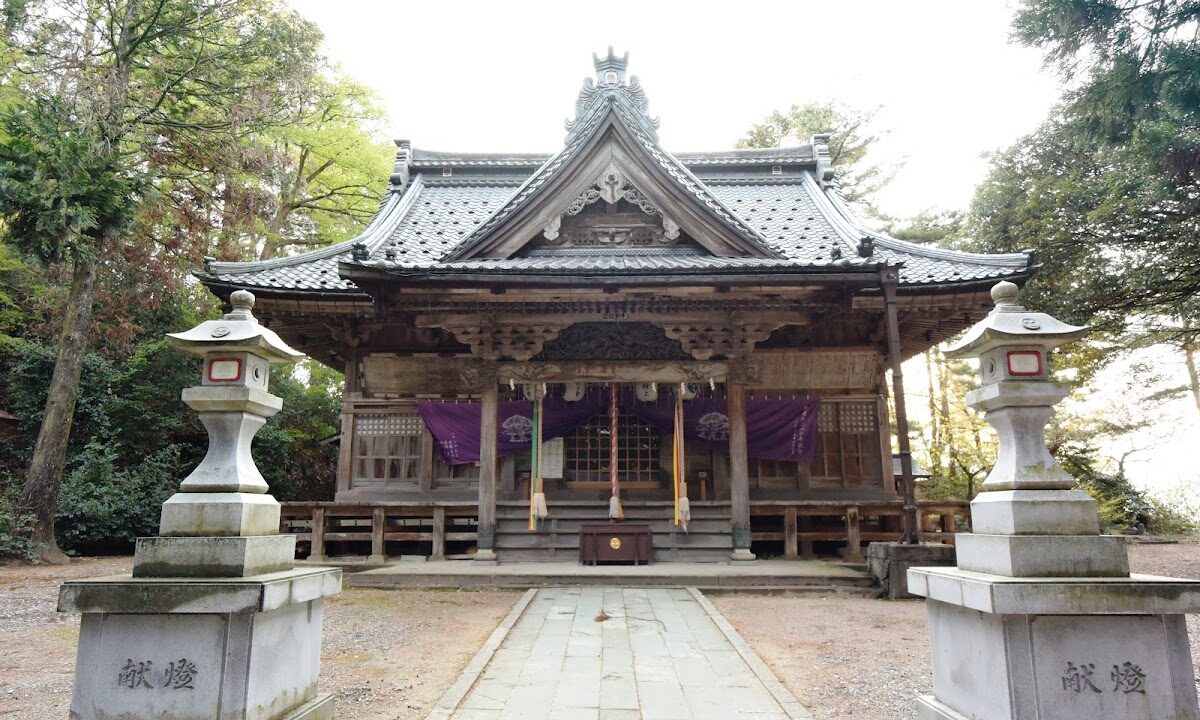
Complete Guide to Senami Haguro Shrine (Murakami City, Niigata Prefecture) | Thorough Explanation of History, Deities, Cultural Assets, and Visiting Information
Senami Haguro Shrine, located in Haguro-cho, Murakami City, Niigata Prefecture, is a venerable ancient shrine boasting a history of over 1300 years. Affectionately known locally as “Haguro Shrine,” it has been deeply rooted in the lives of the people of Murakami, serving as a center of faith and an important stage for the Murakami Grand Festival.
This article provides a comprehensive explanation of the shrine’s charm, from its founding to the present day, including its history, the origins of its deities, valuable cultural assets, its connection to the Murakami Grand Festival, and visiting information.
Basic Information on Senami Haguro Shrine
Official Name: Senami Haguro Shrine
Common Name: Haguro Shrine
Location: 7-9 Haguro-cho, Murakami City, Niigata Prefecture
Former Shrine Rank: Prefectural Shrine
Shikinaisha (Shrine Listed in the Engishiki): Senami Shrine, Iwafune District, Echigo Province (Contender)
Deities Enshrined: Natsuhime-no-Mikoto, Ukanomitama-no-Mikoto, Tsukuyomi-no-Mikoto
Senami Haguro Shrine, along with Senami Shrine in Senamihama-cho, Murakami City, is considered a candidate for the Shikinaisha “Senami Shrine, Iwafune District, Echigo Province” listed in the Engishiki Jinmyocho (a list of shrines compiled in 927 AD).
History of Nishinami Haguro Shrine
Founding and Ancient Beliefs
Nishinami Haguro Shrine is said to have been founded in the first year of Empress Jito’s reign (687 AD). Initially, it was located on the summit of Mount Nishinami (Mount Gagyū, 135m above sea level) and was worshipped as “Nishinami Shrine.”
The main deity, Natsuhime-no-Mikoto, has been revered since ancient times as the goddess who pioneered this region. As a guardian deity of the area, she has attracted the faith of people as a watchful presence over agriculture and all aspects of life.
Connection to the Dewa Sanzan Mountains
In 1588 (Tenshō 16), when Lord Honjō Shigenaga, lord of Murakami Castle, attacked the Mogami and Tōzenji clans of Shōnai, he prayed for victory at Hagurosan Daigongen in Dewa Province. Following the fulfillment of this prayer, the two deities Ukanomitama-no-Mikoto and Tsukuyomi-no-Mikoto were invited from Mount Haguro and enshrined alongside Natsuhime-no-Mikoto as the principal deities.
As a result, the shrine’s name became “Nishinami Haguro Shrine,” establishing a unique form of worship that blended the Dewa Sanzan faith with local traditional beliefs.
Relocation during the Kan’ei Era
In 1633 (Kan’ei 10), Hori Tango-no-Kami Naoyori, the lord of the Murakami domain at the time, felt it was disrespectful to have the shrine overlooked from Murakami Castle and relocated it to its current location on the mountainside of Sankyo-yama. This decision demonstrated deep respect for the shrine and illustrates the profound relationship between the lord and the shrine.
With this relocation, Nishinami Haguro Shrine took its current location, and it continues to watch over the town of Murakami to this day.
Development during the Edo Period
In 1688 (Jōkyō 5), Haguro Shrine was struck by fire. However, in 1690 (Genroku 3), the Sakakibara clan, lords of Murakami Castle, donated and rebuilt the shrine buildings. The main hall from that time still exists today as the main hall of the Shinmei-gu Shrine, a subsidiary shrine within the grounds, and is designated as a Niigata Prefecture Tangible Cultural Property.
Throughout the Edo period, Nishinami Haguro Shrine received the patronage of the Murakami Domain and developed into a central shrine in the region.
Changes since the Modern Era
In the Meiji era’s shrine ranking system, Nishinami Haguro Shrine was ranked as a prefectural shrine. This indicates that it is one of the most prestigious shrines in Niigata Prefecture.
During the Showa era, the shrine buildings were repaired and the grounds were improved, leading to its current appearance. It continues to play its role as a center of faith for the local people and as an important base for the Murakami Grand Festival.
About the Deities Enshrined
Natsuhime-no-Mikoto
Natsuhime-no-Mikoto, the original principal deity of Nishina-mi Haguro Shrine, is revered as the goddess who pioneered this region. “Natsu” is related to “summer” and “vegetables,” and she is considered a deity symbolizing fertility and vitality.
As a guardian deity of the region, she has been deeply revered to this day as a watchful presence for agricultural prosperity, family safety, and regional development.
Ukanomitama-no-Mikoto
Ukanomitama-no-Mikoto, invited from the Dewa Sanzan mountains, is the god of grain and food, known as Inari-sama. As the name “Kura-Inadama” suggests, she is a deification of the spiritual power residing in grain warehouses, and is believed to bestow the divine virtues of abundant harvests and business prosperity.
She has been worshipped as a god who supports the development of agriculture and commerce in the Murakami region.
Tsukuyomi-no-Mikoto
Tsukuyomi-no-Mikoto, also invited from the Dewa Sanzan mountains, is the god of the moon in Japanese mythology. He is revered as the god who governs the calendar and tides, and is deeply involved in agriculture and fishing.
As the god of the moon who illuminates the night, and as the god who governs the flow of time, he has been considered an indispensable presence in people’s lives.
Highlights of the Shrine Grounds
Stone Steps and Approach
The grounds of Nishina-mi Haguro Shrine are located on the mountainside of Sankyo-yama, and are characterized by a long stone staircase leading from the road to the main shrine. The process of climbing these steps is a precious time to shift one’s mind from everyday life to the sacred realm.
At the top of the steps, a magnificent shrine building welcomes visitors.
Main Shrine
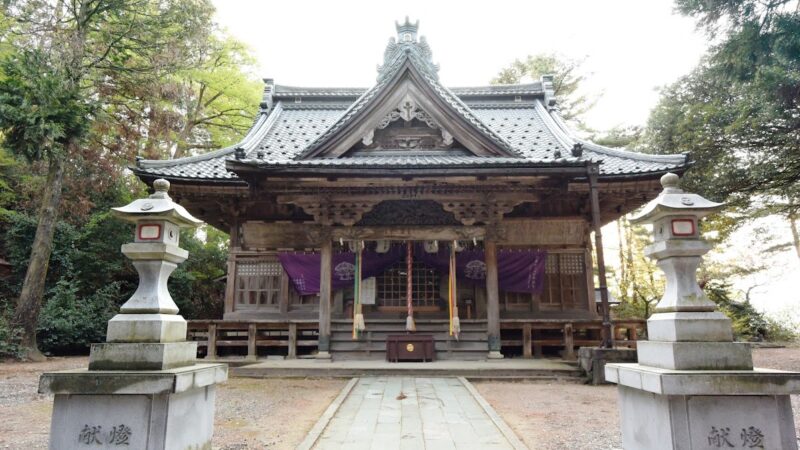
The current main shrine building was constructed after the Edo period and conveys the beauty of traditional shrine architecture. Surrounding the main shrine are various subsidiary shrines and cultural properties, allowing visitors to experience the long history of the shrine.
Subsidiary Shrine: Shinmei-gu Main Hall (Niigata Prefecture Designated Tangible Cultural Property)
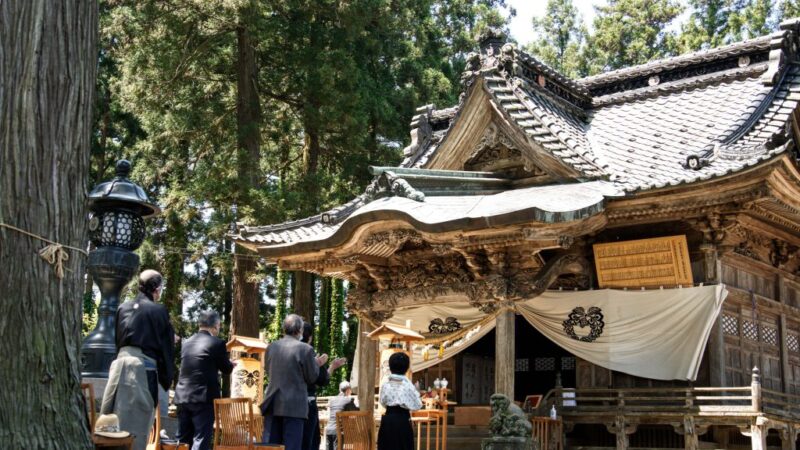
The Shinmei-gu Main Hall, a subsidiary shrine within the grounds of Nishina-mi Haguro Shrine, is a valuable building designated as a Niigata Prefecture Designated Tangible Cultural Property.
It was built as the main hall after the Haguro Shrine fire of 1688 (Jōkyō 5). According to the ridge beam inscription, it was constructed and donated in 1690 (Genroku 3) by the Sakakibara clan, lords of Murakami Castle, with Kataoka Kakubei as the carpenter.
Architectural Features:
- Vivid vermilion paint on both the interior and exterior
- Vividly colored brackets and frog-leg brackets
- Lacquered pillars and door frames
- Some parts are painted with black lacquer, conveying the splendor of Momoyama period architecture
This building retains many characteristics of early Edo period shrine architecture, making it a valuable cultural asset that demonstrates the high level of technology at the time and the deep faith of the Murakami domain in its shrine.
View from the Shrine Grounds
From the grounds of Nishina-mi Haguro Shrine, you can enjoy a panoramic view of Murakami city. Behind the main hall, near the entrance to the Sankyo-yama walking trail, a beautiful view of Murakami town and Shimo-Wataraiyama unfolds, offering visitors a special experience.
The view from the side of the shrine grounds, at the top of the stone steps, is an excellent spot to enjoy the seasonal scenery of Murakami.
Deep Connection to the Murakami Grand Festival
What is the Murakami Grand Festival?
The Murakami Grand Festival is the annual grand festival of the Nishinami Haguro Shrine, held on July 6th and 7th each year, and is the largest festival in Murakami City. It boasts a history of over 300 years and is designated as an Intangible Folk Cultural Property of Niigata Prefecture.
Festival Highlights
During the Murakami Grand Festival, 19 magnificent floats (oshagiri) parade through the town. These floats are large, reaching over 6 meters in height, and are adorned with intricate carvings and decorations.
During the festival, the town is filled with festival music and shouts, and is bustling with many tourists. The Nishinami Haguro Shrine plays a central role in this festival, preserving Murakami’s culture and traditions.
Mikoshi Procession
During the Murakami Grand Festival, the mikoshi (portable shrine) of the Nishinami Haguro Shrine is carried through the town. The festival reaches its climax as the enthusiasm of the parishioners carrying the portable shrine and the cheers of the people along the route merge.
This portable shrine procession is an important Shinto ritual in which the deity tours the parish area, praying for the peace and prosperity of the region.
Visiting Information
Access
Access by Train:
- Approximately 20 minutes on foot from JR Uetsu Main Line “Murakami Station”
- Approximately 1.5 km east from Murakami Station
Access by Car:
- Approximately 10 minutes from Nihonkai Tohoku Expressway “Murakami Senami Onsen IC”
- Approximately 500 m south from Murakami City Hall
Parking:
There is parking space for visitors around the shrine grounds, but the number of spaces is limited. During busy times such as the Murakami Grand Festival, we recommend using public transportation.
Visiting Hours
While the shrine grounds are generally open for worship, the shrine office is only open during the daytime. While it is possible to visit the shrine in the early morning or after sunset, visiting during daylight hours is safer due to the stone steps.
About Goshuin (Shrine Seals)
While Goshuin were previously offered, there is information that they are currently not being issued due to issues with visitor etiquette. Those planning a visit are advised to check in advance.
Inquiries to the shrine can be made through the Murakami City Tourism Association, etc.
Visitor Etiquette
- When climbing the stone steps, please be considerate of other visitors.
- The shrine grounds are a sacred place. Please pray in silence.
- Photography is permitted, but please be considerate of other visitors.
- Please take your trash with you.
Nearby Tourist Attractions
Murakami Castle Ruins
Murakami Castle Ruins, located within walking distance of Nishina-mi Haguro Shrine, are the remains of a mountain castle dating from the medieval to early modern periods. The stone walls remain well-preserved, and from the castle ruins, you can enjoy a panoramic view of Murakami city and the Sea of Japan.
Samurai Residence Street
The Samurai Residence Street in Murakami retains the atmosphere of a castle town, and Edo-period samurai residences are open to the public. It’s a valuable spot to learn about the lifestyle of that time.
Townhouse Area
Many traditional townhouses remain in Murakami’s old town. There are also shops where you can enjoy local food culture, such as salmon dishes and Murakami tea.
Senami Onsen
Located along the Sea of Japan coast in Murakami City, Senami Onsen is a hot spring resort where you can enjoy beautiful sunsets and seafood. It’s about a 15-minute drive from Nishina-mi Haguro Shrine, making it ideal to visit in conjunction with a visit to the shrine.
Annual Events
New Year’s Day Festival (January 1st)
A festival to welcome the new year and pray for peace and prosperity throughout the year. It is bustling with many first-time visitors.
Spring Festival (Spring)
A festival is held to celebrate the arrival of spring and pray for a bountiful harvest.
Murakami Grand Festival (July 6th & 7th)
This is the most important festival of Nishinami Haguro Shrine, and the entire town is immersed in the festival atmosphere.
Autumn Festival (Autumn)
This festival is a celebration of gratitude for the harvest. Local people gather to express their gratitude to the gods.
Summary of the Charms of Nishinami Haguro Shrine
Nishinami Haguro Shrine, as an ancient shrine with a history of over 1300 years and as a central figure in the Murakami Grand Festival, is a shrine that symbolizes the history and culture of Murakami City.
Main Attractions:
- Historical Value: An ancient shrine said to have been founded in the first year of Empress Jito’s reign (687 AD), and a candidate for being a Shikinaisha (a shrine listed in the Engishiki, an ancient Japanese legal code).
- Cultural Properties: Valuable structures, including the Shinmei-gu Main Hall, a Niigata Prefecture-designated Tangible Cultural Property.
- Murakami Grand Festival: The center of a traditional festival that has continued for over 300 years.
- View: Beautiful views of Murakami city from the shrine grounds.
- Three Deities Enshrined: A unique form of worship that fuses local beliefs with the Dewa Sanzan faith.
Climbing the stone steps leading to the shrine grounds, located on the mountainside of Sankyo-yama, and offering prayers in a tranquil atmosphere provides visitors with a special experience. When visiting Murakami City, be sure to add a visit to Nishinami Haguro Shrine to your travel plans.
Recommended Accommodations
For those considering accommodation near Nishinami Haguro Shrine, the following areas are recommended.
Senami Onsen Area
Facing the Sea of Japan, Senami Onsen boasts numerous hot spring inns and hotels where you can enjoy fresh seafood. Soaking in the hot springs while watching the beautiful sunset is a truly special experience. It’s also easily accessible, approximately a 15-minute drive from the shrine.
Murakami City Area
Murakami city center, near Nishinami Haguro Shrine, offers business hotels and traditional inns. Its convenient location makes it an ideal base for exploring the castle town and sightseeing.
Accommodation During the Murakami Grand Festival
During the Murakami Grand Festival in July, accommodations become extremely crowded. If you plan to visit during the festival, reservations several months in advance are recommended.
Summary
Nishinami Haguro Shrine is a historic shrine representing Murakami City, Niigata Prefecture. Since its founding in 687 AD (the first year of Empress Jito’s reign), it has attracted the faith of the local people for over 1300 years, playing a vital role as the center of Murakami’s history and culture.
This shrine possesses many attractions, including its unique form of worship that blends the Dewa Sanzan faith with local traditional beliefs, the Shinmei-gu main hall which is a Niigata Prefecture designated tangible cultural property, and its deep connection to the Murakami Grand Festival.
When you visit Murakami City, be sure to stop by Nishina-mi Haguro Shrine and experience the sacred atmosphere nurtured by its long history. The shrine grounds that unfold after climbing the stone steps, and the view of Murakami town from there, will surely be a memorable experience.