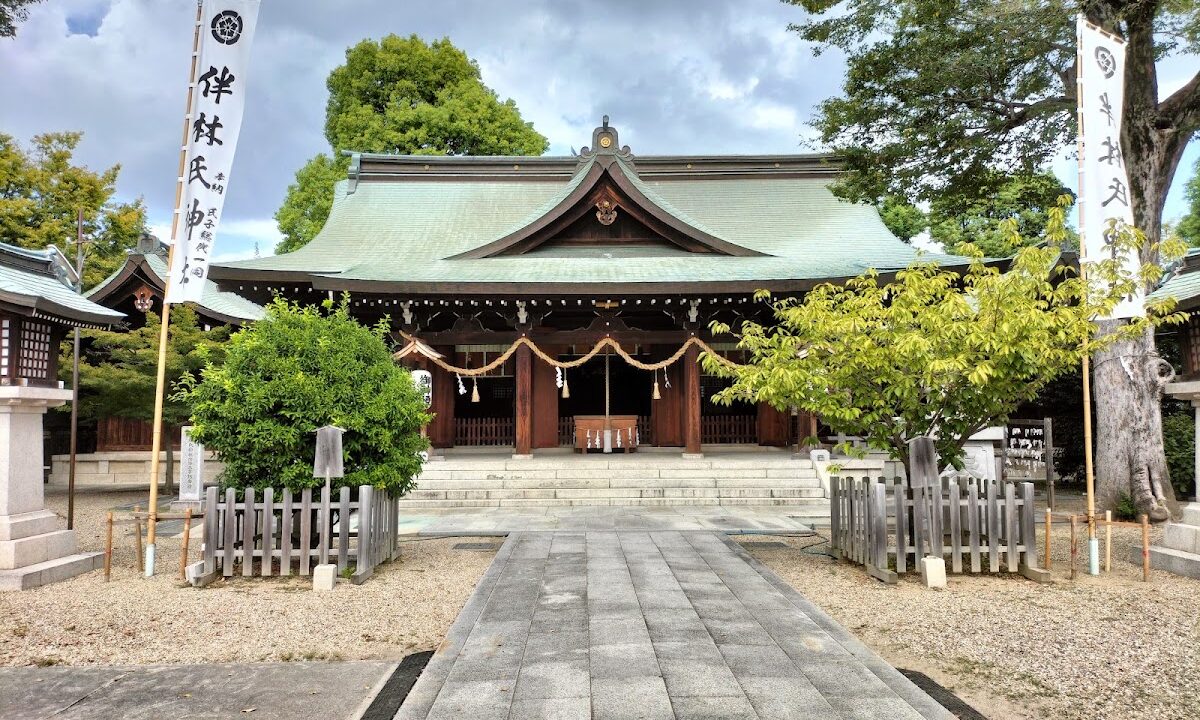
Complete Guide to Tomobayashi-uji Shrine (Fujiidera City, Osaka Prefecture) | History, Goshuin (Shrine Seals), Cultural Properties, and Access Information
Tomobayashi-uji Shrine, located in Hayashi, Fujiidera City, Osaka Prefecture, is a historically significant shrine listed in the Engishiki (ancient Japanese legal code), where the Tomobayashi clan, a branch of the ancient Otomo clan, enshrined their ancestral deity. Before World War II, it was known as the “Yasukuni Shrine of the West,” and even today, its magnificent shrine architecture continues to captivate visitors. This article provides a detailed explanation of Tomobayashi-uji Shrine, including its history, cultural properties, goshuin information, and access methods.
Overview of Tomobayashi-uji Shrine
Tomobayashi-uji Shrine is located at 3-6-30 Hayashi, Fujiidera City, Osaka Prefecture, and is a shrine listed in the Engishiki (an ancient Japanese legal code) (Tomobayashi-uji Shrine, Shiki District, Kawachi Province). Its former shrine rank was Prefectural Shrine, and it is affectionately known locally as “Hayashi no Miya” or “Hayashi no Gongen-san.”
Basic Information
- Location: 3-6-30 Hayashi, Fujiidera City, Osaka Prefecture
- Main Deity: Takamimusubi-no-kami
- Enshrined Deities: Michi-no-omi-no-mikoto, Ame-no-oshihi-no-mikoto
- Shrine Rank: Shikinaisha (Shrine listed in the Engishiki), Former Prefectural Shrine
- Annual Festival Day: Third Sunday of October
- Opening Hours: May-October 8:30-17:00, November-April 8:30-16:00
The main deity, Takamimusubi-no-kami, is known as one of the three creation gods who appeared at the time of the creation of heaven and earth. The enshrined deities, Michi-no-omi-no-mikoto and Ame-no-oshihi-no-mikoto, are both considered ancestral deities of the Otomo clan and were central to the faith of the Otomo clan, who played a vital role in military affairs and security in ancient Japan.
History of Banbayashi Shrine
The Otomo and Banbayashi Clans
The founding of Banbayashi Shrine is deeply connected to the Banbayashi clan, a branch of the Otomo clan. The Otomo clan was a powerful local family that supported the imperial family militarily in ancient Japan, and their activities are recorded in the Kojiki and Nihon Shoki. During Emperor Jimmu’s eastern expedition, Michiomi no Mikoto distinguished himself by accompanying the emperor, and was therefore considered the ancestor of the Otomo clan.
The Banbayashi clan, a branch of the Otomo clan, held power in Hayashi-go, Shiki-gun, Kawachi Province (present-day Hayashi area, Fujiidera City), and used this region as their base. It is believed that Banbayashi Shrine was founded by this clan to enshrine their ancestral deity.
Status as a Shikinaisha Shrine
The Engishiki Jinmyocho (a list of shrines compiled in 927 AD), compiled in the early Heian period, lists “Banbayashi Shrine, Shiki-gun, Kawachi Province,” indicating that it was a prestigious shrine recognized by the imperial court from ancient times. There are approximately 3,000 Shikinaisha shrines throughout Japan, and among them, Banbayashi-shi Shrine was positioned as one of the important shrines in Kawachi Province.
From the Medieval to the Early Modern Period
Although detailed records from the medieval period onward are scarce, it continued to attract worshippers as the local tutelary deity. During the Edo period, it was affectionately known to local residents as “Hayashi Gongen” and “Hayashi no Miya,” and was revered as a god protecting agriculture and the safety of the region.
The Great Showa Renovation as the “Yasukuni Shrine of the West”
The current appearance of Banbayashi-shi Shrine was shaped by a large-scale renovation project carried out from 1940 to 1941. During this period, against the backdrop of the transition from the Sino-Japanese War to the Pacific War, it received national support as a shrine dedicated to a war god.
Because the Otomo clan was an ancient military clan, Banbayashi-shi Shrine attracted attention as a shrine dedicated to a war god and came to be known by the nickname “Yasukuni Shrine of the West.” This renovation involved the construction of a large shrine building using Taiwanese cypress, and the relocation of the purification fountain from Yasukuni Shrine in Tokyo, resulting in a shrine with a scale and status comparable to that of a Kanpei Taisha (Grand Imperial Shrine).
Post-War to Modern Times
After the war, with the dismantling of State Shinto, the shrine lost its special status, but it has been carefully preserved as the local tutelary shrine and as a shrine with historical buildings. In the 2000s, the main hall, worship hall, offering hall, and purification fountain were designated as National Registered Tangible Cultural Properties, and are valued as a precious legacy of shrine architecture from the early Showa period.
Shrine Grounds and Cultural Properties
Within the grounds of Banbayashi Shrine stand a group of dignified shrine buildings constructed in the early Showa period, many of which are designated as Registered Tangible Cultural Properties.
Main Hall (Registered Tangible Cultural Property)
The main hall, built in 1940, is a luxurious building with a three-bay Kasuga-zukuri style front and constructed of plain Taiwanese cypress. The main hall features a gabled roof and a large, dignified structure, typical of modern shrine architecture.
The Kasuga style is a shrine architectural style exemplified by the Kasuga Grand Shrine in Nara, characterized by a gabled roof and a portico (a canopy above the stairs) at the front. While the main hall of Banbayashi Shrine follows this traditional style, it incorporates a modern interpretation using early Showa-era technology and materials.
Located west of the Ichinoyama Kofun (ancient burial mound), its location evokes a sense of history rooted in this area since the Kofun period.
Worship Hall and Offering Hall (Registered Tangible Cultural Property)
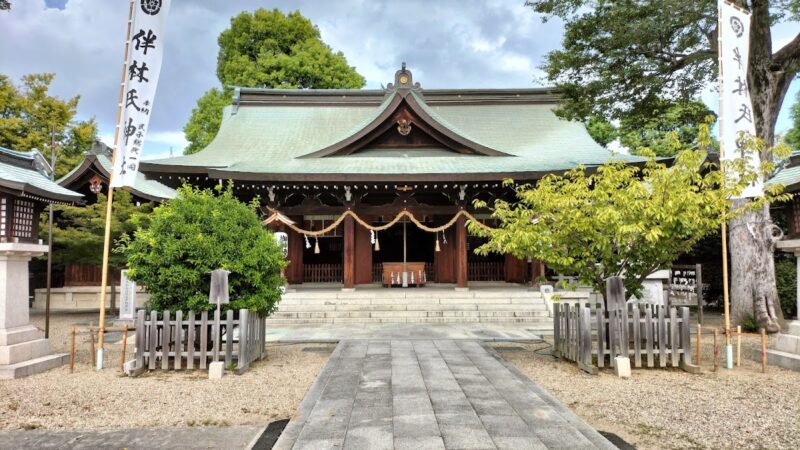
Completed in 1941, the worship hall is a large structure facing south, located south of the main hall. It features a hipped roof and a three-bay portico topped with a chidori-hafu (a type of gable), giving it a dignified and majestic impression.
The interior is constructed of plain Taiwanese cypress wood, featuring a coffered ceiling and a spacious earthen floor paved with granite. This expansive space is designed to accommodate many worshippers and reflects the original intention when the shrine was developed as the “Yasukuni Shrine of the West.”
Between the worship hall and the main sanctuary is the offering hall, and the three buildings together form a solemn and magnificent shrine space.
Water Basin (Registered Tangible Cultural Property)
Located west of the large torii gate on the south side of the shrine grounds, the water basin was relocated from Yasukuni Shrine in Tokyo in 1941. The relocation of this water basin is an important element symbolizing the fact that Banbayashi Shrine was positioned as the “Yasukuni Shrine of the West.”
It is still used today as a facility for worshippers to purify themselves, conveying the historical connection with Yasukuni Shrine.
Other Shrine Facilities
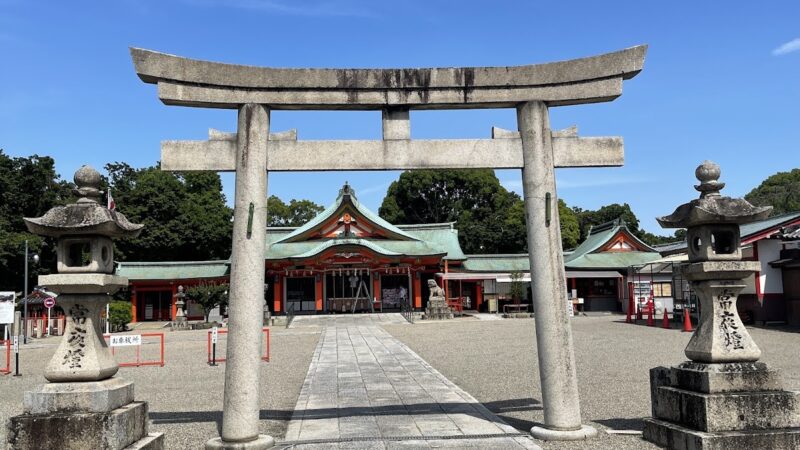
The shrine grounds include a large torii gate, a shrine office, and a gift shop. Although the shrine grounds are relatively compact, they maintain a beautiful and unified landscape, a result of the planned shrine development in the early Showa period.
While surrounded by residential areas, stepping onto the shrine grounds envelops you in a tranquil atmosphere, allowing you to forget the hustle and bustle of the city.
Goshuin (Shrine Seal) and Other Items
Goshuin Information
Goshuin (shrine seals) are available at Banbayashi Shrine. They can be obtained after your visit during the shrine office’s opening hours.
The goshuin features the shrine’s name, “Banbayashi Shrine,” written in ink, and stamped with the shrine’s seal. The simple yet powerful calligraphy is characteristic, conveying the shrine’s status as a Shikinaisha (a shrine listed in the Engishiki, an ancient Japanese legal code).
Goshuin (Shrine Stamp) Reception Hours: During opening hours (May-October: 8:30 AM – 5:00 PM, November-April: 8:30 AM – 4:00 PM)
Offering Fee: Generally around 300-500 yen (subject to change, please check on-site)
For information on Goshuin notebooks, please inquire at the shrine office. Original Goshuin notebooks may also be available.
Items Offered
Items such as amulets and votive tablets are also available at the shrine office. Various amulets are available, including those for traffic safety, family safety, and academic success.
Since the Otomo clan was an ancient military clan, amulets related to good fortune and success in competitions are also popular.
Access and Parking Information
Access by Train
The nearest station to Banbayashi Shrine is Hajinosato Station on the Kintetsu Minami-Osaka Line.
Approximately 5 minutes on foot from Kintetsu Minami-Osaka Line “Hajinosato Station”
After exiting the station, head northwest and you will see the shrine’s torii gate after passing through a residential area. It’s very conveniently located near the station.
From Osaka Abenobashi Station, it takes approximately 20 minutes to reach Hajinosato Station on the Kintetsu Minami-Osaka Line’s semi-express or express train.
Access by Car
Approximately 10 minutes from Hanshin Expressway Route 14 Matsubara Line “Miyake IC”
Approximately 10 minutes from Nishimeihan Expressway “Fujiidera IC”
It is also accessible from National Route 170 (Outer Ring Road), and is just a few minutes’ drive from Fujiidera city center.
Parking
There is parking space for visitors on the shrine grounds, but the number of spaces is limited, so we recommend using public transportation. There are also coin-operated parking lots nearby, so please use those if the main parking lot is full.
Nearby Attractions
Numerous historical sites from ancient to medieval times surround the Banbayashi Shrine.
Ichinoyama Kofun (Emperor Ingyo’s Mausoleum)
Immediately east of the Banbayashi Shrine lies the Ichinoyama Kofun (Emperor Ingyo’s Mausoleum). This large tumulus, believed to have been constructed in the mid-5th century, is a keyhole-shaped mound approximately 230 meters long. Designated by the Imperial Household Agency as the mausoleum of Emperor Ingyo, its magnificent form, surrounded by a moat, can be viewed from the perimeter.
Kofun Clusters in Fujiidera City
Fujiidera City is one of the central areas of the Furuichi Kofun Cluster, containing several components of the World Cultural Heritage site “Mozu-Furuichi Kofun Group.” Several tumuli, including the Nakahime-no-Mikoto Mausoleum (Nakatsuyama Kofun), Nabezuka Kofun, and Tsudo-Shiroyama Kofun, are within walking distance, making a visit to these sites in conjunction with a tumulus tour highly recommended.
Fujiidera City is one of the central areas of the Furuichi Kofun Cluster, and contains several components of the World Cultural Heritage site “Mozu-Furuichi Kofun Cluster.” Several tumuli, such as the Nakahime-no-Mikoto Mausoleum (Nakatsuyama Kofun), Nabezuka Kofun, and Tsudo-Shiroyama Kofun, are within walking distance, making a visit to these sites in conjunction with a tumulus tour highly recommended. ### Domyoji Tenmangu Shrine
Located about a 3-minute walk from Domyoji Station, the station next to Hajinosato Station, Domyoji Tenmangu Shrine is a historic Tenmangu shrine dedicated to Sugawara no Michizane. It is also known as a famous spot for plum blossoms, and a plum blossom festival is held annually from late February to early March.
Fujii-dera Temple
Located about a 5-minute walk from Fujii-dera Station on the Kintetsu Minami-Osaka Line, Fujii-dera Temple is an ancient temple known as the 5th temple of the Saigoku Thirty-Three Kannon Pilgrimage. Its principal image is a seated statue of the Eleven-faced, Thousand-armed, Thousand-eyed Kannon Bodhisattva, a national treasure, which is unveiled on the 18th of each month.
Annual Events and Festivals
Annual Festival (Autumn Festival)
The annual festival is held on the third Sunday of October every year. Local parishioners gather, and a portable shrine procession and dedication ceremonies take place, creating a lively atmosphere.
First Shrine Visit of the Year
During the first three days of the New Year, many worshippers visit shrines for their first shrine visit of the year. The shrines are bustling with people praying for a safe year and the safety of their families.
Other Events
Various Shinto rituals are held throughout the year, such as the Setsubun Festival and the Summer Purification Ceremony. For detailed schedules, it is recommended to contact the shrine directly or confirm during your visit.
Points to Note When Visiting a Shrine
Proper Shrine Etiquette
The basic shrine etiquette is “two bows, two claps, one bow.”
- Bow before passing through the torii gate.
- Purify yourself at the water basin (left hand, right hand, mouth, left hand in that order).
- Offer your donation in front of the main hall.
- Bow deeply twice.
- Clap your hands twice.
- Bow deeply once.
- When leaving, bow towards the shrine after passing through the torii gate.
Photography
Photography is generally permitted on the shrine grounds, but please refrain from taking pictures in restricted areas such as inside the main hall. Also, please be considerate of other worshippers.
Dress Code
There are no specific dress code regulations, but as it is a sacred place, it is advisable to avoid overly casual or revealing clothing.
The Charm of Banbayashi Shrine
The greatest charm of Banbayashi Shrine is that it is a valuable shrine that conveys the history of the ancient Otomo clan. The long history of this shrine, as a Shikinaisha (a shrine listed in the Engishiki, an ancient Japanese legal code), and its unique experience as the “Western Yasukuni Shrine” in the early Showa period, create a multifaceted history that makes this shrine special.
The shrine buildings, designated as a Registered Tangible Cultural Property, represent the pinnacle of shrine architecture in the early Showa period. The luxurious construction using Taiwanese cypress and the dignified design are impressive even for those interested in architecture.
The majestic shrine buildings, suddenly appearing amidst a residential area, surprise and move visitors. Even in today’s increasingly urbanized world, the shrine’s commitment to preserving local history and faith inspires respect in many worshippers.
The history of this region dating back to the Kofun period, the footsteps of the ancient Otomo clan, the historical context of the early Showa period, and the continuation of local faith to the present day—all these layers combine to make Banbayashi Shrine one of the most worthwhile shrines to visit in Osaka Prefecture.
Summary
Banbayashi Shrine, located in Fujiidera City, Osaka Prefecture, is a Shikinaisha (a shrine listed in the Engishiki, an ancient Japanese legal code) and a historical shrine where the Banbayashi clan, a branch of the ancient Otomo clan, enshrined their ancestral deity. In the early Showa period, it underwent extensive renovations and was known as the “Yasukuni Shrine of the West.” The dignified shrine buildings, designated as a Registered Tangible Cultural Property, remain to this day.
It is easily accessible, approximately a 5-minute walk from Hajinosato Station on the Kintetsu Minami-Osaka Line, and offers Goshuin (shrine stamps). The surrounding area boasts many historical sites, including the World Heritage Site of the Furuichi Kofun Group, making it an ideal shrine to visit in conjunction with a historical walk.
As a place of worship that has continued from ancient times to the present day, and as a valuable example of early Showa-era shrine architecture, Banbayashi Shrine holds a special place in Osaka Prefecture. When visiting Fujiidera City, be sure to pay your respects.
Basic Information Summary
- Location: 3-6-30 Hayashi, Fujiidera City, Osaka Prefecture
- Access: Approximately 5 minutes on foot from Hajinosato Station on the Kintetsu Minami-Osaka Line
- Opening Hours: May-October 8:30-17:00, November-April 8:30-16:00
- Goshuin (Temple Seal): Available
- Parking: Available (Limited number of spaces)
- Cultural Properties: Main Hall, Worship Hall and Offering Hall, Water Basin (all registered tangible cultural properties)
- Annual Festival: Third Sunday of October